In This Issue
Outreach & Training
- CISA and the FBI Launch Operation Flashpoint
- CISA OBP Trains the United Nations on C-IED
- CISA OBP Supports FEMA’s Caribbean Initiative
- New Video Highlights C-IED Training Solutions
Data & Insights
- IED Attack in Norway Inspires Extremists 10 Years Later
Capability Assessments
- Law Enforcement Taps Database to Assess C-IED Capabilities
- Eastern National Robot Rodeo Offers Innovation, Competition
Policy
- DHS Group Stresses IED Threats to Schools, and Key Resources
Outreach and Training
CISA and the FBI Launch Operation Flashpoint
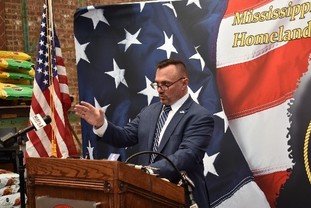
CISA and the FBI recently launched a regional pilot program called “Operation Flashpoint.” This show of united federal government action is intended to encourage communities to serve as the “eyes and ears” in recognizing suspicious activities and helping prevent acts of terrorism.
The 90-day pilot aims to encourage businesses and the public to voluntarily report suspicious activities, such as buying large amounts of chemicals and materials (or a combination of these) that can be used to build explosive devices.
For CISA, the Office for Bombing Prevention’s Bomb-Making Materials Awareness Program participates in Operation Flashpoint, while its partner, the Weapons of Mass Destruction Directorate, coordinates the efforts for the FBI.
At the pilot’s launch event at Revell Ace Hardware in Clinton, Miss., on June 30, CISA and FBI officials described the threat of domestic violent extremists (DVEs) and others of building IEDs from common household items using instructions found on the internet.
Approximately 250,000 point-of-sale businesses in the U.S. sell, use, or distribute materials that can build bombs. Major bombings can cause mass casualty events with drastic loss of life and also cost communities hundreds of millions of dollars or more.
The pilot will include outreach activities in the southeastern cities of Columbia, S.C.; Louisville, Ky.; and Orlando/Tampa, Fla. The pilot seeks to reduce the threat of IED attacks both by helping businesses detect the illegitimate acquisition, theft, or diversion of dangerous chemicals, and by encouraging businesses to report suspicious activity by calling 1-855-TELL-FBI (1-855-835-5324).
Recently, BMAP released three videos that provide clear and simple guidance to the general public and to others about the steps they can take to recognize the threat of bombings and suspicious purchasing activity, and then take appropriate action. Watch these videos about how to be a vigilant neighbor, a vigilant employee, and a vigilant manager.
|
CISA OBP Trains the United Nations on C-IED
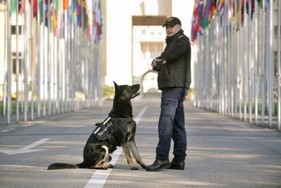
CISA OBP and the United Nations worked together to enhance bombing prevention capabilities and hostile surveillance and reconnaissance detection against UN facilities around the world through OBP trainings this summer.
OBP conducted seven virtual courses on bombing prevention and surveillance detection principles for UN security professionals at 10 locations around the world. The UN’s Department of Security and Safety (UNDSS) provides security for over 36,000 staff members, 58,000 dependents, and 1,000 VIPs (including government leaders).
IEDs are a serious threat for the UN; 57% of targeted attacks against UN facilities used an IED. This was CISA OBP’s first virtual and first cohort training to an international body. The training effort underscores CISA OBP’s strong commitment to working with international partners to counter IED attacks.
|
CISA OBP Supports FEMA's Caribbean Initiative
CISA OBP and the United Nations worked together to enhance bombing prevention capabilities and hostile surveillance and reconnaissance detection against UN facilities around the world through OBP trainings this summer.
OBP conducted seven virtual courses on bombing prevention and surveillance detection principles for UN security professionals at 10 locations around the world. The UN’s Department of Security and Safety (UNDSS) provides security for over 36,000 staff members, 58,000 dependents, and 1,000 VIPs (including government leaders).
IEDs are a serious threat for the UN; 57% of targeted attacks against UN facilities used an IED. This was CISA OBP’s first virtual and first cohort training to an international body. The training effort underscores CISA OBP’s strong commitment to working with international partners to counter IED attacks.
|
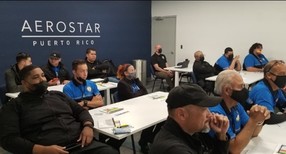
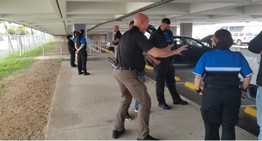
The Caribbean Area Initiative is an extensive training effort geared specifically to Puerto Rico and the Virgin Islands on preparedness and response.
Puerto Rico is home to 3.5 million people and welcomes millions of tourists each year. The training demonstrates CISA OBP’s commitment to building bombing prevention capabilities and capacity in US Territories.
|
This Quarter's Highlighted Training
New Video Highlights: C-IED Training Solutions
CISA OBP launched a Counter-IED Training and Awareness Solutions video on July 19. The Counter-IED Training and Awareness Branch develops and delivers a diverse suite of counter-IED training for every learner.
The learning solutions ensure that stakeholders have the necessary knowledge to mitigate, prevent, and respond to a wide array of potential IED threats.
Ensure the safety of our critical infrastructure and local populations by watching this short video and discover the many convenient and exciting bombing prevention training opportunities available at no cost. Sign up today!
Visit YouTube to view training and awareness solutions opportunities today: https://www.youtube.com/watch?v=xUgLIIduLWY
To request training or gain more information about the OBP Counter-IED Training offerings, visit us at https://www.cisa.gov/bombing-prevention-training or email us at OBPTraining@cisa.dhs.gov
|
IED Attack in Norway Inspires Extremists 10 Years Later
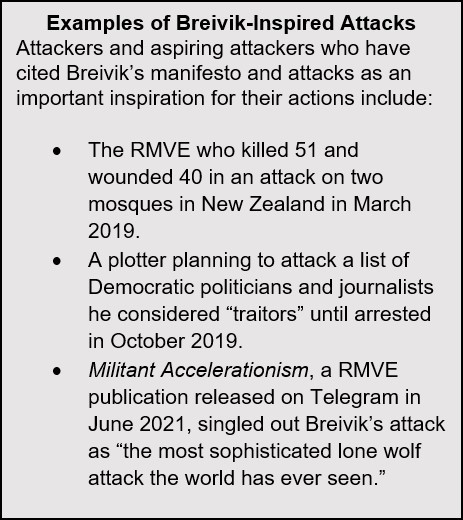
On July 22, 2011, Anders Breivik detonated a vehicle-borne IED in the Government quarter in Oslo, Norway, in front of the building housing the Prime Minister’s office. Two hours later, Breivik opened fire at a youth camp, northwest of Oslo. The attacks killed 77 people and wounded hundreds more.
OBP has released a TRIPwire Awareness Bulletin (TAB) to raise awareness among first responders and law enforcement of the attack’s significance today. It focuses on the tactics, techniques, and procedures used in the VBIED attack, and on the impact Breivik’s example has had on racially or ethnically motivated violent extremists (RMVEs) and other domestic violent extremists (DVEs) over the past decade.
|
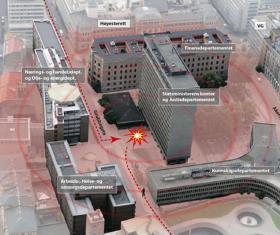
RMVEs and DVEs have cited Breivik’s manifesto as inspiration for attacks, as well as a source of detailed guidance on how to prepare an attack. For instance, in his manifesto, Breivik railed against perceived enemies—multiculturalism, liberalism, certain religious communities—for more than 1,000 pages, and spent 100+ pages detailing his attack preparations. In his manifesto, Breivik often returns to his concerns about procuring bomb-making materials without raising law enforcement suspicion and how to synthesize homemade explosives safely. Norwegian police identified 43 purchases Breivik made linked to the manufacture of the device from 36 suppliers in five countries between September 2010 and July 2011.
RMVEs have highlighted Breivik’s 2011 attack as inspiration for their own violent action and have mined his manifesto for tactical guidance. Since the Breivik attack, social media has only heightened the impact of these “inspiring” factors on attackers and plotters. Insular social media communities created by RMVEs increasingly accelerate the evolution of tactics and drive perpetrators to compete against each other to cause greater damage in each subsequent attack.
|
Capability Assessments
Law Enforcement Taps Database to Assess C-IED Capabilities
Law enforcement agencies are increasingly using CISA OBP’s National Counter-IED Capabilities Analysis Database (NCCAD) to prepare and protect their communities. The New York State Division of Homeland Security and Emergency Services (NYDHSES) has been pivotal in driving this interest. The state sees the NCCAD as the gold standard for assessing the Counter-Improvised Explosive Device (C-IED) capabilities of New York police departments and other units.
The NYDHSES considers the NCCAD to be so effective that it mandates all bomb squads, SWAT teams, and explosive detection canine units applying for a State Homeland Security Grant to first complete an NCCAD assessment. The agency uses the NCCAD to gain a state-wide view of the C-IED capabilities of more than 50 teams and to better understand gaps across the state.
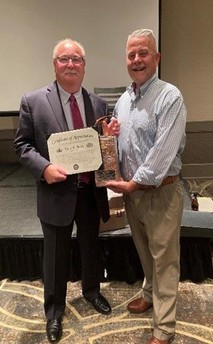
James Turley is one of the chief drivers of the NCCAD effort at NYDHSES. He served as the Law Enforcement Coordinator for NYDHSES’s Office of Counter Terrorism from 2005 to 2021. After more than 40 years working in the law enforcement community, to include 27 years as former Chief of Police for the City of Albany Police Department, he recently retired. Mr. Turley made significant contributions to the C-IED mission for both the state of New York and the nation.
|
Eastern National Robot Rodeo Offers Innovation and Competition
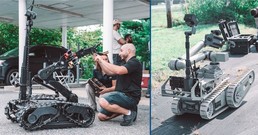
Public safety bomb squads and military explosives ordnance disposal teams seized the opportunity to evaluate both new and emerging robotic technologies at the Eastern National Robot Rodeo (ENRR) in Indian Head, Md., in August.
The 5th annual ENRR enabled bomb technicians to better understand the capabilities and limitations of these systems to align industry research and development with the needs of responders.
|

The ENRR drilled into applications in real-world operating environments. Various vendors were on hand to showcase their capabilities, and teams engaged in friendly competitions on robotics and equipment tactics, techniques, and procedures. Participants used different robotics technologies in complex urban scenarios designed to replicate commonly encountered threats across the nation.
CISA’s Office for Bombing Prevention co-sponsored the event, in partnership with the Air Force Civil Engineer Center; Naval Surface Warfare Center Indian Head Division; and United Kingdom Defense Science and Technology Laboratory.
|
Policy
DHS Group Stresses IED Threats to Schools, and Key Resources
Led by CISA OBP, the DHS Counter-IED Working Group (DHS IEDWG) met on July 21 to discuss DHS’s ongoing efforts to support school safety. The meeting was particularly timely, with a new school year on the horizon and most students resuming in-person attendance.
IED threats and incidents related to educational institutions rose in 2020 despite school closures due to the COVID-19 pandemic, according to the National Explosives Task Force (NETF) Annual Report. An FBI intelligence analyst from its Hazardous Devices School noted that an FBI study on explosives incidents in schools from 2016 to 2019 also highlighted a range of threats of explosives to the educational system. Consequently, it is vital that educational facilities understand how to prepare for and respond to potential incidents.
DHW IEDWG meeting participants discussed students’ ability to make lethal devices and create complex bomb plots. The most dramatic uptick in activity was seen after nationally televised school violence—and especially after the shooting at a high school in Parkland, Fla., that killed 17 people and injured 17 others.
The DHS-IEDWG focuses on policy issues including capacity building. At the meeting, CISA School Safety Task Force shared with participants a variety of resources from the Federal School Safety Clearinghouse on schoolsafety.gov, which features actionable information on school security and resilience. In 18 months, almost 500 resources have been published and are tailored to the academic community to address potential capability gaps.
During the meeting, CISA OBP highlighted the school safety-related products its Bomb-Making Materials Awareness Program (BMAP) is developing with the CISA School Safety Task Force. The resources are designed to help parents and teachers identify indicators such as interest in bombs and bomb-making videos, suspicious purchasing, and social media activity.
For schools (and others), CISA OBP offers free, online trainings and educational What to Do videos to help guard against attacks. It also offers this poster and postcard to help you quickly recognize and respond to suspicious items.
Become a Part of the CISA OBP Team
For more information about CISA OBP, visit https://cisa.gov/obp or email
OBP@cisa.dhs.gov
|


