|
CISA OBP Bulletin Issue 2 - May 18, 2021 |
|
In This Issue
Outreach and Training
- BMAP Makes Ripples in U.S.
- CISA OBP Delivers C-IED Training to Mexico
- This Quarter’s Highlighted Training
Data & Insights
- TRIPwire to Publish Annual C-IED Report
Capability Assessments
- CISA OBP Releases Multi-Jurisdiction IED Highlights
Policy
- CISA OBP, Partners Advance C-IED Policy Across DHS
The CISA OBP Bulletin features a range of news stories, statistics, training information, and resources about the Cybersecurity and Infrastructure Security Agency’s (CISA) Office for Bombing Prevention (OBP). CISA OBP leads and coordinates efforts to protect life and critical infrastructure by building capabilities across public and private sectors to prevent, protect against, and respond to improvised explosive devices.
BMAP Makes Ripples in U.S.

The City of Austin, TX, has created an app to provide guidance and resources to help Central Texans prepare for and respond to emergencies and disasters. One of the chief resources the app highlights is CISA OBP’s Bomb-Making Materials Awareness Program (BMAP). It’s just one example of how CISA OBP is working with state, local, tribal, and territorial partners to use technology to heighten awareness of the everyday products used in constructing explosive devices.
|
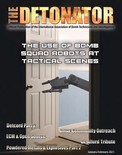
Detonator Magazine, a resource for public safety officials, bomb squads, and investigators, also recently highlighted BMAP and the importance for each public safety agency to have a bombing prevention program. The article uses examples such as the following that face law enforcement personnel each day. "A customer with an extensive shopping list searches your local home improvement store for a curious assortment of goods: galvanized pipe cut to specific lengths, with matching endcaps; a variety of nails, washers, and screws; a soldering iron; a glue gun; egg timers; electrical tape; explosives precursor chemicals, and wire strippers. The trained cashier easily recognizes the possible components of a destructive device, commonly known as an improvised explosive device (IED).”
|
|
CISA OBP Product Corner
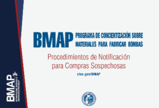
BMAP Employee Card (Spanish)
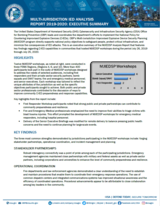
MJ Annual Report - Executive Summary
Upcoming BMAP Community Liaison Courses
May 18, 2021 – Lexington, Kentucky
Aug 4, 2021 - Bangor, Maine
Upcoming BMAP Outreach Visits
May 17-21, 2021 – Lexington, Kentucky
June 20-26, 2021 – South Florida
July 19-23, 2021 – Scottsdale, Arizona
August 2-6, 2021 – Bath/Augusta, Maine
August 17-21, 2021 – Orlando, Florida
September 27 - October 1, 2021 – Santa Cruz, California
|
|
CISA OBP Delivers C-IED Training to Mexico
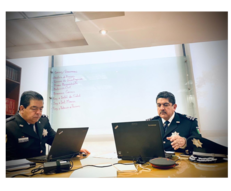
As part of the U.S.’s bilateral collaboration with Mexico, CISA OBP recently delivered counter-IED trainings to several Mexican federal agency partners. Conducted with the Department of State’s Export Control and Border Security (EXBS) Program, it represented CISA OBP’s first training in Spanish.
The courses also represented a first-ever collaboration between the Department of Homeland Security (DHS) and EXBS Mexico, which draws on the expertise and cooperation of a range of U.S. government agencies to deliver training and technical assistance to the Mexican government.
CISA conducted three 2-day training sessions in support of the EXBS program, teaching CISA OBP’s Bombing Prevention Awareness Course and Protective Measures Course. The trainings were given to Mexico’s Naval Secretariat, Secretariat of National Defense, Ministry of Security and Citizen Protection, and Federal Protective Service, as well as to participants from the National Coordination of Civil Protection and General Prosecutor’s Office. CISA OBP leveraged the Empowered Trainer program and its training partnership with TSA to obtain an additional native Spanish-speaking instructor to co-teach the courses.
Partnerships are critical for CISA’s mission—and certainly for the U.S. and Mexico, which both face major security and C-IED challenges. “We recognize the great importance of the U.S.-Mexico partnership,” said CISA’s Executive Assistant Director for Infrastructure Security, Dr. David Mussington. “We’re grateful to have had the opportunity to deliver these courses virtually in Spanish to our counterparts in Mexico. I am delighted that CISA is active in this area—so central to the shared interests of both countries.”
The training has led additional Mexican government agencies and private sector organizations to request trainings from CISA OBP, which also has been active elsewhere internationally, such as training its Canadian partners. “OBP embraces the opportunity to help EXBS advance the U.S. and Mexico’s cooperative efforts to build capacity to prevent bombing incidents in Mexico,” said Sean Haglund, Associate Director of OBP. “Sharing information can enable us to best prevent IED attacks and save lives.”
The trainings have fueled EXBS interest in collaborating more with DHS on security matters. “We were delighted with both the professional delivery of the courses, as well as the uniformly positive response from our Mexican counterparts, which have already requested that we engage DHS for more programs,” said Ambassador Robert Weisberg, EXBS Advisor at the US Embassy in Mexico. “I also want to salute the Office for Bombing Prevention’s Training Division, which worked virtually for a year with us to develop such excellent courses and in Spanish. We eagerly look forward to future joint initiatives with DHS, which will play an essential role in our overall mission of maintaining robust export control systems to prevent dual use materials, products and technologies being used to build weapons of mass destruction.”
|

This Quarter's Highlighted Training
Description: The Bomb-Making Materials Awareness: Your Role course uses an immersive, graphic novel-style storytelling approach to educate and empower community members on how to identify and report suspicious activity and purchasing behaviors related to bomb-making materials.
This 40-minute independent study training (IST) is a self-paced, web-based course covering the roles the general public, private sector, public safety personnel, and fusion centers have in recognizing and reporting suspicious incidents related to bomb-making, indicators of suspicious activities and purchasing behaviors, how to report a suspicious incident, introduction to the terrorist attack cycle, and responding to suspicious behaviors and items.
Audience: This course is designed for all community members interested in preventing bombing incidents. Participants may come from various backgrounds, including: the general public, private sector, public safety dispatchers, law enforcement, and fire and emergency medical technicians.
Course registration requires a FEMA Student ID (SID). To complete the one-time registration process for a FEMA SID, please visit: https://cdp.dhs.gov/femasid/register.To request training or for more information on the OBP Counter-IED Training offerings, visit us at https://www.cisa.gov/bombing-prevention-training or email us at OBPTraining@cisa.dhs.gov
We Offer In-Person and Virtual Trainings
CISA OBP is prepared to support in-person training requests, and has increasingly scheduled such trainings. CISA OBP is supporting direct delivery courses on location with its mobile training team throughout the Nation. CISA OBP also has excellent distance learning options through its Virtual Instructor-Led Training (VILT) and Web-based Independent Study Training (IST). To view the schedule of upcoming VILTs and register for a course, please visit the VILT Schedule and Registration Page and have your FEMA Student ID (SID) ready. CISA OBP also offers educational What to Do videos to help you learn to guard against attacks, respond to suspicious behavior and/or safeguard precursor chemicals to IEDs.
|
 TRIPwire to Publish Annual C-IED Report
CISA OBP is poised to release the TRIPwire 2020 Domestic Open Source Intelligence (OSINT) Improvised Explosive Device (IED) Report. The annual report, which is planned for release this month, can be accessed by logging into TRIPwire and clicking on the report graphic at the top of the page. It provides an overview of open source data insights for each of the 10 Federal Regions during 2020 and includes key trends in “explosive, bomb-making material, and IED incidents and notable tactics, techniques, and procedures (TTPs). The report includes key analyses for intelligence and law enforcement partners, public safety officers, and many other security and emergency services professionals across the federal, state, local, and tribal sectors of the United States.
TRIPwire is DHS’s secure, online, collaborative information- and resource-sharing portal for security and emergency services professionals and private sector partners. It aims to increase awareness of evolving IED TTPs; incident lessons learned; and counter-IED preparedness. The TRIPwire Open Source Intelligence (OSINT) Team compiles, categorizes, and maps domestic IED-related incidents and gathers relevant documents, images, and videos directly from extremist sources, then prepares a wide variety of products and resources to help stakeholders anticipate, identify, and prevent IED incidents.
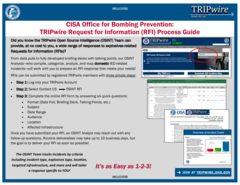
TRIPwire Requests for Information
Did you know the TRIPwire OSINT Team can provide responses to explosives-related Requests for Information (RFIs) at no cost to you? From data pulls to fully developed briefing decks with talking points, our OSINT analysts will work with you to prepare an RFI response that meets your needs.
|
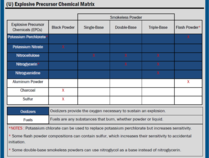
OSINT Product of the Quarter: Explosive Powders
Explosive Powders (Black Powder, Smokeless Powder, and Flash Powder): The TRIPwire Awareness Bulletin (TAB) provides information on common explosive powders—specifically black powder, smokeless powder, and flash powder—their precursors, and their differences to increase situational awareness for those who may encounter them. These explosives are not illegal to possess and are readily available or easily manufactured using their precursor chemicals. First responders need to be able to distinguish between common explosive powders and their precursor chemicals due to their frequent use in illicit activities.
-
Black powder: Commercially manufactured black powder and many of its substitutes are available for public purchase. Homemade black powder can be produced by combining its easily obtainable explosive precursor chemicals (EPCs).
-
Smokeless powder: Commercially manufactured single- and double-base smokeless powders are also available for public purchase. Smokeless powders can be produced by reacting multiple EPCs but are typically purchased due to widespread availability.
-
Flash powder: Flash powder is commonly used in commercial pyrotechnics. Homemade flash powder can be produced by combining its EPCs.
This document is For Official Use Only and requires logging on to TRIPwire to view. View and download at tripwire.dhs.gov/reports/258166.
Other OSINT Products
Connect with the TRIPwire OSINT Team!
- Need a TRIPwire account? Go to the TRIPwire login page at tripwire.dhs.gov and select “Register Now.
- Want to receive a daily email highlighting significant domestic and international IED incidents? Email and request to be added to the What’s New distro.
- Want more information on TRIPwire’s range of OSINT offerings, including daily, weekly, monthly, and annual reports; analytic assessments on explosives-related TTPs and bad actors; reference aids to inform first responders and the private sector on homemade explosives, IED components, and emerging threats; and RFIs? Download TRIPwire’s Catalog of Products at tripwire.dhs.gov/reports/254214.
|
Capability Assessments
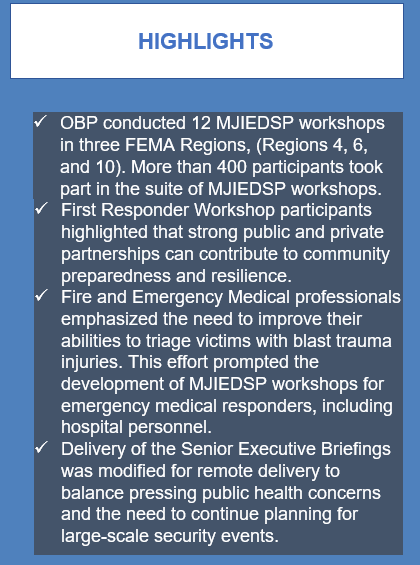
CISA OBP released this month an executive summary of its 2019-2020 annual Multi-Jurisdiction Improvised Explosive Device Security Planning (MJIEDSP) report.
The MJIEDSP Program directly supports national policy objectives to safeguard people, protect critical infrastructure, and minimize the consequences of IED attacks. The program fuses counter-IED education, capability analysis, training, and planning to enhance the IED prevention, protection, mitigation, and response capabilities of participating communities.
The report provides recommendations to improve C-IED capabilities in the communities that hosted MJIEDSP workshops, that can be used by other communities to improve their own C-IED capabilities, during the period July 26, 2019 through July 25, 2020.
The report describes CISA OBP’s three types of workshops:
-
First Responders– Assists the first responder community, including the private sector, in understanding and identifying the unique operational aspects of responding to IED incidents.
-
Bomb Squad-Special Weapons and Tactics Teams (SWAT) Interoperability– Focuses on tactical coordination of bomb squads and SWAT teams in responding to IED incidents involving active shooters.
-
Executive Level Briefing– Provides high-level decision-makers with a greater understanding of the unique challenges associated with responding to large-scale IED incidents based on the observations from the workshops conducted in their jurisdiction.
Local jurisdictions can use the analysis from the MJIEDSP Program workshops to create corrective actions and improvement plans. It can also lead to Federal and state grant funding for training, equipment, personnel, and technical assistance.
The MJIEDSP process strengthens IED prevention, protection, mitigation, and response capabilities of specific communities by:
- Identifying requisite counter-IED capabilities and assets (with associated gaps).
- Defining steady-state and threat-initiated tasks specific to a particular community.
- Emphasizing National Incident Management System (NIMS)-compliant Mutual Aid Agreements.
The executive summary of the annual report is available on CISA OBP’s TRIPwire website. Click here for more details about the MJ program, or see this video.
|
CISA OBP, Partners Advance C-IED Policy Across DHS
CISA OBP is working closely with partners across DHS to implement the National Policy for Countering Improvised Explosive Devices, through Presidential Policy Directive 17 (PPD-17). Led by CISA OBP, the DHS Counter-IED Working Group (DHS IEDWG) is a cross-agency effort to exchange information, highlight areas for intra-Departmental coordination, and monitor execution of C-IED goals.
During its meeting in March, officials looked at the implications of the bombing incident in Nashville, TN, on Christmas in 2020 and identified the steps taken since the devastating Oklahoma City bombing of 1995 that reduced the severity of the attack in Nashville. The C-IED mission continues to evolve as bad actors use new tactics, techniques, and procedures, while CISA OBP policy efforts aim to guide interagency efforts to stay ahead of new threats to protect our nation.
CISA OBP also has been collaborating closely, as Deputy Administrator, with the Joint Program Office for Countering Improvised Explosive Devices (JPO C-IED). In coordination with interagency partners, the JPO C-IED is targeting four goals:
- Reduce adversaries’ access to IED materials,
- Disrupt IED facilitation networks and interdicting plots before threats become imminent,
- Safeguard people, protect critical infrastructure and soft targets, and minimize consequences of IED incidents, and
- Enhance coordination and capacity-building to increase the impact and sustainment of the C-IED mission.
Similar to the DHS IEDWG, the JPO C-IED regularly convenes working groups to coordinate efforts across departments and agencies, share information, and advance the national C-IED mission.
Become a Part of the CISA OBP Team
For more information about CISA OBP, visit https://cisa.gov/obp or email
OBP@cisa.dhs.gov
|
|
|
|
|