|
Chemical Security Quarterly - December 2020 |
|
Register for the Chemical Security Seminars
We are pleased to announce that REGISTRATION IS OPEN for the 2020 Chemical Security Seminars!
The virtual 2020 Chemical Security Seminars—to be held in lieu of the 2020 Chemical Security Summit—will feature important chemical security information for industry organizations, facility owners and operators, government officials, first responders, and law enforcement. Sessions will discuss and share the latest in chemical security best practices, including:
Make sure to register for this highly anticipated series! Agenda and additional information is available on the Chemical Security Summit webpage.
|
|
Global Congress on Chemical Security
The Global Congress on Chemical Security and Emerging Threats is an annual conference that convenes a community of international experts to counter the threat of chemical and explosives terrorism by non-state actors. Read about the Global Congress below.
|
 Automatic Mitigation: What It Really Means
For chemical facilities that possess chemicals of interest (COI) with release toxic, explosive, or flammable security concerns, automatic mitigation can assist in addressing both detection and response security measures. Read about automatic mitigation below.
|
Hydrogen Peroxide at Warehouses
Hydrogen peroxide—which is used in more than 100 different industries for a variety of purposes—is one of the most common COI reported to CISA under CFATS by warehouse, storage, and distribution facilities. Read more about hydrogen peroxide at warehouses below.
|
|
Global Congress on Chemical Security
The Global Congress on Chemical Security and Emerging Threats is an annual conference that convenes a community of international experts that work to counter the threat of chemical and explosives terrorism by non-state actors. It is organized and implemented by CISA, INTERPOL, the United States Federal Bureau of Investigation (FBI), and the Defense Threat Reduction Agency (DTRA), in cooperation with the G7 Global Partnership Against the Spread of Weapons and Materials of Mass Destruction.
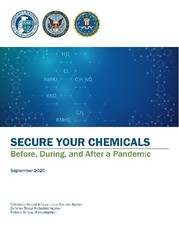
In conjunction with the webinar series, CISA also published the Secure Your Chemicals: Before, During, and After a Pandemic guide. This guidance document—a collaborative effort between CISA, FBI, and DTRA—provides a set of special considerations so that chemical companies and facilities can maintain critical operations safely and securely before, during, and after a pandemic event. It also incorporates an appendix with a variety of different guidance resources.
If you are interested in learning more or becoming a part of the Global Congress network, please contact chemcongress@interpol.int.
|
Automatic Mitigation: What It Really Means
For chemical facilities that possess chemicals of interest (COI) with release toxic, explosive, or flammable security concerns, automatic mitigation measures can assist in addressing both detection and response security measures.
When considering automatic mitigation measures, keep in mind that the goal is to prevent or reduce the effects of an attack on a release COI on the targeted area or population. This can be performed by containing the release of COI and/or mitigating the effects of an already released COI.
For example, automatic mitigation at a release-flammable facility might include a process control that automatically shuts off the flow of COI at the moment of release and an automatically triggered deluge system to suppress any fire resulting from the COI that has already been released.
Components of an automatic mitigation system may include:
- Dikes or other physical containment measures capable of containing all COI within the associated tank(s).
- Automated controls systems for process units containing COI that are capable of rapidly putting the COI in a safe and stable condition.
- Automatic deluge systems that suppress fire through extinguishing materials, such as water, foam, dry powder chemicals, or inert gases.
Once a facility has received a high-risk tiering determination and begins working on their Site Security Plan, the facility may request assistance from CISA to determine how the mitigation measures at the site support the overall security of the COI at the facility.
For more information, contact your local Chemical Security Inspector or the Chemical Security Assessment Tool (CSAT) Help Desk at 1-866-323-2957 or CSAT@hq.dhs.gov.
|
|
Hydrogen Peroxide at Warehouses
Hydrogen peroxide—which is used in more than 100 different industries for a variety of purposes—is one of the most common COI reported to CISA under the Chemical Facility Anti-Terrorism Standards (CFATS) program by warehouse, storage, and distribution facilities.
Given past use and current threat intelligence on the continued use of peroxides as explosive precursor chemicals, CISA is reminding law enforcement and industries that manufacture, store, use, or transport hydrogen peroxide of the vital need to keep hydrogen peroxide out of the hands of terrorists.
Learn more about what kind of hydrogen peroxide must be reported under the CFATS program in the Hydrogen Peroxide Flyer.
To learn more on how CFATS applies to warehouse, storage, and distribution facilities and how industry can play a role in preventing hazardous chemicals from falling into the hands of potential terrorists, CISA Chemical Security has published a new warehouse industry fact sheet, which can be found on the CFATS Industry Resources webpage.
CFATS Program Statistics
To date, CISA has received more than 99,000 Top-Screen submissions from more than 42,000 facilities. Of these, CFATS covers 3,301 facilities. Additionally, the program has completed 4,284 Authorization Inspections, 6,703 Compliance Inspections, and 8,339 Compliance Assistance Visits.
|
|
CFATS Facilities: Are You Prepared?
You never know when an emergency may arise. Whether a natural disaster or an attack by an adversary, preparedness is critical to mitigating the consequences of an emergency. For chemical facilities that manufacture, store, use, or transport hazardous chemicals, the ramifications of an incident could be deadly. Thus, being prepared for a variety of different emergency scenarios and threats is a necessity for chemical facilities to ensure continuity of operations and prevent and mitigate a chemical being released into the environment or stolen to be used for nefarious purposes.
Depending on the time of year and where your facility is located across the country, you may be at risk of disasters such as impending fires or potential hurricanes. These may be instances where you may need to deploy additional resources, whether planned or perhaps unplanned due to evacuations or power outages. Have you thought about how this may impact your COI?
Some things to consider in enhancing your preparedness:
- In the event of power loss, do you have back-up power in place for security measures, such as your camera systems or intrusion detection systems (IDS)?
- If you must move or relocate your COI as a last resort, have you notified CISA to determine if additional requirements are needed?
- Have you conducted recent outreach to your local police or fire departments in the event you require support?
- Have you conducted employee refresher trainings on emergency response procedures? Have you recently conducted drills or exercises?
- Have you backed up or mirrored all your relevant process control system data and secured it at a site outside of the emergency event area for rapid recovery after the event?
As always, you may request assistance at any time—contact your local Chemical Security Inspector or the CSAT Help Desk at 1-866-323-2957 or CSAT@hq.dhs.gov.
Compliance Corner: PSP Toolkit Series
Many CFATS-covered facilities have completed their initial implementation of the Personnel Surety Program (PSP) and are continuing to ensure all parts of RBPS 12 are being applied as new affected individuals are onboarded. However, if your facility has not yet updated your Site Security Plan or submitted names for vetting, keep in mind this will be a two-step process for your site.
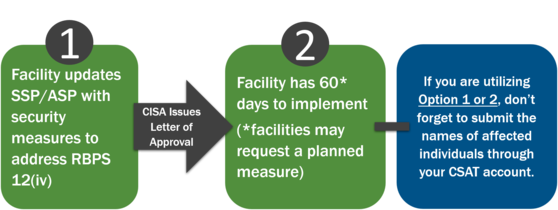 For more information regarding implementing PSP, visit the PSP Toolkit. You can also watch and listen to the PSP webinar. If you have questions, contact your local Chemical Security Inspector or the CSAT Help Desk at 1-866-323-2957 or CSAT@hq.dhs.gov.
New and Updated Resources
As always, the CFATS Resources webpage has the latest flyers, fact sheets, guidance documents, and more. Here are some of the latest updated resources:
Request for Technical and On-Site Assistance
We are committed to helping facility personnel understand and comply with CFATS. If you have any questions, reach out to our team of CFATS experts.
Request a CFATS Presentation to learn about the program—from submitting a Top-Screen to editing a security plan.
Request a Compliance Assistance Visit to learn how to prepare for CFATS-related inspections.
Meet your local Chemical Security Inspector (CSI) to develop partnerships and for assistance. Contact your CSI by emailing CFATS@hq.dhs.gov.
Call the CSAT Help Desk for technical support on the CSAT Portal or CFATS-related applications. Call 1-866-323-2957 Monday-Friday 8:30am to 5:00pm ET, or email CSAT@hq.dhs.gov.
Bookmark Our URLs
Chemical Security | CFATS Homepage | CFATS Process | CSAT SSP Submission Tips
The CFATS Knowledge Center is a repository of FAQs, latest news, and resources.
|
|
|
|
|