 LEARN THE SIGNS, STOP THE CRIMES.
April is both Child Abuse Prevention Month and Sexual Assault Prevention Month, a timely moment to focus on spotting the signs that someone may be in danger. Has a student stopped going to school? Does a customer seem coached on what to say at the cash register? The indicators of human trafficking often overlap with the signs of child abuse and sexual assault, so take time this month to refresh your knowledge with Blue Campaign resources. Remember, even the smallest act of vigilance can change a life.
Protecting Vulnerable Communities is a Team Effort
From 2003 to 2010, three brothers lured Mexican women and girls—some as young as 14—into forced sex work in Mexico, New York, and other U.S. cities. Any attempt to resist was met with threats against their families. Working together, U.S. and Mexican law enforcement were able to recover the victims and bring their traffickers to justice.
We all deserve to live safely without fear of exploitation, especially vulnerable communities like children and people who might be searching for love. Stories like this show why it is important for all of us to do our part to stop human trafficking. Visit our website to learn how your awareness can help turn victims into survivors.
Calling All Law Enforcement Officers: Explore Continued Presence
You just recovered a victim of human trafficking and are ready to investigate their trafficker(s), but you realize the victim isn’t a U.S. citizen or Legal Permeant Resident. The victim’s participation is essential to the case moving forward. That’s where Continued Presence comes in: It’s a law enforcement tool that allows victims of human trafficking to lawfully remain in the U.S. temporarily and play an active role in bringing their trafficker to justice.
Want to learn how DHS’s Continued Presence program can help your investigation? Join our free webinar tomorrow at 3:30pm EDT, or check out our training online.
AT THE CENTER
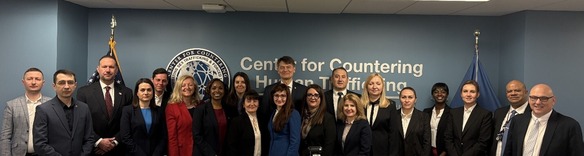 Moldovan Delegation Visits the CCHT to Advance Victim-Centered Counter-Trafficking Efforts
On Feb. 18, 2026, the Center for Countering Human Trafficking welcomed a senior delegation from the Republic of Moldova for a study visit focused on strengthening international collaboration and advancing shared efforts to combat trafficking in persons. The delegation included 11 senior officials — among them a Deputy Prosecutor General, a State Secretary from Moldova’s Ministry of Internal Affairs, and leaders of specialized investigative and victim assistance units — all working to enhance Moldova’s national response to trafficking.
The visit provided an opportunity for participants to examine U.S. best practices in prevention, investigation, and prosecution while reinforcing a victim-centered, trauma-informed approach. Discussions highlighted how advanced investigative, analytical, and technological tools are helping law enforcement address both traditional and emerging forms of trafficking. CCHT personnel also shared insights on interagency coordination, illustrating how collaboration across federal, state, and local partners strengthens operational outcomes and victim support.
A key focus of the exchange was building sustainable institutional partnerships between Moldovan and U.S. counterparts. Participants explored strategies to improve coordination among law enforcement, migration, labor, and protection authorities, as well as approaches to staff retention and professional development within specialized anti-trafficking units.
By fostering open dialogue and knowledge sharing, the study visit underscored the importance of international cooperation in addressing a crime that knows no borders. As trafficking networks continue to evolve, partnerships like these help ensure that global responses remain adaptive, coordinated, and centered on the protection and dignity of survivors.
IN THE FIELD
HSI-Supported Investigation Leads to 29-Year Sentence in Sex Trafficking Case
Through a collaborative investigation supported by Homeland Security Investigations and partner agencies, a significant sex trafficking case has resulted in the sentencing of Damarquis McGee, also known as “Lilblue,” to 348 months (29 years) in federal prison. Efforts like this reflect the broader mission of the CCHT, which works to strengthen victim-centered investigations, enhance interagency coordination, and support the identification and recovery of trafficking victims nationwide.
McGee pleaded guilty on August 26, 2024. A U.S. District judge described his conduct as “horrific,” detailing the exploitation of multiple teenage girls through force, violence, threats, and coercion. McGee will also serve 15 years of supervised release, register as a sex offender, and face strict restrictions limiting his access to children and the internet.
From April 2019 through February 2020, McGee and his co-conspirators recruited and trafficked minor victims, forcing them to engage in commercial sex acts in cars and motels along the Bissonnet corridor in Houston—an area widely known for trafficking activity. Victims were subjected to daily quotas, violence, and humiliation, and were treated as commodities rather than individuals. Traffickers also exchanged victims among themselves and enforced control through physical abuse and financial exploitation.
Three co-conspirators were previously sentenced to prison terms ranging from 20 to over 30 years. This case was investigated as part of the Human Trafficking Rescue Alliance (HTRA), a longstanding, multi-agency partnership that continues to serve as a national model for coordinated, victim-centered anti-trafficking efforts.
|