|
Loan Application Packaging Express |
|
Collaboration Keeps Sisters Together as Homeowners and Neighbors
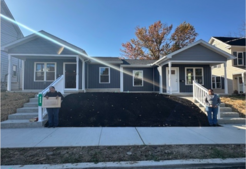
USDA Rural Development (RD), in collaboration with Habitat for Humanity of Franklin County, PA (HFH) and The Housing Council at Pathstone helped two sisters gain independence as homeowners but remain close as neighbors. In October 2024, Rural Development staff, along with partner agencies celebrated their newest homeowners, Angelina and Josefina Martinez at a joint home dedication ceremony.
Angelina and Josefina were living in an overcrowded apartment with family members. Their living situation was less than ideal; ten family members residing in a small two-bedroom apartment. Both sisters wanted to live independently and improve their living situation, but were unsure how they could affordably make this dream a reality. Angelina, a single mother, knew she had to improve her son’s living situation and contacted Pathstone to discuss housing options. Pathstone, who is a certified Section 502 direct loan application packager, assisted Angelina with the 502 direct application process, and Pennsylvania RD staff determined her eligible for the program. While Pathstone was working with Angelina, they discovered that she relied heavily on her sister, Josefina, for transportation to her workplace where they both worked as food inspectors. Pathstone reached out to USDA RD staff and Habitat for Humanity of Franklin County to see how they could assist both sisters to become homeowners. It was perfect timing, as Habitat for Humanity was finalizing a new twin duplex style build that would be a perfect side by side homes for Angelina and Josefina.
Josefina immediately worked with Pathstone to package her loan application for a Section 502 direct loan. Upon RD’s review of the application package, it was determined Josefina was eligible. The sisters both entered into an Agreement for Sale for the newly built twin style homes, where each sister was able to purchase their own unit with a shared communal wall between the dwellings. After living together for over three years in the small 2-bedroom apartment with their extended family, they can remain close, ride share, and each have a house to call their own.
Surrounded by their family, USDA RD employees, Pathstone, HFH staff and volunteers, Angelina and Josefina were able to showcase their independence and appreciation in October 2024, as neighbors, homeowners and sisters, side by side. They provided a joint statement to USDA, “Thank you very much. We are both very happy for owning our own little home and house. God bless all of you for helping us realize our dreams.”
Because of the Section 502 Direct loan funding from USDA, leveraged grant assistance from our packaging partner, Pathstone, and the sweat equity collaboration with Habitat for Humanity, the sisters are able to be independent while still supporting each other.
|
|
|

Candace Perry, who works as a Service Coordinator in a senior living facility, had been living with her young daughter and her fiancé until he suffered a traumatic brain injury back in 2019. As his focus shifted to healing and recovery, Candace moved back into her childhood home on the southside of Chicago with her daughter to start their own road to recovery.
As a single mother to a vibrant eight year old, Candace wanted to be able to provide her daughter with a stable and loving home as she helped her work through the pain of missing her father, her home, and her dog in such a short amount of time. Candace needed assistance with putting the pieces together of what can feel like a homeownership puzzle.
Candace reached out to certified loan application packager, Chicagoland Habitat for Humanity (HFH), who assisted her in completing and submission of her USDA loan application package and connected her with Will County HFH who was in the process of a new home development in an eligible rural area of Will County, Illinois. The pieces continued to come together through down payment assistance programs supplied by Habitat for Humanity, Will County Land Use, and the Illinois Housing Development Authority, with the final piece coming from the USDA Rural Development Single Family Housing (SFH) direct loan program. Candace was able to purchase a brand-new home that was constructed through the efforts of the Will County HFH staff and volunteers.
For the key hand over event, USDA SFH Direct Loan Specialist, Kristen Reber, worked closely with Will County HFH Director of Family Services, Cynthia Harvey, to ensure an unforgettable first-time homebuyer’s experience for Candace and her daughter. Illinois USDA Rural Development staff, including State Director, Jesus Ortega, joined Habitat for Humanity staff, family, and City Officials in welcoming Candace home.
The Perry’s new home will help restore a sense of normalcy in the lives of Candace and her daughter, and also give Candace’s parents back their own home to enjoy being retired seniors again. Candace’s daughter now has room to play, and her dog, Sir, can join them in their new home.
Candace is excited to be a first time homebuyer, and thankful for the community that helped her put the pieces together to help her achieve her dream.
|
The Direct Loan Application Packagers Page provides USDA program training, an intermediary coverage map, and other resources. Be sure to bookmark and visit the site often to check for updates.
Current updates posted on the Direct Loan Application Packager site include:
-
Intermediary Coverage Map – Revision date 2/18/2025
-
Stacking Order Checklist – Revision date 2/25/2025
-
Worksheet for Computing Income and Max Loan Calculator (March 7, 2025 v2)
As a friendly reminder, application package materials are periodically updated (i.e. RD Form 410-4, Uniform Residential Loan Application, etc.), so be sure to check eForms for the most current form versions. We also recommend you sign up for GovDelivery to stay up to date on all program notices.
Please visit 502 Loan Application Packager Training for a calendar of events and registration information related to upcoming certified loan application packager trainings which are provided by approved non-Agency trainers.
|
|
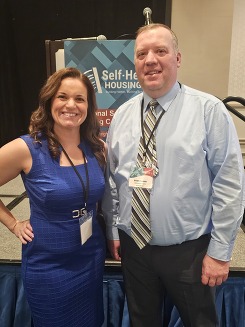
The National Self-Help Housing Conference is a pivotal event that brings together housing advocates, nonprofit organizations, policymakers, and industry experts to discuss and advance self-help housing initiatives across the United States. This year, the conference was held in Orlando, FL, from March 11-13, 2025, drawing 247 attendees who participated in 42 breakout sessions and four general sessions focused on affordable housing solutions and community-driven development.
The conference highlights the success of the USDA Rural Development Self-Help Housing Program, a model in which families work together to build or repair their own homes under the supervision of nonprofit organizations. This collaborative approach significantly reduces construction costs while fostering a sense of community and financial stability.
Representatives from the U.S. Department of Agriculture (USDA) Rural Development provided training on the program and discussed funding opportunities. Attendees gained insights into how USDA and other resources can be leveraged to support affordable housing development and ensure long-term program sustainability.
Nonprofit organizations play a crucial role in facilitating self-help housing programs. Through the 42 breakout sessions, attendees participated in workshops providing training on program and construction management, community engagement, leveraging, and regulatory compliance. The goal of these sessions is to help organizations improve their operational efficiency and expand their impact in underserved communities.
One of the most inspiring aspects of the conference was the presentation of success stories from families who have benefited from self-help housing programs. Homeowners shared their journeys, emphasizing the empowerment and financial stability that come with building and owning a home. These testimonials reinforced the importance of continued investment in self-help housing initiatives.
The four general sessions brought all attendees together to discuss the broader impact of self-help housing and the future of affordable homeownership. The National Self-Help Housing Conference continues to serve as a vital gathering for stakeholders committed to expanding homeownership opportunities. By fostering collaboration, sharing best practices, and exploring new opportunities for funding and innovation, the conference strengthens the self-help housing movement. As housing challenges persist nationwide, the knowledge and connections gained from this event play a crucial role in expanding affordable homeownership for low-income families.
|
Since 1991, USDA Rural Development has been guaranteeing loans in rural areas through the Single Family Housing Guaranteed Loan Program. This program helps approved lenders offer 100 percent-financed, no-money-down loans to eligible low-and moderate-income people.
The 90-percent loan guarantee encourages lender participation by minimizing risk.
With this loan program, rural residents can buy an existing home, cover the cost of rehabilitating, improving, or relocating a home, or build new (even with a Single-Close Construction loan, which saves time and money over the two-closing conventional construction loans).
Among other requirements, applicants must:
- Agree to occupy the home as their primary residence,
- Meet median household income requirements for the area in which the eligible home is located. Income limits are found here: tinyurl.com/SFHG-income,
- Be unable to get conventional financing with no private mortgage insurance (PMI),
- Meet U.S. citizen or noncitizen requirements and not be suspended or debarred from participating in federal programs
Among other requirements, single-family dwellings must be located in eligible rural areas (the same rural areas as the Direct program).
- Loans are based on repayment ability, and there is no set maximum purchase price or acreage limit as long as acreage is considered common for the area,
- Provided they are otherwise eligible, “flipped” properties are allowed.
What are some other loan terms?
- Applicants must have stable, dependable income and demonstrate a willingness and ability to repay debt.
- No down payment is required, and there is no limit on gift funds.
- Fixed, 30-year interest rates are negotiated between the applicant and the approved lender.
- Loans are based on a property’s appraised value, not purchase price. Thus, applicants potentially can also include closing costs, home repair expenses, and such items as utilities connection fees, tax and insurance escrow, essential household equipment, and site preparation in their financing.
To get started, applicants must work with an approved USDA RD lender. A state-based list is available here: rd.usda.gov/resources/lenders
|
|
|
Question: If the monthly debt’s outstanding balance listed on credit report will be paid off in less than 12 months, do we include it in the monthly debt?
- If the debt is an installment loan, per HB 1-3550, Chapter 4, Par 4.22 B, long-term installment obligations with more than 10 months of repayment remaining are counted towards the total debt ratios. However, short term obligations (with 6 months or less of remaining payments) that significantly impact repayment ability should also be included. An example of a short‐term payment with a significant impact, might be a car loan payment of $500/month. While the payment only has 6 months remaining, it could adversely impact the applicant’s ability to make their payments in those first 6 months. Because the ultimate goal is to have successful homeowners, these types of short‐term debts are included to ensure that the borrower will be able to make their payments timely after loan closing.
- All medical debts (including medical collections) are excluded.
- If the debt is revolving, use the following applicable approach: 1) Use $0 if the credit report indicates no outstanding balance. 2) Use the minimum monthly payment as reflected on the credit report if the credit report indicates an outstanding balance and a minimum monthly payment. 3) Use 5% of the outstanding balance if the credit report indicates an outstanding balance but no specific minimum monthly payment or obtain a copy of the most recent billing statement that reflects the actual monthly payment and use that amount if lower. 4) If the credit report indicates an outstanding balance but the applicant indicates that it will be (or has been) paid in full, a monthly payment will not be used provided the applicant provides documentation of payment in full.
Question: When developing alternative credit, if verification of rent covers less than two years of history, is that sufficient for consideration as two sources?
No, the Verification of Rent must cover the past two years (may be different landlords) of rental history to be considered two sources of nontraditional or alternative credit. Handbok-1-3550, Paragraph 4.12 states: Form RD 1944-60, Landlord Verification is used to verify the applicant’s past record of making timely rental payments. The Loan Originator should generate separate copies of Form RD 1944-60 for each landlord listed on the application for the past 2 years. A landlord’s verification is required when the applicant’s credit score is less than 640.
Question: What are RD’s tax return submission requirements for a Section 502 direct loan application package during income tax filing season?
- The Handbook-1-3550, Attachment 3-J, states that the applicant(s) must provide the last two signed Federal Income Tax Returns with all applicable tax return schedules, all W-2’s, 1099’s, and other forms attached to the returns.
- If the applicant(s) have not yet filed the prior calendar year’s tax return and it is prior to the IRS established return deadline, or they have provided the proper extension documentation, the Agency would not require the return and any W-2’s or 1099’s associated with the unfiled return for a complete application package submission. The applicant(s) would still be required to submit the prior two years filed returns and all applicable schedules (e.g. 2023 and 2022).
- However, the applicant should be informed they would need to provide their filed return and all additional required documentation as noted in Attachment 3-J, once it is available.
- We do recommend, when available, the applicant(s) provide the most recent W-2’s and 1099 information to assist with providing the most accurate calculations of income, even if the tax returns have not been filed.
- If applicant(s) are unable to provide their full tax return, they may obtain them directly from the IRS.gov site: Get your tax records and transcripts | Internal Revenue Service (irs.gov).
- If tax returns are filed electronically, include a copy of the signature page with the Self-Select PIN, confirmation that the return was accepted, or evidence that it was filed by an authorized E-File provider.
Question: Can loan application packages use digital signatures?
As noted in HB-1-3550, Attachment 3-A, Loan Application Packagers:
- The Agency will accept the electronic Form RD 410-4 submitted through eForms; a signature is not required on the Form RD 410-4 for the application to be considered complete.
- Certified application packagers and intermediaries who choose to accept electronic signatures for other application documents must meet the standards and requirements set forth in the E-Sign Act, as well as all other applicable federal and state regulations and guidelines; and are charged with the same responsibility of due diligence with electronically signed documents as they are with paper documents.
|
|
|
Single Family Housing Direct Loan Programs USDA Rural Development
|
|
1400 Independence Ave. SW Mail Stop 0783 Room 2211 Washington, D.C. 20250 |
|
USDA is an equal opportunity provider, employer, and lender. |
|
|
|
|


