|
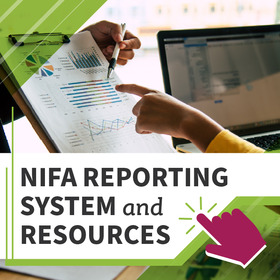
More Programs Are Moving to eRA: What Applicants Should Know
As part of NIFA's Grants Modernization Initiative, 28 additional grant programs will move into eRA in FY 2027, joining the nine programs already in the system. Each Notice of Funding Opportunity (NOFO) will indicate the program is managed using eRA. If your program is one of them, here’s what to expect.
-
You still apply through Grants.gov. What changes is how your application is processed and tracked after submission.
-
Set up an eRA Commons account before you start. Your organization (must be registered with SAM.gov), your PD/PI and all Senior/Key Personnel need active accounts and only your Signing Official can create them. If you’re unsure where to begin, refer to the “Get Started with eRA Commons” section of the GMI eRA Reference Center.
-
Applicants can use eRA’s ASSIST module to help submit their proposals. ASSIST helps navigate the application process and checks for errors before final submission.
Note: Applications will be rejected if your account is inactive, if your Senior/Key Personnel’s eRA Commons usernames are missing from the application or if the organization’s UEI doesn’t match the one used to register in eRA Commons.
NIFA Mourns Long-time Colleague Dr. Jim Dobrowolski
USDA’s National Institute of Food and Agriculture is mourning the loss of long-time colleague Dr. Jim Dobrowolski. Jim devoted his career to understanding and protecting the land and water on which we all depend. Scientific research and teaching were among the greatest satisfactions of his life, and he shared his knowledge generously with students, colleagues and children discovering the world around them.
At the time of his death, Jim served as NIFA’s national program leader for water and natural resources. During his 20-year career, Jim was a true public servant, committed to advancing agricultural research. Jim provided leadership as the USDA representative to teams across government, including EPA’s Interagency Working Group for Water Reuse, the Sub-committee on Environment, Innovation, and Public Health and the Hypoxia Task Force. Jim was a well-respected scientist and was recently awarded the EPA Medal for Commendable Service. His work with Native Waters on Arid Lands held a special place in his heart. On the international stage, Jim represented the U.S. government through a joint program with Israel on agricultural research and development; addressing trans-boundary issues with the Rio Grande in Mexico and the Global Research Alliance.
Jim is survived by his wife, Jan Dobrowolski; his children, Jessica Larson and Jonathan Dobrowolski, and Jonathan’s partner, Rosa Oh; his five grandchildren, Olivia, Ivy, Jack, Sam and Duke; and a large extended family. Read the complete obituary here.

|
|
|
Continuously Accepted
|
|
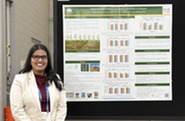
Kentucky State Researchers Look at Biochar’s Benefits for Farmland
Food security depends on soils that remain productive over many growing seasons. Biochar, a charcoal‑like material made by heating plant matter with little oxygen, may help soils retain water, nutrients and carbon, but farmers need long‑term field evidence to understand its value. At Kentucky State University, researchers are tracking the effects of biochar in the same soybean field year after year, adding a third year of results to a question that can only be answered over time. Learn more about their NIFA‑supported project and recently published findings.
Srijana Kandel presenting biochar study results. Image courtesy of Kentucky State.
|
|
|
USDA Builds Upon Great American Cotton Plan
USDA has announced two new actions under the Great American Cotton Plan to strengthen support for American cotton producers. USDA’s Risk Management Agency will allow producers, including cotton growers, to purchase multiple endorsements on a crop insurance policy for the 2027 crop year, and USDA's Foreign Agricultural Service (FAS) is designing a mechanism that will incentivize purchases of American cotton that will launch next year. Read more about these programs here.
|
|
NIFA Soliciting FY27 Commodity Board Topics
NIFA is inviting commodity boards to submit AFRI‑aligned research topics for FY 2027 co‑funding. Topics are due Nov. 19 and must be submitted through NIFA’s online form and email process. More details are available on the NIFA website.
|
|
|
USDA NIFA invests in research, education, and outreach that keeps American agriculture productive, profitable, and at the forefront of innovation. Through partnerships with the Land-grant University System, NIFA leverages more than 10,000 scientists, educators, and Extension professionals to turn discovery into real-world solutions for farmers, ranchers, families, and communities.
The National Institute of Food and Agriculture (NIFA) is committed to ensuring that its programs and services are accessible to all individuals, including individuals with disabilities and individuals with limited English proficiency. If you need a reasonable accommodation to participate in any NIFA event, please contact the appropriate Program staff no later than 10 days prior to the event. To find Program staff by event, please visit the NIFA Calendar of Events. NIFA Language access services, such as interpretation or translation of vital information, will be provided free of charge to limited English proficient individuals upon request.
If you need interpretation or translation services, please contact sm.nifa.eeo@usda.gov no later than 10 days prior to the event.
Keep informed about NIFA, USDA, our Land-grant and non-Land-grant university partners, and stakeholders with the NIFA Update. Read past issues online, sign up for email updates or follow us on X (formerly Twitter) @USDA_NIFA, #NIFAImpacts or LinkedIn @usda-nifa.
If you wish to submit a news item or information, send an email to NIFAUpdate.
USDA is an equal opportunity lender, provider, and employer.
|
|
|
|
|