|
Making a Difference
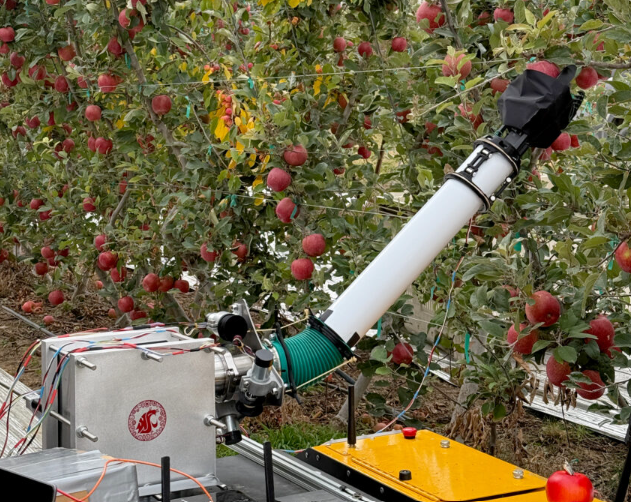
Enhancing Automation for Specialty Crop Production
Specialty crops—such as fruits, vegetables, tree nuts, and nursery plants—are a vital part of U.S. agriculture. Properly designed and implemented automated technologies can play a critical role in improving efficiency across growing, harvesting, and processing operations.
Researchers at Land-grant Universities are collaborating with Extension professionals and industry partners to develop automated systems that optimize specialty crop production. Read more about this multistate work supported by USDA National Institute of Food and Agriculture.
. Washington State University researchers are developing low-cost robotic solutions to aid the tree fruit industry. Image courtesy of Ryan Dorosh, Washington State University.
|
|
NIFA Director Visits LSU
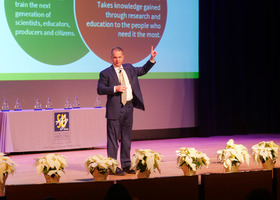
NIFA Director Dr. Jaye Hamby visited Louisiana State University (LSU) in December 2025, speaking at the Louisiana Land-Grant Agriculture Summit. While on the LSU campus, he and other NIFA leaders got a firsthand look at some of the NIFA-supported research during tours of LSU AgCenter facilities.
|
|
|
Photo 1: NIFA Director Dr. Jaye Hamby, speaks to attendees at the Louisiana Land-Grant Agriculture Summit on the LSU campus.
Photo 2: LSU AgCenter crop geneticist Prasanta Subudhi discusses his work examining sustainable rice varieties and growing practices.
Photo 3: Jack Koch, LSU AgCenter Aquatic Germplasm and Genetic Resources Center assistant director, and Gabbie Bush, an undergraduate student worker, share the work of a crawfish genetic preservation project.
Photo 4: Terry Tiersch, LSU AgCenter Aquatic Germplasm and Genetic Resources Center director, shows a 3D-printed device used to hold tank lids shut.
All images courtesy of LSU AgCenter/Olivia McClure.
|
|
|
Information about the program area priorities—including program contacts, types of projects allowed, and more—can be found in the Agriculture and Food Research Initiative - Education and Workforce Development NOFO.
- Professional Development for Agricultural Literacy - March 19
- Agricultural Workforce Training at Community Colleges - March 19
- Food and Agricultural Non-formal Education - March 19
- Research and Extension Experiences for Undergraduates - March 19
- Predoctoral Fellowships - April 16
- Postdoctoral Fellowships - April 30
- Education and Workforce Development Workshop Grants (A7001) Continuous throughout the year but at least 210 days before the start of the workshop and upon invitation after submission of a Letter of Intent at least 255 days before the workshop begins.
Deadline March 26
Accepted on a Continuous Basis
|
|
Penn State AI System Identifies Weeds in Apple Orchards
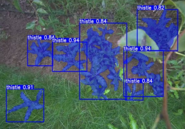
Weed control is essential in apple orchards because weeds compete with trees for nutrients, water and sunlight. Penn State University (PSU) researchers are developing an automated, robotic weed-management system. PSU researchers developed an AI machine vision model that can accurately find, outline, interpret and estimate the weed density. The system, intended to guide a robotic precision sprayer, uses a machine vision innovation that allows a side-view camera to detect and identify weeds for treatment — even weeds that are partially obscured. Learn more about this NIFA-supported research.
Photo shows one weed species that Penn State researchers trained the artificial intelligence (AI) machine vision model to recognize. Image courtesy of Penn State.
|
|
|
USDA ARS Scientists Develop Innovative Pipeline to Analyze Plant Pathogens
USDA Agriculture Research Service scientists in Corvallis, OR, in collaboration with Oregon State University, have developed a disease surveillance platform that could improve U.S. agriculture by unlocking the future of plant health. PathogenSurveillance is an innovative, open-source software tool that can quickly analyze and identify novel microbial variants based on DNA sequences.
It is an innovative workflow tool to help scientists respond in real-time to emerging, or re-emerging, invasive pathogens and pests. Read more about this work.
|
|
|
The National Institute of Food and Agriculture (NIFA) is committed to ensuring that its programs and services are accessible to all individuals, including individuals with disabilities and individuals with limited English proficiency. If you need a reasonable accommodation to participate in any NIFA event, please contact the appropriate Program staff no later than 10 days prior to the event. To find Program staff by event, please visit the NIFA Calendar of Events. NIFA Language access services, such as interpretation or translation of vital information, will be provided free of charge to limited English proficient individuals upon request.
If you need interpretation or translation services, please visit NIFA language services or contact Gabriel de Zayas, Equal Opportunity Specialist, at Gabriel.DeZayasrodriguez@usda.gov or (202) 655-7842 no later than 10 days prior to the event.
USDA NIFA invests in and advances high-impact agricultural research, education, and Extension to solve the Nation’s pressing challenges, grow U.S. agricultural innovation and competitiveness, fuel rural prosperity, and develop the future agricultural workforce. Keep informed about NIFA, USDA, our Land-grant and non-Land-grant university partners, and stakeholders with the NIFA Update. Read past issues online, sign up for email updates or follow us on X (formerly Twitter) @USDA_NIFA, #NIFAImpacts or LinkedIn @usda-nifa.
If you wish to submit a news item or information, send an email to NIFAUpdate.
USDA is an equal opportunity lender, provider, and employer.
|
|
|
|
|