|
Making a Difference
Military Teen Adventure Camps Equip Young People for Success
USDA’s National Institute of Food and Agriculture (NIFA), home to the 4-H National Headquarters, celebrates the achievements of 4-H, including the impact of youth development programs for military youths and families.
With support from NIFA, Purdue University has expanded access and opportunity for military teens ages 13-18 to participate in adventure camps at locations around the U.S. At the camps, military youths and their families participate in high adventure experiences such as whitewater rafting, rock climbing, boating, camping, survival camps, running rope courses and other activities, building skills, resilience and confidence. Read more about these camps and the young people they support.
MTAC teens rafting the Colorado River in the Grand Canyon. Photo courtesy of Tucson Village Farm with Arizona 4-H and Arizona Raft Adventures.
|
|
Training Sessions for New eRA Grants System Rescheduled
As part of NIFA's Grants Modernization Initiative (GMI), we are transitioning to the eRA grants management system to support a more efficient and streamlined grants process. To help prepare for this transition, we are committed to providing our applicants and the research community with training and support.
We have rescheduled the following training sessions that were originally planned for October 2025.
Upcoming Training Sessions
As a reminder, here’s a quick recap of the programs transitioning to eRA in the first half of FY 2026.
- Agricultural Genome to Phenome Initiative (AG2PI)
- Equipment Grants Program (EGP)
- Farm Business Management and Benchmarking Competitive Grants Program (FBMB)
- Food and Agriculture Service Learning Program (FASLP)
- Food Safety Outreach Competitive Grants Program (FSOP)
- Organic Agriculture Research & Extension Initiative (OREI)
- Renewable Resource Extension Act National Focus Fund Program (REEA-NFF)
- Secondary Education, Two-Year Postsecondary Education, and Agriculture in the K-12 Classroom Challenge Grants Program (SPECA)
- Smith-Lever Special Needs Competitive Grants Program (SLSNCGP)
Transition Timeline (based on calendar year)
-
Q1 2026: Notices of Funding Opportunity published for selected programs
-
Q2 2026: Application reviews conducted
-
Q3 2026: Awards issued; grants managed and tracked on eRA
-
2027-2028: Remaining NIFA programs transition to eRA
What does this mean for you?
2026 National 4-H Conference Information Session
NIFA will host a 2026 National 4-H Conference information session on Thursday, Dec. 18, 4 p.m. EST. The information session will share details about the 2026 conference, including a preliminary look at the agenda, registration process, costs and more. Register for the information session here.
National 4-H Conference is the flagship youth development opportunity of USDA. It brings together young people, volunteer leaders, Extension staff, Land-grant University faculty, as well as state and federal government officials. Learn more about National 4-H Conference here. Contact National4-HConference@usda.gov with any questions.
Presidential AI Challenge Supports K-12 Education
There is still time to submit projects for the Presidential AI Challenge! This initiative seeks to inspire young people and educators to create AI-based innovative solutions to community challenges while fostering AI interest and competency. Students and educators of all backgrounds and expertise are encouraged to participate and ignite a new spirit of innovation. Projects must be submitted by Jan. 20, 2026. Virtual office hours are being held throughout December and January. Learn more about the challenge and how to support youth participation.
The Presidential AI Challenge is seeking volunteers -- AI programming or user experts; STEM professionals; or professionals with experience working with students or teachers. Judges will independently score each submission against a detailed rubric in late January. The expected time commitment to score the submissions is approximately four hours, plus a one-hour training session in mid-January. Those interested can register here.
|
|
Information about the program area priority—including program contacts, types of projects allowed and more— will be found in Part I, C of the AFRI Foundational and Applied Science RFA. Letters of Intent (if applicable) and applications must be received at NIFA by 5 p.m. EST on the deadlines below. |
|
|
Dec. 4
- Biorefining and Biomanufacturing
- Diet, Nutrition and the Prevention of Chronic Diseases
- Economics, Markets and Trade
- Engineering for Agricultural Production and Processing
- Engineering for Precision Crop and Water Management
- Food Safety and Defense
- Foundational Knowledge of Agricultural Production Systems
- Foundational Knowledge of Plant Products
- Innovations in Food Manufacturing Technologies
- Physiology of Agricultural Plants
- Plant Breeding for Agricultural Production
- Soil Health
- Landscape-Scale Production Systems
- Bioeconomy and Biobased Products
- Water Quantity and Quality
Dec. 11
- Agricultural Microbiomes in Plant Systems and Natural Resources
- Conventional Plant Breeding for Cultivar Development
- Food and Human Health
- Mitigating Antimicrobial Resistance Across the Food Chain
- Nanotechnology for Agricultural and Food Systems
- Environmental and Natural Resource Economics
- Pollinator Health: Research and Application
- Rural Economic Development
- Small and Medium-Sized Farms
- Social Implications of Food and Agricultural Technologies
|
|
Dec. 18
- Agricultural Biosecurity
- Animal Breeding, Genetics, and Genomics
- Animal Nutrition, Growth and Lactation
- Animal Reproduction
- Critical Agricultural Research and Extension
- Data Science for Food and Agricultural System
- Diseases of Agricultural Animals
- Pests and Beneficial Species in Agricultural Production Systems
- Welfare of Agricultural Animals
Accepted on a Continuing Basis
- Rapid Response to Emerging and Re-emerging Pest and Disease Events Across Food and Agricultural Systems
- Rapid Response to Weather Events Across Food and Agricultural Systems
|
|
Poultry Processing's Future Includes Automation, Robotics and Virtual Reality Headsets
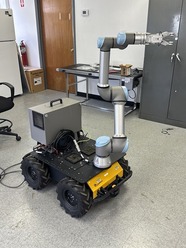
University of Arkansas researchers say robotics, virtual reality and artificial intelligence could be game changers for poultry processors. When grocery store shelves went short of chicken products during the COVID-19 pandemic due to labor shortages, scientists began considering how artificial intelligence and robotics could help.
University of Arkansas scientists with collaborators from other universities have put a twist on the robotics technology that has been used in other industrial settings. They are integrating human assistance with virtual reality headsets and artificial intelligence connected to robotic arms in the poultry processing facility. Read more about this NIFA supported research.
An autonomous pathogen detection rover was developed to assess the effectiveness of sanitation in poultry processing facilities. Photo courtesy of University of Arkansas System Division of Agriculture.
|
|
|
USDA Launches Screwworm.gov
USDA has launched a unified New World screwworm (NWS) website, screwworm.gov. This site centralizes NWS information available across the federal government and reflects the government effort to fight this pest through a comprehensive five-pronged plan. Learn more about the website.
|
|
Ag Outlook Forum
Proposals Due Dec. 5
Proposals for Ag Outlook Forum must be submitted to Dr. Melanie Abley (melanie.abley@usda.gov) by Dec. 5. Messages should include the subject line Ag Outlook Forum Proposal. Reach out to Dr. Abley for further information.
|
|
|
The National Institute of Food and Agriculture (NIFA) is committed to ensuring that its programs and services are accessible to all individuals, including individuals with disabilities and individuals with limited English proficiency. If you need a reasonable accommodation to participate in any NIFA event, please contact the appropriate Program staff no later than 10 days prior to the event. To find Program staff by event, please visit the NIFA Calendar of Events. NIFA Language access services, such as interpretation or translation of vital information, will be provided free of charge to limited English proficient individuals upon request.
If you need interpretation or translation services, please visit NIFA language services or contact Gabriel de Zayas, Equal Opportunity Specialist, at Gabriel.DeZayasrodriguez@usda.gov or (202) 655-7842 no later than 10 days prior to the event.
USDA NIFA invests in and advances high-impact agricultural research, education, and Extension to solve the Nation’s pressing challenges, grow U.S. agricultural innovation and competitiveness, fuel rural prosperity, and develop the future agricultural workforce. Keep informed about NIFA, USDA, our Land-grant and non-Land-grant university partners, and stakeholders with the NIFA Update. Read past issues online, sign up for email updates or follow us on X (formerly Twitter) @USDA_NIFA, #NIFAImpacts or LinkedIn @usda-nifa.
If you wish to submit a news item or information, send an email to NIFAUpdate.
USDA is an equal opportunity lender, provider, and employer.
|
|
|
|
|