|
Making a Difference
Rutgers Scientists Uncover New Spray that Finally Beats Back Bed Bug Resistance
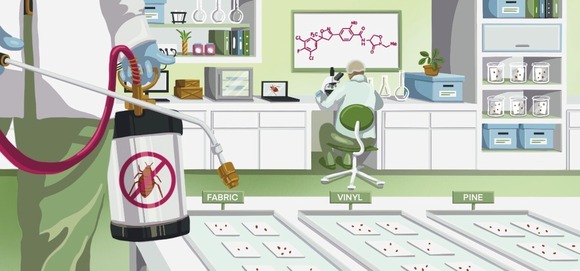
Rutgers University researchers have identified a new pesticide that killed every bed bug it touched — including those that thwarted today’s leading products — and stayed lethal for at least a month.
The potential benefits of the discovery are significant. Complete control in one treatment could save landlords and pest control firms weeks of labor and follow-up visits. And because the active ingredient, isocycloseram, remains potent for at least a month, technicians may spray less often, reducing chemical exposure indoors.
Read more about their work on managing a pest that vanished for decades after World War II, only to roar back in the early 2000s.
Illustration of bed bug research. NIFA graphic.
|
|
NIFA Director Meets with Illinois FFA Members
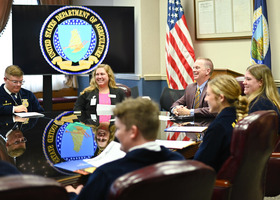
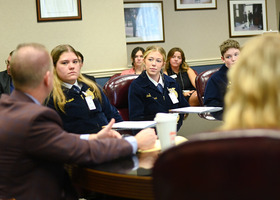
NIFA Director Dr. Jaye Hamby met recently with Illinois FFA members at the Whitten Building in Washington, D.C. In addition to visiting with Dr. Hamby, the students met with a number of USDA agency leaders and representatives to learn more about how the USDA helps America's farmers, ranchers and forest landowners.
|
|

Clemson Graduate Student Helps Lead Breakthrough in Cotton Gene Editing
Jacob Johnson, a Clemson University master’s student in plant and environmental sciences, is helping shape the future of cotton farming through cutting-edge gene editing research. Johnson is part of a multidisciplinary team of scientists working on Building Better Cotton: Gene Editing to Improve Oil, Protein and Fiber Quality in Upland Cotton.
Christopher Saski, a plant geneticist and translational scientist in Clemson’s College of Agriculture, Forestry and Life Sciences, is leading the initiative. The project builds on a previous NIFA-funded study focused on gene discovery. The current phase translates those discoveries into practical applications using CRISPR-Cas12a and other advanced genetic engineering tools. The team aims to develop high-yielding Upland cotton varieties with Pima-like fiber quality, enhanced seed traits and resistance to Fusarium wilt—a disease that has devastated cotton crops across the U.S. The goal is to create a dual-purpose crop that boosts economic and environmental sustainability for cotton growers. Read more about how this work and the importance of graduate students to high impact research.
Jacob Johnson, a Clemson University master's student, uses a stereo microscope to study Upland cotton genes. Image courtesy of Clemson University.
|
|
|
USDA NASS Release 2022 Census of Agriculture Typology Report
Family farms comprise 95% of all U.S. farms, according to the 2022 Census of Agriculture Farm Typology report released by the U.S. Department of Agriculture’s National Agricultural Statistics Service.
The farm typology report primarily focuses on the “family farm,” defined as any farm where the majority of the business is owned by the producer and individuals related to the producer. The report classifies all farms into unique categories based on two criteria: who owns the operation and gross cash farm income (GCFI). GCFI includes the producer’s sales of crops and livestock, fees for delivering commodities under production contracts, government payments, and farm-related income. Read more about the report findings.
Recent Executive Order on Oversight of Federal Grantmaking
On Aug. 7, the White House released an Executive Order focused on improving oversight of federal grantmaking. Read the full Executive Order here.
|
|
NIFA’s First Programs Are Moving to eRA
NIFA is transitioning its first programs to the eRA grants management system in the first quarter of Fiscal Year 2026. A training webinar to introduce eRA and its capabilities will be Thursday, Sept. 11, 2-4 p.m. EDT. Register here.
|
|
|
The National Institute of Food and Agriculture (NIFA) is committed to ensuring that its programs and services are accessible to all individuals, including individuals with disabilities and individuals with limited English proficiency. If you need a reasonable accommodation to participate in any NIFA event, please contact the appropriate Program staff no later than 10 days prior to the event. To find Program staff by event, please visit the NIFA Calendar of Events. NIFA Language access services, such as interpretation or translation of vital information, will be provided free of charge to limited English proficient individuals upon request. If you need interpretation or translation services please visit NIFA language services or contact Lois Tuttle, Equal Opportunity Specialist, at Lois.Tuttle@usda.gov or (443) 386-9488 no later than 10 days prior to the event.
NIFA’s mission is to invest in and advance agricultural research, education, and Extension that solves societal challenges. NIFA’s investments in transformative science directly support the long-term prosperity and global preeminence of U.S. agriculture. Keep informed about NIFA, USDA, our Land-grant and non-Land-grant university partners, and stakeholders with the NIFA Update. Read past issues online, sign up for email updates or follow us on X (formerly Twitter) @USDA_NIFA, #NIFAImpacts or LinkedIn @usda-nifa.
If you wish to submit a news item or information, send an email to NIFAUpdate.
USDA is an equal opportunity lender, provider, and employer.
|
|
|
|
|