|
Making a Difference
Researchers Turn Idaho Dairy Manure into Profits, Protect Waterways
A team of University of Idaho scientists backed by USDA’s National Institute of Food and Agriculture is turning manure into opportunity, transforming waste into fertilizer, clean water and even biodegradable plastics. The Idaho Sustainable Agriculture Initiative for Dairy, or ISAID, has spent five years developing and testing systems that capture valuable nutrients and byproducts from manure and wastewater.
The team has undertaken a groundbreaking plan to harness nitrogen and phosphorus from dairy production, converting them into valuable bioproducts. These products can be transported and used in other areas for crop production or as raw materials for value-added products like bioplastics.
Read more about their work to convert dairy manure nutrients into commercial fertilizers and value-added bioproducts.
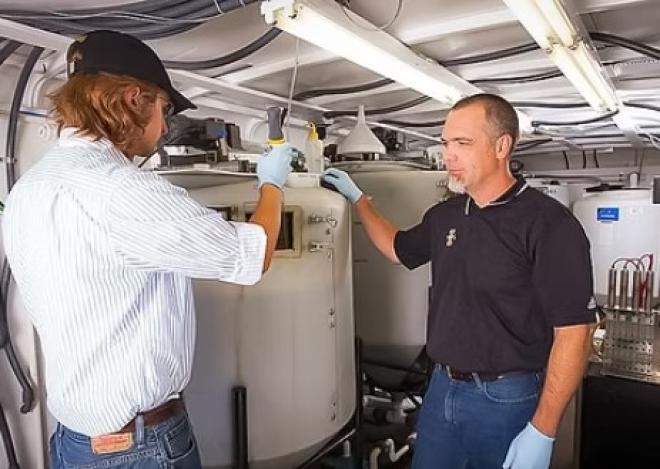
Doctoral student Nick Guho (left) and Professor Erik Coats sample the fermenters where bacteria produce bioplastics. Image courtesy of University of Idaho.
|
|
NIFA Invests Over $10.6 Million in Commodity Board Research Topics
USDA NIFA has invested more than $10.6 million in 23 research projects co-funded by commodity boards that aim to improve crop production efficiency and advance solutions to critically important problems in U.S. agriculture.
In FY 2024, boards that submitted topics for co-funding support included the American Egg Board, California Prune Board, The Cotton Board, Dairy Management, National Peanut Board, National Pork Board, United Sorghum Checkoff Program and United Soybean Board.
This arrangement strengthens relationships between NIFA and commodity groups, which also connect with stakeholder groups relevant to NIFA. These grants are part of NIFA’s Agriculture and Food Research Initiative (AFRI 1811).
|
|
Keeping South Dakota's Food Supply Safe
The Animal Disease Research and Diagnostic Laboratory (ADRDL) at South Dakota State University is part of a national network of food surveillance laboratories that work to keep the state's food supply safe. Each day, the ADRDL receives shipments of meat samples from butchers and processing facilities around the state. For facilities that aren't large enough to be inspected by USDA, the South Dakota Animal Industry Board provides inspection services, and affiliated testing is done through the ADRDL.
Meat from individual facilities is tested on a quarterly basis, but the number of meat-producing facilities in the state makes meat testing a daily activity. It's not just meat the lab is testing. The facility also tests a variety of farmer's market-type products, such as canned jellies, jams and pickles and raw milk. Read more about the work being done at this NIFA-supported facility.
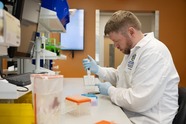
Senior microbiologist Zachary Lau prepares a meat sample for testing. Image courtesy of South Dakota State University.
|
|
|
USDA ARS Using Advanced Tracking Technology to Improve Fruit Fly Management
Recent USDA Agricultural Research Service (ARS) findings suggest that wind could play a major factor in surveillance, containment and eradication of fruit flies. Advanced technology in tracking the effects of wind dispersal on tiny, winged creatures in the wild promises to refine fruit fly management strategies, identify outbreak sources, and help scientists anticipate their movement, feeding and mating patterns. Learn more about how ARS is using harmonic radar tagging to study the pest.
|
|
Public Comment Open on USDA Reorganization Plan
A public comment period continues so stakeholders may provide feedback on USDA’s reorganization plan, as outlined in Agriculture Secretary Brooke L. Rollins’ memorandum issued July 24. All stakeholders, including USDA employees, members of Congress, and agricultural and nutrition partners, are encouraged to provide feedback by emailing reorganization@usda.gov. The comment period closes Aug. 26.
|
|
|
The National Institute of Food and Agriculture (NIFA) is committed to ensuring that its programs and services are accessible to all individuals, including individuals with disabilities and individuals with limited English proficiency. If you need a reasonable accommodation to participate in any NIFA event, please contact the appropriate Program staff no later than 10 days prior to the event. To find Program staff by event, please visit the NIFA Calendar of Events. NIFA Language access services, such as interpretation or translation of vital information, will be provided free of charge to limited English proficient individuals upon request. If you need interpretation or translation services please visit NIFA language services or contact Lois Tuttle, Equal Opportunity Specialist, at Lois.Tuttle@usda.gov or (443) 386-9488 no later than 10 days prior to the event.
NIFA’s mission is to invest in and advance agricultural research, education, and Extension that solves societal challenges. NIFA’s investments in transformative science directly support the long-term prosperity and global preeminence of U.S. agriculture. Keep informed about NIFA, USDA, our Land-grant and non-Land-grant university partners, and stakeholders with the NIFA Update. Read past issues online, sign up for email updates or follow us on X (formerly Twitter) @USDA_NIFA, #NIFAImpacts or LinkedIn @usda-nifa.
If you wish to submit a news item or information, send an email to NIFAUpdate.
USDA is an equal opportunity lender, provider, and employer.
|
|
|
|
|