|
Happy Fourth of July from NIFA! |
|
Making a Difference
Survey Conducted Across Three U.S. Regions Shed Light on Household and Community Well-Being
Supported by USDA NIFA, Regional Rural Development Centers are a trusted source of economic and community development data.
The regional centers partnered to conduct a multi-region Baseline Survey in 2024 and recently published the open access data. This data establishes an important baseline for future research and can inform policy decisions, community development strategies and targeted interventions to address regional challenges and opportunities.
The survey explored topics related to household, business and community well-being. When the fourth and final regional survey is completed, survey data will be available for the entire United States. Read more about the survey results.
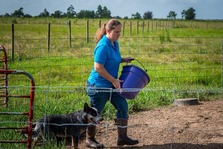
Farmer feeding livestock. USDA image.
|
|
|
Corn Rootworm’s Secret Weapon: How A Genetic ‘Pause’ Helps A Billion-Dollar Pest Survive Winter
A University of Kentucky (UK) research study offers fresh insights into a billion-dollar annual problem for U.S. corn producers. New research shows how two pests, western and northern corn rootworms, survive cold winters and return the following year to wreak havoc on corn yields.
Supported in part by NIFA, UK researchers identified mechanisms that regulate an underlying process corn rootworms use called diapause. By pinpointing the genetic mechanisms that help rootworm eggs “pause” underground during winter, the research may lay the groundwork for improved pest-management strategies. Read more about UK’s work on these pests.
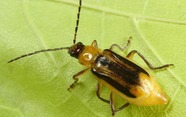
Western corn rootworm adult on soybean. Image courtesy of Winston Beck, Iowa State University, Bugwood.org.
|
|
|
Extension Disaster Education Network Helps Prepare Nation for Hurricane Season
The 2025 Atlantic hurricane season is one month old, and the National Oceanic and Atmospheric Administration predicts a 60% chance of above-average hurricane activity this year.
Supported by NIFA, the Extension Disaster Education Network (EDEN) is a collaborative multi-state effort by Cooperative Extension Services across the country to improve timely information delivery to people affected by disasters, including hurricanes. Read more about EDEN’s work in this USDA blog.
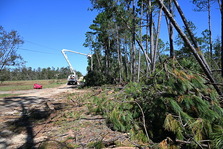
Hurricane Helene damage in southeast Georgia. USDA photo by Chris Groskreutz.
|
|
|
|
The National Institute of Food and Agriculture (NIFA) is committed to ensuring that its programs and services are accessible to all individuals, including individuals with disabilities and individuals with limited English proficiency. If you need a reasonable accommodation to participate in any NIFA event, please contact the appropriate Program staff no later than 10 days prior to the event. To find Program staff by event, please visit the NIFA Calendar of Events. NIFA Language access services, such as interpretation or translation of vital information, will be provided free of charge to limited English proficient individuals upon request. If you need interpretation or translation services please visit NIFA language services or contact Lois Tuttle, Equal Opportunity Specialist, at Lois.Tuttle@usda.gov or (443) 386-9488 no later than 10 days prior to the event.
NIFA’s mission is to invest in and advance agricultural research, education, and Extension that solves societal challenges. NIFA’s investments in transformative science directly support the long-term prosperity and global preeminence of U.S. agriculture. Keep informed about NIFA, USDA, our Land-grant and non-Land-grant university partners, and stakeholders with the NIFA Update. Read past issues online, sign up for email updates or follow us on X (formerly Twitter) @USDA_NIFA, #NIFAImpacts or LinkedIn @usda-nifa.
If you wish to submit a news item or information, send an email to NIFAUpdate.
USDA is an equal opportunity lender, provider, and employer.
|
|
|
|