|
NOTICE: Gain of Function Research Reporting
NIFA has posted on its website important information for universities and other grant recipients to report Gain of Function Research in a timely and effective manner. As part of USDA’s response to Executive Order (E.O.) 14292 on Improving the Safety and Security of Biological Research, USDA is asking grant recipients to self-identify any USDA-funded projects, inclusive of all source(s) or type(s) of funding, including in-kind support, that is believed to meet or has the potential to meet the gain-of-function definition. Read more about how, what and when to report this information.
NIFA Reporting System: Supporting Your Success in Capacity Reporting
The NIFA Reporting System (NRS) is the central platform for completing and submitting Annual Reports of Accomplishments, Plans of Work, and other required reports for organizations receiving capacity funding. If your organization receives funding through the Hatch Act, the Smith-Lever Act, McIntire-Stennis or Evans-Allen, you’ve likely worked in NRS to meet reporting requirements. These reports help tell the story of how Land-grant Universities and other capacity-funded organizations across the country are advancing research, Extension and education in support of agricultural communities.
To help you make the most of the system, NIFA offers a range of tools and resources to support your work in NRS. Stay up to date on capacity reporting deadlines, access video tutorials and training and review user guides to help you navigate the system and complete each report successfully, by using these resources and tools.
NIFA is committed to supporting your work through innovative tools and responsive support. We appreciate the continued efforts of our capacity-funded partners and look forward to working together to strengthen research and Extension programs. If you have questions or need technical assistance, the NRS Help Desk is ready to support you at nrs@usda.gov.
|
|
Finger Limes: An HLB-Tolerant Prospect for Florida Growers
University of Florida (UF) researchers are working to bring finger limes, often known as citrus caviar to Florida as a new crop for the state’s citrus industry. This work is supported by NIFA’s Emergency Citrus Disease Research and Extension Program. One of the most promising aspects of finger limes is their natural resistance to Huanglongbing also known as citrus greening, a disease that has highly impacted Florida’s citrus industry. Read here to learn more about UF’s work to develop improved finger lime varieties that are well adapted to the state’s climate.
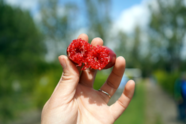
‘UF SunLime’, a hybrid finger lime with unique “citrus caviar” vesicles and are red when mature. Image courtesy of the University of Florida.
|
|
|

USDA APHIS Supports Chronic Wasting Disease Management and Research
USDA’s Animal and Plant Health Inspection Service (APHIS) will provide approximately $12 million for States and Tribal governments, research institutions and universities to control and prevent chronic wasting disease (CWD) in wild and farmed cervids (e.g., deer, elk). To more efficiently and quickly move this work forward this year, APHIS will non-competitively fund the most promising projects to develop new tools or methods and support interested States/Tribes with CWD control programs. Read more about the APHIS CWD program.
Whitetail deer. Image courtesy of Adobe Stock.
|
|
|
SARE Seeks Outreach Products to Advance Sustainable Agriculture
Do you have an idea for an outreach product or project that could help farmers or ranchers improve their profitability, environmental stewardship and/or quality of life? SARE Outreach is seeking recommendations for information products or outreach initiatives that extend research-based innovations to improve the sustainability of American agriculture. Submit your ideas by June 30.
|
|
|
The National Institute of Food and Agriculture (NIFA) is committed to ensuring that its programs and services are accessible to all individuals, including individuals with disabilities and individuals with limited English proficiency. If you need a reasonable accommodation to participate in any NIFA event, please contact the appropriate Program staff no later than 10 days prior to the event. To find Program staff by event, please visit the NIFA Calendar of Events. NIFA Language access services, such as interpretation or translation of vital information, will be provided free of charge to limited English proficient individuals upon request. If you need interpretation or translation services please visit NIFA language services or contact Lois Tuttle, Equal Opportunity Specialist, at Lois.Tuttle@usda.gov or (443) 386-9488 no later than 10 days prior to the event.
NIFA’s mission is to invest in and advance agricultural research, education, and Extension that solves societal challenges. NIFA’s investments in transformative science directly support the long-term prosperity and global preeminence of U.S. agriculture. Keep informed about NIFA, USDA, our Land-grant and non-Land-grant university partners, and stakeholders with the NIFA Update. Read past issues online, sign up for email updates or follow us on X (formerly Twitter) @USDA_NIFA, #NIFAImpacts or LinkedIn @usda-nifa.
If you wish to submit a news item or information, send an email to NIFAUpdate.
USDA is an equal opportunity lender, provider, and employer.
|
|
|
|
|