|
Making a Difference
‘Buzz me in:’ Bees Wearing Itty Bitty QR Codes Reveal Hive Secrets
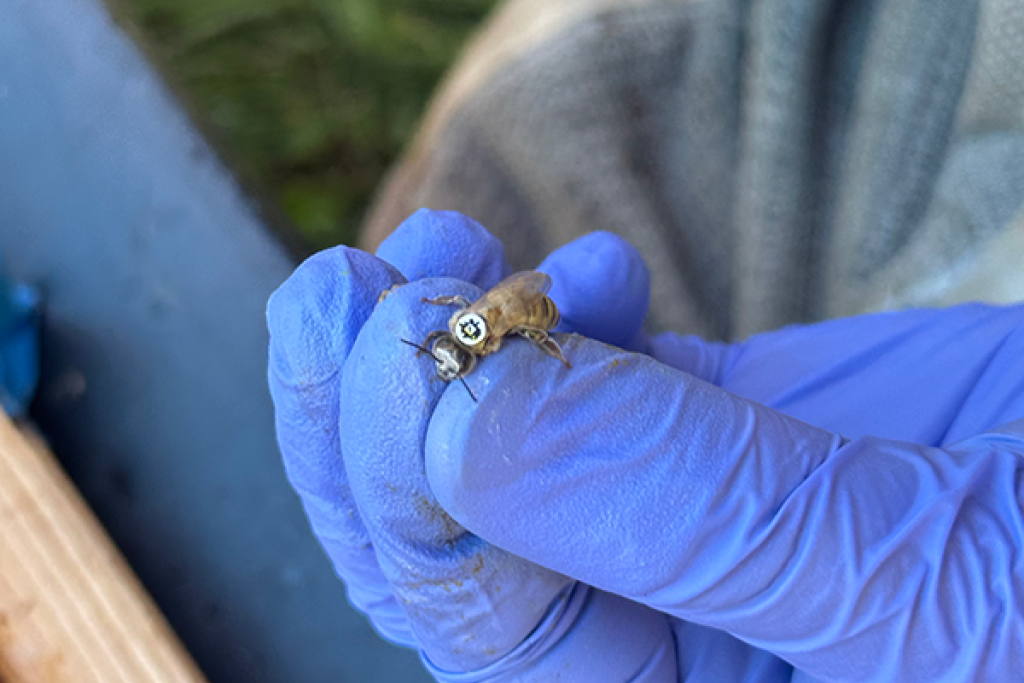
Several hundred bees in rural Pennsylvania and rural New York are sporting tiny QR codes on their backs. The tags let researchers track when bees go in and out of their hives to better understand how long honey bees spend foraging for food outside of their hives.
The work, a collaboration among Penn State entomologists and electrical engineers, is the first step in solving a long-standing mystery of how far bees travel from their hives to collect pollen and nectar. Read more about this research.
QR code on back of honey bee. Courtesy of Penn State.
|
|
NIFA Invests Nearly $1.2 Million in Response to Hurricane Helene
NIFA has funded—through the Rapid Response to Extreme Weather Events Across Food and Agriculture Systems program— four projects that address concerns related to Hurricane Helene. Rapid responses to extreme weather events are critical to maintaining a secure, accessible, safe, nutritious, affordable and abundant food supply. Innovative Extension and applied research efforts are needed to alleviate the impacts of extreme weather and disasters across the food and agricultural system.
The Rapid Response to Extreme Weather Events program, funded through the Agriculture and Food Research Initiative, is designed to rapidly deploy strategies and fill knowledge and information gaps to protect the nation’s food and agricultural supply chains from production through consumption — during and after extreme weather and disasters.
|
|
Engineers Using ‘Digital Twins’ to Improve Agriculture, Health, Manufacturing and More
Iowa State University researchers took weekly videos of millet plants, documenting grown from sprouting to maturity.
With the help of an artificial intelligence tool called NeRF (for neural radiance fields), they converted their 2-D videos into 3-D digital models of the plants. The videos were the beginning of the creation of a digital twin of a millet plant. A digital twin is a virtual construct that mimics the structure, context and behavior of a natural, engineered or social system. Regularly updated with data from its physical twin, a digital twin can help make predictions and inform decisions. Read more about Iowa State’s digital twin research and its potential impact on agriculture and other industries.
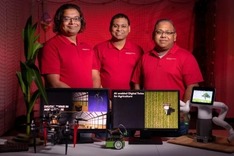
Iowa State engineers, left to right, Baskar Ganapathysubramanian, Adarsh Krishnamurthy and Soumik Sarkar are developing "digital twins" as powerful research tools. Image courtesy of Iowa State.
|
|
|
USDA Researchers Find Viruses from Miticide Resistant Parasitic Mites are Cause of Recent Honey Bee Colony Collapses
Scientists at USDA’s Agricultural Research Service (ARS) are helping American beekeepers solve the mystery behind honey bee colony collapse and its impact on U.S. agriculture. Research findings identified high levels of deformed wing virus A and B and acute bee paralysis in all recently USDA-sampled bees.
These viruses are responsible for recent honey bee colony collapses and losses across the U.S. Since the viruses are known to be spread by parasitic Varroa mites, ARS scientists screened the mites from collapsed colonies and found signs of resistance to amitraz, a critical miticide used widely by beekeepers. This miticide resistance was found in virtually all collected Varroa, underscoring the need for new parasitic treatment strategies. Read more about the ARS research.
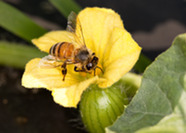
Honey bee landing on a watermelon flower. Image courtesy of USDA ARS.
|
|
|
SARE Seeks Outreach Products to Advance Sustainable Agriculture
Do you have an idea for an outreach product or project that could help farmers or ranchers improve their profitability, environmental stewardship and/or quality of life? Sustainable Agriculture Research and Education (SARE) Outreach is seeking recommendations for information products or outreach initiatives that extend research-based innovations to improve the sustainability of American agriculture. Submit your ideas by June 30.
|
|
|
The National Institute of Food and Agriculture (NIFA) is committed to ensuring that its programs and services are accessible to all individuals, including individuals with disabilities and individuals with limited English proficiency. If you need a reasonable accommodation to participate in any NIFA event, please contact the appropriate Program staff no later than 10 days prior to the event. To find Program staff by event, please visit the NIFA Calendar of Events. NIFA Language access services, such as interpretation or translation of vital information, will be provided free of charge to limited English proficient individuals upon request. If you need interpretation or translation services please visit NIFA language services or contact Lois Tuttle, Equal Opportunity Specialist, at Lois.Tuttle@usda.gov or (443) 386-9488 no later than 10 days prior to the event.
NIFA’s mission is to invest in and advance agricultural research, education, and Extension that solves societal challenges. NIFA’s investments in transformative science directly support the long-term prosperity and global preeminence of U.S. agriculture. Keep informed about NIFA, USDA, our Land-grant and non-Land-grant university partners, and stakeholders with the NIFA Update. Read past issues online, sign up for email updates or follow us on X (formerly Twitter) @USDA_NIFA, #NIFAImpacts or LinkedIn @usda-nifa.
If you wish to submit a news item or information, send an email to NIFAUpdate.
USDA is an equal opportunity lender, provider, and employer.
|
|
|
|