|
Making a Difference
NIFA-Funded Researchers Aim to Boost Herb Production in Controlled Environments
The demand for culinary herbs is growing rapidly in the United States, increasing by up to 10 % annually. However, field production is concentrated in California, Hawaii and Florida, leaving herb availability vulnerable to a variety of challenges. In addition, the nation imports more than $294 million in fresh herbs each year.
However, growing herbs in controlled environments, such as greenhouses and indoor farms, could expand production nationwide, reduce reliance on imports, stabilize the supply and create local jobs.
Funded by USDA’s National Institute of Food and Agriculture through the Specialty Crop Research Initiative, a project led by Michigan State University (MSU) focuses on improving yield, enhancing flavor and aroma, and preventing issues like chilling injuries, diseases and nutritional imbalances, while increasing the shelf-life of herbs.
Read more about how MSU and collaborators from multiple universities led team are developing growing, post-harvest, marketing and food safety best practices for culinary herb production in controlled environments to improve the availability and safety of locally grown fresh-cut and potted herbs.
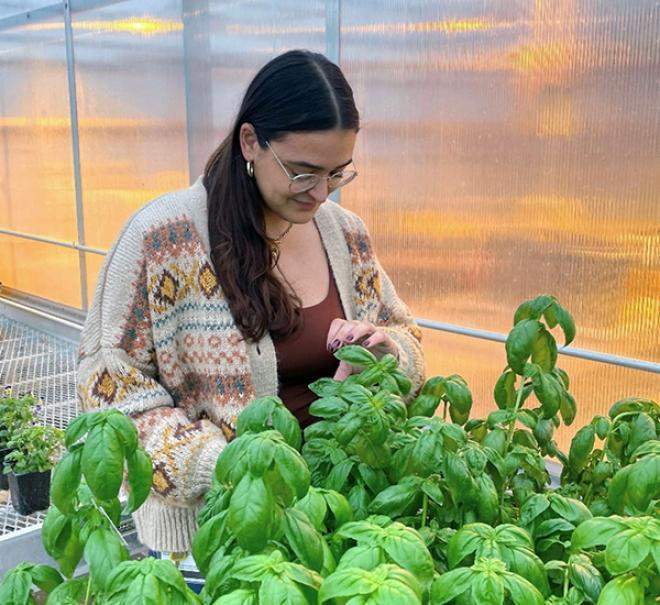
Above: Maddeline Anthony, MSU graduate student, evaluates her basil stock plants that are used for pathogenicity tests. Image courtesy of Ethan Tippett, MSU.
|
|
 NIFA Staff at 2025 NERAOC
NIFA brought key staff to the annual National Extension and Research Administrative Officers Conference (NERAOC) held recently in Reno, NV. More than 500 participants attended the conference which provides a venue for professional development, information sharing and networking to state Cooperative Extension, agInnovation and USDA NIFA staff.
Through the opportunity to share and discuss information related to fiscal, grant (competitive and capacity), administrative, communications and human resources management, NERAOC participants gain important professional development.
|
|
|
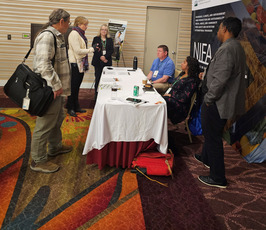
NIFA team assisting grantees at 2025 NERAOC.
|
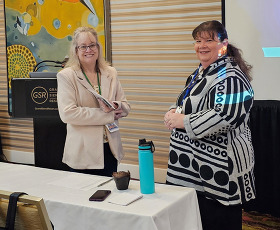 Sheila Zajkowski, left, explaining details of NIFA's financial system to a grantee.
|
|
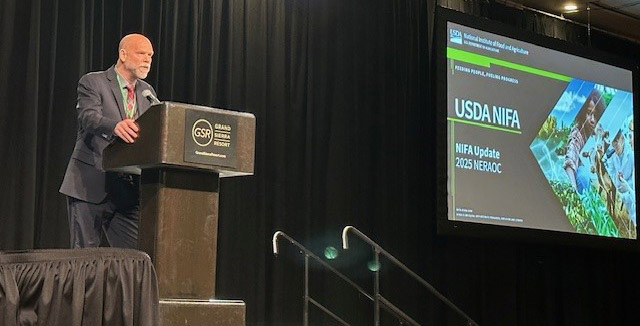 Matt Faulkner, deputy director of the Office of Grants and Financial Management, gives the NIFA Update at 2025 NERAOC.
|
|
Sustainable Wood Preservation Offers Innovative Solutions for Longer-Lasting, Eco-Friendly Materials
Wood is a fundamental element of building and construction. But natural materials have drawbacks. Wood decays over time, and it is susceptible to fire and termites. Researchers at the University of Idaho are working to find environmentally friendly solutions to extend the service life of wood used in construction and reduce carbon emissions from the building sector.
One project is studying how potato peel waste can be used to create wood additives that provide sustainable preservation solutions. Another project is investigating the possibilities for a completely bio-based wood coating that can withstand weathering and is resistant to fungi and termites. Read more about the multiple NIFA-supported projects underway at the University of Idaho.
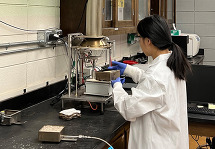
Above: University of Idaho researcher Dr. Lili Cai performing fire test using a mass loss cone calorimeter under a hood. Image courtesy of University of Idaho.
|
|
|
USDA Extends Response Deadline for 2024 Census of Horticultural Specialties
USDA’s National Agricultural Statistics Service will continue to collect the 2024 Census of Horticultural Specialties through April 18. The 2024 Census of Horticultural Specialties data will expand on the 2022 Census of Agriculture data with information on horticultural crop production, value of products, square footage used for growing crops and production expenses.
The 2024 Census of Horticultural Specialties data is scheduled to be available on Dec. 16 at nass.usda.gov/AgCensus and in the Quick Stats database at quickstats.nass.usda.gov.
|
|
|
The National Institute of Food and Agriculture (NIFA) is committed to ensuring that its programs and services are accessible to all individuals, including individuals with disabilities and individuals with limited English proficiency. If you need a reasonable accommodation to participate in any NIFA event, please contact the appropriate Program staff no later than 10 days prior to the event. To find Program staff by event, please visit the NIFA Calendar of Events. NIFA Language access services, such as interpretation or translation of vital information, will be provided free of charge to limited English proficient individuals upon request. If you need interpretation or translation services please visit NIFA language services or contact Lois Tuttle, Equal Opportunity Specialist, at Lois.Tuttle@usda.gov or (443) 386-9488 no later than 10 days prior to the event.
NIFA’s mission is to invest in and advance agricultural research, education, and Extension that solves societal challenges. NIFA’s investments in transformative science directly support the long-term prosperity and global preeminence of U.S. agriculture. Keep informed about NIFA, USDA, our Land-grant and non-Land-grant university partners, and stakeholders with the NIFA Update. Read past issues online, sign up for email updates or follow us on X (formerly Twitter) @USDA_NIFA, #NIFAImpacts or LinkedIn @usda-nifa.
If you wish to submit a news item or information, send an email to NIFAUpdate.
USDA is an equal opportunity lender, provider, and employer.
|
|
|
|
|