|
 USDA Invests $100 Million to Combat Highly Pathogenic Avian Influenza
USDA has announced plans for a funding opportunity to explore prevention, therapeutics, research and potential vaccine candidates to fight highly pathogenic avian influenza (HPAI). USDA will invest up to $100 million in these projects.
Funding is available, through a competitive process, to for-profit organizations, including manufacturers of vaccines, biologics, and therapeutics, states, universities, livestock producer organizations and other eligible entities. USDA will prioritize proposals that address one or more of the following:
- Development of novel therapeutics and improved diagnostics to address HPAI in poultry.
- Research to further understand risk pathways of avian influenza for producers and to inform improved biosecurity and response strategies.
- Development of novel vaccines to protect poultry from HPAI while promoting biosecurity.
The notice of funding opportunity, including application instructions and additional information, is available on the Animal and Plant Health Inspection Service website. Applicants can also find information on the ezFedGrants website or Grants.gov by searching USDA-APHIS-10025-VSSP0000-25-0015. Deadline to apply is May 19.
|
|
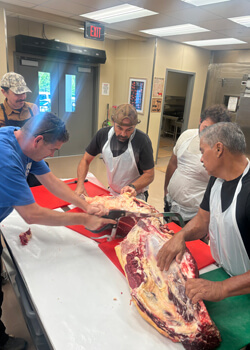
Carving A New Path: Hawai‘i CC’s First Butchery Class Graduates
The inaugural class of Hawaiʻi Community College’s new butchery course—the first program of its kind in the state—graduated in March at the Kō Education Center in Honokaʻa. The groundbreaking course aims to strengthen Hawaiʻi’s local food systems by preparing a new generation of skilled professionals in sustainable meat processing.
The course offers students comprehensive, hands-on training in butchery, including humane slaughter methods, carcass breakdown and meat processing. The curriculum also covers food safety standards, proper meat labeling and animal husbandry, to prepare students for employment in Hawaiʻi’s butchery industry. Two new butchery course cohorts are planned for summer 2025.
Read more about this NIFA-supported program, funded by the Alaska Native and Native Hawaiian-Serving Institutions Education Competitive Grants Program.
Hands on training is critical element of Hawaii Community College Butchery Class. Image courtesy of University of Hawaii.
|
|
|
Reminder: Correctly Acknowledging NIFA Funding
Proper acknowledgment of your USDA NIFA funding in published manuscripts, posters, presentations, press releases and other communications is critical for the success of our agency’s programs. Find acknowledgement guidelines here.
|
|
|
The National Institute of Food and Agriculture (NIFA) is committed to ensuring that its programs and services are accessible to all individuals, including individuals with disabilities and individuals with limited English proficiency. If you need a reasonable accommodation to participate in any NIFA event, please contact the appropriate Program staff no later than 10 days prior to the event. To find Program staff by event, please visit the NIFA Calendar of Events. NIFA Language access services, such as interpretation or translation of vital information, will be provided free of charge to limited English proficient individuals upon request. If you need interpretation or translation services please visit NIFA language services or contact Lois Tuttle, Equal Opportunity Specialist, at Lois.Tuttle@usda.gov or (443) 386-9488 no later than 10 days prior to the event.
NIFA’s mission is to invest in and advance agricultural research, education, and Extension that solves societal challenges. NIFA’s investments in transformative science directly support the long-term prosperity and global preeminence of U.S. agriculture. Keep informed about NIFA, USDA, our Land-grant and non-Land-grant university partners, and stakeholders with the NIFA Update. Read past issues online, sign up for email updates or follow us on X (formerly Twitter) @USDA_NIFA, #NIFAImpacts or LinkedIn @usda-nifa.
If you wish to submit a news item or information, send an email to NIFAUpdate.
USDA is an equal opportunity lender, provider, and employer.
|
|
|
|