|

USDA Assists Farmers, Ranchers and Communities Affected by Weekend Windstorms
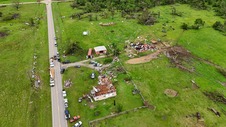
U.S. Secretary of Agriculture Brooke Rollins announced earlier this week that USDA will deliver any assistance it can for communities and agricultural producers affected by the weekend storms that cut a path of devastation through the South and Midwest.
Cooperative Extension, based at Land-grant Universities, serves as a vital conduit for resources and expertise related to preparedness, recovery and mitigation for many types of disasters.
Extension efforts are bolstered by the Extension Disaster Education Network (EDEN). Supported by USDA’s National Institute of Food and Agriculture, EDEN is a collaborative national effort by Extension services across the country to improve the delivery of services to people affected by disasters. EDEN’s mission is to reduce the impact of disasters through research-based Extension education. Additionally, EDEN ensures that Extension can respond to local, state, regional and national education needs during a crisis.
EDEN’s website provides Extension professionals with access to resources on disaster preparedness, recovery, and mitigation to enhance their programming efforts. EDEN also maintains a shared database of disaster-related resources that are available from member states. While it was designed for use by Extension agents and educators, anyone can access these resources.
Stock image of tornado damage courtesy of Adobe Stock.
|
|
|

Southern Land-grant Scientists Team Up to Promote Pollinator Friendly Lawns
Research and Extension faculty at Mississippi State University (MSU), Auburn University and the University of Georgia are working together to promote the adoption of pollinator friendly lawns by consumers. The team is studying the benefits of growing common forbs (herbaceous flowering plants) within Southeastern lawns. The team is also finding new ways to manage turfgrass systems to better support insect pollinators.
Led by MSU Extension Specialist Jay McCurdy, this NIFA-supported project focuses on including habitat for insect visitors in lawns and turf systems. In particular, they are working to identify which flowers are better resources for native pollinators as well as how effective including flowering forbs into lawns could be at improving pollinator populations. Learn more about this multi-state effort.
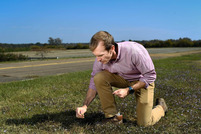
Jay McCurdy examines plants in a refuge lawn. Image courtesy of Grace Cockrell, Mississippi State University.
|
|
|
 USDA Houses Vital Collections of Grape Germplasm
USDA’s collection of grape accessions and cultivars play a significant role in preserving genetic materials for variety development, improved traits and crop protection. USDA has two grape germplasm collections, one in New York and another in California. Learn more about these collections and how researchers can use them.
|
|
 Reminder: Using NIFA’s Official Identifier Correctly
The official NIFA identifier was updated in November 2020 and is comprised of the USDA logo with NIFA signature lockup. Per NIFA regulations and guidelines, it is expected that grantees use NIFA’s official identifier in publications, posters, websites and presentations resulting from their award. The updated official NIFA identifier should be used on all print and digital materials.
|
|
|
The National Institute of Food and Agriculture (NIFA) is committed to ensuring that its programs and services are accessible to all individuals, including individuals with disabilities and individuals with limited English proficiency. If you need a reasonable accommodation to participate in any NIFA event, please contact the appropriate Program staff no later than 10 days prior to the event. To find Program staff by event, please visit the NIFA Calendar of Events. NIFA Language access services, such as interpretation or translation of vital information, will be provided free of charge to limited English proficient individuals upon request. If you need interpretation or translation services please visit NIFA language services or contact Lois Tuttle, Equal Opportunity Specialist, at Lois.Tuttle@usda.gov or (443) 386-9488 no later than 10 days prior to the event.
NIFA’s mission is to invest in and advance agricultural research, education, and Extension that solves societal challenges. NIFA’s investments in transformative science directly support the long-term prosperity and global preeminence of U.S. agriculture. Keep informed about NIFA, USDA, our Land-grant and non-Land-grant university partners, and stakeholders with the NIFA Update. Read past issues online, sign up for email updates or follow us on X (formerly Twitter) @USDA_NIFA, #NIFAImpacts or LinkedIn @usda-nifa.
If you wish to submit a news item or information, send an email to NIFAUpdate.
USDA is an equal opportunity lender, provider, and employer.
|
|
|
|