| |
Making a Difference
Land-grant Programs Strengthen Local Food Systems
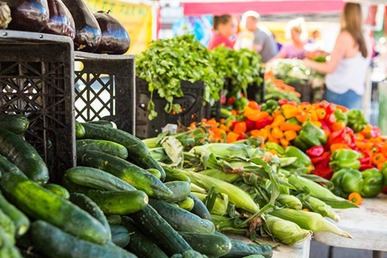
Creating new opportunities for local and regional foods is a crucial element in developing stronger food systems. Supported by NIFA, the Land-grant University System provides important assistance to new farmers just starting out and established farmers looking to expand into new markets. Read more about how Land-grants use NIFA programs to strengthen farmers and local food systems.
Produce at farmer’s market. Image courtesy of Adobe Stock.
|
|
New Grants Training/Technical Assistance Resources
In response to stakeholder recommendations, NIFA has developed a number of new resources for applicants and grantees, especially to assist new and underrepresented applicants to NIFA programs. Visit this one-stop page for most Grants Training/Technical Assistance information. You will find links to recordings of some past events on this page as well, including:
- Multi-day grant support technical assistance workshops.
- Grant applicant/awardee technical assistance sessions.
- Webinars in collaboration with the National Agricultural Library to increase awareness about their resources.
This site also includes a mock panel video to demonstrate how a panel operates, information about volunteering to serve as a panelist, and required training for panel managers and panelists. The Competitive Grants Application Process Overview is a new tool which assists new applicants and those at small organizations to help search and write applications. In addition, the site has information about planned activities and registration information. NIFA is seeking input for additional topics to be included on the website and in future webinars. Your feedback will help NIFA enhance access to its grants programs and improve services for all.
2025 Extension Risk Management Education National Conference
|
The Extension Risk Management Education (ERME) National Conferencewill be held April 1-3, 2025, in Nashville, TN. It will bring together public and private sector educators, crop insurance agents, lenders and other agricultural professionals to share ongoing and emerging successful risk management education efforts for producers and their families.
Proposals for both concurrent sessions and poster presentations will be accepted until Jan. 17, 2025. Proposals should highlight successful and innovative risk management education programming and its impacts. Abstract submission is encouraged from any public or private entity involved in risk management education for agricultural producers, regardless of whether the project was funded through a regional ERME center. Learn more on how to submit a proposal.
NextGen Students Represent the U.S. at G7 Agri-Young Hackathon
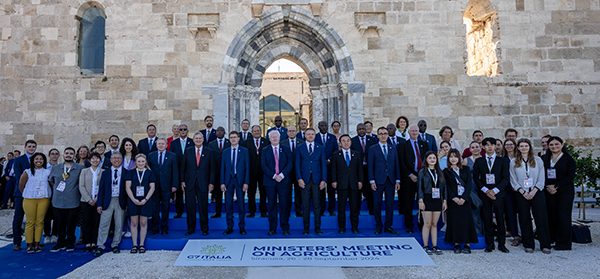
Three college students and one faculty member supported by the USDA National Institute of Food and Agriculture’s (NIFA) NextGen program attended the 2024 G7 Ministers’ Meeting on Agriculture in Italy. The delegation represented the United States and participated in the Agri-Young Hackathon to discuss and propose solutions to world issues in agriculture.
During the Hackathon, the NextGen delegates were assigned to groups with students, young farmers and professors from the G7 countries to engage in discussions and draft policy recommendations on agriculture topics. After discussing their respective issue, each group’s youth delegates presented their conclusions and proposals to the G7 Ministers, including USDA Secretary Tom Vilsack. Read more about the delegation and their experiences at the G7 conference.
|
|
|
|
|
|
|
Participants of the Agri-Young Hackathon with the G7 Ministers of Agriculture, ministers from multiple countries in Africa, and government leaders in Syracuse, Italy. Photo courtesy of G7 Italia.
|
|

How “Thirsty” Trees May Make Forests More Vulnerable to Climate Change
A new study done by North Carolina State University (NCSU) suggests that increased maple populations may leave forests in western North Carolina more vulnerable to extreme weather conditions like flooding and drought.
The southern Appalachian Mountains feature large, intact forests with frequent precipitation. This kind of area would not typically be a place to look for the effects of climate change, but the emergence of more “thirsty” trees like maples shifts that dynamic. Maples are an example of “diffuse-porous” trees, which require more water to grow than “ring-porous” trees like oaks.
NCSU scientists modeled these effects in future scenarios including both low and heavy rainfall. In both dry and wet future climate projections, the model predicted that forests with more diffuse-porous trees would have more water loss and less streamflow, as well as a decreased ability to sequester carbon through photosynthesis.
Previous models did not account for the different water needs of various tree species leading to a potential underestimation of the threat posed by climate change in areas with increasing diffuse-porous tree populations. Read more about this NIFA-supported work.
Great Smoky Mountains National Park. Image courtesy of Adobe Stock.
|
|
|

USDA Seeking Public Comment on 2025 Dietary Guidelines Advisory Committee’s Newly Released Report
The 2025 Dietary Guidelines Advisory Committee’s Scientific Report is now available on DietaryGuidelines.gov. The report contains the Committee’s independent, evidence-based findings and advice to the U.S. Department of Health and Human Services (HHS) and the USDA.
USDA and HHS have opened a 60-day public comment period and encourage the public to provide written comments on the Committee’s Scientific Report. The departments will also hold a public meeting on Jan. 16, 2025, to listen to oral comments from the public on the Scientific Report. Pre-registration is required for the public meeting. More information on the public meeting and comment period is available on DietaryGuidelines.gov.
National Academies Seeking Feedback on Study to Aid USDA in Addressing PFAS in Agriculture
The National Academies of Sciences, Engineering and Medicine are launching a study to assist the U.S. Department of Agriculture in building a framework for addressing the presence of perfluoroalkyl and polyfluoroalkyl substances (PFAS) on agricultural land. The study will guide the efforts of programs within the USDA’s Farm Production and Conservation mission area that directly deal with conservation on the land.
Comments related to the project, as well as on committee composition, will be accepted through January 5, 2025. Visit the study webpage for more information and to provide feedback.
|
|

Save the Date for 2025 NERAOC
The 2025 National Extension and Research Administrative Officers Conference (NERAOC) will be March 31-April 3, 2025, in Reno, NV. NIFA staff will partner with Land-grant Colleges and Universities to share and exchange current best practices, discuss policy, obtain definitive interpretation of regulations, and discuss future issues. Registration will open in January 2025.
|
|
NIFA Update Returns Jan. 8, 2025
|
|
|
The National Institute of Food and Agriculture (NIFA) is committed to ensuring that its programs and services are accessible to all individuals, including individuals with disabilities and individuals with limited English proficiency. If you need a reasonable accommodation to participate in any NIFA event, please contact the appropriate Program staff no later than 10 days prior to the event. To find Program staff by event, please visit the NIFA Calendar of Events. NIFA Language access services, such as interpretation or translation of vital information, will be provided free of charge to limited English proficient individuals upon request. If you need interpretation or translation services please visit NIFA language services or contact Lois Tuttle, Equal Opportunity Specialist, at Lois.Tuttle@usda.gov or (443) 386-9488 no later than 10 days prior to the event.
NIFA’s mission is to invest in and advance agricultural research, education, and Extension that solves societal challenges. NIFA’s investments in transformative science directly support the long-term prosperity and global preeminence of U.S. agriculture. Keep informed about NIFA, USDA, our Land-grant and non-Land-grant university partners, and stakeholders with the NIFA Update. Read past issues online, sign up for email updates or follow us on X (formerly Twitter) @USDA_NIFA, #NIFAImpacts or LinkedIn @usda-nifa.
If you wish to submit a news item or information, send an email to NIFAUpdate.
USDA is an equal opportunity lender, provider, and employer.
|
|
|
|
|