|
Having trouble viewing this email? View it as a Web page.

|
|
|
Fresh from the
Field is a weekly album showcasing transformative impacts made by
partners supported by the National Institute of Food and Agriculture.
Editor: Falita Liles
March 29, 2018
|
|
Success Stories

Nanocellulose Effects on Human
Food Digestion and Health
A team of scientists is
conducting studies that will shed light on ways nanotechnology can impact human
health. The team is led by University of Georgia (UGA) food engineer
Fanbin Kong, who is studying the safety of nanocellulose and how it affects
humans’ food digestion and nutrient absorption. Nanocellulose is a light, solid
substance obtained from plant matter, generally wood pulp. It has unique
physical chemical properties and can be used in the food industry as a
stabilizing agent, a functional food ingredient, and in food packaging
production. Scientists know the benefits of nanocellulose, but they don’t know
how it behaves in the digestive system once it’s ingested. Kong developed
models of the human stomach and intestine that realistically demonstrate the
way food breaks down in the human body. These models help test the
effectiveness of functional foods and develop new foods aimed at helping those
with specific health issues. This project will fill the knowledge gap about the
behavior of nanocellulose during digestion and reveal any toxic effects.
NIFA supports this project through the Agriculture and Food Research Initiative.
Read the full
story at College News at UGA. Photo of Fanbin Kong by UGA.
|
News Coverage
Swine Vaccine May Benefit Humans
Scientists
at the University of Minnesota have discovered that a single swine
vaccine can control both a problematic swine pathogen Lawsonia intracellularis (L.
intracellularis) and a harmful human pathogen Salmonella. L. intracellularis causes a disease
called “proliferative enteropathy” in swine, characterized by decreased weight
post-weaning and diarrhea. Salmonella is linked to over a million human cases
of illness in the United States, of which about 10 percent are associated with
pork and pork products.
A new study suggests that the vaccination against Lawsonia reduced shedding of Salmonella. It
is unclear why this occurs. It is almost certain that the anti-Lawsonia
vaccine is not directly responsible for the reduced shedding of Salmonella,
however, the vaccine did change the composition of the gut microbiome. The
scientists hypothesize that these changes in the microbiome composition led to
a reduction in Salmonella. While vaccines that target Salmonella directly
are available on the market, this approach offers certain advantages:
microbiome manipulations with anti-Lawsonia vaccine can protect against a
diversity of Salmonella strains and is a cost-effective practice that is
already in place on many farms. This study again confirms a well-established
notion that vaccines are an effective way to control most pathogens, with some
vaccines offering unexpected "two-for-one" benefits.
NIFA supports this project
through the Agriculture and Food Research Initiative.
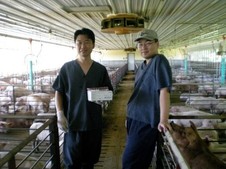
Read the Scientific Reports article. Photo credit: UMN. Graduate students Hyenn Bum Kim (left) and Kwang Soo Lyoo
(right).
|
The Library
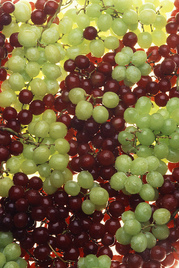 Improving Fine Wine Grapes
Grapes are the
highest-value fruit crop grown in the United States and researchers at Virginia
Polytechnic Institute and State University, University of Maryland,
and other land-grant universities are evaluating and improving grapes across
the United States. Over 70 percent of the grapes grown are used in wine. As
wine grape production expands to new areas in the country, growers need grape
varieties suited to their specific growing conditions. Wine producers are also
interested in new varieties they can use to create new wines and expand sales.
NIFA supports this research through the Multistate Research Fund.
Read
the full article here. USDA photo.
|
Video
 Gardening with Class
Dave Berger, teacher at
Crossroads School and Vocational Center in St. Francis, Minnesota and an extension
volunteer Master Gardener, advances his students quest to learn in a schoolyard
garden that serves as an outdoor living laboratory. The students at Crossroads
have significant challenges, but their story has a lot of heart and the
schoolyard gardens feed families in need. Master Gardeners help Minnesota
students grow and donate 13,000 pounds of vegetables to food shelves in a
single season.
NIFA funds this program
through the Smith-Lever Act Capacity Grant.
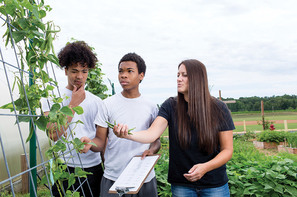
Watch the University of Minnesota Extension video. Photo
credit: UMN. Rachel Beehler, extension Master Gardener volunteer.
|
Tweet of the Week
#NIFAIMPACTS
|
|

NIFA’s mission is to invest in and advance agricultural research, education, and extension that solve societal challenges. NIFA’s investments in transformative science directly support the long-term prosperity and global preeminence of U.S. agriculture. To learn more about NIFA’s impact on agricultural sciences, visit www.nifa.usda.gov/Impacts, sign up for email updates or follow us on Twitter @USDA_NIFA, #NIFAImpacts.
USDA is an equal opportunity lender, provider, and employer.
|
|



