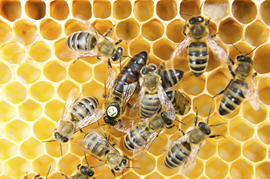
 September is National
Honey Month and you can’t have honey without honey bees. There are direct
links between the health of American agriculture and the health of bees and
other pollinators.
Pollination is critical to the production of fruits,
vegetables, and nuts, which are important parts of a healthy diet. Pollination
by managed honey bee colonies adds at least $15 billion to the
value of U.S. agriculture annually through increased yields and
superior-quality harvests.
Since 2006, honey bee colonies worldwide have experienced historically
high and unexpected losses caused by colony collapse disorder (CCD). CCD and other stressors, such as parasitic mites,
diseases, and transport, hinder commercial beekeepers’ ability to meet U.S.
agriculture’s pollination demands.
In response to recent declines in pollinator populations,
the White House launched an
initiative to protect pollinator health. As part of this initiative, the
USDA National Institute of Food and Agriculture (NIFA) supports pollinator
health research, education, and extension through its Agriculture and Food
Research Initiative (AFRI), Crop Protection and Pest Management Program, and
the Specialty Crop Research Initiative (SCRI).
Emory
University research suggests that modern beekeeping practices may foster virulent
strains of deadly parasitic mites and related diseases. The research
hypothesizes that there is a direct relationship between the transmission rate
and incidence of more virulent strains of Varroa mites. To test this
hypothesis, researchers are tracking the movements of different mite lineages,
in managed and feral colonies, and evaluating colony health. The results of
this research have the potential to help beekeepers protect colonies from mites
and diseases and produce healthy honeybees.
A North
Carolina State University project found that urban environments increase
pathogen abundance in honey bees and reduce honey bee survival. Researchers
selected 15 feral colonies in trees or buildings, and 24 colonies managed by
beekeepers in urban, suburban, and rural areas. The researchers analyzed the
bee colonies to quantify the amount and variety of pathogens (pathogen
pressure) present and the bees' immune response. The research team found that
colonies closer to urban areas experienced greater pathogen pressure. In
subsequent lab experiments, bees from urban environments - whether feral or
managed - were three times less likely to survive similar pathogen pressure
than rural bees. The results of this study may help develop approaches to
protect honey bee health.
NIFA-supported research and outreach efforts, such as the Bee Health eXtension
Community of Practice, also provide growers and producers with information on
pollination, pollinators, and management practices that will continue to keep
these crops and honey yields productive
For more NIFA impacts, visit nifa.usda.gov/impacts or
the Land-Grant
University Impacts website. Send us your NIFA-funded impacts at impactstories@nifa.usda.gov or
share them with USDA_NIFA on
Twitter #NIFAimpacts.
NIFA invests in, and advances agricultural research, education,
and extension and seeks to make transformative discoveries that solve societal
challenges.
| 



