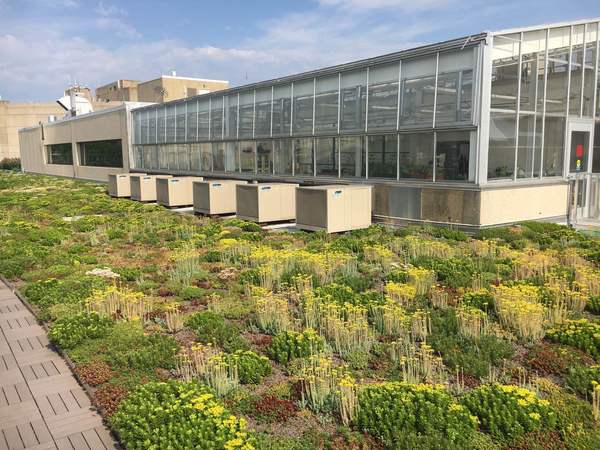
 A garden in the sky. That’s the best way to describe the Green
Roof, a rooftop garden at the University of the District of Columbia (UDC), the
nation’s only urban land grant university. This living laboratory is one of the
latest features at UDC’s College of Agriculture, Urban Sustainability and
Environmental Sciences (CAUSES), which is also home to The Center for 4-H &
Youth Development. 4-H is the nation’s premiere youth development
program, managed by National Institute of Food and Agriculture (NIFA).
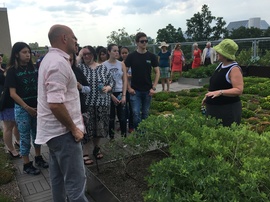
UDC 4-H students were
among the Green Roof guests at an event to highlight National Pollinator Week and the White House Pollinator Health Initiative, a
multi-agency partnership to promote pollinator health, reduce honey bee colony
loss, and restore pollinator habitat.
The event’s special guest
was Dr. Ann Bartuska, Deputy Under
Secretary for Research, Education, and Economics, USDA. Bartuska addressed the
importance of pollinators and food security.
“As part of the
White House Pollinator Health Initiative, the USDA is investing in pollinator
health through its Research, Education, and Economics mission area. Between FY
2008 and 2014, NIFA invested
approximately $40 million in pollinator health research and education,” said
Bartuska.
Bartuska was joined by Dr. Thomas Bewick, National Program
Leader, Division of Plant Systems-Production, National Institute of Food and
Agriculture, USDA, and UDC CAUSES Director Dwane Jones. Sandy Farber Bandier,
UDC Green Roof Master Gardner Coordinator and UDC extension agent, led the tour
of the 40,000 square foot oasis filled with a variety of insect-pollinated
crops such as strawberries, cherries, apples, and peaches.
“This is the nation’s only
urban agricultural garden,” Farber noted, as she explained importance of the
green roof, and the pollinator’s role in helping provide nutritious food for
the community. She also noted that the creation of this pollinator garden
jump-started reliable fruit production at UDC. As a sweet finale, beekeepers
from Capital Bee CARE brought an exhibit hive of honey bees, and guests sampled
locally produced honey from neighborhoods in Washington, DC and Northern
Virginia.
From a rooftop garden in
Washington, DC, to farmlands across the country, pollinator health is a
critical issue for the nation’s economy, food security, and environmental
health.
According to USDA’s Natural Resource Conservation Service, there
are approximately 1,000 plants grown, worldwide, for food, beverages, spices and
medicine that depend on pollinators. Honey bees alone are responsible for
pollinating $15 billion worth of vegetable and fruit crops, making them
critical to the nation’s economy, food security, and environmental health.
Along with honey bees,
other pollinators include bats, butterflies, birds, native bees, and other
insects. They all play a vital role in the production of healthy crops for
food, fiber and other agricultural uses. Without them, our diets would be
less diverse. Recently, the National Agricultural Statistics Service (NASS)
released a survey that reported an eight percent drop in
honey bee colonies from the previous year. Declining numbers are linked to
multiple stressors, such as pests, disease, reduced habitat, nutrition, and
pesticides.
NIFA is addressing those
concerns through various research, education, and extension projects. The Integrated Pest Management program at Lincoln
University teaches local farmers effective and environmentally friendly methods
to control pests and minimize pesticide use. Scientists at the University of
Nevada recently completed a trial study on American foulbrood disease, a rampant, serious
bacterial disease that affects honeybees.
For more NIFA impacts,
visit nifa.usda.gov/impacts or the Land-Grant University Impacts website. Send us
your NIFA-funded impacts at impactstories@nifa.usda.gov or share them with
USDA_NIFA on Twitter #NIFAimpacts.
|