New York FSA Updates - October 16, 2026
In This Issue:

The U.S. Department of Agriculture’s (USDA) Farm Service Agency (FSA) is delivering approximately $89 million in farm safety net and conservation program payments to New York farmers, ranchers and landowners. USDA recently announced nationwide historic safety net assistance totaling $13.8 billion in gross payments through the Agriculture Risk Coverage (ARC) and Price Loss Coverage (PLC) programs for the 2025 crop year and an additional $1.8 billion in Conservation Reserve Program (CRP) annual payments for 2026.
“These dollars help producers and landowners in our state cover operating expenses, purchase supplies and equipment, and do business with local companies, creating a positive economic ripple effect throughout our rural communities,” said Clark Putman, State Executive Director in New York. “It's a tremendous investment in New York agriculture and, collectively, in American agriculture.”
ARC and PLC Working Families Tax Cuts Act Improvements
The Working Families Tax Cuts Act (WFTCA) strengthens ARC and PLC beginning with the 2025 crop year, including higher statutory reference prices and improvements to the effective reference price calculation. Additionally, for the 2025 crop year only, producers automatically receive the higher payment rate of either ARC or PLC, regardless of their program election. The WFTCA also increases the ARC and PLC payment limit from $125,000 to $155,000, starting with the 2025 crop year with annual adjustments based on inflation. The payment limit for the 2025 crop year is $160,000.
The following six crops in New York triggered a PLC payment for the 2025 crop year: barley, corn, grain sorghum, oats, soybeans and wheat.
Producers receiving ARC and PLC payments are reminded that this does not account for payment limitation reductions and the 5.7% sequestration rate required by statute that will be applied to all ARC and PLC payments. ARC-County (ARC-CO) payments are based on county-level revenue and therefore trigger at the county level. FSA will issue payments to eligible producers as calculations are completed.
Also, the ARC and PLC election and enrollment period for the 2026 crop year opened Sept. 16 and runs through Dec. 11, 2026, and for the 2027 crop year from Nov. 2, 2026, through March 15, 2027. The WFTCA added an additional 30 million new base acres to farms nationwide. Because eligible acres exceeded the nationwide 30-million-acre cap, FSA applied an across-the- board, prorated reduction of 3.69% to all newly allocated base acres. In New York, over 599,000 additional base acres were added. These additional base acres impact ARC and PLC starting with the 2026 and future crop years, further improving the farm safety net.
Through annual election and enrollment on covered commodities, ARC and PLC protect producers from substantial declines in crop prices or revenues. PLC provides income support when the effective price for a covered commodity falls below its effective reference price. ARC provides income support when actual crop revenue falls below a guaranteed level. Depending on the coverage elected, ARC protection is based on either county-level revenue or the revenue of an individual farm.
Producers with questions about ARC or PLC enrollment or 2025 crop year payments should contact their local FSA county office.
CRP Acres and Impact
CRP payments to agricultural producers and private landowners for 2026 cover 12,425 acres currently under active CRP contracts in New York. These annual rental payments are made to eligible landowners who establish long-term, resource-conserving vegetative covers. CRP payments support participating landowners while protecting natural resources, enhancing wildlife habitat and strengthening rural economies.
Grassland CRP continues to play an important role in working lands conservation. Following 2026 enrollment, Grassland CRP is expected to account for more than 40% of all CRP enrolled acreage nationwide including 3,107 acres in New York, helping ranchers conserve valuable grasslands while maintaining livestock grazing and haying operations.
Questions about participation in CRP and 2026 annual rental payments should be directed to the local FSA county office.
|
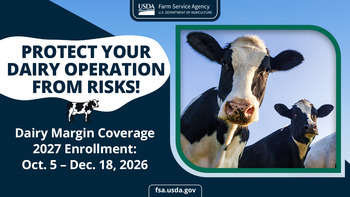
USDA announced that dairy producers starting next Monday can enroll for 2027 Dairy Margin Coverage (DMC), a voluntary risk management program that was recently strengthened by the Working Families Tax Cuts Act with greater risk protection for dairy producers. DMC enrollment for 2027 starts Oct. 5 and runs through Dec. 18, 2026.
DMC provides financial protection when the difference between the national all-milk price and average feed cost falls below a producer-selected coverage level.
The Working Families Tax Cut Act reauthorized DMC through 2031 and strengthened the program to provide dairy producers with greater risk protection. These improvements took effect beginning with the 2026 program year and expanded the amount of production eligible for Tier 1 protection from five to six million pounds, updated production histories to better reflect current dairy operations, and provided producers with an opportunity to secure coverage through 2031 at a 25% reduced premium cost.
By protecting against periods of tighter margins, DMC provides an additional measure of financial stability and helps producers manage cash flow when milk prices, feed costs or a combination of the two put pressure on their operations. DMC payments trigger when the national dairy margin falls below a participating operation’s selected coverage level.
2027 Enrollment
Producers can select DMC coverage levels ranging from $4.00 to $9.50 per hundredweight. DMC includes a catastrophic level of coverage available at no premium cost, although an annual $100 administrative fee generally applies. Producers may also purchase higher levels of coverage to provide additional protection against declining margins.
Dairy producers should evaluate their operation’s risk management needs when selecting a coverage level. USDA provides an online dairy decision tool. Producers should contact their local FSA county office to enroll in DMC for the 2027 program year.
Producers who previously elected the multi-year DMC option for 2026 through 2031 are reminded that they must still certify to commercially market milk, sign a DMC contract, and pay the $100 administrative fee for each program year to maintain coverage. These producers will continue at the coverage level and percentage selected under their multi-year election and receive the 25% premium discount.
For more information about DMC, including current program information and DMC margins, dairy producers can visit fsa.usda.gov/dmc or contact their local FSA county office.
|

USDA Farm Service Agency (FSA) reminds producers of approaching application deadlines for purchasing risk coverage for some crops through the Noninsured Crop Disaster Assistance Program (NAP). NAP provides financial assistance to producers of non-insurable crops impacted by natural disasters that result in lower yields, crop losses, or prevented crop planting.
NAP covers losses from natural disasters on crops for which no permanent federal crop insurance program is available, including forage and grazing crops, fruits, vegetables, floriculture, ornamental nursery, aquaculture, turf grass and more.
Upcoming application deadlines for NAP coverage in New York for the 2027 production season include:
-
November 20: perennial fruits & nuts, strawberries, asparagus, ginger, horseradish, and rhubarb
-
December 31: Honey & Maple Sap
NAP basic coverage is available at 55% of the average market price for crop losses that exceed 50% of expected production. Buy-up coverage is available in some cases. NAP offers higher levels of coverage, ranging from 50% to 65% of expected production in 5% increments, at 100% of the average market price. Producers of organic crops and crops marketed directly to consumers also may exercise the “buy-up” option to obtain NAP coverage of 100% of the average market price at coverage levels ranging between 50% and 65% of expected production. Buy-up coverage is not available for crops intended for grazing.
For all coverage levels, the NAP service fee is the lesser of $325 per crop or $825 per producer per county, not to exceed a total of $1,950 for a producer with farming interests in multiple counties. Premiums apply for buy-up coverage.
If a producer has a Socially Disadvantaged, Limited Resource, Beginning and Veteran Farmer or Rancher Certification (form CCC-860) on file with FSA, it may serve as an application for basic coverage for all eligible crops. These producers will have all NAP-related service fees for basic coverage waived. These producers may also receive a 50% premium reduction if higher levels of coverage are elected on form CCC-471, prior to the application closing date for each crop.
To learn more about NAP visit fsa.usda.gov/nap or contact your local USDA Service Center.
|
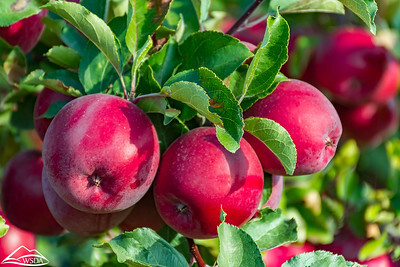
The U.S. Department of Agriculture’s (USDA) Risk Management Agency (RMA) announced that beginning with the 2027 crop year, New York apple growers will be able to insure their fresh apples as individual varieties on their insurance policy rather than the varietal groupings available in previous crop years. This change also allows growers to elect optional units for the individual varieties listed as types.
The individual varieties listed as types in New York include: Acey Mac/Spartan, Cortland, Empire, Envy/Scilate, EverCrisp, Fuji, Gala, Ginger Gold, Golden Delicious, Honeycrisp, Macoun, McIntosh, Paula Red, Pink Lady/Cripps Pink, Red Delicious, Rome, RubyFrost/NY2, SnapDragon/NY1, SweeTango/Minneiska and WildTwist/R10-45. An “All Other Varieties (Fresh)” type will be available for growers who produce any varieties not already included in this list. For growers who choose not to insure at the variety level, a general “Fresh” type remains an option.
RMA partnered with New York apple industry to identify varieties that could be added as individual types and with improved price elections.
New York growers looking to purchase coverage or update their current policy to reflect the new available varieties should contact a crop insurance agent before Nov. 20, 2026, the sales closing date for the 2027 crop year.
|
FSA and NRCS program applicants for benefits are required to submit a completed CCC-902 Farming Operation Plan and CCC-941 Average Gross Income (AGI) Certification and Consent to Disclosure of Tax Information for FSA to determine the applicant’s payment eligibility and establish the maximum payment limitation applicable to the program applicant.
Participants are not required to annually submit new CCC-902s for payment eligibility and payment limitation purposes unless a change in the farming operation occurs that may affect the previous determination of record. A valid CCC-902 filed by the participant is considered to be a continuous certification used for all payment eligibility and payment limitation determinations applicable for the program benefits requested.
Participants are responsible for ensuring that all CCC-902 and CCC-941 and related forms on file in the county office are updated, current, and correct. Participants are required to timely notify the county office of any changes in the farming operation that may affect the previous determination of record by filing a new or updated CCC-902 as applicable.
Changes that may require a new determination include, but are not limited to, a change of:
- Shares of a contract, which may reflect:
- A land lease from cash rent to share rent
- A land lease from share rent to cash rent (subject to the cash rent tenant rule
- A modification of a variable/fixed bushel-rent arrangement
- The size of the producer’s farming operation by the addition or reduction of cropland that may affect the application of a cropland factor
- The structure of the farming operation, including any change to a member's share
- The contribution of farm inputs of capital, land, equipment, active personal labor, and/or active personal management
- Farming interests not previously disclosed on CCC-902 including the farming interests of a spouse or minor child
- Certifications of average AGI are required to be filed annually for participation in an annual USDA program. For multi-year conservation contracts and NRCS easements, a certification of AGI must be filed prior to approval of the contract or easement and is applicable for the duration of the contract period.
Participants are encouraged to file or review these forms within the deadlines established for each applicable program for which program benefits are being requested.
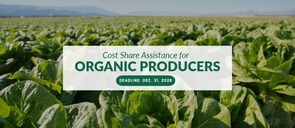
The U.S. Department of Agriculture (USDA) is helping organic producers and handlers cover certification costs as part of the Department’s effort to put Farmers First and Make America Healthy Again. USDA’s Farm Service Agency (FSA) is accepting applications to help with organic certification costs for the 2025 and 2026 program years through the Organic Certification Cost Share Program (OCCSP), which covers up to 75% of eligible organic certification costs. Producers and handlers must apply by Dec. 31, 2026, for both program years.
Cost Share Assistance
OCCSP provides cost share assistance to producers and handlers for the costs of obtaining or maintaining organic certification under the National Organic Program, which is administered by USDA’s Agricultural Marketing Service. Producers and handlers are eligible to receive 75% of the costs, up to $750 for each of the following scopes: crops, wild crops, livestock, processing/handling and state organic program fees.
FSA will make payments as applications are received on a first-come, first-served basis until available funds are depleted.
Eligibility
To be eligible for OCCSP, a producer or handler must have their USDA organic certification for the applicable program year at the time of application and must have paid fees or expenses related to the initial certification or renewal from a certifying agent during the program year. For program year 2025, they must have possessed a USDA organic certification at any time during the program year.
There are four USDA organic regulation recognized scopes that must be individually inspected and certified: crops, livestock, wild crops, and handling. The scopes must be listed on the producer or handler’s organic certificate to be eligible for OCCSP. Eligible costs include:
- Application and administrative fees for USDA organic certification
- Inspection fees for USDA organic certification, including travel and per diem costs for organic inspectors
- USDA organic certification costs, including fees necessary to access international markets with which AMS has equivalency agreements or arrangements
- State organic program fees
- User and sale assessment fees for USDA organic certification
- Postage costs for materials related to obtaining or renewing USDA organic certification.
How to Apply
To apply, producers and handlers should contact their local FSA county office. As part of completing the OCCSP application, producers and handlers will need to provide documentation of their organic certification and eligible expenses.
Organic producers and handlers may also apply for OCCSP through participating state agencies.
|
The U.S. Department of Agriculture’s (USDA) updates to the Farm Service Agency’s (FSA) Farm Loan Programs are officially in effect. These changes, part of the Enhancing Program Access and Delivery for Farm Loans rule, are designed to increase financial flexibility for agricultural producers, allowing them to grow their operations, boost profitability, and build long-term savings.
These program updates reflect USDA’s ongoing commitment to supporting the financial success and resilience of farmers and ranchers nationwide, offering critical tools to help borrowers manage their finances more effectively.
What the new rules mean for you:
- Low-interest installment set-aside program: Financially distressed borrowers can now defer up to one annual loan payment at a reduced interest rate. This simplified option helps ease financial pressure while keeping farming operations running smoothly.
- Flexible repayment terms: New repayment options give borrowers the ability to increase their cash flow and build working capital reserves, allowing for long-term financial planning that includes saving for retirement, education, and other future needs.
- Reduced collateral requirements: FSA has lowered the amount of additional loan security needed for direct farm loans, making it easier for borrowers to leverage their existing equity without putting their personal residence at risk.
These new rules provide more financial freedom to borrowers. By giving farmers and ranchers better tools to manage their operations, we’re helping them build long-term financial stability. It’s all about making sure they can keep their land, grow their business, and invest in the future.
If you’re an FSA borrower or considering applying for a loan, now is the time to take advantage of these new policies. We encourage you to reach out to your local FSA farm loan staff to ensure you fully understand the wide range of loan making and servicing options available to assist with starting, expanding, or maintaining your agricultural operation.
To conduct business with FSA, please contact your local FSA county office.
|

Marketing Assistance Loans (MALs) and Loan Deficiency Payments (LDPs) provide financing and marketing assistance for wheat, feed grains, soybeans, and other oilseeds, pulse crops, wool and honey. MALs provide you with interim financing after harvest to help you meet cash flow needs without having to sell your commodities when market prices are typically at harvest-time lows. A producer who is eligible to obtain a loan, but agrees to forgo the loan, may obtain an LDP if such a payment is available.
FSA is now accepting requests for 2026 MALs and LDPs for all eligible commodities after harvest. Requests for loans and LDPs shall be made on or before the final availability date for the respective commodities.
Commodity certificates are available to loan holders who have outstanding nonrecourse loans for wheat, feed grains, pulse crops (dry peas, lentils, large and small chickpeas), wool, soybeans and designated minor oilseeds. These certificates can be purchased at the posted county price (or adjusted world price or national posted price) for the quantity of commodity under loan, and must be immediately exchanged for the collateral, satisfying the loan. MALs redeemed with commodity certificates are not subject to Adjusted Gross Income provisions.
To be considered eligible for an LDP, you must have form CCC-633EZ, Page 1 on file at your local FSA Office before losing beneficial interest in the crop. Pages 2, 3 or 4 of the form must be submitted when payment is requested.
Marketing loan gains (MLGs) and loan deficiency payments (LDPs) are no longer subject to payment limitations, actively engaged in farming and cash-rent tenant rules.
Adjusted Gross Income (AGI) provisions state that if your total applicable three-year average AGI exceeds $900,000, then you’re not eligible to receive an MLG or LDP. You must have a valid CCC-941 on file to earn a market gain of LDP. The AGI does not apply to MALs redeemed with commodity certificate exchange.
For more information and additional eligibility requirements, contact your local USDA Service Center or visit fsa.usda.gov.
|
A farmers.gov account provides self-service opportunities to Farm Service Agency (FSA) and Natural Resources Conservation Service (NRCS) customers through a secure, authenticated access process.
A new feature now provides access to your current or prior year FSA-578, Report of Commodities (Nationwide Producer Print). Your FSA-578 contains annual crop acreage reporting information submitted to USDA’s Farm Service Agency (FSA). If you are a shareholder (operator, owner or other producer) for a crop on the acreage report, you will be able to view, save and/or print your selected annual FSA-578.
How to Access Your FSA-578’s
From the Land tab in your farmers.gov account, click Land Overview on the navigation drop-down. On the Land Overview page, you will see an information block that states “View and Print Your Acreage Reports” containing a View Your FSA-578 button.
Clicking the button will open a popup modal with a drop-down menu to select the acreage report year. Once you have selected a year, the View FSA-578 button becomes active. Clicking the button will open a new tab with a message indicating the PDF file is being loaded. Once the load is complete, the FSA-578, Report of Commodities (Nationwide Producer Print) PDF document is displayed. You can view, save and/or print the FSA-578 as needed.
If there is no acreage report information on file for the selected acreage report year, the PDF will display the message, “This producer does not have a producer print currently available.”
How to Access FSA-578s Using Your Representative Authority to Act on Behalf of Another Customer
Additionally, if you have been granted the authority to act on behalf of another individual or entity, you can use the yellow banner to “Switch Profile” and view the current or prior year FSA-578, Report of Commodities (Nationwide Producer Print) for the customer you on whose behalf you have been elected to act.
Contact your local FSA office for more information or questions regarding your FSA-578, Report of Commodities (Nationwide Producer Print) or if you have questions regarding establishing representative authority or do not see the expected representative authority options when you log in.
More information can be found in the farmers.gov Fact Sheet and video tutorials. Visit the farmers.gov Account page to log in or learn how to create an account.
FSA guaranteed loans allow lenders to provide agricultural credit to farmers who do not meet the lender's normal underwriting criteria. Farmers and ranchers apply for a guaranteed loan through a lender and the lender arranges for the guarantee. FSA can guarantee up to 95 percent of the loss of principal and interest on a loan. Guaranteed loans can be used for both farm ownership and operating purposes.
Guaranteed farm ownership loans can be used to purchase farmland, construct or repair buildings, develop farmland to promote soil and water conservation or to refinance debt.
Guaranteed operating loans can be used to purchase livestock, farm equipment, feed, seed, fuel, farm chemicals, insurance and other operating expenses.
FSA can guarantee farm ownership and operating loans up to $2,558,000. Repayment terms vary depending on the type of loan, collateral and the producer's ability to repay the loan. Generally, operating loans are set to a term between one and seven years and farm ownership loans between 20 and 40 years.
For more information on guaranteed loans, contact your local USDA Farm Loan team or visit fsa.usda.gov.
Top of page
Farm Service Agency
New York State Office
441 S. Salina St.
Syracuse, NY 13202
Ph: 315-477-6300
http://www.fsa.usda.gov/ny
Click to find your local FSA office.
|
|
State Executive Director
Clark Putman
clark.putman@usda.gov
|
|
New York FSA State Committee
Lawrence K. Eckhardt, Chair
Ryan Timothy Fessenden
Barbara J. Hanselman
Brenden L. Martin
Joseph P. Shultz
|
|
Deputy State Executive Director
Robert Gallinger
robert.gallinger@usda.gov
|
|
Farm Program Chief:
Jenifer Dean
jenifer.dean@usda.gov
|
Farm Loan Chief:
Christopher Wager
christopher.wager@usda.gov
|
|
________________________________________________________
|
|
Current Interest Rates
|
|
Farm Storage Facility Loans:
3 yr - 4.500%
5 yr - 4.625%
7 yr - 4.750%
10 yr - 4.875%
12 yr - 5.000%
Commodity Loans: 5.250%
|
Farm Loan Programs:
Farm Operating: 5.375%
Farm Ownership: 6.250%
Conservation Loans: 4.250%
Direct Down Payment: 2.250%
Joint Financing: 4.250%
Emergency Loan: 3.750%
|
|