Idaho State Office FSA Newsletter - September 10, 2026
In This Issue:
-
September 30: Supplemental Disaster Relief Program (SDRP) Deadline
-
October 12: Columbus Day - Offices Closed
Click here to learn more about local deadlines and ongoing programs.
Top of page
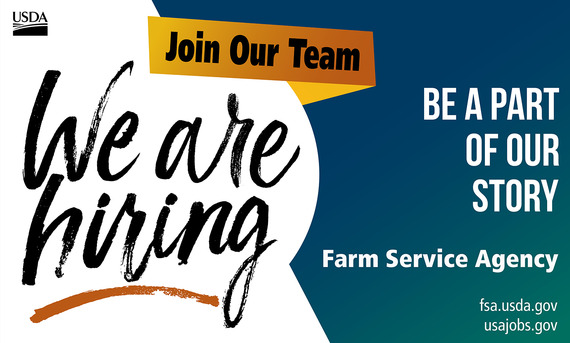
The USDA Farm Service Agency (FSA) in Idaho is hiring several County Executive Director in Training positions. The deadline to apply is September 16, 2026.
Duties include serving as a CED trainee and completing a structured training program designed to build the managerial and program knowledge required for advancement to a CED position. The incumbent gains progressively deeper understanding of FSA policy and program development and administration, and applies this knowledge to provide leadership, direction, and coordination in program operations.
How to Apply
The application process starts by creating your profile at USAJOBS.gov.
Apply for this role today! CED in Training-North Idaho or CED in Training-East/South Idaho
Applications must be completed through USAJOBs no later than September 16, 2026.
For more information or questions regarding these positions, contact Brandi May at Brandi.May@usda.gov.
If you know of someone who might be interested in this role, please share this information with them.
About FSA
FSA helps America’s farmers and ranchers invest in, improve, and expand their agricultural operations through disaster assistance, farm loans, price support, income support, and conservation programs.
USDA is an equal opportunity provider, employer, and lender.
The U.S. Department of Agriculture (USDA) is helping organic producers and handlers cover certification costs as part of the Department’s effort to put Farmers First and Make America Healthy Again. USDA’s Farm Service Agency (FSA) is accepting applications to help with organic certification costs for the 2025 and 2026 program years through the Organic Certification Cost Share Program (OCCSP), which covers up to 75% of eligible organic certification costs. Producers and handlers must apply by Dec. 31, 2026, for both program years.
Cost Share Assistance
OCCSP provides cost share assistance to producers and handlers for the costs of obtaining or maintaining organic certification under the National Organic Program, which is administered by USDA’s Agricultural Marketing Service. Producers and handlers are eligible to receive 75% of the costs, up to $750 for each of the following scopes: crops, wild crops, livestock, processing/handling and state organic program fees.
FSA will make payments as applications are received on a first-come, first-served basis until available funds are depleted.
Eligibility
To be eligible for OCCSP, a producer or handler must have their USDA organic certification for the applicable program year at the time of application and must have paid fees or expenses related to the initial certification or renewal from a certifying agent during the program year. For program year 2025, they must have possessed a
USDA organic certification at any time during the program year.
There are four USDA organic regulation recognized scopes that must be individually inspected and certified: crops, livestock, wild crops, and handling. The scopes must be listed on the producer or handler’s organic certificate to be eligible for OCCSP. Eligible costs include:
- Application and administrative fees for USDA organic certification
- Inspection fees for USDA organic certification, including travel and per diem costs for organic inspectors
- USDA organic certification costs, including fees necessary to access international markets with which AMS has equivalency agreements or arrangements
- State organic program fees
- User and sale assessment fees for USDA organic certification
- Postage costs for materials related to obtaining or renewing USDA organic certification.
How to Apply
To apply, producers and handlers should contact their local FSA county office. As part of completing the OCCSP application, producers and handlers will need to provide documentation of their organic certification and eligible expenses. Organic producers and handlers may also apply for OCCSP through participating state agencies.
Opportunity for State Agency Participation
FSA will soon announce a 30-day application period for state agencies to apply through grants.gov to administer OCCSP.
If a state agency chooses to participate in OCCSP, both the state agency and FSA county offices in that state will accept OCCSP applications and make payments to eligible certified operations. However, producers and handlers may not receive OCCSP payments for the same scope through both the state agency and their FSA county office.
For more information, producers and handlers can visit the OCCSP webpage or contact their local FSA county office.
Landowners and operators are reminded that in order to receive payments from USDA, compliance with Highly Erodible Land (HEL) and Wetland Conservation (WC) provisions are required. Farmers with HEL determined soils are reminded of tillage, crop residue, and rotation requirements as specified per their conservation plan. Producers are to notify the USDA Farm Service Agency prior to breaking sod, clearing land (tree removal), and of any drainage projects (tiling, ditching, etc.) to ensure compliance. Failure to update certification of compliance, with form AD-1026, triggering applicable HEL and/or wetland determinations, for any of these situations, can result in the loss of FSA farm program payments, FSA farm loans, NRCS program payments, and premium subsidy to Federal Crop Insurance administered by RMA.
The Noninsured Crop Disaster Assistance Program (NAP) provides financial assistance to you for crops that aren’t eligible for crop insurance to protect against lower yields or crops unable to be planted due to natural disasters including freeze, hail, excessive moisture, excessive wind or hurricanes, flood, excessive heat and qualifying drought (includes native grass for grazing), among others.
In order to participate, you must obtain NAP coverage for the crop year by the applicable deadline using form CCC-471 “Application for Coverage” and pay the service fee. Application closing dates vary by crop. Producers are also required to submit an acceptable crop acreage report. Additionally, NAP participants must provide:
- The quantity of all harvested production of the crop in which the producer held an interest during the crop year
- The disposition of the harvested crop, such as whether it is marketable, unmarketable, salvaged or used differently than intended
- Acceptable crop production records (when requested by FSA)
Producers who fail to report acreage and production information for NAP-covered crops could see reduced or zero NAP assistance. These reports are used to calculate the approved yield.
If your NAP-covered crops are affected by a natural disaster, notify your FSA office by completing Part B of form CCC-576 “Notice of Loss and Application for Payment.” This must be completed within 15 calendar days of the occurrence of the disaster or when losses become apparent or 15 days of the final harvest date. For hand-harvested crops and certain perishable crops, you must notify FSA within 72 hours of when a loss becomes apparent.
To receive benefits, you must also complete Parts D, E, F, G and H of the CCC-576 “Notice of Loss and Application for Payment” within 60 days of the last day of coverage for the crop year for any NAP covered crops. The CCC-576 requires acceptable appraisal information. Producers must provide evidence of production and note whether the crop was marketable, unmarketable, salvaged or used differently than intended.
Eligible crops must be commercially produced agricultural commodities for which crop insurance is not available, including perennial grass forage and grazing crops, fruits, vegetables, mushrooms, floriculture, ornamental nursery, aquaculture, turf grass, ginseng, honey, syrup, bioenergy, and industrial crops.
For more information on NAP, contact your local FSA County Office or visit fsa.usda.gov/nap.
FSA and NRCS program applicants for benefits are required to submit a completed CCC-902 Farming Operation Plan and CCC-941 Average Gross Income (AGI) Certification and Consent to Disclosure of Tax Information for FSA to determine the applicant’s payment eligibility and establish the maximum payment limitation applicable to the program applicant.
Participants are not required to annually submit new CCC-902s for payment eligibility and payment limitation purposes unless a change in the farming operation occurs that may affect the previous determination of record. A valid CCC-902 filed by the participant is considered to be a continuous certification used for all payment eligibility and payment limitation determinations applicable for the program benefits requested.
Participants are responsible for ensuring that all CCC-902 and CCC-941 and related forms on file in the county office are updated, current, and correct. Participants are required to timely notify the county office of any changes in the farming operation that may affect the previous determination of record by filing a new or updated CCC-902 as applicable.
Changes that may require a new determination include, but are not limited to, a change of:
- Shares of a contract, which may reflect:
- A land lease from cash rent to share rent
- A land lease from share rent to cash rent (subject to the cash rent tenant rule
- A modification of a variable/fixed bushel-rent arrangement
- The size of the producer’s farming operation by the addition or reduction of cropland that may affect the application of a cropland factor
- The structure of the farming operation, including any change to a member's share
- The contribution of farm inputs of capital, land, equipment, active personal labor, and/or active personal management
- Farming interests not previously disclosed on CCC-902 including the farming interests of a spouse or minor child
- Certifications of average AGI are required to be filed annually for participation in an annual USDA program. For multi-year conservation contracts and NRCS easements, a certification of AGI must be filed prior to approval of the contract or easement and is applicable for the duration of the contract period.
Participants are encouraged to file or review these forms within the deadlines established for each applicable program for which program benefits are being requested.
USDA’s National Agricultural Statistics Service (NASS) conducts hundreds of surveys every year and prepares reports covering virtually every aspect of U.S. agriculture.
If you receive a survey questionnaire, please respond quickly and online if possible.
The results of the surveys help determine the structure of USDA farm programs, such as soil rental rates for the Conservation Reserve Program and prices and yields used for the Agriculture Risk Coverage and Price Loss Coverage programs. This county-level data is critical for USDA farm payment determinations. Survey responses also help associations, businesses and policymakers advocate for their industry and help educate others on the importance of agriculture.
NASS safeguards the privacy of all respondents and publishes only aggregate data, ensuring that no individual operation or producer can be identified.
NASS data is available online at nass.usda.gov/Publications and through the searchable Quick Stats database. Watch a video on how NASS data is used at youtube.com/watch?v=m-4zjnh26io&feature=youtu.be.
Farm Service Agency (FSA) program payments are issued electronically into your bank account. In order to receive timely payments, you need to notify your FSA servicing office if you close your account or if your bank information is changed for any reason (such as your financial institution merging or being purchased). Payments can be delayed if FSA is not notified of changes to account and bank routing numbers.
If the bank account was closed due to the death of an individual or dissolution of an entity or partnership before the payment was issued, please notify your local FSA office as soon as possible to claim your payment.
Farm Service Agency (FSA) is committed to providing our farm loan borrowers the tools necessary to be successful. FSA staff will provide guidance and counsel from the loan application process through the borrower’s graduation to commercial credit. While it is FSA’s commitment to advise borrowers as they identify goals and evaluate progress, it is crucial for borrowers to communicate with their farm loan staff when changes occur. It is the borrower’s responsibility to alert FSA to any of the following:
- Any proposed or significant changes in the farming operation
- Any significant changes to family income or expenses
- The development of problem situations
- Any losses or proposed significant changes in security
If a farm loan borrower can’t make payments to suppliers, other creditors, or FSA on time, contact your farm loan staff immediately to discuss loan servicing options.
For more information on FSA farm loan programs, contact your local County USDA Service Center or visit fsa.usda.gov.
|
Top of page
Idaho FSA State Office
9173 West Barnes Drive, Ste. B
Boise, Idaho 83709
Phone: 208-378-5650
Fax: 855-516-8875
|
| |
|
Idaho State Executive Director
Kevin Andrus ~ 208-378-5656 Kevin.Andrus2@usda.gov
Deputy State Executive Director
Nick Treasure ~ 208-378-5671 nicholas.treasure@usda.gov
Farm Program Chief
Kyla Pearson ~ 208-378-5667 kyla.pearson@usda.gov
|
Administrative Officer
Brandi May ~ 208-378-5670 brandi.may@usda.gov
Farm Loan Chief
Susan R. Smith ~ 208-378-5664 susan.r.smith@usda.gov
|
|
Idaho FSA State Committee
Roy Bunderson, Bloomington ~ Committee Chair
Glen Dalling, Hamer ~ Member
Brian Jemmett, Caldwell ~ Member
Marie Mustoe Linehan, Genesee ~ Member
Kenneth Roberts, Donnelly ~ Member
Next State Committee Meeting: TBA
Note: To check the status of your FSA Farm Loan (FLP) account, call 1-888-518-4983 or check with your local office. To find contact information for your local office go to www.fsa.usda.gov/id
|
|