Ohio FSA State Newsletter - September 18, 2026
In This Edition of the Ohio FSA State Newsletter:
As we move toward fall, many folks will soon begin hauling grain from storage. Please remember if the grain you are hauling is under a Farm Service Agency (FSA) Marketing Assistance Loan, you must contact your county FSA office before you move it.
Our staff is preparing to issue Conservation Reserve Program rental payments in October and if applicable, Agriculture Risk Coverage (ARC) and Price Loss Coverage (PLC) payments. Most folks receive these payments electronically. Please contact your FSA County office if you have closed your bank account, changed accounts or banks, or if your bank has been purchased by another financial institution. Payments can be delayed if we are not aware of these changes. If you are not using direct deposit, please consider this option as it’s faster and more secure.
This week FSA announced the enrollment period for the Agriculture Risk Coverage (ARC) and Price Loss Coverage (PLC) programs, which the U.S. Department of Agriculture (USDA) recently updated to include more than 30 million new base acres. This expansion, the first in 20 years, was made possible by the Working Families Tax Cuts Act and is part of USDA’s efforts to put Farmers First.
Now that the base allocation process is complete, producers can make elections and enroll for the 2026 crop year from Sept. 16 through Dec. 11, 2026, and for the 2027 crop year from Nov. 2, 2026, through March 15, 2027. Because eligible acres exceeded the nationwide 30-million-acre cap, FSA is applying an across-the-board, prorated reduction of 3.69% to all newly allocated base acres. Visit fsa.usda.gov/arc-plc to view your base allocation notification and enroll for ARC and PLC.
On a different note, if you have not yet used Microsoft Bookings to make an appointment with your county office, we encourage you to explore your options by using the FSA County Office Locator. Once you select your county, you can click “Make Appointment” then select the service you need, find a date and time that works best for you, provide any additional information and book. It is that simple! Producers still have the option to call or visit their local FSA office in person to make an appointment.
Producers who want to take it a step further and have the option to work with FSA online can create a Login.gov account. With a Login.gov account, you can view, complete, certify, submit and track applications online for applicable programs.
USDA is committed to expanding credit access by modernizing its policies, updating technology, and accelerating the application process. Please note that our farm loan staff will be out of the office for statewide training on Sept. 22 and 23. To avoid delays, we highly recommend scheduling your appointments in advance for those days.
Additional program details and more in-depth information is provided in our newsletter. Please don’t hesitate to contact your FSA county office for questions about our programs, loans and information that is included in this newsletter edition.
Don Jones State Executive Director, Ohio FSA
The U.S. Department of Agriculture’s Farm Service Agency (FSA) is expanding payment limitation and payment eligibility provisions that affect program payments including allowing for the equitable treatment of business entities. Additionally, producers will benefit from an increased payment limitation for certain programs, and a broader definition of farming income that will result in more exceptions to income limitations.
Payment Eligibility
Starting with the 2026 crop year, for payment eligibility purposes, FSA will treat applicable limited liability companies (LLCs) and S-Corporations (S-Corps), and other similar entities, as “pass through entities.” Each member of the qualified pass-through entity who meets actively engaged in farming criteria will help qualify the entity for expanded payments.
Previously, farm operations that were structured as an LLC or an S-Corp were limited to a single payment limitation, which varies by program. Now, partnerships, S-Corps, qualifying LLCs, and joint ventures or general partnerships will be treated the same.
After program year 2026, FSA will continue to use June 1 as the date for determining ownership interest in an entity. Producers who have crop insurance or Noninsured Crop Disaster Assistance Program coverage should contact their crop insurance agent or local FSA office before restructuring their farm operation to ensure appropriate timing for restructuring without impacting current insurance coverage.
Members of qualified pass-through entities must provide contributions and be engaged in farming for the entity to be considered actively engaged in farming.
An additional change allows members of all entity types to receive compensation for labor and management contributions and use the same contribution to qualify as “actively engaged in farming.” This update provides consistent treatment of member contributions across all entity types.
Payment Limitation and Attribution
Payment limitation changes include an increased payment limit for the Agriculture Risk Coverage (ARC) and Price Loss Coverage (PLC) program. Starting with crop year 2025, the ARC and PLC payment limit will increase from $125,000 to $155,000. This payment limit will be adjusted going forward annually based on inflation.
Payment limitations are the maximum amount that a person or legal entity can receive for any crop year, directly or indirectly, through certain USDA programs. The same maximum payment limitation that applied to joint ventures and general partnerships will apply to qualified pass-through entities.
The policy change to payment limitation calculations takes effect beginning with program year 2026 for all qualified pass-through entities.
Average Adjusted Gross Income
The Working Families Tax Cuts Act broadened the definition of farming income to be more reflective of modern agricultural business practices. As a result, diversified producers will not be penalized under USDA’s requirements for average adjusted gross income (AGI).
Producers are exempt from the $900,000 AGI cap for conservation and disaster programs if at least 75% of their average gross income is from farming, ranching, or silviculture, which now includes agri-tourism, direct-to-consumer sales, and certain equipment sales.
Additionally, qualified pass-through entities are not required to certify compliance with the average AGI limitation at the entity level. However, members individually must meet average AGI requirements, which is the same requirement for joint operations.
Producers should contact their local FSA county office for more information or to update their farm operating plan by the Sept. 15, 2026, deadline for the 2026 program year.
The U.S. Department of Agriculture (USDA) is extending the deadline for farmers to apply for Stages 1 and 2 of the Supplemental Disaster Relief Program (SDRP) to Sept. 30, 2026. Additionally, USDA’s Farm Service Agency (FSA) is providing greater flexibility for farmers who experienced quality losses on eligible crops.
Now, when applying for this key program, farmers who experienced quality-related discounts can use verifiable and reliable documentation to show quality losses due to natural disasters occurring 2023 and 2024. Farmers also now have the flexibility to use a quality loss percentage for crops having a final use that is different from their intended use.
SDRP provides more than $16 billion in disaster relief payments to producers who suffered revenue, quality or production losses to crops, trees, bushes, or vines due to qualifying disaster events in calendar years 2023 and 2024. These payments are authorized under the American Relief Act, 2025.
Producers with indemnified losses can apply through SDRP Stage 1, which leverages Federal Crop Insurance or Noninsured Crop Disaster Assistance Program (NAP) data as the basis for calculating payments. Producers with non-indemnified (including shallow losses), uncovered (uninsured), and quality losses can apply for Stage 2 assistance. Eligible producers can receive SDRP payments for both Stages 1 and 2, if applicable, and for one or both calendar years 2023 and 2024, depending on losses.
Required Documentation for SDRP Quality Losses
FSA is now allowing producers to use verifiable and reliable documentation to demonstrate quality-related discounts on production impacted by natural disasters.
For quality losses, producers are required to provide third-party verifiable documentation of the grading factors or nutrient tests and acceptable production records that illustrate eligible affected production. Verifiable documentation must be dated within 30 days of harvest. FSA county committees can consider grading factors or nutrient tests taken more than 30 days after harvest if the test or grading factor represents crop condition at the time of harvest.
Verifiable third-party documentation for one producer can be considered verifiable for all producers with similar documentation, providing flexibility for vertically integrated operations that serve as the buying point for multiple operations, including their own.
For producers with documentation that includes expected price, actual price received due to quality discounts, and quantity of affected production, FSA county committees have the flexibility to use knowledge of the disaster event and impact on other producers to determine documentation is reliable.
Flexibility for Quality-Related Discounts
To address quality-related economic impacts for SDRP Stage 1 and Stage 2 insured and NAP crops that were intended for fresh but sold as processed or could not be sold in a recognized market, FSA updated policy for crops with a final use different from the intended use (secondary use) and for crops not sold in a recognized market (salvage value). In these cases, producers will be required to provide acceptable production records documenting the actual production and price received.
Stage 1 Quality Loss Applications with Missing Production Data
For SDRP Stage 1 quality losses, some applications were not generated because the pre-quality adjusted production information used to calculate the Quality Loss Percentage was unavailable. Although this production information will not be available before the SDRP application deadline of Sept. 30, 2026, producers are still required to file an application by the deadline.
Once FSA receives missing production data, impacted producers will be notified and provided with adequate time to review and re-sign SDRP applications.
Online Quality Loss Calculator
For assistance determining quality loss percent, producers can use the quality loss calculators on the SDRP webpage.
For more information on SDRP, visit fsa.usda.gov/sdrp. Producers can request an application or make an appointment online with their FSA county office.
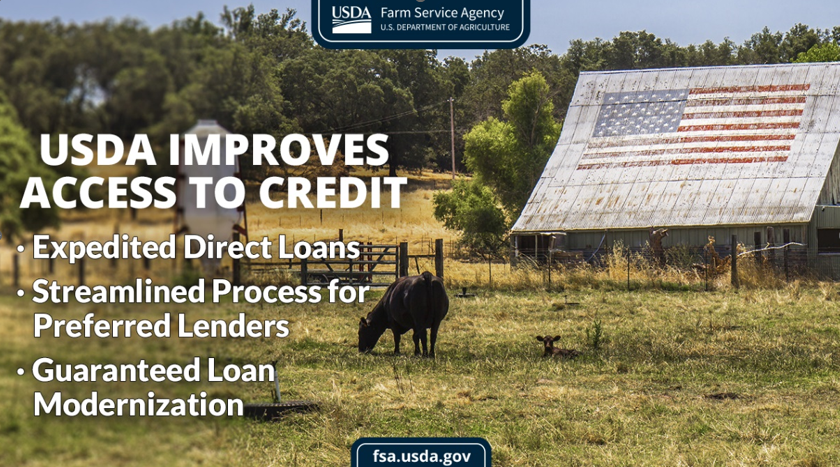 The U.S. Department of Agriculture (USDA) is improving access to credit for farmers and ranchers by making farm loan policy and technology improvements, reducing administrative burdens and strengthening financial security. These updates will increase efficiency by expediting the application process for direct loans, streamlining the process for certain guaranteed lenders who partner with USDA’s Farm Service Agency (FSA) and laying the groundwork for an electronic interface for guaranteed loans.
FSA makes direct and guaranteed loans to farmers and ranchers who are unable to obtain sufficient commercial credit at reasonable rates and terms. FSA farm loans can be used to purchase personal property or farmland, finance agricultural production expenses, or address day-to-day operational needs. The Consolidated Farm and Rural Development Act authorizes most farm loans including farm ownership, farm operating, and emergency loans.
Fast Tracking Direct Loan Applications
Following a successful pilot program, FSA is permanently implementing the Application Fast Track (AFT) process to expedite the loan application and approval process for low-risk direct loan applicants. AFT expedites the underwriting process for direct loan applicants who are least likely to default on their loans based on financial benchmarks and historical repayment data.
Since the pilot started in 2023, an average of 23% of direct loan customers qualified for the streamlined process, which decreased the application processing time by approximately eight calendar days. This resulted in improved access to credit for borrowers and increased efficiency for FSA staff.
AFT is currently available to all qualifying producers nationwide, and these changes simply transition AFT from a pilot program into a permanent part of FSA’s regulations and policies. In addition to AFT, FSA is also making several changes to the direct loan collateral valuation process, which will expedite loan closings.
Streamlining for Preferred Lenders
FSA partners with credit unions, commercial banks, and farm credit organizations to deliver Guaranteed Loans, which help borrowers who cannot secure credit without a federal guarantee. Through Guaranteed Loans, the financial institution makes the loan, but FSA guarantees the farm loan against possible financial loss, reducing the lender’s risk.
FSA is further streamlining the process for lenders in the Preferred Lender Program, which includes the most experienced and highest-performing lending institutions. These lenders will have delegated authority to certify that applicants meet FSA lending requirements for creditworthiness, financial feasibility, and adequacy of collateral in place of a more detailed agency review. This streamlined process reduces documentation requirements and expedites loan processing. Preferred lenders will receive more information and guidance on exercising delegated authority in the new electronic system before it goes live in early 2027. However, preferred lenders can begin exercising delegated authority through traditional loan narratives starting Oct. 1, 2026.
Guaranteed Loan Modernization
USDA is modernizing outdated technology systems with the goal of expediting loan delivery. This multi-year effort will begin with the guaranteed loan program and later extend to all loan types.
The new modernized system will allow guaranteed loan applications, lender notifications and supporting documents to be electronically submitted, replacing the agency’s largely paper-based process. Paper applications will still be accepted, and FSA will provide notifications consistent with the submission method.
FSA is making regulatory changes ahead of implementing the new modernized system and will provide more information and training for guaranteed lenders before transitioning to the electronic interface in early 2027.
More Information
For more information on farm loans, producers can visit fsa.usda.gov, view the Federal Register notice or use the Loan Assistance Tool to check eligibility requirements and find the right loan for their operation. Producers can also make an appointment online with their local FSA farm loan office for assistance.
The U.S. Department of Agriculture (USDA) reminds agricultural producers that the final date to apply for or make changes to their existing crop insurance coverage is quickly approaching for fall planted crops. Sales closing dates vary by crop and location, but the next major sales closing date is Sept. 30.
Producers are encouraged to visit their crop insurance agent soon to learn specific details for the 2027 crop year. Crop insurance coverage decisions must be made on or before the applicable sales closing date. The USDA’s Risk Management Agency lists sales closing dates in the Actuarial Information Browser, under the “Dates” tab.
Producers can also access the RMA Map Viewer tool to visualize the insurance program date choices for acreage reporting, cancellation, contract change, earliest planting, end of insurance, end of late planting period, final planting, premium billing, production reporting, sales closing, and termination dates, when applicable, per commodity, insurance plan, type and practice. Additionally, producers can access the RMA Information Reporting System tool to specifically identify applicable dates for their operation, using the “Insurance Offer Reports” application.
Federal crop insurance is critical to the farm safety net. It helps producers and owners manage revenue risks and strengthens the rural economy. Producers may select from several coverage options, including yield coverage, revenue protection and area risk plans of insurance.
Crop insurance options include Whole-Farm Revenue Protection and Micro Farm. Whole-Farm Revenue Protection provides a risk management safety net for all commodities on the farm under one insurance policy and is available in all counties nationwide. Micro Farm aims to help direct market and small-scale producers that may sell locally, and this policy simplifies record keeping and covers post-production costs such as washing and value-added products.
Crop insurance is sold and delivered solely through private crop insurance agents. A list of crop insurance agents is available online at the RMA Agent Locator. Producers can learn more about crop insurance and the modern farm safety net at rma.usda.gov or by contacting their RMA Regional Office.
Marketing Assistance Loans (MALs) and Loan Deficiency Payments (LDPs) provide financing and marketing assistance for wheat, feed grains, soybeans, and other oilseeds, pulse crops, wool and honey.
MALs provide interim financing after harvest to help you meet cash flow needs without having to sell your commodities when market prices are typically at harvest-time lows. A producer who is eligible to obtain a loan, but agrees to forgo the loan, may be eligible for an LDP.
FSA is now accepting requests for 2026 MALs and LDPs for all eligible commodities after harvest. For more information and additional eligibility requirements, contact your FSA County office.
Farm Service Agency (FSA) program payments are issued electronically into your bank account. In order to receive timely payments, you need to notify your FSA servicing office if you close your account or if your bank information is changed for any reason (such as your financial institution merging or being purchased). Payments can be delayed if FSA is not notified of changes to account and bank routing numbers.
If the bank account was closed due to the death of an individual or dissolution of an entity or partnership before the payment was issued, please notify your local FSA office as soon as possible to claim your payment.
Do you want the convenience of conducting business with USDA online? Create your Login.gov account today!
With a Login.gov account, you can view, complete, certify, submit and track applications online for applicable programs.
Login.gov uses one account and password for secure, private access to participating government agencies, including the Farm Service Agency and the Natural Resources Conservation Service. If you already have a Login.gov account, there is no need to create a new account to work with USDA, just link your Login.gov account with your USDA customer record.
To create your Login.gov account, you’ll need:
- U.S. state or government issued photo ID (driver’s license or U.S. passport)
- Email address
- Secure password (at least 12 characters)
- Desktop or mobile device
Create Your Account
Follow the steps below to create your Login.gov account and tie it to your USDA customer record:
Login.gov can verify your identity online using personal information you submit with an approved U.S. state or government issued photo ID. If you cannot verify your identity through the online process, visit an FSA Office to complete the verification process in person.
Linking your USDA Customer Record
If you have worked with FSA or NRCS in the past and have a USDA customer record, the system will attempt to automatically link your Login.gov account to your existing USDA Customer Record.
If you are new to working with USDA, you will need to have a USDA Customer Record created. This record is sometimes called a Business Partner ID, BPID, or Business Partner Customer Record. After you verify your identity online, you will be taken to a page to fill out and submit a form to begin that process.
If you run into issues linking your customer record, we may need to update existing forms or your contact information on file. Please reach out to your FSA county office for assistance.
For assistance in creating your Login.gov account, refer to the Login.gov Quick Reference Guide. For troubleshooting, visit login.gov/help/ or contact your FSA county office.
The U.S. Department of Agriculture’s (USDA) Risk Management Agency (RMA) announced it is enhancing Federal crop insurance options for grape producers in Michigan and Ohio. Beginning with the 2027 crop year, these updates will expand grape coverage into additional counties across both states and allow producers to receive variety-specific pricing and optional units, rather than relying on the broader type groupings currently in place.
Counties receiving coverage for Native and Hybrid varieties include:
-
Michigan: Cass and Kalamazoo
-
Ohio: Ashland, Coshocton, Fairfield, Geauga, Holmes, Medina, Sandusky, Stark, Summit and Wayne
Counties receiving coverage for Native, Hybrid, and Vinifera varieties include:
-
Michigan: Allegan, Antrim, Benzie, Berrien, Grand Traverse, Leelanau, Muskegon, Oceana and Van Buren
-
Ohio: Ashtabula, Brown, Erie, Lake and Lorain
Separating grape varieties allows producers to benefit from pricing and yield data specific to each type. As part of these updates, producers will need to maintain individual actual production history (APH) databases for each type and practice.
Producers are encouraged to contact their crop insurance agent for more information. The sales closing date for the grape insurance program in Michigan and Ohio is Nov. 20, 2026.
The U.S. Department of Agriculture is putting farmers first by offering a new option to schedule appointments online with their County Farm Service Agency (FSA) office. Following a successful pilot program, FSA is using a digital appointment platform across the agency to allow producers to conveniently make farm program or farm loan program appointments online.
Appointments can be scheduled through FSA’s digital platform, Microsoft Bookings, using a mobile device, tablet, laptop or desktop computer. To assist producers in finding their local FSA office to make an appointment, FSA has also launched a new FSA County Office locator that is searchable by state and by county. Each county office contact page has a unique link for producers to make an appointment online and shows contact information for the local FSA office and the farm loan team. Scheduled appointments may be in-person or virtual with the local FSA office depending on producer preference.
Producers can conveniently schedule appointments for a variety of services with both farm program and farm loan staff. The Microsoft Bookings-based system will automatically send a confirmation email to the producer along with reminder emails for upcoming appointments.
Producers still have the option to call their County FSA Office or visit in person to make an appointment.
Farm Operating Loans, Direct -- 5.250%
Farm Ownership Loans, Direct -- 6.000%
Limited Resource Loans -- 5.000%
Farm Ownership Loans, Down Payment -- 2.000%
Farm Ownership – Joint Financing -- 4.000%
Emergency Loans -- 3.750%
Farm Storage Facility Loan, 3 year -- 4.250%
Farm Storage Facility Loan, 5 year -- 4.375%
Farm Storage Facility Loan, 7 year -- 4.500%
Farm Storage Facility Loan, 10 year -- 4.625%
Farm Storage Facility Loan, 12 year -- 4.875%
Sugar Storage Facility Loans, 15 year -- 5.000%
Commodity Loans -- 5.000%
|
September 30
|
Deadline to obtain 2027 NAP coverage for Aquaculture, Christmas trees, Floriculture, Ginseng, Mushrooms, Turf grass Sod and Watercress.
|
|
September 30
|
Supplemental Disaster Relief Program Stage 1 and Stage 2 Deadline.
|
|
October 12
|
Columbus Day Holiday. USDA Service Center is Closed.
|
|
Early November
|
County committee ballots mailed to voters.
|
|
November 11
|
Veterans Day Holiday. USDA Service Center is Closed.
|
|
November 20
|
Last day to apply for coverage for asparagus, blueberries, caneberries, cherries, chestnuts, forage for hay and pasture, grapes, nectarines, peaches, pears, plums, strawberries, honey, hops and maple syrup.
|
|
November 26
|
Thanksgiving Day Holiday. USDA Service Center is Closed.
|
|
Ongoing
|
Reports of Failed Acreage must be filed with the County Office before disposition of the crop.
|
|
Ongoing
|
Reports of Prevented Planting Acreage must be filed with the County Office no later than 15 calendar days after the final planting date for that county and producers of hand-harvested crops and certain perishable crops must notify FSA within 72 hours of when a loss becomes apparent.
|
|
Ongoing
|
Contact your FSA County office right away for notice of loss deadlines and disaster program requirements.
|
|
Continuous
|
New applications for Farm Service Agency Loan Programs.
|
|
Continuous
|
Submit an Application for a Farm Storage Facility Loan.
|
|
Continuous
|
Sign up for GovDelivery Newsletters, Bulletins and Ohio Press Releases (Subscribe to USDA Emails for Farmers | Farmers.gov)
|
Ohio FSA State Office
200 North High Street, Room 540
Columbus, Ohio 43215
Phone: 614-255-2441
|
|
Visit the Ohio FSA website at: www.fsa.usda.gov/oh
fsa.usda.gov/fsa-office-locator
|
State Executive Director:
Don Jones
|
Deputy State Executive Director:
Traci Garza
|
|
Administrative Officer:
Stephanie Moran
|
Conservation Chief:
Brandi Koehler
|
|
Farm Loan Chief:
Andrew Huey
|
Price Support Chief:
Trevor Kerr
|
|
Production Adjustment / Compliance and Risk Management Chief:
Matt Kleski
|
|
|
|