Kentucky FSA Newsletter - AUGUST 2026
In This Issue:

Across Kentucky, many crop producers are beginning preparations for harvest. This growing season has been anything but predictable. Farmers began the year facing drought conditions, only to see that shift to flooding in some areas, while others received steady, timely rainfall. It’s fair to say we’ve been on the Kentucky weather rollercoaster! Yet despite how bleak things looked a month ago, some parts of the state are now seeing higher-than-average yields, and many other producers still expect solid returns considering the challenges faced. Livestock producers have also felt the impact of fluctuating rainfall, with stunted early-season forage growth followed by improved mid-summer grazing conditions.
The Farm Service Agency (FSA) is busy supporting our producers and recently wrapped up another reporting season for spring-planted crops. This year brought an increase in producers visiting our offices due to the Livestock Forage Program (LFP) and the need to have a crop acreage report on file. Livestock producers who suffered grazing losses due to drought can still enroll in LFP at their local FSA service center. All livestock producers are encouraged to stop by and learn about program enhancements included in the Working Family Tax Cut Act (WFTCA). These enhancements strengthen our livestock disaster programs, ensuring the economic success of farmers and ranchers who rely on a strong safety net when natural disasters impact their infrastructure or when market prices challenge their profitability.
The WFTCA also made significant updates to some of our price support programs as well. This Act authorized the allocation of 30 million commodity bases acres. Earlier this year, FSA staff completed the cropping history reviews, and Aug. 31 concludes the base allocation summary review period for landowners. WFTCA improvements strengthen the farm safety net nationwide and help producers better manage risk by providing greater flexibility for operations that have expanded or diversified since the last base allocation update more than two decades ago.
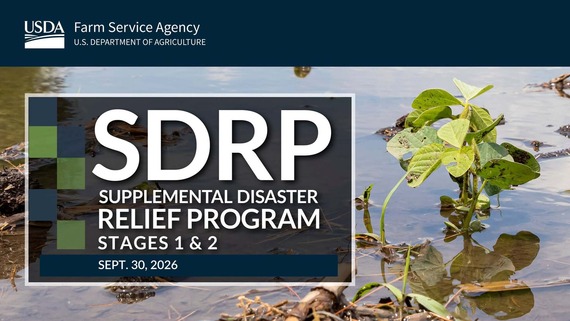
Additionally, USDA extended the deadline for the Supplemental Disaster Relief Program (SDRP) to Sept. 30, 2026, giving farmers additional time to apply for both Stage 1 and Stage 2 disaster assistance. New flexibilities allow producers to use expanded documentation for quality losses and support crops sold for uses different from their original intent. Producers should still file applications now, even if some required production data is pending.
There is a famous quote from Theodore Roosevelt, “Far and away the best prize that life offers is the chance to work hard at work worth doing”. Farming is work worth doing and I believe that serving farmers is also work worth doing. That’s why we remain committed to putting Farmers First.
|
The U.S. Department of Agriculture (USDA) is extending the deadline for farmers to apply for Stages 1 and 2 of the Supplemental Disaster Relief Program (SDRP) to Sept. 30, 2026. Additionally, USDA’s Farm Service Agency (FSA) is providing greater flexibility for farmers who experienced quality losses on eligible crops.
Now, when applying for this key program, farmers who experienced quality-related discounts can use verifiable and reliable documentation to show quality losses due to natural disasters occurring 2023 and 2024. Farmers also now have the flexibility to use a quality loss percentage for crops having a final use that is different from their intended use.
SDRP provides more than $16 billion in disaster relief payments to producers who suffered revenue, quality or production losses to crops, trees, bushes, or vines due to qualifying disaster events in calendar years 2023 and 2024. These payments are authorized under the American Relief Act, 2025.
Producers with indemnified losses can apply through SDRP Stage 1, which leverages Federal Crop Insurance or Noninsured Crop Disaster Assistance Program (NAP) data as the basis for calculating payments. Producers with non-indemnified (including shallow losses), uncovered (uninsured), and quality losses can apply for Stage 2 assistance. Eligible producers can receive SDRP payments for both Stages 1 and 2, if applicable, and for one or both calendar years 2023 and 2024, depending on losses.
Required Documentation for SDRP Quality Losses
FSA is now allowing producers to use verifiable and reliable documentation to demonstrate quality-related discounts on production impacted by natural disasters.
For quality losses, producers are required to provide third-party verifiable documentation of the grading factors or nutrient tests and acceptable production records that illustrate eligible affected production. Verifiable documentation must be dated within 30 days of harvest. FSA county committees can consider grading factors or nutrient tests taken more than 30 days after harvest if the test or grading factor represents crop condition at the time of harvest.
Verifiable third-party documentation for one producer can be considered verifiable for all producers with similar documentation, providing flexibility for vertically integrated operations that serve as the buying point for multiple operations, including their own.
For producers with documentation that includes expected price, actual price received due to quality discounts, and quantity of affected production, FSA county committees have the flexibility to use knowledge of the disaster event and impact on other producers to determine documentation is reliable.
Flexibility for Quality-Related Discounts
To address quality-related economic impacts for SDRP Stage 1 and Stage 2 insured and NAP crops that were intended for fresh but sold as processed or could not be sold in a recognized market, FSA updated policy for crops with a final use different from the intended use (secondary use) and for crops not sold in a recognized market (salvage value). In these cases, producers will be required to provide acceptable production records documenting the actual production and price received.
Stage 1 Quality Loss Applications with Missing Production Data
For SDRP Stage 1 quality losses, some applications were not generated because the pre-quality adjusted production information used to calculate the Quality Loss Percentage was unavailable. Although this production information will not be available before the SDRP application deadline of Sept. 30, 2026, producers are still required to file an application by the deadline.
Once FSA receives missing production data, impacted producers will be notified and provided with adequate time to review and re-sign SDRP applications.
Online Quality Loss Calculator
For assistance determining quality loss percent, producers can use the quality loss calculators on the SDRP webpage.
For more information on SDRP, visit fsa.usda.gov/sdrp. Producers can request an application or make an appointment online with their FSA county office.
 Top of page
The Farm Service Agency’s (FSA) Farm Storage Facility Loan (FSFL) program provides low-interest financing to help you build or upgrade storage facilities and to purchase portable (new or used) structures, equipment and storage and handling trucks.
Eligible commodities include corn, grain sorghum, rice, soybeans, oats, peanuts, wheat, barley, minor oilseeds harvested as whole grain, pulse crops (lentils, chickpeas and dry peas), hay, honey, renewable biomass, fruits, nuts and vegetables for cold storage facilities, controlled atmosphere storage, floriculture, hops, malted small grains, maple sap, maple syrup, rye, milk, cheese, butter, yogurt, meat and poultry (unprocessed), eggs, and aquaculture (excluding systems that maintain live animals through uptake and discharge of water). Qualified facilities include grain bins, hay barns and cold storage facilities for eligible commodities.
Loans up to $50,000 can be secured by a promissory note/security agreement, loans between $50,000 and $100,000 may require additional security, and loans exceeding $100,000 require additional security.
You do not need to demonstrate the lack of commercial credit availability to apply. The loans are designed to assist a diverse range of farming operations, including small and mid-sized businesses, new farmers, operations supplying local food and farmers markets, non-traditional farm products, and underserved producers.
Producers can request an application or make an appointment online with their FSA county office or visit fsa.usda.gov/pricesupport.
Top of page
Agricultural producers of perishable commodities including fruits, vegetables and floriculture can now get funding for controlled atmosphere storage through Farm Storage Facility Loans (FSFL) offered by the U.S. Department of Agriculture’s (USDA) Farm Service Agency (FSA). Controlled atmosphere storage regulates the concentrations of oxygen, carbon dioxide and nitrogen in a storage room to increase the shelf life of crops.
In addition to now supporting controlled atmosphere storage, FSFLs also provide low-interest financing to help producers build or upgrade storage facilities and to purchase portable (new or used) structures, equipment and storage and handling trucks.
The low-interest funds can also be used for controlled atmosphere storage monitoring equipment, designed to notify facility owners immediately if potential atmospheric concerns are detected. Producers may renovate existing storage facilities to include controlled atmosphere storage monitoring equipment. Authorized loan terms for FSFL renovations are three and five years only.
To assist with monitoring gases and particle concentrations for controlled atmosphere storage, the following equipment, but not limited to, is eligible for an FSFL:
- Optical oxygen sensor.
- Low power CO2 sensor.
- Air quality sensor.
- Gas detection devices.
- Air temperature and relative humidity sensor.
- Water activity meter.
- Temperature stabilized water activity analyzer.
- Precision and performance humidity and temperature transmitter.
Loans of up to $50,000 can be secured by a promissory note/security agreement, loans between $50,000 and $100,000 may require additional security and loans exceeding $100,000 require additional security.
FSFL borrowers do not need to demonstrate lack of commercial credit availability to apply. The loans are designed to assist a diverse range of agricultural operations, including small and mid-sized businesses, new farmers and ranchers, operations supplying local food and farmers markets, non-traditional farm products and underserved producers.
For more information, see the FSFL fact sheet and contact FSA at your local USDA Service Center.
Top of page
Farm loan borrowers who have pledged real estate as security for their Farm Service Agency (FSA) direct or guaranteed loans are responsible for maintaining loan collateral. Borrowers must obtain prior consent or approval from FSA or the guaranteed lender for any transaction that affects real estate security. These transactions include, but are not limited to:
- Leases of any kind
- Easements of any kind
- Subordinations
- Partial releases
- Sales
Failure to meet or follow the requirements in the loan agreement, promissory note, and other security instruments could lead to nonmonetary default which could jeopardize your current and future loans.
It is critical that borrowers keep an open line of communication with their FSA loan staff or guaranteed lender when it comes to changes in their operation. For more information on borrower responsibilities, read Your FSA Farm Loan Compass.
Top of page
USDA’s Debt Consolidation Tool allows agricultural producers to enter their farm operating debt and evaluate the potential savings that might be provided by obtaining a debt consolidation loan with USDA’s Farm Service Agency (FSA) or a local lender.
A debt consolidation loan is a new loan used to pay off other existing operating loans or lines of credit that might have higher rates and unfavorable terms. By combining multiple eligible debts into a single, larger loan, borrowers may obtain more favorable payment terms such as a lower interest rate or lower payments. Consolidating debt may also provide farmers and ranchers additional cash flow flexibilities.
The Debt Consolidation Tool is one of many significant additions to FSA’s suite of improvements designed to modernize its Farm Loan Programs. The tool enhances customer service and increases opportunities for farmers and ranchers to achieve financial viability by helping them identify potential savings that could be reinvested in their farming and ranching operation, retirement accounts, or college savings accounts.
Producers can access the Debt Consolidation Tool by visiting farmers.gov/debt-consolidation-tool. The tool is built to run on modern browsers including Chrome, Edge, Firefox, or the Safari browser. Producers do not need to create a farmers.gov account or access the authenticated customer portal to use the tool.
USDA encourages producers to reach out to their local FSA farm loan staff to ensure they fully understand the wide range of loan and servicing options available to assist with starting, expanding, or maintaining their agricultural operation. To conduct business with FSA, please contact your local USDA Service Center.
Top of page
|
Farm Operating Loans - Direct
|
5.250%
|
|
Farm Ownership Loans - Direct
|
6.000%
|
|
Farm Ownership Loans — Direct Down Payment, Beginning Farmer or Rancher
|
2.000%
|
|
Emergency Loans - Amount of Actual Loss
|
3.750%
|
|
Farm Storage Facility Loans (7 years)
|
4.375%
|
|
Commodity Loans 1996-Present
|
5.000%
|
|
90-Day Treasury Bill
|
3.625%
|
Top of page
The first 10 years of a farming or ranching operation can be difficult to navigate for any new farmer. USDA recognizes you need dedicated support to help make sense of all the information coming your way. Now each state has a Beginning Farmer and Rancher team headed up by a state coordinator. The coordinator helps producers who have operated a farm or ranch for less than 10 years navigate USDA and partner resources.
To find your State coordinator here. For more beginning farmer and rancher information, visit farmers.gov/newfarmers.
Top of page
This is likely no surprise to you, but drought persists across the U.S. and is intensifying in some areas. No geographic area is immune to the potential of drought at any given time. The U.S. Drought Monitor provides a weekly drought assessment, and it plays an important role in USDA programs that help farmers and ranchers recover from drought.
Fact #1 - Numerous agencies use the Drought Monitor to inform drought-related decisions.
The map identifies areas of drought and labels them by intensity on a weekly basis. It categorizes the entire country as being in one of six levels of drought. The first two, None and Abnormally Dry (D0), are not considered to be drought. The next four describe increasing levels of drought: Moderate (D1), Severe (D2), Extreme (D3) and Exceptional (D4).
While many entities consult the Drought Monitor for drought information, drought declarations are made by federal, state and local agencies that may or may not use the Drought Monitor to inform their decisions. Some of the ways USDA uses it to determine a producer’s eligibility for certain drought assistance programs, like the Livestock Forage Disaster Program and Emergency Haying or Grazing on Conservation Reserve Program acres and to “fast-track” Secretarial drought disaster designations.
Fact #2 - U.S. Drought Monitor is made with more than precipitation data.
When you think about drought, you probably think about water, or the lack of it. Precipitation plays a major role in the creation of the Drought Monitor, but the map’s author considers numerous indicators, including drought impacts and local insight from over 450 expert observers around the country. Authors use several dozen indicators to assess drought, including precipitation, streamflow, reservoir levels, temperature and evaporative demand, soil moisture and vegetation health. Because the drought monitor depicts both short and long‐term drought conditions, the authors must look at data for multiple timeframes. The final map produced each week represents a summary of the story being told by all the pieces of data. To help tell that story, authors don’t just look at data. They converse over the course of the map-making week with experts across the country and draw information about drought impacts from media reports and private citizens.
Fact #3 - A real person, using real data, updates the map.
Each week’s map author, not a computer, processes and analyzes data to update the drought monitor. The map authors are trained climatologists or meteorologists from the National Drought Mitigation Center at the University of Nebraska-Lincoln (the academic partner and website host of the Drought Monitor), the National Oceanic and Atmospheric Administration, the National Aeronautics and Space Administration and USDA. The author’s job is to do what a computer can’t – use their expertise to reconcile the sometimes-conflicting stories told by each stream of data into a single assessment.
Fact #4 - The Drought Monitor provides a current snapshot, not a forecast.
The Drought Monitor is a “snapshot” of conditions observed during the most recent week and builds off the previous week’s map. The map is released on Thursdays and depicts conditions based on data for the week that ended the preceding Tuesday. Rain that falls on the Wednesday just before the USDM’s release won’t be reflected until the next map is published. This provides a consistent, week‐to‐week product and gives the author a window to assess the data and come up with a final map.
Fact #5 – Your input can be part of the drought-monitoring process.
State climatologists and other trained observers in the drought monitoring network relay on-the-ground information from numerous sources to the US Drought monitor author each week. That can include information that you contribute.
The Drought Monitor serves as a trigger for multiple forms of federal disaster relief for agricultural producers, and sometimes producers contact the author to suggest that drought conditions in their area are worse than what the latest drought monitor shows. When the author gets a call like that, it prompts them to look closely at all available data for that area, to see whether measurements of precipitation, temperature, soil moisture and other indicators corroborate producer-submitted reports. This is the process that authors follow whether they receive one report or one hundred reports, although reports from more points may help state officials and others know where to look for impacts.
There are multiple ways to contribute your observations:
-
Talk to your state climatologist - Find the current list at the American Association of State Climatologists website.
-
Email - Emails sent to droughtmonitor@unl.edu inform the USDM authors.
-
Become a CoCoRaHS observer - Submit drought reports along with daily precipitation observations to the Community Collaborative Rain, Hail & Snow Network.
-
Submit Condition Monitoring Observer Reports (CMOR) - go.unl.edu/CMOR.
For more information, read our Ask the Expert blog with a NDMC climatologist or visit farmers.gov/protection-recovery.
Top of page
Kentucky FSA State Office
|
| |
771 Corporate Dr., Ste 205 Lexington, KY 40503 Phone: 859-224-7601 State Webpage
|
|
|
Contact your local USDA Service Center for assistance with FSA loans or programs
|
| |
State Executive Director David Wayne
859-224-7601 David.Wayne@usda.gov
|
|
|
Deputy State Executive Director
Clark Sturgeon
859-224-7622
clark.sturgeon@usda.gov
|
|
Administrative Officer Caleb Thomas
859-224-7441 caleb.thomas@usda.gov
|
Farm Programs Chief Kellie Samuels
859-224-7640 kellie.samuels@usda.gov
|
Farm Loan Chief
Warren Whitaker
859-224-7443 warren.whitaker@usda.gov
|
| |
|
|
|
Kentucky FSA State Committee
Sharon Walker Furches, Chair (Murray)
Tyler Ferguson, Member (Flatgap)
Mark Jenkins, Member (Hopkinsville)
David Andrew Langley, Member (Glendale)
Timothy Wayne White, Member (Lexington)
|
|
|