Ohio FSA State Newsletter - August 26, 2026
In This Edition of the Ohio FSA State Newsletter:
I want to take a moment to thank everyone for visiting our offices and completing their crop acreage reports in July. Thank you for your patience and cooperation with our local offices as they buttoned up activities on this heavy workload item.
Many of you are aware of the Working Families Tax Cuts Act (WFTCA) also known as the One Big Beautiful Bill Act (OBBBA), signed by President Trump on July 4, 2025, which reauthorized and updates several Title I farm bill programs and allows for the addition of 30 million new base acres. This law made historic investments in the farm safety net, including changes to payment eligibility and payment limitations, as well as many updates to disaster assistance and commodity loan programs.
We are currently adjusting our farm loan office boundaries over the next several months. Although this shift might change who manages your loan, it will not change the high-quality customer service you expect from us. Please reach out to your FSA loan team with any questions about these new coverage areas. This will not impact producers who have commodity or farm storage facility loans.
Lastly, landowners have until Aug. 31, 2026, to review their owner notification and base acre allocation summary(s). Landowners who have a Login.gov account can access their Base Allocation Summary online. Landowners who do not have a Login.gov account can contact their local FSA office to request their summary.
Additional program details and more in-depth information is provided in our newsletter. Please don’t hesitate to contact your FSA County office for questions about our programs, loans and information that is included in this newsletter edition.
Respectfully,
Don Jones State Executive Director, Ohio FSA
The U.S. Department of Agriculture (USDA) is extending the deadline for farmers to apply for Stages 1 and 2 of the Supplemental Disaster Relief Program (SDRP) to Sept. 30, 2026. Additionally, USDA’s Farm Service Agency (FSA) is providing greater flexibility for farmers who experienced quality losses on eligible crops.
Now, when applying for this key program, farmers who experienced quality-related discounts can use verifiable and reliable documentation to show quality losses due to natural disasters occurring 2023 and 2024. Farmers also now have the flexibility to use a quality loss percentage for crops having a final use that is different from their intended use.
SDRP provides more than $16 billion in disaster relief payments to producers who suffered revenue, quality or production losses to crops, trees, bushes, or vines due to qualifying disaster events in calendar years 2023 and 2024. These payments are authorized under the American Relief Act, 2025.
Producers with indemnified losses can apply through SDRP Stage 1, which leverages Federal Crop Insurance or Noninsured Crop Disaster Assistance Program (NAP) data as the basis for calculating payments. Producers with non-indemnified (including shallow losses), uncovered (uninsured), and quality losses can apply for Stage 2 assistance. Eligible producers can receive SDRP payments for both Stages 1 and 2, if applicable, and for one or both calendar years 2023 and 2024, depending on losses.
Required Documentation for SDRP Quality Losses
FSA is now allowing producers to use verifiable and reliable documentation to demonstrate quality-related discounts on production impacted by natural disasters.
For quality losses, producers are required to provide third-party verifiable documentation of the grading factors or nutrient tests and acceptable production records that illustrate eligible affected production. Verifiable documentation must be dated within 30 days of harvest. FSA county committees can consider grading factors or nutrient tests taken more than 30 days after harvest if the test or grading factor represents crop condition at the time of harvest.
Verifiable third-party documentation for one producer can be considered verifiable for all producers with similar documentation, providing flexibility for vertically integrated operations that serve as the buying point for multiple operations, including their own.
For producers with documentation that includes expected price, actual price received due to quality discounts, and quantity of affected production, FSA county committees have the flexibility to use knowledge of the disaster event and impact on other producers to determine documentation is reliable.
Flexibility for Quality-Related Discounts
To address quality-related economic impacts for SDRP Stage 1 and Stage 2 insured and NAP crops that were intended for fresh but sold as processed or could not be sold in a recognized market, FSA updated policy for crops with a final use different from the intended use (secondary use) and for crops not sold in a recognized market (salvage value). In these cases, producers will be required to provide acceptable production records documenting the actual production and price received.
Stage 1 Quality Loss Applications with Missing Production Data
For SDRP Stage 1 quality losses, some applications were not generated because the pre-quality adjusted production information used to calculate the Quality Loss Percentage was unavailable. Although this production information will not be available before the SDRP application deadline of Sept. 30, 2026, producers are still required to file an application by the deadline.
Once FSA receives missing production data, impacted producers will be notified and provided with adequate time to review and re-sign SDRP applications.
Online Quality Loss Calculator
For assistance determining quality loss percent, producers can use the quality loss calculators on the SDRP webpage.
For more information on SDRP, visit fsa.usda.gov/sdrp. Producers can request an application or make an appointment online with their FSA county office.
The National Environmental Policy Act (NEPA) requires Federal agencies to consider all potential environmental impacts for federally funded projects before the project is approved.
For all Farm Service Agency (FSA) programs, an environmental review must be completed before actions are approved, such as site preparation or ground disturbance. These programs include, but are not limited to, the Emergency Conservation Program (ECP), Farm Storage Facility Loan (FSFL) program and farm loans. If project implementation begins before FSA has completed an environmental review, the request will be denied. Although there are exceptions regarding the Stafford Act and emergencies, it’s important to wait until you receive written approval of your project proposal before starting any actions.
Applications cannot be approved until FSA has copies of all permits and plans. Contact your local FSA office early in your planning process to determine what level of environmental review is required for your program application so that it can be completed timely.
Farmers and producers know all too well that natural disasters can be a common, and likely a costly, variable to their operation. FSA has emergency assistance programs to provide assistance when disasters strike, and for some of those programs, a disaster designation may be the eligibility trigger. When natural disaster occurs, there is a process for requesting a USDA Secretarial disaster designation for a county. You can play a vital role in this process.
If you have experienced a production loss as a result of a natural disaster, you may submit a request to your local FSA county office for your county to be evaluated for a Secretarial disaster designation. Once a request is received, the county office will collect disaster data and create a Loss Assessment Report. The County Emergency Board will review the Loss Assessment Report and determine if a recommendation is sent forward to the U.S. Secretary of Agriculture for the designation.
For more information on FSA disaster programs and disaster designations, contact your FSA County office or visit fsa.usda.gov/disaster.
The Tree Assistance Program (TAP) provides financial assistance to help you replant or rehabilitate eligible trees, bushes and vines damaged by natural disasters.
Eligible tree types include trees, bushes or vines that produce an annual crop for commercial purposes. Nursery trees include ornamental, fruit, nut and Christmas trees that are produced for commercial sale. Trees used for pulp or timber are ineligible.
To qualify for TAP, eligible orchardists and nursery tree growers must suffer a qualifying tree, bush or vine loss from an eligible natural disaster in excess of normal mortality. The Working Families Tax Cut Act removed the 15% loss requirement, and a producer now qualifies for TAP if their loss exceeds the normal mortality for a tree, bush, or vine. For 2026 losses, producers who did not meet the 15% loss requirement but are now eligible must submit an application for payment by the later of Oct. 7, 2026, or 90 days from the date of the disaster event or when the loss is apparent.
Additionally, the reimbursement rate increased to 65% for activities like pruning and removal and the implementation period was extended to 24 months with an option to extend.
The eligible trees, bushes or vines must have been owned when the natural disaster occurred; however, eligible growers are not required to own the land on which the eligible trees, bushes and vines were planted.
The cumulative total quantity of acres planted to trees, bushes or vines, for which you can receive TAP payments, cannot exceed 1,000 acres annually.
For more information on these programs, contact your FSA County office or visit fsa.usda.gov/disaster.
NAP provides financial assistance to you for crops that aren’t eligible for crop insurance to protect against lower yields or crops unable to be planted due to natural disasters including: drought, extreme wet conditions, excessive rain, and flooding.
To receive payment, you had to purchase NAP coverage for 2026 crops and file a notice of loss the earlier of 15 days of the occurrence of the disaster or when losses become apparent or 15 days of the final harvest date.
For hand-harvested crops and certain perishable crops, you must notify FSA within 72 hours of when a loss becomes apparent.
Eligible crops must be commercially produced agricultural commodities for which crop insurance is not available, including perennial grass forage and grazing crops, fruits, vegetables, mushrooms, floriculture, ornamental nursery, aquaculture, turf grass, ginseng, honey, syrup, bioenergy, and industrial crops.
For more information on NAP, contact your FSA County office or visit fsa.usda.gov/nap.
The Conservation Reserve Program (CRP) is a program administered by the Farm Service Agency (FSA) to conserve farmland for future generations while providing habitat for wildlife, reducing soil erosion, and improving water quality. Regular maintenance on CRP acres is needed to ensure the acreage continues to provide conservation benefits and remains in compliance with the CRP contract.
Regular Maintenance
Producers with CRP contracts are required to control all weeds, insects, pests, and other undesirable species to the extent necessary to ensure that the approved conservation cover is adequately protected and to ensure there is no adverse impact on surrounding land. Mowing is one of the allowable practices for weed control, but mowing for aesthetic purposes is never permitted. The Conservation Plan states the required weed control methods for each site.
Once a stand has been certified as fully established, participants are required to maintain plant diversity and stand density according to the Conservation Plan and offer (CRP-2) for the life of the contract. Stands that do not meet practice specific plant diversity or density requirements may be considered non-compliant. Refer to your conservation plan or contact FSA if you have any questions or concerns about the vegetative cover requirements.
Maintenance activities cannot occur during the primary nesting season for birds without written prior approval from the local county office. The primary nesting season in Ohio is March 15 through July 15.
Mid-Contract Management
Regular maintenance for weed and pest control is separate from the Mid-Contract Management (MCM) requirement. MCM ensures plant diversity and wildlife benefits while ensuring protection of the soil and water resources. Such activities are site-specific and are for the purpose of enhancing the approved cover.
MCM must be completed between years four and six of a 10-year contract and between years seven and nine of a 15-year contract. The Conservation Plan will state what year MCM must take place.
Noncompliance with Maintenance Requirements
Failure to adequately maintain the stand may result in noncompliance with the terms and conditions of the CRP contract. Noncompliance can result in adverse actions up to and including termination of the CRP contract. Contracts that are out of compliance are ineligible to re-enroll, unless the stand is brought back into compliance prior to the enrollment deadline.
For general information about CRP, visit the Conservation Reserve Program webpage. For information about specific contracts, reach out to the local FSA office.
FSA offers two types of set-aside programs to assist FSA direct loan borrowers. These programs are intended to help distressed borrowers as well as borrowers impacted by natural disasters.
Disaster Set-Aside Program
The Disaster Set-Aside Program (DSA) assists existing FSA direct loan borrowers who have been impacted by natural disasters. The DSA program provides short-term financial relief by allowing eligible borrowers to delay FSA direct loan payments that are due either this year or next year (but not both). You may delay up to one full annual payment per loan and the delayed payment will then be moved to the end of the loan term. You will not be required to pay this set-aside installment until the loan’s final due date. Notably, interest will accrue on the principal portion until the installment is repaid.
To be eligible, borrowers must have operated a farm in a county declared a disaster area or a contiguous county at the time of the disaster. In addition, the borrower’s inability to make their upcoming payment must be due to the disaster.
To apply for DSA, borrowers must provide their local USDA Service Center with a letter requesting DSA, which must be signed by all parties liable for the debt. The letter must be provided to your local Service Center within eight months of the disaster declaration date. The application process also includes providing your actual production, income, and expense records for the last three years, and any additional information needed to make an eligibility decision.
Distressed Borrower Set-Aside Program
FSA Direct Farm Loan Program borrowers whose loans were closed before Sept. 25, 2024, may be eligible for assistance under the Distressed Borrower Set-Aside Program (DBSA). Similar to DSA, DBSA also provides short-term financial relief by allowing eligible borrowers to delay FSA direct loan payments that are due this year or next year (but not both). You may delay up to one full annual payment per loan and the delayed payment will be moved to the end of the loan term. You will not be required to pay this set-aside installment until the loan’s final due date.
An increased benefit with DBSA is that the principal portion of the set-aside will accrue interest at a reduced rate of 0.125% rather than your loan’s existing interest rate.
To be eligible for DBSA, the borrower must demonstrate financial distress, but their inability to make the upcoming payment does not need to be due to a disaster.
The DBSA application process is similar to DSA as borrowers must provide their local USDA Service Center with a letter requesting DBSA, which must be signed by all parties liable for the debt. The application process also includes providing your actual production, income, and expense records for the last three years. FSA may also request additional information as needed to make an eligibility decision.
Important Factors for Both DSA and DBSA:
FSA direct loan borrowers are not able to obtain more than one set-aside per loan. Borrowers also cannot obtain both a DSA and DBSA simultaneously on the same loan. In addition, FSA direct loans with less than two years remaining are not eligible for a DSA or DBSA. Other eligibility requirements apply; we encourage you to contact your local Service Center for more information.
Both DSA and DBSA are intended to provide short-term relief for situations where borrowers anticipate the ability to resume paying their full annual installment(s) in the following year. If you require a more long-term form of financial relief, FSA has other potential options available through primary loan servicing (PLS).
For more information on DSA, DBSA, or PLS, please contact your FSA County office.
Additional information, eligibility criteria and program limitations may be found within the Disaster Set-Aside and Distressed Borrower Set-Aside Program fact sheets.
The Ohio State University Extension will be hosting Harvesting Success: Growing Future Urban Farmers on October 24th, 2026. This free one-day event, held in cooperation with the USDA FSA, will bring together youth, educators, urban farmers, and community leaders to explore educational pathways, mentorship opportunities, and practical resources that support the development of the next generation of urban agriculture leaders.
The event will be hosted at the Cuyahoga Community College (Tri-C) Metropolitan Campus Center (MCC 201) on Saturday, October 24th, from 10 AM - 4 PM. Registration is required and lunch will be provided.
If you are passionate about educating youth and young people about urban agriculture, this is a great opportunity to connect. Throughout the event, our invited speakers will answer questions live and share experiences in four panel sessions including On-Farm Youth Training Programs, USDA Youth Programs, Campus Learning-by-Doing Experiences, and Farm-to-School Programs. Representatives from local and state organizations and vendors will exhibit resources, products, and services that supports youth urban agriculture education.
For more information and registration for the event, please visit http://go.osu.edu/harvestingsuccess.
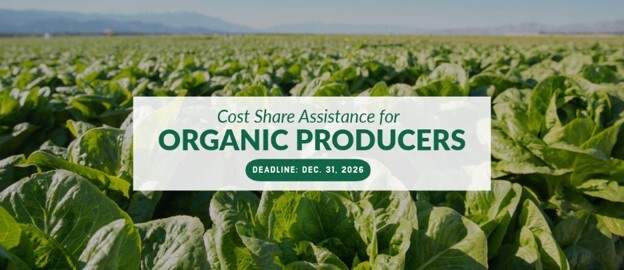 FSA is accepting applications to help with organic certification costs for the 2025 and 2026 program years through the Organic Certification Cost Share Program (OCCSP), which covers up to 75% of eligible organic certification costs. Producers and handlers must apply by Dec. 31, 2026, for both program years.
Cost Share Assistance
OCCSP provides cost share assistance to producers and handlers for the costs of obtaining or maintaining organic certification under the National Organic Program, which is administered by USDA’s Agricultural Marketing Service. Producers and handlers are eligible to receive 75% of the costs, up to $750 for each of the following scopes: crops, wild crops, livestock, processing/handling and state organic program fees.
FSA will make payments as applications are received on a first-come, first-served basis until available funds are depleted.
Eligibility
To be eligible for OCCSP, a producer or handler must have their USDA organic certification for the applicable program year at the time of application and must have paid fees or expenses related to the initial certification or renewal from a certifying agent during the program year. For program year 2025, they must have possessed a USDA organic certification at any time during the program year.
There are four USDA organic regulation recognized scopes that must be individually inspected and certified: crops, livestock, wild crops, and handling. The scopes must be listed on the producer or handler’s organic certificate to be eligible for OCCSP. Eligible costs include:
- Application and administrative fees for USDA organic certification
- Inspection fees for USDA organic certification, including travel and per diem costs for organic inspectors
- USDA organic certification costs, including fees necessary to access international markets with which AMS has equivalency agreements or arrangements
- State organic program fees
- User and sale assessment fees for USDA organic certification
- Postage costs for materials related to obtaining or renewing USDA organic certification.
How to Apply
To apply, producers and handlers should contact their local FSA county office. As part of completing the OCCSP application, producers and handlers will need to provide documentation of their organic certification and eligible expenses.
Organic producers and handlers may also apply for OCCSP through participating state agencies.
Opportunity for State Agency Participation
FSA will soon announce a 30-day application period for state agencies to apply through grants.gov to administer OCCSP.
If a state agency chooses to participate in OCCSP, both the state agency and FSA county offices in that state will accept OCCSP applications and make payments to eligible certified operations. However, producers and handlers may not receive OCCSP payments for the same scope through both the state agency and their FSA county office.
More Information
For more information, producers and handlers can visit the OCCSP webpage or contact their local FSA county office.
Farm Operating Loans, Direct -- 5.250%
Farm Ownership Loans, Direct -- 6.000%
Limited Resource Loans -- 5.000%
Farm Ownership Loans, Down Payment -- 2.000%
Farm Ownership – Joint Financing -- 4.000%
Emergency Loans -- 3.750%
Farm Storage Facility Loan, 3 year -- 4.125%
Farm Storage Facility Loan, 5 year -- 4.250%
Farm Storage Facility Loan, 7 year -- 4.375%
Farm Storage Facility Loan, 10 year -- 4.500%
Farm Storage Facility Loan, 12 year -- 4.625%
Sugar Storage Facility Loans, 15 year -- 4.875%
Commodity Loans -- 5.000%
|
August 31
|
Deadline for landowners to review their owner notification and base allocation summary(s).
|
|
September 7
|
Labor Day Holiday. USDA Service Center is Closed.
|
|
September 30
|
Deadline to obtain 2027 NAP coverage for Aquaculture, Christmas trees, Floriculture, Ginseng, Mushrooms, Turf grass Sod and Watercress.
|
|
September 30
|
Supplemental Disaster Relief Program Stage 1 and Stage 2 Deadline.
|
|
October 12
|
Columbus Day Holiday. USDA Service Center is Closed.
|
|
Early November
|
County committee ballots mailed to voters.
|
|
November 11
|
Veterans Day Holiday. USDA Service Center is Closed.
|
|
November 20
|
Last day to apply for coverage for asparagus, blueberries, caneberries, cherries, chestnuts, forage for hay and pasture, grapes, nectarines, peaches, pears, plums, strawberries, honey, hops and maple syrup.
|
|
November 26
|
Thanksgiving Day Holiday. USDA Service Center is Closed.
|
|
Ongoing
|
Reports of Failed Acreage must be filed with the County Office before disposition of the crop.
|
|
Ongoing
|
Reports of Prevented Planting Acreage must be filed with the County Office no later than 15 calendar days after the final planting date for that county and producers of hand-harvested crops and certain perishable crops must notify FSA within 72 hours of when a loss becomes apparent.
|
|
Ongoing
|
Contact your FSA County office right away for notice of loss deadlines and disaster program requirements.
|
|
Continuous
|
New applications for Farm Service Agency Loan Programs.
|
|
Continuous
|
Submit an Application for a Farm Storage Facility Loan.
|
|
Continuous
|
Sign up for GovDelivery Newsletters, Bulletins and Ohio Press Releases (Subscribe to USDA Emails for Farmers | Farmers.gov)
|
Ohio FSA State Office
200 North High Street, Room 540
Columbus, Ohio 43215
Phone: 614-255-2441
|
|
Visit the Ohio FSA website at: www.fsa.usda.gov/oh
fsa.usda.gov/fsa-office-locator
|
State Executive Director:
Don Jones
|
Deputy State Executive Director:
Traci Garza
|
|
Administrative Officer:
Stephanie Moran
|
Conservation Chief:
Brandi Koehler
|
|
Farm Loan Chief:
Andrew Huey
|
Price Support Chief:
Trevor Kerr
|
|
Production Adjustment / Compliance and Risk Management Chief:
Matt Kleski
|
|
|
|