Connecticut State Newsletter - July 30, 2026
In This Issue:

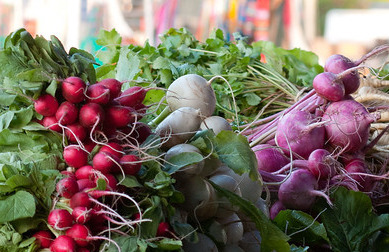
Summer is a special and busy time for our state’s agricultural community as production is in full swing and fair season begins. This time of year, I encourage you to support our farmers and ranchers by checking out your local farmers markets for fresh produce, meats, eggs, honey, flowers, and the many other amazing products our farmers have to offer. I hope to see many of you at Ag fairs throughout the state as I attend livestock shows, truck and equipment pulls, 4-H and FFA shows, and learn more about our vibrant farming community.
With so much summer excitement still ahead, I wanted to take a moment to slow down and remind everyone about some very important deadlines coming up. The first one is the deadline for nominations for our County Committee Elections. Local voices matter and agricultural producers play an important role in the administration of federal programs. By nominating yourself or another trusted farmer or rancher, you ensure that your community is well represented. Nationally, nearly 7,700 producers serve on more than 2,200 FSA County Committees where they apply their experience and local knowledge to make informed decisions during producer appeals, hiring decisions, and program support. All nomination forms for the 2026 election must be postmarked or received by the local FSA office by August 3, 2026.
Another important upcoming deadline is our Assistance for Specialty Crop Farmers (ASCF) program, which provides financial support in response to elevated input costs and market disruptions during the 2025 growing season. Building on the success of the Farmer Bridge Assistance program, we are using an expedited program application and payment process through Login.gov. Producers who have a Login.gov account can access and submit their pre-filled application online. Producers who do not have a Login.gov account or prefer to enroll in person at their local Farm Service Agency (FSA) office must complete enrollment by the August 7, 2026 deadline.
Finally, September 15, 2026, is the deadline to submit any changes to your farm operating plans for program year 2026 to be eligible for the new program payment eligibility and payment limitations requirements. The Working Families Tax Cuts Act broadened the definition of farming income to be more reflective of modern agricultural business practices by allowing the equitable treatment of business entities. Producers will benefit from an increased payment limitation for certain programs, and a broader definition of farming income that will result in more exceptions to income limitations. Included in the newsletter below is an article highlighting these important changes.
I look forward to keeping you informed on important FSA program updates and deadlines. I would like to give a huge acknowledgment to the extraordinary staff here in Connecticut. Our staff throughout the state are passionate, driven, and thorough, working extremely hard to ensure our programs are administered timely and accurately for all producers. Please take the time to contact your local FSA office and see how your farm can benefit from working with our agency.
Robert Sullivan
State Executive Director, Connecticut and Rhode Island
|
-
August 3, 2026 - Deadline for FSA County Committee nominations.
-
August 7, 2026 - Application deadline for the Assistance for Specialty Crop Farmers (ASCF) program.
-
August 31, 2026 - Eligible landowners have from June 1, 2026, until August 31, 2026, to review and consider base acre increases on farms enrolled in the Agriculture Risk Coverage (ARC) and Price Loss Coverage (PLC) programs.
-
September 15, 2026 - Deadline to submit changes to your farm operating plan for 2026 program year.
-
September 30, 2026 - Deadline to submit 2026 application for coverage for garlic and value loss crops for the Noninsured Crop Disaster Assistance Program (NAP).
-
September 30, 2026 - Deadline to report acreage for value loss crops.
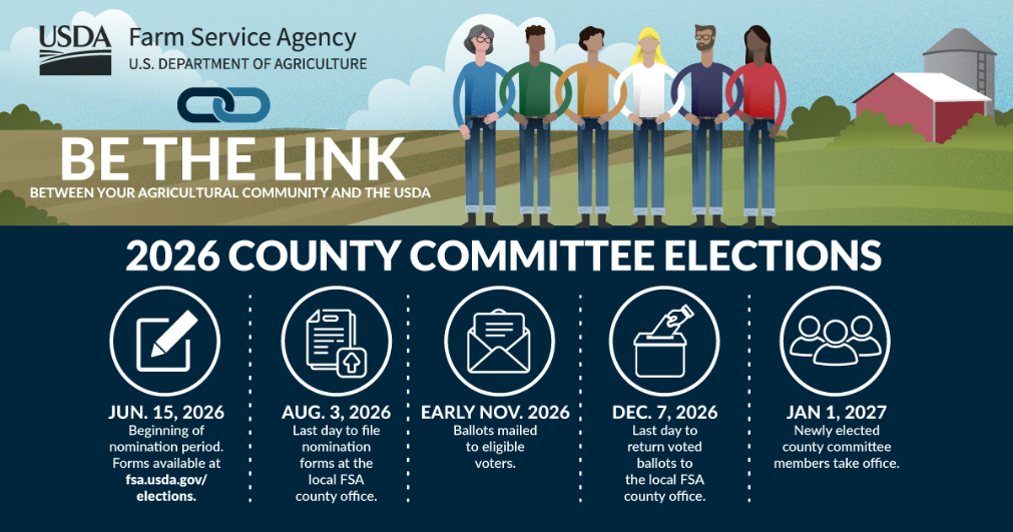 Nominations are now being accepted for farmers and ranchers to serve on local U.S. Department of Agriculture (USDA) Farm Service Agency (FSA) county committees. These committees make important decisions about how federal farm programs are administered locally. All nomination forms for the 2026 election must be postmarked or received in the local FSA office by Aug. 3, 2026.
Elections for committee members will occur in certain Local Administrative Areas (LAA). LAAs are FSA committee elective areas in a single county or multi-county jurisdiction and may include LAAs that are focused on an urban or suburban area.
Producers interested in serving on the FSA county committee can locate their LAA at fsa.usda.gov/coc and determine if their LAA is up for election by contacting their local FSA office.
Agricultural producers may be nominated for candidacy for the county committee if they:
- Participate or cooperate in a USDA program.
- Reside in the LAA that is up for election this year.
A cooperating producer is someone who has provided information about their farming or ranching operation to FSA, even if they have not applied or received program benefits.
Individuals may nominate themselves or others and qualifying organizations may also nominate candidates. USDA encourages all eligible producers to nominate, vote and hold office.
Nationwide, more than 7,700 dedicated members of the agriculture community serve on FSA county committees. The committees are made up of three to 11 members who serve three-year terms.
Committee members play a key role in how FSA delivers disaster recovery, conservation, commodity and price support programs, as well as making decisions on county office employment and other agricultural issues.
Producers should contact their local FSA office today to learn more about their county’s election. To be considered, a producer must sign an FSA-669A nomination form. This form and other information about FSA county committee elections are available at fsa.usda.gov/coc.
All nomination forms for the 2026 election must be postmarked or received in the local USDA Service Center by the Aug. 3, 2026, deadline. Election ballots will be mailed to eligible voters in November 2026.
^ back to top
 Significant enhancements to disaster assistance and commodity loan programs
The U.S. Department of Agriculture (USDA) is making significant improvements to its disaster assistance and commodity loan programs as outlined in the Working Families Tax Cuts Act. As part of the commitment to put Farmers First, USDA’s Farm Service Agency (FSA) is strengthening disaster assistance support for livestock producers, orchardists and nursery tree growers, increasing Marketing Assistance Loan rates, and expanding Marketing Assistance Loans to better help cotton and sugar producers.
Cumulatively, the changes outlined in the Working Families Tax Cuts Act provide a significant investment in American agriculture. Last month, FSA announced expanded payment limitation and payment eligibility provisions and the opportunity to increase base acres on eligible farms. FSA also previously announced that producers will benefit from increased reference prices for major commodities starting this fall. Additional policy enhancements for FSA disaster and commodity loan programs are taking effect.
Disaster Assistance Programs
USDA is expanding disaster assistance coverage and increasing benefits to help producers recover from eligible losses.
-
Emergency Assistance for Livestock, Honeybees, and Farm-Raised Fish Program (ELAP): ELAP helps producers with losses due to disease, certain adverse weather events, and qualifying conditions that are not covered by other USDA disaster assistance programs. Retroactive to Jan. 1, 2026, ELAP is providing benefits to farm-raised fish losses due to birds that feed on fish and has established a payment rate of $600 per acre of farm raised fish. Also, effective for 2026 losses, FSA will use a normal mortality rate of 15% for eligible honeybee colony losses.
-
Livestock Forage Disaster Program (LFP): LFP provides financial assistance to livestock producers who suffer eligible grazing losses due to a qualifying drought or fire. Retroactive to Jan. 1, 2026, the threshold has been lowered for producers to qualify for a one-month payment with payments now triggering after four consecutive weeks of qualifying severe drought (D2 on the U.S. Drought Monitor) conditions instead of eight weeks. And producers may receive a two-month payment if D2 drought conditions continue for seven out of eight consecutive weeks during the normal grazing period.
-
Livestock Indemnity Program (LIP): LIP helps livestock owners and contract growers who suffer livestock losses beyond normal mortality levels due to eligible adverse events. Starting this year, retroactive to Jan. 1, 2026, LIP rates increase to 100% for predation from animals listed as endangered or protected (compared with 75% of market value), and producers have the option to document regional price premiums that exceed the national average market price for eligible livestock losses. Additionally, LIP will also cover unborn livestock losses that occurred on or after Jan. 1, 2024. In most cases, the payment will be automatic for 2024 and 2025 losses based on LIP data on file with FSA with no action required by the producer.
-
Tree Assistance Program (TAP): TAP helps orchardists and nursery tree growers replant or rehabilitate trees, bushes, and vines that were lost due to an eligible natural disaster. Retroactive to Jan. 1, 2026, FSA is removing the 15% normal mortality rate, increasing the reimbursement rate for activities like pruning and removal, and extending the implementation period to 24 months with an option to extend.
Marketing Assistance Loans
Marketing Assistance Loans (MALs) help producers manage cash flow needs and provide marketing flexibility until market prices improve. Producers who choose to forego an MAL can receive a Loan Deficiency Payment (LDP) that provides immediate financial support without taking out a loan. Both are reauthorized through crop year 2031 and, starting in 2026, loan rates will increase for all eligible commodities. FSA is improving MALs for cotton and sugar producers by:
- Increasing cotton storage credit cap starting with the 2026 crop.
- Updating prevailing world market price for upland cotton, using the three lowest-price growth quotes instead of five. This change is retroactive to July 4, 2025.
- Calculating a new prevailing world market price for extra-long staple cotton, which will be announced weekly, similar to upland cotton.
- Authorizing refunds of upland cotton loan redemptions when the Adjusted World Price (AWP) declines within 30 days of the loan repayment date. Producers who request an LDP may be eligible for an additional LDP disbursement if a lower AWP is announced. This change is retroactive to July 4, 2025.
- Extending sugar program through 2031 and increasing raw cane and refined beet sugar loan rates. Additionally, sugar marketing allotments will be adjusted for beet sugar processors.
For more information on these updates to FSA programs, visit the respective program webpage. Producers interested in applying for disaster assistance, Marketing Assistance Loans, or other FSA programs should contact their local FSA office.
^ back to top
The U.S. Department of Agriculture’s Farm Service Agency (FSA) is expanding payment limitation and payment eligibility provisions that affect program payments including allowing for the equitable treatment of business entities. Additionally, producers will benefit from an increased payment limitation for certain programs, and a broader definition of farming income that will result in more exceptions to income limitations.
Payment Eligibility
Starting with the 2026 crop year, for payment eligibility purposes, FSA will treat applicable limited liability companies (LLCs) and S-Corporations (S-Corps), and other similar entities, as “pass through entities.” Each member of the qualified pass-through entity who meets actively engaged in farming criteria will help qualify the entity for expanded payments.
Previously, farm operations that were structured as an LLC or an S-Corp were limited to a single payment limitation, which varies by program. Now, partnerships, S-Corps, qualifying LLCs, and joint ventures or general partnerships will be treated the same.
For program year 2026 only, farm operations that are structured as LLCs or S-Corps or one of the new qualified pass-through entities must file updated farm operating plans with FSA for program year 2026 by Sept. 15, 2026. After program year 2026, FSA will continue to use June 1 as the date for determining ownership interest in an entity. Producers who have crop insurance or Noninsured Crop Disaster Assistance Program coverage should contact their crop insurance agent or local FSA office before restructuring their farm operation to ensure appropriate timing for restructuring without impacting current insurance coverage.
Members of qualified pass-through entities must provide contributions and be engaged in farming for the entity to be considered actively engaged in farming.
An additional change allows members of all entity types to receive compensation for labor and management contributions and use the same contribution to qualify as “actively engaged in farming.” This update provides consistent treatment of member contributions across all entity types.
Payment Limitation and Attribution
Payment limitation changes include an increased payment limit for the Agriculture Risk Coverage (ARC) and Price Loss Coverage (PLC) program. Starting with crop year 2025, the ARC and PLC payment limit will increase from $125,000 to $155,000. This payment limit will be adjusted going forward annually based on inflation.
Payment limitations are the maximum amount that a person or legal entity can receive for any crop year, directly or indirectly, through certain USDA programs. The same maximum payment limitation that applied to joint ventures and general partnerships will apply to qualified pass-through entities.
The policy change to payment limitation calculations takes effect beginning with program year 2026 for all qualified pass-through entities.
Average Adjusted Gross Income
The Working Families Tax Cuts Act broadened the definition of farming income to be more reflective of modern agricultural business practices. As a result, diversified producers will not be penalized under USDA’s requirements for average adjusted gross income (AGI).
Producers are exempt from the $900,000 AGI cap for conservation and disaster programs if at least 75% of their average gross income is from farming, ranching, or silviculture, which now includes agri-tourism, direct-to-consumer sales, and certain equipment sales.
Additionally, qualified pass-through entities are not required to certify compliance with the average AGI limitation at the entity level. However, members individually must meet average AGI requirements, which is the same requirement for joint operations.
Producers should contact their local FSA county office for more information or to update their farm operating plan by the Sept. 15, 2026, deadline for the 2026 program year.
^ back to top
U.S. Secretary of Agriculture Brooke L. Rollins announced payment rates and the enrollment period for the Assistance for Specialty Crops Farmers (ASCF) program. The U.S. Department of Agriculture (USDA) will issue $1.625 billion in payments to eligible specialty crop producers in response to elevated input costs and market disruptions resulting from foreign competitors engaging in unfair trade practices that impeded specialty crop exports. Producers who have a Login.gov account can access and submit their pre-filled application starting June 1, 2026. Producers who do not have a Login.gov account or prefer to enroll in person at their local Farm Service Agency (FSA) office can request their prefilled application beginning June 8, 2026. The ASCF enrollment period closes on Aug. 7, 2026.
These payments are authorized under the Commodity Credit Corporation Charter Act and are administered by the Farm Service Agency (FSA). Specialty crop payments are intended to provide financial support to allow producers to pay for production and marketing inputs in the face of significant market disruptions during the 2025 growing season.
How to Apply
Pre-filled applications will be available online to producers with a Login.gov account who timely filed their 2025 crop acreage report for eligible specialty crops. Starting on June 1, 2026, producers who have a Login.gov account can access and submit their pre-filled application from fsa.usda.gov/ascf. Beginning June 8, 2026, producers can request their pre-filled ASCF application from their FSA county office.
The deadline to submit completed ASCF applications is Aug. 7, 2026. Producers can complete their applications online or submit them to their FSA county office. Payments will be issued as applications are submitted and approved, beginning as early as the first week of signup.
Login.gov
Login.gov is the public’s one account for government. Producers can use one account and password for secure, private access to participating government agencies, including FSA.
To apply for ASCF online, producers can start by visiting fsa.usda.gov/ascf to create their Login.gov account. Producers who have an existing Login.gov account can work with FSA using their existing account.
With a secure Login.gov account, producers can be amongst the first to apply for ASCF, allowing them to view, complete, certify, and submit their application as well as track their application and payment status. For assistance creating a Login.gov account, visit login.gov/help.
Eligibility
Specialty crop acres of eligible crops reported to FSA as an initial, double crop, repeat crop, or subsequent crop by April 24, 2026, will be used to determine ASCF program payments. Acreage that is reported as a cover crop, prevented planted, or with an intended use of grazing, left standing, green manure, silage, forage, volunteer, or experimental will not be used to determine ASCF program payments.
For a list of eligible specialty crops visit fsa.usda.gov/ascf. Specialty crops grown in a controlled environment are not eligible, except for mushrooms.
Crop insurance linkage is not required; however, USDA strongly urges producers to take advantage of the new risk management tools provided in the Working Families Tax Cuts Act, also known as the One Big Beautiful Bill Act, to best protect against future price risk and volatility.
Payment Calculation
FSA used national average revenue per crop as a metric for developing the ASCF program payment categories and payment rates listed below. For a full list of eligible crops under each category, visit fsa.usda.gov/ascf.
-
Tier 1 - $650 per acre Includes eligible specialty crops with an average annual revenue of more than $10,000 per acre.
-
Tier 2 - $225 per acre Includes eligible specialty crops with an average annual revenue of more than $2,300 per acre and up to $10,000 per acre.
-
Tier 3 - $65 per acre Includes eligible specialty crops with an average annual revenue of up to $2,300 per acre.
-
Beans and Peas - $25 per acre Includes all types of beans and peas that were not eligible for the FBA program.
The ASCF payment limitation is $250,000.
More information on ASCF is available online at fsa.usda.gov/ascf. Producers can also contact their local FSA county office.
^ back to top
Book your next FSA appointment online!
The U.S. Department of Agriculture is putting farmers first by offering them a new option to schedule appointments online with their local Farm Service Agency (FSA) office. Following a successful pilot program, FSA is now using a digital appointment platform across the agency to allow producers to make farm program or farm loan appointments online at their convenience.
Producers can schedule appointments through FSA’s digital platform, Microsoft Bookings, using a mobile device, tablet, laptop or desktop computer. To assist producers in finding their local FSA office to make an appointment, FSA has also launched a new FSA County Office locator that is searchable by state and by county. Each county office contact page has a unique link for producers to make an appointment online and shows contact information for the local FSA office and the farm loan team. Appointments may be in-person or virtual with the local FSA office depending on producer preference.
Producers can conveniently schedule appointments for a variety of services with both farm program and farm loan staff. The Bookings-based system will automatically send a confirmation email to the producer along with reminder emails for upcoming appointments. Producers still have the option to call or visit their local FSA office in person to make an appointment.
For more information, producers can contact their local FSA office.
^ back to top
The USDA Farm Service Agency’s (FSA) Direct Farm Ownership loans are a resource to help farmers and ranchers become owner-operators of family farms, improve and expand current operations, increase agricultural productivity, and assist with land tenure to save farmland for future generations.
There are three types of Direct Farm Ownership Loans: regular, down payment and joint financing. FSA also offers a Direct Farm Ownership Microloan option for smaller financial needs up to $50,000.
Direct Farm Ownership Loans can be used to construct, purchase or improve farm dwellings, service buildings or other facilities, and to make improvements essential to an operation.
Applicants must provide FSA with an estimate of the total cost of all planned development that completely describe the work, prior to loan approval and must show proof of sufficient funds to pay for the total cost of all planned development at or before loan closing. In some instances, applicants may be asked to provide certified plans, specifications or contract documents. The applicant cannot incur any debts for materials or labor or make any expenditures for development purposes prior to loan closing with the expectation of being reimbursed from FSA funds.
Construction and development work may be performed either by the contract method or the borrower method. Under the contract method, construction and development contractors perform work according to a written contract with the applicant or borrower. If applying for a direct loan to finance a construction project, the applicant must obtain a surety bond that guarantees both payment and performance in the amount of the construction contract from a construction contractor if:
- The contract exceeds $100,000; or
- An authorized agency official determines that a surety bond appears advisable to protect the borrower against default of the contractor; or
- A contract provides for partial payments in excess of the amount of 60 percent of the value of the work in place
Under the borrower method, the applicant or borrower will perform the construction and development work. The borrower method may only be used when the authorized agency official determines, based on information from the applicant, that the applicant possesses or arranges to obtain the necessary skill and managerial ability to complete the work satisfactorily and that such work will not interfere with the applicant’s farming operation or work schedule.
Potential applicants should visit with FSA early in the initial project planning process to ensure environmental compliance.
For more eligibility requirements and information about FSA Loan programs, contact your Local County USDA Service Center or visit fsa.usda.gov.
^ back to top
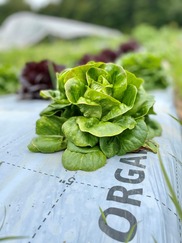
The U.S. Department of Agriculture (USDA) is helping organic producers and handlers cover certification costs as part of the Department’s effort to put Farmers First and Make America Healthy Again. USDA’s Farm Service Agency (FSA) is accepting applications to help with organic certification costs for the 2025 and 2026 program years through the Organic Certification Cost Share Program (OCCSP), which covers up to 75% of eligible organic certification costs. Producers and handlers must apply by Dec. 31, 2026, for both program years.
Cost Share Assistance
OCCSP provides cost share assistance to producers and handlers for the costs of obtaining or maintaining organic certification under the National Organic Program, which is administered by USDA’s Agricultural Marketing Service. Producers and handlers are eligible to receive 75% of the costs, up to $750 for each of the following scopes: crops, wild crops, livestock, processing/handling and state organic program fees.
FSA will make payments as applications are received on a first-come, first-served basis until available funds are depleted.
Eligibility
To be eligible for OCCSP, a producer or handler must have their USDA organic certification for the applicable program year at the time of application and must have paid fees or expenses related to the initial certification or renewal from a certifying agent during the program year. For program year 2025, they must have possessed a USDA organic certification at any time during the program year.
There are four USDA organic regulation recognized scopes that must be individually inspected and certified: crops, livestock, wild crops, and handling. The scopes must be listed on the producer or handler’s organic certificate to be eligible for OCCSP. Eligible costs include:
- Application and administrative fees for USDA organic certification
- Inspection fees for USDA organic certification, including travel and per diem costs for organic inspectors
- USDA organic certification costs, including fees necessary to access international markets with which AMS has equivalency agreements or arrangements
- State organic program fees
- User and sale assessment fees for USDA organic certification
- Postage costs for materials related to obtaining or renewing USDA organic certification.
How to Apply
To apply, producers and handlers should contact their local FSA county office. As part of completing the OCCSP application, producers and handlers will need to provide documentation of their organic certification and eligible expenses.
Organic producers and handlers may also apply for OCCSP through participating state agencies.
Opportunity for State Agency Participation
FSA will soon announce a 30-day application period for state agencies to apply through grants.gov to administer OCCSP.
If a state agency chooses to participate in OCCSP, both the state agency and FSA county offices in that state will accept OCCSP applications and make payments to eligible certified operations. However, producers and handlers may not receive OCCSP payments for the same scope through both the state agency and their FSA county office.
More Information
For more information, producers and handlers can visit the OCCSP webpage or contact their local FSA county office.
^ back to top
|
Many Farm Service Agency (FSA) programs require all program participants, either individuals or legal entities, to be “actively engaged in farming.” This means participants must provide a significant contribution to the farming operation, whether it is capital, land, equipment, active personal labor and/or management. For entities, each partner, stockholder or member with an ownership interest, must contribute active personal labor and/or management to the operation on a regular basis that is identifiable and documentable as well as separate and distinct from contributions of any other member. Members of qualified pass-through entities must have a share of the profits or losses from the farming operation commensurate with the member’s contributions to the operation and must make contributions to the farming operation that are at risk for a loss, with the level of risk being commensurate with the member’s claimed share on the farming operation.
Qualified pass-through entities comprised of non-family members or partners, stockholders or persons with an ownership in the farming operation must meet additional payment eligibility provisions. Qualified pass-through entities comprised of family members are exempt from these additional requirements. For 2026 and subsequent crop years, non-family qualified pass-through entities can have one member that may use a significant contribution of active personal management exclusively to meet the requirements to be determined “actively engaged in farming.” The person or member will be defined as the farm manager for the purposes of administering these management provisions.
Non-family qualified pass-through entities may request to add up to two additional managers for their farming operation based on the size and/or complexity of the operation. If additional farm managers are requested and approved, all members who contribute management are required to complete form CCC-902MR, Management Activity Record. The farm manager should use the form to record management activities including capital, labor and agronomics, which includes crop selection, planting decisions, acquisition of inputs, crop management and marketing decisions. One form should be used for each month and the farm manager should enter the number of hours of time spent for each activity under the date of the month the actions were completed. The farm manager must also document if each management activity was completed on the farm or remotely.
The records and supporting business documentation must be maintained and timely made available for review by the appropriate FSA reviewing authority, if requested.
If the farm manager fails to meet these requirements, their contribution of active personal management to the farming operation for payment eligibility purposes will be disregarded and their payment eligibility status will be re-determined for the applicable program year.
In some instances, additional persons or members of a non-family qualified pass-through entity who meet the definition of farm manager may also be allowed to use such a contribution of active personal management to meet the eligibility requirements. However, under no circumstances may the number of farm managers in a non-family qualified pass-through entityexceed a total of three in any given crop and program year.
^ back to top
The U.S. Department of Agriculture has announced that Rural Development is accepting applications for the Fertilizer Investment & Expansion for Long-term Domestic Supply (FIELDS) Program. The program will provide United States farmers with more access to domestic fertilizer for producing agricultural commodities.
The Commodity Credit Corporation is utilizing the services of USDA Rural Business-Cooperative Service to make funding available through FIELDS, with $500 million in awards to expand domestic production capacity, promote competition, strengthen supply chain resilience, and increase fertilizer availability for United States farmers in support of agricultural productivity and the production of agricultural commodities.
Eligible applicants include Tribes, Tribal entities, Alaska native corporations, for-profit entities, corporations, non-profit entities, producer-owned cooperatives and corporations, certified benefit corporations, and state or local government entities. Private entities must be independently owned and operated.
Projects funded through FIELDS may include expansions or upgrades of existing facilities, construction of new domestic production facilities, shovel-ready projects capable of rapidly increasing domestic supply, and on-site fertilizer terminals and transportation infrastructure that improve supply chain efficiency. The process of manufacturing fertilizer must be:
- Independent and outside the dominant fertilizer suppliers;
- Made in America;
- Innovative;
- Energy dominant and secure; and
- Farmer focused.
Priority will be given to projects in the later stages of development, technically feasible, financially viable, and have already identified other sources of funds.
Competitive, cost-share awards of $15 million up to $150 million are available to eligible entities to expand capacity, improve competition, and increase supply chain resilience within the agricultural fertilizer sector, in connection with the production of agricultural commodities. Matching funds are required under this funding opportunity.
Electronic applications must be submitted through Grants.gov by 11:59 p.m. on August 17, 2026. Details on eligibility and requirements are available on Grants.gov or by visiting https://www.rd.usda.gov/programs-services/business-programs/fertilizer-investment-expansion-long-term-domestic-supply.
If you’d like to subscribe to USDA Rural Development updates, visit our GovDelivery subscriber page.
^ back to top
The U.S. Department of Agriculture (USDA) Rural Development is accepting applications for grants to help eligible meat and poultry processors expand their operational capacity. The Meat and Poultry Processing Expansion Program (MPPEP) reflects Secretary Brooke Rollins’ efforts under the leadership of the Trump administration to fortify the American beef industry, strengthen competition, support sustainable growth in the U.S. meat processing sector, and improve overall supply chain resiliency.
USDA is making $60 million in grant funding available through Phase 4 of MPPEP. This phase is designed to support the American beef industry by diversifying the meat and poultry supply chain and expanding access to local market opportunities.
“Strengthening local and regional meat processing capacity is vital to our strategy to support producers and ensure consumers have reliable access to high-quality American beef at affordable prices,” said USDA Rural Development Southern New England State Director Christopher Lyon. “These investments help create new market opportunities, build resilience in our supply chain and support the long-term economic vitality of our rural communities.”
Eligible applicants include for‑profit organizations, nonprofit organizations, producer-owned cooperatives, tribes, and tribal entities. All applicants must be domestically owned, independently operated (if privately owned) and have facilities physically located and operating within the United States or its territories. Facilities must primarily process cattle to qualify, though grant funds or equipment may be used for processing other meat and poultry products at the same location.
Funding for Phase 4 will be split into two competitions: Very Small Processors and Small Processors, and Intermediate Processors.
Two types of applications will be accepted for each competition:
Processing Expansion Projects: Awards ranging from $50,000 to $2 million will support activities that increase and diversify processing capacity, including equipment purchases over $250,000 and necessary facility improvements. A 50 percent match is required.
Simplified Equipment‑Only Projects: Awards ranging from $10,000 to $250,000 are available for equipment‑only proposals that exclude installation, labor, renovation and certification costs. A 25 percent match is required.
Electronic applications must be submitted through Grants.gov by 11:59 p.m. on August 7, 2026. Full eligibility details and requirements are available on Grants.gov and on the MPPEP website at https://www.rd.usda.gov/programs-services/business-programs/meat-and-poultry-processing-expansion-program-phase-4
About USDA Rural Development
USDA Rural Development is committed to improving the economy and quality of life in rural America. Through loan, grant and loan guarantee programs, USDA assists communities with infrastructure improvements; business development; housing; community facilities such as schools, public safety and health care; and high-speed internet access. For more information, visit www.rd.usda.gov. For more information on USDA Rural Development investments in rural America, visit the Rural Data Gateway. The Rural Data Gateway is an online tool that strengthens USDA Rural Development partnerships with rural people, entrepreneurs, government officials and Congress by making investment data accessible to the public.
Learn more online at www.rd.usda.gov, subscribe to GovDelivery updates and follow us on X at @RD_SNE
^ back to top
Connecticut State NRCS Office
344 Merrow Road, Suite A
Tolland, CT 06084-3917
Phone: 860-871-4011
Connecticut NRCS State Website
Connecticut State FSA Office
344 Merrow Road, Suite B
Tolland, CT 06084-3917
Phone: 860-871-4090
Fax: 855-934-2463
State Executive Director:
Robert Sullivan
|
|
Connecticut FSA State Website
|
|
State Office Staff:
Rebecca Palmer, Acting Deputy State Executive Director/ Program Chief
Jule Dybdahl, Administrative Officer
Claire Vaterlaus-Staby, Outreach Coordinator
Keith Durao, Administrative Specialist
|
State Committee Chair:
Jeffery Lipton
State Committee Members:
Kelly Bloom
Shane Collett
Joseph Geremia
Kies Orr LaVack
|
Top of page
|