
South Dakota USDA Newsletter - July 21, 2026
In This Issue:
Greetings from the South Dakota FSA State Office,
The celebration of America’s 250th Anniversary is now complete and hopefully you all had a great Independence Day Holiday!
The calendar has turned to July so the first half of the year is now complete. South Dakota farmers and ranchers are experiencing a vast difference in climate and soil moisture across the state. While some areas are parched and dry, other areas are experiencing flooding which has prevented planting. At the state office we know these diverse conditions exist and understand that producers will have different needs for FSA assistance. Many of our FSA Disaster Recovery Programs are based on your location, so I encourage you to sign up to receive email and text messages from your local county office. You can stay updated on the latest USDA news by subscribing online here. For text messaging, simply send a text message to 372669 with the State Abbreviation and County Name (i.e. SDBeadle).
In addition to disaster programs, we see strong participation in FSA’s Conservation Reserve Program (CRP). South Dakota is among the top three states for total acres accepted into CRP in 2026, including General CRP, Grassland CRP, and Continuous CRP. Our producers recognize the importance of allowing land to rest and be utilized for conservation.
Please contact your local FSA County Office with questions or to discuss eligibility for any FSA programs. You can also now use our new FSA Office Locator tool to book an appointment to meet with your local FSA farm program and farm loan staff.
Roger Chase
State Executive Director, South Dakota FSA
Top of page
Greetings,
I first want to acknowledge the storms that have swept through both the Highmore and Huron areas—my heart goes out to producers and families who were affected. USDA’s Natural Resources Conservation Service (NRCS) provides financial resources through its Environmental Quality Incentives Program and Conservation Stewardship Program to offer long-term support to help recover from natural disasters and conserve water resources. NRCS staff are always available to provide free technical assistance related to disaster recovery.
Small grain harvest time has arrived in South Dakota and with that is the opportunity to plant cover crops into the stubble. Visit our Cover Crops in South Dakota webpage to find resources on cover crop selection and management by accessing the cover crop table, chart, guidance, and even download the poster which is a great tool for agronomists, seed suppliers, and producers planning cover crop plantings as it references 20 plant characteristics such as rooting depth and salinity tolerance for over 40 common cover crop plants. If you are unable to download this poster, visit your local NRCS office for a copy.
Thank you to all South Dakota farmers, ranchers, land managers, landowners, and conservation partners who are moving the needle of conservation in our state.
Sincerely,
Jessica Michalski
Acting State Conservationist, South Dakota NRCS
Top of page
July 28, 2026 - Disaster Losses and Related Tax Rules Webinar: 1:00 - 2:30 p.m. Central. Presenters: JC Hobbs, Oklahoma State University and Adam Kantrovich, Clemson University. Register for the Webinar.
July 31, 2026 - Deadline to submit feedback that fuels local working groups focuses: sdconservation.org/share-what-youre-seeing
August 3, 2026 - All nomination forms for the 2026 FSA County Committee election must be postmarked or received in the local FSA office by Aug. 3, 2026
August 7, 2026 - Deadline to apply for 2025 Assistance for Specialty Crop Farmers (ASCF) Program
August 12, 2026 - Deadline to apply for Supplemental Disaster Relief Program Stage 1, Stage 1 Quality and Stage 2
July 2026
|
Farm Operating Loans — Direct
|
5.125% |
|
Farm Ownership Loans — Direct
|
6.000% |
|
Farm Ownership Loans — Direct Down Payment, Beginning Farmer or Rancher
|
2.000% |
|
Emergency Loans
|
3.750% |
|
Farm Storage Facility Loans (7 years)
|
4.375% |
Top of page
The U.S. Department of Agriculture (USDA) is making significant improvements to its disaster assistance and commodity loan programs as outlined in the Working Families Tax Cuts Act. As part of the commitment to put Farmers First, USDA’s Farm Service Agency (FSA) is strengthening disaster assistance support for livestock producers, orchardists and nursery tree growers, increasing Marketing Assistance Loan rates, and expanding Marketing Assistance Loans to better help cotton and sugar producers.
Cumulatively, the changes outlined in the Working Families Tax Cuts Act provide a significant investment in American agriculture. Last month, FSA announced expanded payment limitation and payment eligibility provisions and the opportunity to increase base acres on eligible farms. FSA also previously announced that producers will benefit from increased reference prices for major commodities starting this fall. Additional policy enhancements for FSA disaster and commodity loan programs are taking effect.
Disaster Assistance Programs
USDA is expanding disaster assistance coverage and increasing benefits to help producers recover from eligible losses.
-
Emergency Assistance for Livestock, Honeybees, and Farm-Raised Fish Program (ELAP): ELAP helps producers with losses due to disease, certain adverse weather events, and qualifying conditions that are not covered by other USDA disaster assistance programs. Retroactive to Jan. 1, 2026, ELAP is providing benefits to farm-raised fish losses due to birds that feed on fish and has established a payment rate of $600 per acre of farm raised fish. Also, effective for 2026 losses, FSA will use a normal mortality rate of 15% for eligible honeybee colony losses.
-
Livestock Forage Disaster Program (LFP): LFP provides financial assistance to livestock producers who suffer eligible grazing losses due to a qualifying drought or fire. Retroactive to Jan. 1, 2026, the threshold has been lowered for producers to qualify for a one-month payment with payments now triggering after four consecutive weeks of qualifying severe drought (D2 on the U.S. Drought Monitor) conditions instead of eight weeks. And producers may receive a two-month payment if D2 drought conditions continue for seven out of eight consecutive weeks during the normal grazing period.
-
Livestock Indemnity Program (LIP): LIP helps livestock owners and contract growers who suffer livestock losses beyond normal mortality levels due to eligible adverse events. Starting this year, retroactive to Jan. 1, 2026, LIP rates increase to 100% for predation from animals listed as endangered or protected (compared with 75% of market value), and producers have the option to document regional price premiums that exceed the national average market price for eligible livestock losses. Additionally, LIP will also cover unborn livestock losses that occurred on or after Jan. 1, 2024. In most cases, the payment will be automatic for 2024 and 2025 losses based on LIP data on file with FSA with no action required by the producer.
-
Tree Assistance Program (TAP): TAP helps orchardists and nursery tree growers replant or rehabilitate trees, bushes, and vines that were lost due to an eligible natural disaster. Retroactive to Jan. 1, 2026, FSA is removing the 15% normal mortality rate, increasing the reimbursement rate for activities like pruning and removal, and extending the implementation period to 24 months with an option to extend.
Marketing Assistance Loans
Marketing Assistance Loans (MALs) help producers manage cash flow needs and provide marketing flexibility until market prices improve. Producers who choose to forego an MAL can receive a Loan Deficiency Payment (LDP) that provides immediate financial support without taking out a loan. Both are reauthorized through crop year 2031 and, starting in 2026, loan rates will increase for all eligible commodities. FSA is improving MALs for cotton and sugar producers by:
- Increasing cotton storage credit cap starting with the 2026 crop.
- Updating prevailing world market price for upland cotton, using the three lowest-price growth quotes instead of five. This change is retroactive to July 4, 2025.
- Calculating a new prevailing world market price for extra-long staple cotton, which will be announced weekly, similar to upland cotton.
- Authorizing refunds of upland cotton loan redemptions when the Adjusted World Price (AWP) declines within 30 days of the loan repayment date. Producers who request an LDP may be eligible for an additional LDP disbursement if a lower AWP is announced. This change is retroactive to July 4, 2025.
- Extending sugar program through 2031 and increasing raw cane and refined beet sugar loan rates. Additionally, sugar marketing allotments will be adjusted for beet sugar processors.
For more information on these updates to FSA programs, visit the respective program webpage. Producers interested in applying for disaster assistance, Marketing Assistance Loans, or other FSA programs should contact their local FSA office.
Top of page
The U.S. Department of Agriculture’s Farm Service Agency (FSA) is expanding payment limitation and payment eligibility provisions that affect program payments including allowing for the equitable treatment of business entities. Additionally, producers will benefit from an increased payment limitation for certain programs, and a broader definition of farming income that will result in more exceptions to income limitations.
Payment Eligibility
Starting with the 2026 crop year, for payment eligibility purposes, FSA will treat applicable limited liability companies (LLCs) and S-Corporations (S-Corps), and other similar entities, as “pass through entities.” Each member of the qualified pass-through entity who meets actively engaged in farming criteria will help qualify the entity for expanded payments.
Previously, farm operations that were structured as an LLC or an S-Corp were limited to a single payment limitation, which varies by program. Now, partnerships, S-Corps, qualifying LLCs, and joint ventures or general partnerships will be treated the same.
For program year 2026 only, farm operations that are structured as LLCs or S-Corps or one of the new qualified pass-through entities must file updated farm operating plans with FSA for program year 2026 by Sept. 15, 2026. After program year 2026, FSA will continue to use June 1 as the date for determining ownership interest in an entity. Producers who have crop insurance or Noninsured Crop Disaster Assistance Program coverage should contact their crop insurance agent or local FSA office before restructuring their farm operation to ensure appropriate timing for restructuring without impacting current insurance coverage.
Members of qualified pass-through entities must provide contributions and be engaged in farming for the entity to be considered actively engaged in farming.
An additional change allows members of all entity types to receive compensation for labor and management contributions and use the same contribution to qualify as “actively engaged in farming.” This update provides consistent treatment of member contributions across all entity types.
Payment Limitation and Attribution
Payment limitation changes include an increased payment limit for the Agriculture Risk Coverage (ARC) and Price Loss Coverage (PLC) program. Starting with crop year 2025, the ARC and PLC payment limit will increase from $125,000 to $155,000. This payment limit will be adjusted going forward annually based on inflation.
Payment limitations are the maximum amount that a person or legal entity can receive for any crop year, directly or indirectly, through certain USDA programs. The same maximum payment limitation that applied to joint ventures and general partnerships will apply to qualified pass-through entities.
The policy change to payment limitation calculations takes effect beginning with program year 2026 for all qualified pass-through entities.
Average Adjusted Gross Income
The Working Families Tax Cuts Act broadened the definition of farming income to be more reflective of modern agricultural business practices. As a result, diversified producers will not be penalized under USDA’s requirements for average adjusted gross income (AGI).
Producers are exempt from the $900,000 AGI cap for conservation and disaster programs if at least 75% of their average gross income is from farming, ranching, or silviculture, which now includes agri-tourism, direct-to-consumer sales, and certain equipment sales.
Additionally, qualified pass-through entities are not required to certify compliance with the average AGI limitation at the entity level. However, members individually must meet average AGI requirements, which is the same requirement for joint operations.
Producers should contact their local FSA county office for more information or to update their farm operating plan by the Sept. 15, 2026, deadline for the 2026 program year.
Top of page
U.S. Secretary of Agriculture Brooke L. Rollins announced payment rates and the enrollment period for the Assistance for Specialty Crops Farmers (ASCF) program. The U.S. Department of Agriculture (USDA) will issue $1.625 billion in payments to eligible specialty crop producers in response to elevated input costs and market disruptions resulting from foreign competitors engaging in unfair trade practices that impeded specialty crop exports. Producers who have a Login.gov account can access and submit their pre-filled application starting June 1, 2026. Producers who do not have a Login.gov account or prefer to enroll in person at their local Farm Service Agency (FSA) office can request their prefilled application beginning June 8, 2026. The ASCF enrollment period closes on Aug. 7, 2026.
These payments are authorized under the Commodity Credit Corporation Charter Act and are administered by the Farm Service Agency (FSA). Specialty crop payments are intended to provide financial support to allow producers to pay for production and marketing inputs in the face of significant market disruptions during the 2025 growing season.
How to Apply
Pre-filled applications will be available online to producers with a Login.gov account who timely filed their 2025 crop acreage report for eligible specialty crops. Starting on June 1, 2026, producers who have a Login.gov account can access and submit their pre-filled application from fsa.usda.gov/ascf. Beginning June 8, 2026, producers can request their pre-filled ASCF application from their FSA county office.
The deadline to submit completed ASCF applications is Aug. 7, 2026. Producers can complete their applications online or submit them to their FSA county office. Payments will be issued as applications are submitted and approved, beginning as early as the first week of signup.
Login.gov
Login.gov is the public’s one account for government. Producers can use one account and password for secure, private access to participating government agencies, including FSA.
To apply for ASCF online, producers can start by visiting fsa.usda.gov/ascf to create their Login.gov account. Producers who have an existing Login.gov account can work with FSA using their existing account.
With a secure Login.gov account, producers can be amongst the first to apply for ASCF, allowing them to view, complete, certify, and submit their application as well as track their application and payment status. For assistance creating a Login.gov account, visit login.gov/help.
Eligibility
Specialty crop acres of eligible crops reported to FSA as an initial, double crop, repeat crop, or subsequent crop by April 24, 2026, will be used to determine ASCF program payments. Acreage that is reported as a cover crop, prevented planted, or with an intended use of grazing, left standing, green manure, silage, forage, volunteer, or experimental will not be used to determine ASCF program payments.
For a list of eligible specialty crops visit fsa.usda.gov/ascf. Specialty crops grown in a controlled environment are not eligible, except for mushrooms.
Crop insurance linkage is not required; however, USDA strongly urges producers to take advantage of the new risk management tools provided in the Working Families Tax Cuts Act, also known as the One Big Beautiful Bill Act, to best protect against future price risk and volatility.
Payment Calculation
FSA used national average revenue per crop as a metric for developing the ASCF program payment categories and payment rates listed below. For a full list of eligible crops under each category, visit fsa.usda.gov/ascf.
-
Tier 1 - $650 per acre Includes eligible specialty crops with an average annual revenue of more than $10,000 per acre.
-
Tier 2 - $225 per acre Includes eligible specialty crops with an average annual revenue of more than $2,300 per acre and up to $10,000 per acre.
-
Tier 3 - $65 per acre Includes eligible specialty crops with an average annual revenue of up to $2,300 per acre.
-
Beans and Peas - $25 per acre Includes all types of beans and peas that were not eligible for the FBA program.
The ASCF payment limitation is $250,000.
More information on ASCF is available online at fsa.usda.gov/ascf. Producers can also contact their local FSA county office.
Top of page
The U.S. Department of Agriculture (USDA) is helping organic producers and handlers cover certification costs as part of the Department’s effort to put Farmers First and Make America Healthy Again. USDA’s Farm Service Agency (FSA) is accepting applications to help with organic certification costs for the 2025 and 2026 program years through the Organic Certification Cost Share Program (OCCSP), which covers up to 75% of eligible organic certification costs. Producers and handlers must apply by Dec. 31, 2026, for both program years.
Cost Share Assistance
OCCSP provides cost share assistance to producers and handlers for the costs of obtaining or maintaining organic certification under the National Organic Program, which is administered by USDA’s Agricultural Marketing Service. Producers and handlers are eligible to receive 75% of the costs, up to $750 for each of the following scopes: crops, wild crops, livestock, processing/handling and state organic program fees.
FSA will make payments as applications are received on a first-come, first-served basis until available funds are depleted.
Eligibility
To be eligible for OCCSP, a producer or handler must have their USDA organic certification for the applicable program year at the time of application and must have paid fees or expenses related to the initial certification or renewal from a certifying agent during the program year. For program year 2025, they must have possessed a USDA organic certification at any time during the program year.
There are four USDA organic regulation recognized scopes that must be individually inspected and certified: crops, livestock, wild crops, and handling. The scopes must be listed on the producer or handler’s organic certificate to be eligible for OCCSP. Eligible costs include:
- Application and administrative fees for USDA organic certification
- Inspection fees for USDA organic certification, including travel and per diem costs for organic inspectors
- USDA organic certification costs, including fees necessary to access international markets with which AMS has equivalency agreements or arrangements
- State organic program fees
- User and sale assessment fees for USDA organic certification
- Postage costs for materials related to obtaining or renewing USDA organic certification.
How to Apply
To apply, producers and handlers should contact their local FSA county office. As part of completing the OCCSP application, producers and handlers will need to provide documentation of their organic certification and eligible expenses.
Organic producers and handlers may also apply for OCCSP through participating state agencies.
Opportunity for State Agency Participation
FSA will soon announce a 30-day application period for state agencies to apply through grants.gov to administer OCCSP.
If a state agency chooses to participate in OCCSP, both the state agency and FSA county offices in that state will accept OCCSP applications and make payments to eligible certified operations. However, producers and handlers may not receive OCCSP payments for the same scope through both the state agency and their FSA county office.
More Information
For more information, producers and handlers can visit the OCCSP webpage or contact their local FSA county office.
Top of page
The U.S. Department of Agriculture’s (USDA) Farm Service Agency (FSA) announced eligible landowners have from June 1 until Aug. 31, 2026, to review and consider base acre increases on farms enrolled in the Agriculture Risk Coverage (ARC) and Price Loss Coverage (PLC) programs, as authorized by provisions included in the Working Families Tax Cuts Act, also known as the One Big Beautiful Bill Act.
The Act provides landowners with the opportunity to increase base acres in preparation for enrollment in ARC and PLC beginning with the 2026 and future crop years. Nationwide, up to 30 million new base acres can be added by eligible farms.
ARC and PLC are cornerstone commodity safety net programs that provide financial protection to farmers when market prices or revenues decline. These programs help producers manage risk and maintain the economic viability of their operations amid challenging market and weather conditions.
FSA began notifying eligible landowners, by direct mail, that Base Allocation Summaries outlining potential base acre increases will be available for review beginning June 1, 2026. These Base Allocation Summaries can be accessed online at fsa.usda.gov/arc-plc using a Login.gov account. Landowners who do not currently have a Login.gov account are encouraged to contact their local FSA county office to obtain their Base Allocation Summary beginning June 1, 2026. The Base Allocation Summary should be reviewed and any necessary actions completed by Monday, Aug. 31, 2026.
Farm operators often maintain detailed historical planting records. Early communication between landowners and farm operators will ensure the Base Allocation Summary is accurate and all necessary actions are completed by the deadline.
To be eligible for new base acres, a current covered commodity must have been planted or prevented from being planted on the farm during the 2019 through 2023 crop years. The farm’s average planted and prevented planted acres during that period must exceed the total existing base acres for all covered commodities in effect on Sept. 30, 2024, excluding unassigned base acres. FSA farm total base acres cannot exceed the farm’s total cropland acres. If eligible requests exceed the nationwide cap of 30 million acres, USDA will apply an across-the-board, prorated reduction to all approved new base acres.
For additional information, producers should contact their local FSA county office or visit U.S. Department of Agriculture online at fsa.usda.gov/state-offices.
Top of page
Farm Service Agency (FSA) farm loans are considered progression lending. Unlike loans from a commercial lender, FSA loans are intended to be temporary in nature. Our goal is to help you graduate to commercial credit, and our farm loan staff is available to help borrowers through training and credit counseling.
The FSA team will help borrowers identify their goals to ensure financial success. FSA staff will advise borrowers on developing strategies and a plan to meet your goals and graduate to commercial credit. FSA borrowers are responsible for the success of their farming operation, but FSA staff will help in an advisory role, providing the tools necessary to help you achieve your operational goals and manage your finances.
For more information on FSA farm loan programs, contact your local County USDA Service Center or visit fsa.usda.gov.
Top of page
Farm Service Agency (FSA) is committed to providing our farm loan borrowers the tools necessary to be successful. FSA staff will provide guidance and counsel from the loan application process through the borrower’s graduation to commercial credit. While it is FSA’s commitment to advise borrowers as they identify goals and evaluate progress, it is crucial for borrowers to communicate with their farm loan staff when changes occur. It is the borrower’s responsibility to alert FSA to any of the following:
- Any proposed or significant changes in the farming operation
- Any significant changes to family income or expenses
- The development of problem situations
- Any losses or proposed significant changes in security
If a farm loan borrower can’t make payments to suppliers, other creditors, or FSA on time, contact your farm loan staff immediately to discuss loan servicing options.
For more information on FSA farm loan programs, contact your local County USDA Service Center or visit fsa.usda.gov.
Top of page
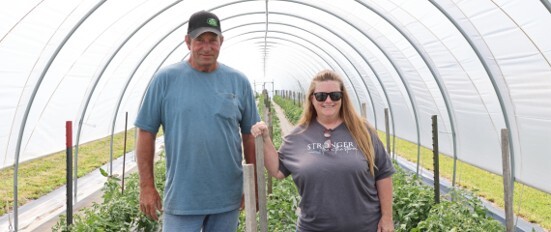 Nestled two miles east and nine miles south of the historic 1880 Town near Midland, South Dakota (SD), Cedar Creek Gardens is operated by Bud Manke and Peggy Martin, whose mission is to grow high-quality, nutritious produce for local consumers and to support the health and well‑being of their community. Passionate about bringing the vibrant flavors of SD to local schools, Cedar Creek Gardens provides farm‑to‑school lunch programs, giving students access to fresh, local produce. They also supply wholesale fruits and vegetables to restaurants, chefs, caterers, food trucks, small grocers, and institutional buyers seeking SD‑grown products.
Support from USDA’s Natural Resources Conservation Service (NRCS) has assisted with advancements to the operation over the years, starting with the first Environmental Quality Incentives Program (EQIP)-funded high tunnel in the state of SD back in 2010 (still used in vegetable production today). Bud and Peggy now operate a network of high tunnels, low tunnels, and caterpillar tunnels that extend the growing season and protect crops from heat, frost, and extreme weather. Their 200‑foot caterpillar tunnels (double the length of a typical 100-foot tunnel) are 14-16 feet wide and ten feet tall, holding 600 pepper plants or 300 tomato plants in each tunnel. In total, 1,300 pounds of tomatoes were planted this growing season.
Starting the planting process early is critical because planting too late in the season can put the entire crop at risk. Just three hours at 104 degrees or higher can lead to total crop failure. Peggy said, “tomatoes don’t like to set fruit above 85 degrees, people get their tomatoes in too late, and they will see beautiful tomato plants, but no fruit because it gets too hot.” At Cedar Creek Gardens, tomatoes are planted in late April, and without the low tunnels covered with frost cloth within cat tunnel system, the crop would not survive due to late frost. State Urban Conservationist, Rachel Lawton, echoed the sentiment saying, “ensure that tomatoes grown in high tunnels are well ventilated because if the high tunnel gets too hot, even for a short amount of time, you’ll likely not have a great harvest.”
Water management is one of their greatest challenges. Rotating between three wells running almost nonstop from May through September, Bud often wakes a couple times throughout the night to adjust the water to keep crops hydrated. Also added into their mix is a Dosatron injector that provides nutrients through the irrigation system, along with pre‑season foliar inputs like molasses. The result: tomato plants producing 40–50 pounds of fruit each, which is double the average home garden.
Cedar Creek Gardens has no lack of ingenuity. Being far from a lumberyard, they have built much of their equipment from salvaged materials, including a custom root washer made with a 21‑to‑1 reduction motor—now eight years into service. They have also built mobile PVC wash stations and even a homemade lettuce washing “salad spinner” created from an old washing machine.
Seeing potential for energy upgrades on their operation, they sought out an energy audit and applied financial assistance through NRCS’s Conservation Innovation Grant via an EQIP contract. After an energy audit, Cedar Creek did LED lighting upgrades in their greenhouses and sheds. Three automatic controllers were placed in the greenhouses to monitor air temperature and raise and lower the sides of the greenhouse curtains to reduce the usage of the fans and save energy usage due to the fans having to run less.
Cedar Creek Gardens demonstrates how conservation, creativity, and NRCS partnership help SD producers thrive, even in challenging conditions. Peggy attributes soil health to the foundation of their success. “I would highly, highly recommend everybody do a soil test,” she said. “You can waste a whole year and not have high production if you don’t.”
Top of page
The U.S. Department of Agriculture (USDA) is expanding coverage options to add revenue protection for forage producers in 12 states, part of the Department’s efforts to put Farmers First through improved crop insurance. Implemented by USDA’s Risk Management Agency (RMA), the new coverage options guard against both yield losses and decline in price due to market changes.
This insurance policy will be structured similarly to other Federal crop insurance revenue programs, replacing Actual Production History (APH) coverage for forage production in select counties located in California, Idaho, Iowa, Michigan, Minnesota, Montana, Nebraska, North Dakota, Pennsylvania, South Dakota, Washington, and Wisconsin beginning with the 2027 crop year.
Forage producers in eligible areas will have three plan options under this change:
- Yield Protection (YP): Provides coverage against loss in yield.
- Revenue Protection (RP): Provides coverage against loss in revenue due to a yield loss, price decline, or yield loss at higher prices.
- Revenue Protection with Harvest Price Exclusions (RP-HPE): Provides coverage against loss in revenue due to a yield loss, decrease in the harvest price below the projected price, or both.
Interested producers in eligible areas should contact a crop insurance agent to enroll before the sales closing date of Sept. 30, 2026. The existing APH-based Forage Production insurance program will continue to be available to producers in all other states where the program is currently offered.
Top of page
USDA in South Dakota
200 4th Street SW
Huron, SD 57350
FSA Phone: (605) 352-1160
NRCS Phone: (605) 352-1200
RMA Phone: (406) 651-8450
|
|
South Dakota Farm Service Agency
South Dakota Natural Resources Conservation Service
|
|
Farm Service Agency
State Executive Director:
Roger Chase
Deputy State Executive Director:
Ryan Vanden Berge
Administrative Officer:
Theresa Hoadley
Program Managers:
Owen Fagerhaug - Conservation
Logan Kopfmann - Disaster Relief
Donita Garry - Program Delivery
Bridget Weber - Farm Loan Program
South Dakota State Committee:
Mark Gross | Chair
Chance Davis | Member
Douglas Noem | Member
Betsy Pravecek | Member
Brian Top | Member
|
Natural Resources Conservation
Service
Acting State Conservationist:
Jessica Michalski
Assistant State Conservationists:
Jessica Michalski - Ecological Sciences
James Reedy - Engineering
Nathan Jones - Soils
Val Dupraz - Programs
Deke Hobbick - Compliance
Denise Gauer - Management & Strategy
|
|
South Dakota FSA State Committee Meeting: August 25, 2026, 9:00 a.m.- 4:30 p.m. CT at Federal Building, 200 4th Street SW, Huron, SD 57350.
- Questions? Contact Jean Wharton at jean.wharton@usda.gov.
- If you need to request an accommodation, please contact Jean Wharton at (605) 352-1160 or jean.wharton@usda.gov by August 15, 2026, to request accommodations (e.g., an interpreter, translator, seating arrangements, etc.) or materials in an alternative format (e.g., Braille, large print, audiotape - captioning, etc.).
|
| Get Started at Your USDA Service Center |
|






