FSA NEWSLETTER -- JUNE 2026
 In This Issue:
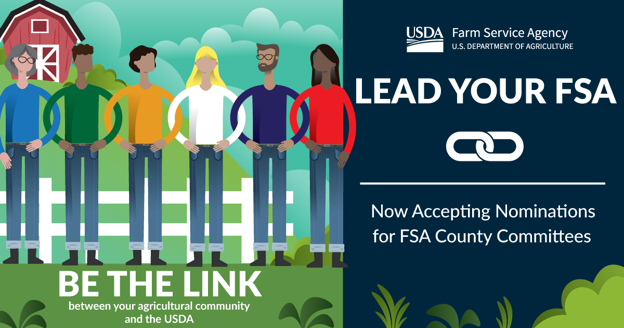
Nominations are now being accepted for farmers and ranchers to serve on local U.S. Department of Agriculture (USDA) Farm Service Agency (FSA) county committees. These committees make important decisions about how federal farm programs are administered locally. All nomination forms for the 2026 election must be postmarked or received in the local FSA office by Aug. 3, 2026.
Learn more about county committee nominations.
Farm Service Agency (FSA) reminds producers that annual acreage reporting is an important eligibility requirement to receive financial benefits through the Livestock Forage Disaster Assistance Program (LFP), as well as several other FSA-administered programs.
The next deadline for annual acreage reporting in Oklahoma is July 15, 2026. This includes common spring-planted crops, such as corn, soybeans, wheat, and grain sorghum, but also includes perennial grass (pasture) and Conservation Reserve Program acres.
Noninsured Crop Disaster Assistance Program (NAP) policy holders should note that the acreage reporting date for NAP-covered crops is July 15, 2026, or 15 calendar days before grazing or harvesting of the crop begins.
Even though the acreage reporting deadline is months away, we are encouraging producers with pasture acres and acres planted for grazing purposes to complete certification of those acres as soon as possible to assist us with preparations for potential program implementation.
LFP provides financial assistance to livestock producers and contract growers who also are producers of grazed forage crop acres (native and improved pasture and crops planted specifically for grazing purposes) and who have suffered a loss due to a qualifying drought during the grazing season.
Other points regarding LFP and acreage certification:
- Producers must have a risk in the pasture or hay crop acres in order to complete the acreage certification process.
- If a producer applies for LFP they must be able to support their application with either a written lease or an Annual Lease Certification (CCC-855).
- In addition to the acreage reporting requirement, LFP applicants who lease acres must be able to support their application with either a written lease or an Annual Lease Certification (CCC-855).
- Producers who previously have certified grazing land through a continuous certification may want to contact the county FSA office to ensure that certification remains in place and reflects 2026 producers and shares.
Producers can contact their County FSA for additional information.
The U.S. Department of Agriculture’s (USDA) Farm Service Agency (FSA) announced eligible landowners have from June 1 until Aug. 31, 2026 to review and consider base acre increases on farms enrolled in the Agriculture Risk Coverage (ARC) and Price Loss Coverage (PLC) programs, as authorized by provisions included in the Working Families Tax Cuts Act, also known as the One Big Beautiful Bill Act.
The Act provides landowners with the opportunity to increase base acres in preparation for enrollment in ARC and PLC beginning with the 2026 and future crop years. Nationwide, up to 30 million new base acres can be added by eligible farms.
ARC and PLC are cornerstone commodity safety net programs that provide financial protection to farmers when market prices or revenues decline. These programs help producers manage risk and maintain the economic viability of their operations amid challenging market and weather conditions.
FSA began notifying eligible landowners, by direct mail, that Base Allocation Summaries outlining potential base acre increases will be available for review beginning June 1, 2026. These Base Allocation Summaries can be accessed online at fsa.usda.gov/arc-plc using a Login.gov account. Landowners who do not currently have a Login.gov account are encouraged to contact their local FSA county office to obtain their Base Allocation Summary beginning June 1, 2026. The Base Allocation Summary should be reviewed and any necessary actions completed by Monday, Aug. 31, 2026.
Farm operators often maintain detailed historical planting records. Early communication between landowners and farm operators will ensure the Base Allocation Summary is accurate and all necessary actions are completed by the deadline.
To be eligible for new base acres, a current covered commodity must have been planted or prevented from being planted on the farm during the 2019 through 2023 crop years. The farm’s average planted and prevented planted acres during that period must exceed the total existing base acres for all covered commodities in effect on Sept. 30, 2024, excluding unassigned base acres. FSA farm total base acres cannot exceed the farm’s total cropland acres. If eligible requests exceed the nationwide cap of 30 million acres, USDA will apply an across-the-board, prorated reduction to all approved new base acres.
For additional information, producers should contact their local FSA county office or visit U.S. Department of Agriculture online at fsa.usda.gov/state-offices.
The New World Screwworm is a parasitic fly that can severely impact U.S. agriculture and animal and public health. Protecting U.S. livestock and wildlife is a national security priority.
Look for the following signs in warm-blooded animals (including pets and birds):
- Maggots or white egg masses in wounds or body openings, such as the nose, ears, genitalia, or the navel of newborn animals;
- Foul odor or the smell of decay; and
- Signs of pain including irritated behavior, depression, not eating, and isolating themselves from other animals or people.
If you see any suspicious wounds, maggots, or infestations in animals or people, report it immediately . Learn more at screwworm.gov.
Are you interested in working with USDA to start or grow your farm, ranch, or private forest operation, but don’t know where to start?
Whether you’re looking to access capital or disaster assistance through USDA’s Farm Service Agency (FSA) or address natural resource concerns on your land with assistance from USDA’s Natural Resources Conservation Service (NRCS), a great place to start is farmers.gov.
Farmers.gov is a one-stop shop for information about the assistance available from FSA and NRCS. The site also offers many easy-to-use tools for farmers, ranchers, and private forestland owners, whether you are reaching out for the first time or are a long-term customer with a years-long relationship with USDA.
With a farmers.gov account you can:
- Complete an AD-2047, Customer Data Worksheet, prior to your first meeting with FSA and NRCS.
- View farm loan payments history from FSA.
- View cost share assistance received and anticipated from NRCS conservation programs.
- Request conservation assistance from NRCS as well as view and track your conservation plans, practices, and contracts.
- View, print, and export detailed farm records and farm/tract maps for the current year, which are particularly useful when fulfilling acreage reporting requirements.
- Print FSA-156 EZ, Abbreviated Farm Record and your Producer Farm Data Report for the current year.
- Pay FSA debt using the “Make an FSA Payment” feature
- Apply for a farm loan online, view information on your existing loans, and make USDA direct farm loan payments using the Pay My Loan feature.
Learn how to create a farmers.gov account today!
FSA offers direct farm ownership and direct farm operating loans to producers who want to establish, maintain, or strengthen their farm or ranch. Direct loans are processed, approved and serviced by FSA loan officers.
Direct farm operating loans can be used to purchase livestock and feed, farm equipment, fuel, farm chemicals, insurance, and other costs including family living expenses. Operating loans can also be used to finance minor improvements or repairs to buildings and to refinance some farm-related debts, excluding real estate.
Direct farm ownership loans can be used to purchase farmland, enlarge an existing farm, construct and repair buildings, and to make farm improvements.
The maximum loan amount for direct farm ownership loans is $600,000 and the maximum loan amount for direct operating loans is $400,000 and a down payment is not required. Repayment terms vary depending on the type of loan, collateral and the producer's ability to repay the loan. Operating loans are normally repaid within seven years and farm ownership loans are not to exceed 40 years.
Please contact your local FSA office for more information or to apply for a direct farm ownership or operating loan.
USDA’s Natural Resources Conservation Service (NRCS) can provide producers with technical assistance and resources to reduce the potential for New World Screwworm establishment, risk of infestation, and spread, while complementing and supporting Animal and Plant Health Inspection Service’s regulatory and operational response.
Protecting U.S. livestock and wildlife is a national security priority. Integrating NRCS conservation practices and activities can enhance farm readiness, protect livestock health, and strengthen national biosecurity.
Conservation Practices and Activities to Consider
-
Conservation Evaluation and Monitoring Activity Feral Swine Damage Assessment (Code 297). Manage and detect where feral swine are present, guiding NWS surveillance as feral swine are highly susceptible to NWS and they are a potential reservoir for NWS establishment and spread.
-
Access Control (Code 472). Controlling access for the purpose of excluding animals can reduce movement of infested animals, prevent exposure to high-risk areas, and limit contact with wildlife.
-
Animal Mortality Facility (Code 316). Appropriate handling and disposal of carcasses can reduce odors that attract flies and reduce larva development in animal tissue (although the NWS flies prefer live tissue). This will help disrupt the NWS fly production cycle but won’t necessarily prevent infestation in live animals.
-
Brush Management (Code 314). Cleaning and thinning brush enhancing vegetative cover and wildlife habitat can reduce habitat for flies by improving airflow and creating an environment unfavorable to flies.
-
Grazing Management (Code 528). Facilitate livestock movement and monitoring based on NWS response movement requirements, as part of an integrated plan to support continuity of business.
-
Livestock Shelter Structure (Code 576). Improve distribution of grazing animals to enhance wildlife habitat, reduce over-used areas, or correct other resource concerns resulting from improper animal distribution that would attract flies, provide breeding habitat, or encourage infestation.
-
Pest Management Conservation System (Code 595). Monitoring and scouting pests to reduce injury to livestock.
If you’re interested in NRCS conservation practices, contact your local USDA Service Center. Additionally, find more information on NRCS’ How to Reduce Risk of New World Screwworm on Livestock Operations webpage or on screwworm.gov.
Major weather events leave damage and destruction in their wake, and often financial and tax records are lost. In the second part of an Ask the Expert series on taxes and dealing with disasters, Dr. Tamara Cushing provides tips for reconstructing records after a disaster. Dr. Cushing is an Extension Forest Business Specialist from the University of Florida, working in the area of taxation.
Learn more about record keeping after disasters.
The Farm Service Agency (FSA) makes loans to youth to establish and operate agricultural income-producing projects in connection with 4-H clubs, FFA and other agricultural groups. Projects must be planned and operated with the help of the organization advisor, produce sufficient income to repay the loan and provide the youth with practical business and educational experience. The maximum loan amount is $10,000.
Youth Loan Eligibility Requirements:
- Be a citizen of the United States (which includes Puerto Rico, the Virgin Islands, Guam, American Samoa, the Commonwealth of the Northern Mariana Islands) or a legal resident alien
- Be 10 years to 20 years of age
- Comply with FSA’s general eligibility requirements
- Conduct a modest income-producing project in a supervised program of work as outlined above
- Demonstrate capability of planning, managing and operating the project under guidance and assistance from a project advisor. The project supervisor must recommend the youth loan applicant, along with providing adequate supervision.
For help preparing the application forms, contact your County USDA Service Center or visit fsa.usda.gov.
The U.S. Department of Agriculture (USDA) today unveiled a new framework for migratory big game conservation, bringing together federal, state and Tribal partners across 17 states to address threats to big game like elk, pronghorn and mule deer.
The Migratory Big Game: A Framework for Conservation Action is the most unified, landscape-scale approach undertaken by the USDA’s Farm Service Agency (FSA) and Natural Resources Conservation Service (NRCS) to support big game conservation while putting farmers and ranchers first by keeping working lands working.
USDA made the announcement at the summer meeting of the Western Association of Fish and Wildlife Agencies (WAFWA) to recognize the key role state fish and wildlife agencies play in managing wildlife species in the United States.
State fish and wildlife agencies (SFWAs), which have the trust responsibility for migratory big game populations, have identified that these species face increasing threats to habitat quality and connectivity. Improving habitat quality requires restoring native plant communities, improving forest health, and addressing invasive species. Improving connectivity requires mitigating physical barriers, such as highways and fences, and minimizing landscape fragmentation.
About the Framework
The Framework provides a strategy for using Farm Bill resources, including NRCS programs, such as the Environmental Quality Incentives Program, Conservation Stewardship Program, Agricultural Conservation Easement Program and Regional Conservation Partnership Program, as well as FSA’s Conservation Reserve Program (CRP).
Through these programs, USDA provides assistance for delivering the Framework’s three strategies:
-
Protecting Habitat and Connectivity:Voluntary conservation easements and CRP contracts help keep working lands intact, preventing fragmentation from development and securing movement corridors for future generations.
-
Reducing Barriers to Movement:Modernizing fences is a centerpiece of the strategy, replacing hazardous designs with wildlife-friendly alternatives and, where possible, removing fencing entirely. The Framework also highlights emerging solutions like virtual fencing, which reduces conflicts between livestock management and wildlife migration while lowering costs for producers.
-
Improving Habitat Quality:Actions include controlling invasive annual grasses, removing encroaching conifers, restoring mesic (wet) habitats, and improving forest health to boost forage and habitat quality on summer and winter These steps strengthen rangeland resilience, reduce wildfire risk, and maintain reliable water and forage sources critical to livestock and wildlife alike.
States include: Arizona, California, Colorado, Idaho, Kansas, Montana, Nebraska, Nevada, New Mexico, North Dakota, Oklahoma, Oregon, South Dakota, Texas, Utah, Washington, and Wyoming.
This is USDA’s fifth Framework for Conservation Action. In the western United States, the Sagebrush and Great Plains Frameworks for Conservation Action provide a collective roadmap for the conservation of working rangelands. USDA developed its first framework on the Great Plains Grasslands in 2020.
Blueprint for Success
The frameworks build on USDA’s efforts through Working Lands for Wildlife (WLFW), the Department’s premier approach for conserving America’s working lands to benefit people, wildlife, and rural communities. WLFW uses win-win solutions to target voluntary, incentive-based conservation that improves agricultural productivity and wildlife habitat on working lands. WLFW takes an ecosystem approach and uses focal wildlife species as barometers of success to help guide conservation delivery.
Spatial targeting lies at the heart of WLFW’s threat-reduction strategies.
As the flagship effort of WLFW, the Sage Grouse Initiative showed what can be achieved through voluntary conservation, helping reduce threats at unprecedented scales, benefiting wildlife, and precluding the need for listing sage grouse under the Endangered Species Act. Interwoven into this framework for big game migrations are lessons learned from 15 years of WLFW implementation, along with new science and technology to inform future delivery.
Next, USDA will incorporate the framework into the locally led process for prioritizing conservation in collaboration with SFWAs, federal land managers and other stakeholders. More details are forthcoming on how this will look in the Framework’s 17 states.
Work with USDA
Farmers and ranchers interested in conserving habitat and implementing wildlife-friendly practices should contact FSA and NRCS at their local USDA Service Center to learn about available practices and programs. Additionally, FSA and NRCS State Offices will share additional information related to efforts in their states.
Top of page
USDA Oklahoma State Office
100 USDA
Stillwater, Oklahoma 74074
Farm Service Agency State Office: 405-742-1130
|
| |
|
State Executive Director
Eddie Fields
Eddie.Fields@usda.gov
Deputy State Executive Director
Jaramie Karcher
Jaramie.Karcher@usda.gov
FSA Executive Officer
Janlyn Elwood
Janlyn.Elwood@usda.gov
State Committee Members:
Gaye Pfeiffer, Chair
Ian Chapman
Terry Jurgensmeyer
Ronald Justice
Matt Muller
|
State Conservationist
FSA Farm Loan Chief
Larry Daniel
Larry.Daniel@usda.gov
State Office Program Chiefs:
J.D Elwood, Production and Payment Eligibility
Sara Grider, Compliance
Kim Haines, Conservation
Madeline Alewine, Public Relations and Outreach
|
| |
|