Connecticut State Newsletter - June 24, 2026
In This Issue:

Hello again from your Farm Service Agency (FSA) State Executive Director. I understand that June is a busy month for farmers across our state as well as our staff here at FSA. With widespread drought creeping across our region, we are working hard maintaining communication on how we can help your operations prepare for and recover from extreme weather as we move into even warmer summer months.
Our newsletters serve as a tool to keep you “in the know” when it comes to our farm and loan programs, so I wanted to take this time to remind you about some important deadlines that are coming up fast. Currently we have a handful of programs with signups overlapping over the next two months.
Right now, FSA county offices are working hard on your acreage reports which are due on July, 15. If you have not yet contacted your local county office to report your 2026 crops, please do as soon as possible. Timely reporting is required to maintain eligibility for many USDA programs, including commodity programs, disaster assistance, and crop insurance benefits.
Secondly, for our specialty crop growers, applications for the Assistance for Specialty Crop Farmers (ASCF) program are now available in your local county office or online for producers who have a Login.gov account. The deadline to submit your ASCF applications is Aug, 7.
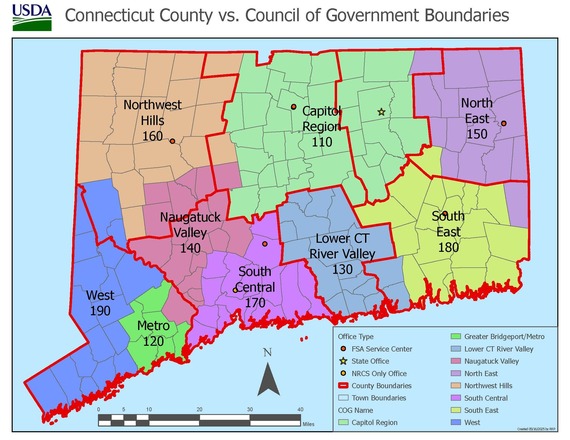
In Connecticut, FSA has reopened the Emergency Conservation Program (ECP) to address damages from 2023 drought and 2024 floods in the South Central, Northwest Hills, Naugatuck Valley, Greater Bridgeport, and West COG.
We have also reopened ECP to address severe drought damage in 2023 in the Southeast Council of Government (COG). Agricultural producers who experienced water issues, specifically with insufficient supply to provide water to confined livestock including deepening wells or irrigation for orchards and vineyards, may be eligible for assistance under ECP administered by the Southeast COG FSA. Expenses for piping, pumps and storage tanks for new wells may also be eligible.
The deadline to sign up for flood or drought ECP is programs is July 17. Producers should contact their local county offices as soon as possible to sign up for this cost-share assistance.
We are also currently accepting nominations for farmers and livestock producers to serve on our FSA county committees. This is an exciting way for you to use your voice and knowledge to help the agricultural community across Connecticut. Producers serving on FSA county committees help make important decisions about how federal farm programs are administered at the local level to best serve local producers and community needs. County committee members also make hiring decisions and assist with education and outreach efforts. All nomination forms for the 2026 election must be postmarked or received in the local USDA Service Center by Aug. 3. Please help us spread the word about this unique opportunity to work with FSA and local producers.
USDA has announced changes to program eligibility passed in the Working Family Tax Cuts Act. Our county offices are working with eligible farmers to make the proper changes to paperwork. If our staff reaches out to you, please make the effort to respond as the eligibility paperwork ensures that you are properly enrolled in USDA FSA and NRCS programs. Changes must be filed no later than Sept. 15.
I am passionate about keeping you up to date on all news related to Connecticut Farm Service Agency and want you to know that we have a great staff here that can help you file applications and answer any questions you may have. Our goal to put Farmers First is the foundation of everything we do at FSA, and we look forward to hearing from you soon as these very important program deadlines are fast-approaching.
Robert Sullivan
State Executive Director, Connecticut and Rhode Island
|
Application Deadline July 17
Tolland, Conn., May 18, 2026 – The U.S. Department of Agriculture (USDA) Farm Service Agency (FSA) in Connecticut today announced the agency is reopening the Emergency Conservation Program (ECP) to address damages from 2023 drought and 2024 floods. ECP provides cost-share and technical assistance to producers to restore farmland to pre-disaster conditions following a qualifying natural disaster. ECP signup begins on May 18, 2026, and ends on July 17, 2026.
“Connecticut producers have faced incredibly difficult conditions from the 2023 drought and the devastating floods in 2024, and USDA is committed to helping them recover,” said Robert Sullivan, FSA State Executive Director for Connecticut. “By reopening the Emergency Conservation Program signup, we are providing another important opportunity for agricultural producers to access the recovery assistance they may need to restore their land, protect their operations and continue producing.”
ECP 2023 (Drought)
FSA is reopening ECP to address severe drought damage in 2023 in the Southeast Council of Government (COG). Agricultural producers who experienced water issues, specifically with insufficient supply to provide water to confined livestock including deepening wells or irrigation for orchards and vineyards, may be eligible for assistance under ECP administered by the Southeast COG FSA. Expenses for piping, pumps and storage tanks for new wells may also be eligible.
Water hauling costs are not an ECP reimbursable expense. ECP funding also cannot be used to install new wells for vegetable or other short-term crops and cannot be used to reimburse for wells that do not produce sufficient water or to frack existing wells.
ECP 2024 (Flood)
FSA is also reopening for the ECP signup to address 2024 severe storm and flood damage experienced in 2024 in the South Central, Northwest Hills, Naugatuck Valley, Greater Bridgeport, and West COG.
For land to be eligible, the natural disaster must create new conservation problems that, if untreated, would:
-
be so costly to rehabilitate that federal assistance is or will be needed to return the land to productive agricultural use,
-
is unusual and is not the type that would recur frequently in the same area,
-
affect the productive capacity of the farmland, or
-
impair or endanger the land.
ECP Cost-Share Assistance
ECP cost-share assistance can provide advance payments for up to 25% of the total allowable cost for all ECP practices before the restoration is carried out. The advance payment must be spent within 60 days. To ensure eligibility for ECP cost-share payment, check with FSA before beginning work.
If you qualify for ECP assistance for 2023 or 2024 disasters, you may receive cost-share levels not to exceed 75% of the eligible cost of restoration measures. Per statute, eligible socially disadvantaged and beginning farmers and ranchers can receive up to 90% of the eligible cost of restoration. No one is eligible for more than $500,000 in cost share assistance per natural disaster event.
Eligibility and Environmental Requirements
Producers with damage from qualifying natural disaster events must apply for ECP assistance before beginning reconstructive work. FSA’s environmental compliance review process is required to be completed before any actions are taken. A waiver can be requested for necessary activities that are taken as emergency action to prevent further loss. Producers who apply after reconstructive work has been completed are at risk of not qualifying for ECP.
To be eligible for assistance, ECP approved practices must not be started until all the following are met:
-
an application for cost-share assistance has been filed,
-
the local FSA county committee (COC) or its representative has conducted an onsite inspection of the damaged area, and
-
the agency responsible for technical assistance, such as the Natural Resources Conservation Service (NRCS), has made a needs determination, which may include cubic yards of earthmoving, etc., required for rehabilitation.
Producers who lease federally owned or managed lands, including tribal trust land, as well as state land, are eligible to participate in ECP. Conservation concerns present on the land prior to the qualifying natural disaster event are not eligible for ECP assistance.
FSA county committees will evaluate applications based on an on-site inspection of the damaged land, taking into consideration the type and extent of the damage. An on-site inspection does not guarantee that cost-share funding will be provided.
More Information
To learn more about ECP, producers can contact your local FSA office fsa.usda.gov/state-offices. For more detailed information about COG boundaries, please visit the Connecticut Geodata Portal.
FSA helps America’s farmers, ranchers and forest landowners invest in, improve, protect and expand their agricultural operations through the delivery of agricultural programs for all Americans. FSA implements agricultural policy, administers credit and loan programs, and manages conservation, commodity, disaster recovery and marketing programs through a national network of state and county offices and locally elected county committees. For more information, visit fsa.usda.gov.
 ^ back to top
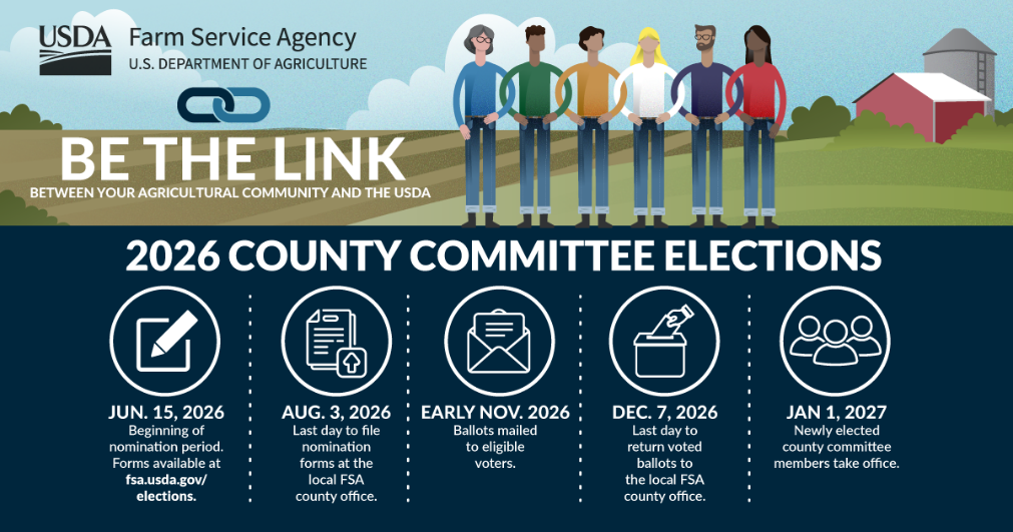 Nominations are now being accepted for farmers and ranchers to serve on local U.S. Department of Agriculture (USDA) Farm Service Agency (FSA) county committees. These committees make important decisions about how federal farm programs are administered locally. All nomination forms for the 2026 election must be postmarked or received in the local FSA office by Aug. 3, 2026.
Elections for committee members occur in certain Local Administrative Areas (LAA). LAAs are FSA committee elective areas in a single county or multi-county jurisdiction and can include LAAs that are focused on an urban or suburban area.
Producers interested in serving on the FSA county committee can locate their LAA at fsa.usda.gov/coc and determine if their LAA is up for election by contacting their local FSA office.
Agricultural producers can be nominated for candidacy for the county committee if they:
- Participate or cooperate in a USDA program.
- Reside in the LAA that is up for election this year.
A cooperating producer is someone who has provided information about their farming or ranching operation to FSA, even if they have not applied or received program benefits.
Individuals can nominate themselves or others and qualifying organizations can also nominate candidates. USDA encourages all eligible producers to nominate, vote and hold office.
Nationwide, more than 7,700 dedicated members of the agriculture community serve on FSA county committees. The committees are made up of three to 11 members who serve three-year terms. Committee members play a key role in how FSA delivers disaster recovery, conservation, commodity and price support programs, as well as making decisions on county office employment and other agricultural issues.
More Information
Producers should contact their local FSA office today to learn more about their county’s election. To be considered, a producer must sign an FSA-669A nomination form. This form and other information about FSA county committee elections are available at fsa.usda.gov/coc.
All nomination forms for the 2026 election must be postmarked or received in the local USDA Service Center by the Aug. 3, 2026, deadline. Election ballots will be mailed to eligible voters in November 2026.
^ back to top
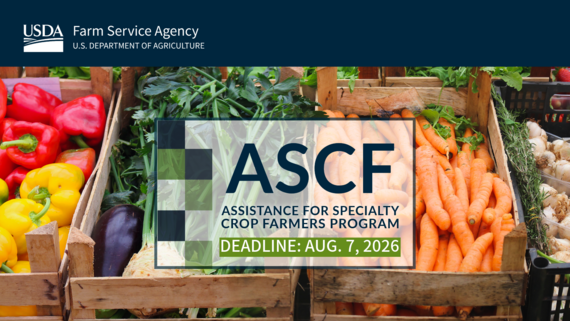 U.S. Secretary of Agriculture Brooke L. Rollins announced payment rates and the enrollment period for the Assistance for Specialty Crops Farmers (ASCF) program. The U.S. Department of Agriculture (USDA) will issue $1.625 billion in payments to eligible specialty crop producers in response to elevated input costs and market disruptions resulting from foreign competitors engaging in unfair trade practices that impeded specialty crop exports. Producers who have a Login.gov account can access and submit their pre-filled application starting June 1, 2026. Producers who do not have a Login.gov account or prefer to enroll in person at their local Farm Service Agency (FSA) office can request their prefilled application beginning June 8, 2026. The ASCF enrollment period closes on Aug. 7, 2026.
These payments are authorized under the Commodity Credit Corporation Charter Act and are administered by the Farm Service Agency (FSA). Specialty crop payments are intended to provide financial support to allow producers to pay for production and marketing inputs in the face of significant market disruptions during the 2025 growing season.
How to Apply
Pre-filled applications will be available online to producers with a Login.gov account who timely filed their 2025 crop acreage report for eligible specialty crops. Starting on June 1, 2026, producers who have a Login.gov account can access and submit their pre-filled application from fsa.usda.gov/ascf. Beginning June 8, 2026, producers can request their pre-filled ASCF application from their FSA county office.
The deadline to submit completed ASCF applications is Aug. 7, 2026. Producers can complete their applications online or submit them to their FSA county office. Payments will be issued as applications are submitted and approved, beginning as early as the first week of signup.
Login.gov
Login.gov is the public’s one account for government. Producers can use one account and password for secure, private access to participating government agencies, including FSA.
To apply for ASCF online, producers can start by visiting fsa.usda.gov/ascf to create their Login.gov account. Producers who have an existing Login.gov account can work with FSA using their existing account.
With a secure Login.gov account, producers can be amongst the first to apply for ASCF, allowing them to view, complete, certify, and submit their application as well as track their application and payment status. For assistance creating a Login.gov account, visit login.gov/help.
Eligibility
Specialty crop acres of eligible crops reported to FSA as an initial, double crop, repeat crop, or subsequent crop by April 24, 2026, will be used to determine ASCF program payments. Acreage that is reported as a cover crop, prevented planted, or with an intended use of grazing, left standing, green manure, silage, forage, volunteer, or experimental will not be used to determine ASCF program payments.
For a list of eligible specialty crops visit fsa.usda.gov/ascf. Specialty crops grown in a controlled environment are not eligible, except for mushrooms.
Crop insurance linkage is not required; however, USDA strongly urges producers to take advantage of the new risk management tools provided in the Working Families Tax Cuts Act, also known as the One Big Beautiful Bill Act, to best protect against future price risk and volatility.
Payment Calculation
FSA used national average revenue per crop as a metric for developing the ASCF program payment categories and payment rates listed below. For a full list of eligible crops under each category, visit fsa.usda.gov/ascf.
-
Tier 1 - $650 per acre Includes eligible specialty crops with an average annual revenue of more than $10,000 per acre.
-
Tier 2 - $225 per acre Includes eligible specialty crops with an average annual revenue of more than $2,300 per acre and up to $10,000 per acre.
-
Tier 3 - $65 per acre Includes eligible specialty crops with an average annual revenue of up to $2,300 per acre.
-
Beans and Peas - $25 per acre Includes all types of beans and peas that were not eligible for the FBA program.
The ASCF payment limitation is $250,000.
More information on ASCF is available online at fsa.usda.gov/ascf. Producers can also contact their local FSA county office.
^ back to top

The U.S. Department of Agriculture’s (USDA) Farm Service Agency (FSA) announced eligible landowners have from June 1 until Aug. 31, 2026 to review and consider base acre increases on farms enrolled in the Agriculture Risk Coverage (ARC) and Price Loss Coverage (PLC) programs, as authorized by provisions included in the Working Families Tax Cuts Act, also known as the One Big Beautiful Bill Act.
The Act provides landowners with the opportunity to increase base acres in preparation for enrollment in ARC and PLC beginning with the 2026 and future crop years. Nationwide, up to 30 million new base acres can be added by eligible farms.
ARC and PLC are cornerstone commodity safety net programs that provide financial protection to farmers when market prices or revenues decline. These programs help producers manage risk and maintain the economic viability of their operations amid challenging market and weather conditions.
FSA began notifying eligible landowners, by direct mail, that Base Allocation Summaries outlining potential base acre increases will be available for review beginning June 1, 2026. These Base Allocation Summaries can be accessed online at fsa.usda.gov/arc-plc using a Login.gov account. Landowners who do not currently have a Login.gov account are encouraged to contact their local FSA county office to obtain their Base Allocation Summary beginning June 1, 2026. The Base Allocation Summary should be reviewed and any necessary actions completed by Monday, Aug. 31, 2026.
Farm operators often maintain detailed historical planting records. Early communication between landowners and farm operators will ensure the Base Allocation Summary is accurate and all necessary actions are completed by the deadline.
To be eligible for new base acres, a current covered commodity must have been planted or prevented from being planted on the farm during the 2019 through 2023 crop years. The farm’s average planted and prevented planted acres during that period must exceed the total existing base acres for all covered commodities in effect on Sept. 30, 2024, excluding unassigned base acres. FSA farm total base acres cannot exceed the farm’s total cropland acres. If eligible requests exceed the nationwide cap of 30 million acres, USDA will apply an across-the-board, prorated reduction to all approved new base acres.
For additional information, producers should contact their local FSA county office or visit U.S. Department of Agriculture online at fsa.usda.gov/state-offices.
^ back to top
|
Producers who received an Emergency Relief Program (ERP) payment need to meet ERP insurance linkage requirements by purchasing crop insurance, or Noninsured Crop Disaster Assistance Program (NAP) coverage where crop insurance is not available.
Purchase coverage must be at the 60/100 coverage level or higher for insured crops or at the catastrophic coverage level or higher for NAP crops for the next two available crop years, which will be determined from the date you received an ERP payment and may vary depending on the timing and availability of coverage. The insurance coverage requirement applies to the physical location of the county where the crop was located and for which an ERP payment was issued.
Contact your crop insurance agent or local FSA county office as soon as possible to ask about coverage options. Producers who do not obtain the applicable coverage by the sales/application closing date will be required to refund the ERP benefits received on the applicable crop, plus interest. To determine which crops are eligible for federal crop insurance or NAP, visit the RMA website.
^ back to top
Maps are now available at FSA Offices for acreage reporting purposes. If you wish to receive your maps by e-mail, please call your local FSA Office.
Please see the following acreage reporting deadlines:
- July 15, 2026: Most annual and perennial crops.
In order to maintain program eligibility and benefits, you must file timely acreage reports. Failure to file an acreage report by the crop acreage reporting deadline may cause ineligibility for future program benefits. FSA will not accept acreage reports provided more than a year after the acreage reporting deadline.
Producers are encouraged to file their acreage reports as soon as planting is completed.
^ back to top
Connecticut State NRCS Office
344 Merrow Road, Suite A
Tolland, CT 06084-3917
Phone: 860-871-4011
Connecticut NRCS State Website
Connecticut State FSA Office
344 Merrow Road, Suite B
Tolland, CT 06084-3917
Phone: 860-871-4090
Fax: 855-934-2463
State Executive Director:
Robert Sullivan
|
|
Connecticut FSA State Website
|
|
State Office Staff:
Rebecca Palmer, Acting Deputy State Executive Director/ Program Chief
Jule Dybdahl, Administrative Officer
Claire Vaterlaus-Staby, Outreach Coordinator
Keith Durao, Administrative Specialist
|
State Committee Chair:
Jeffery Lipton
State Committee Members:
Kelly Bloom
Shane Collett
Joseph Geremia
Kies Orr LaVack
|
Top of page
|