Ohio FSA State Newsletter - June 17, 2026
In This Edition of the Ohio FSA State Newsletter:
At the Ohio FSA, we support our producers and landowners through a variety of disaster, conservation, price support, and loan programs, all delivered by your dedicated county office staff. As school is out and summer is almost upon us, I just want to draw your attention to some items that are keeping our staff busy as we have several new announcements and deadlines that I want to make you aware of.
This week, FSA opened the nomination period for the 2026 FSA County Committee elections. Each county office is looking for producers to serve on the local county committee. County committees are unique to FSA and serve as a direct link between agricultural communities across the country and USDA. Producers who serve on committees work to make FSA agricultural programs serve the needs of local producers. Are you interested? Contact your FSA County office to see which area in your county is up for election or view the GIS locator tool to locate their Local Administrative Area. Nomination forms can be found at fsa.usda.gov/elections or from any FSA county office.
The acreage reporting deadline for corn, soybeans and most other spring planted crops is July 15 in Ohio. Our FSA County offices continue to be busy with acreage certification, and they need to hear from you as soon as you are finished with planting. FSA also needs to know about any acres you are unable to plant due to weather circumstances. Ohio has thousands of customers to get through the acreage reporting process before the July 15 deadline, so the sooner you contact your FSA County office, the better. This includes those of you with perennial forage (pasture) and CRP acres. I also highly recommend calling your FSA County office to make an appointment. Making an appointment will save you time by ensuring someone is available to work with you when you visit your FSA County office.
Recently the U.S. Secretary of Agriculture announced payment rates and the enrollment period for the Assistance for Specialty Crops Farmers (ASCF) program. USDA will issue $1.625 billion in payments to eligible specialty crop producers in response to elevated input costs and market disruptions resulting from foreign competitors engaging in unfair trade practices that impeded specialty crop exports. The deadline to submit completed ASCF applications is Aug. 7, 2026. Producers can complete their applications with a secure online Login.gov account or submit them to their FSA county office.
USDA has extended the Supplemental Disaster Relief Program (SDRP) program deadline to give producers and FSA more time to address any program application changes that could impact payments. The deadline is Aug. 12, 2026, to apply for SDRP Stage 1 and Stage 2.
FSA also announced recently that eligible landowners can now review and consider base acre increases on farms enrolled in the Agriculture Risk Coverage (ARC) and Price Loss Coverage (PLC) programs. Landowners who have a Login.gov account can access their Base Allocation Summary online. Landowners who do not have a Login.gov account can contact their County FSA office for information on how to receive their summary. The Base Allocation Summary should be reviewed and any necessary actions completed by Aug. 31, 2026.
Additional program details and more in-depth information is provided in our newsletter. Please don’t hesitate to contact your FSA County office for questions about our programs, loans and information that is included in this newsletter edition.
Respectfully,
Don Jones State Executive Director, Ohio FSA
 Nominations are now being accepted for farmers and producers to serve on local U.S. Department of Agriculture (USDA) Farm Service Agency (FSA) county committees. These committees make important decisions about how federal farm programs are administered locally. All nomination forms for the 2026 election must be postmarked or received in the local FSA office by Aug. 3, 2026.
Learn more about county committee nominations.
The U.S. Department of Agriculture’s (USDA) Farm Service Agency (FSA) announced eligible landowners have from June 1 until Aug. 31, 2026 to review and consider base acre increases on farms enrolled in the Agriculture Risk Coverage (ARC) and Price Loss Coverage (PLC) programs, as authorized by provisions included in the Working Families Tax Cuts Act, also known as the One Big Beautiful Bill Act.
The Act provides landowners with the opportunity to increase base acres in preparation for enrollment in ARC and PLC beginning with the 2026 and future crop years. Nationwide, up to 30 million new base acres can be added by eligible farms.
ARC and PLC are cornerstone commodity safety net programs that provide financial protection to farmers when market prices or revenues decline. These programs help producers manage risk and maintain the economic viability of their operations amid challenging market and weather conditions.
FSA began notifying eligible landowners, by direct mail, that Base Allocation Summaries outlining potential base acre increases will be available for review beginning June 1, 2026. These Base Allocation Summaries can be accessed online at fsa.usda.gov/arc-plc using a Login.gov account. Landowners who do not currently have a Login.gov account are encouraged to contact their local FSA county office to obtain their Base Allocation Summary beginning June 1, 2026. The Base Allocation Summary should be reviewed and any necessary actions completed by Monday, Aug. 31, 2026.
Farm operators often maintain detailed historical planting records. Early communication between landowners and farm operators will ensure the Base Allocation Summary is accurate and all necessary actions are completed by the deadline.
To be eligible for new base acres, a current covered commodity must have been planted or prevented from being planted on the farm during the 2019 through 2023 crop years. The farm’s average planted and prevented planted acres during that period must exceed the total existing base acres for all covered commodities in effect on Sept. 30, 2024, excluding unassigned base acres. FSA farm total base acres cannot exceed the farm’s total cropland acres. If eligible requests exceed the nationwide cap of 30 million acres, USDA will apply an across-the-board, prorated reduction to all approved new base acres.
For additional information, producers should contact their local FSA county office.
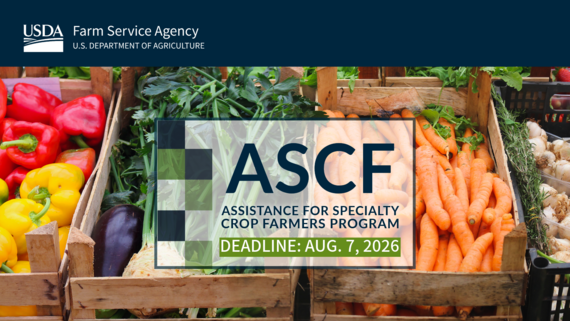 U.S. Secretary of Agriculture Brooke L. Rollins announced payment rates and the enrollment period for the Assistance for Specialty Crops Farmers (ASCF) program. The U.S. Department of Agriculture (USDA) will issue $1.625 billion in payments to eligible specialty crop producers in response to elevated input costs and market disruptions resulting from foreign competitors engaging in unfair trade practices that impeded specialty crop exports. The ASCF enrollment period closes on Aug. 7, 2026.
These payments are authorized under the Commodity Credit Corporation Charter Act and are administered by the Farm Service Agency (FSA). Specialty crop payments are intended to provide financial support to allow producers to pay for production and marketing inputs in the face of significant market disruptions during the 2025 growing season.
How to Apply
Pre-filled applications will be available online to producers with a Login.gov account who timely filed their 2025 crop acreage report for eligible specialty crops. Producers who have a Login.gov account can access and submit their pre-filled application from fsa.usda.gov/ascf. Producers can also request their pre-filled ASCF application from their FSA county office.
The deadline to submit completed ASCF applications is Aug. 7, 2026. Producers can complete their applications online or submit them to their FSA county office. Payments will be issued as applications are submitted and approved, beginning as early as the first week of signup.
Login.gov
Login.gov is the public’s one account for government. Producers can use one account and password for secure, private access to participating government agencies, including FSA.
To apply for ASCF online, producers can start by visiting fsa.usda.gov/ascf to create their Login.gov account. Producers who have an existing Login.gov account can work with FSA using their existing account.
With a secure Login.gov account, producers can be amongst the first to apply for ASCF, allowing them to view, complete, certify, and submit their application as well as track their application and payment status. For assistance creating a Login.gov account, visit login.gov/help.
Eligibility
Specialty crop acres of eligible crops reported to FSA as an initial, double crop, repeat crop, or subsequent crop by April 24, 2026, will be used to determine ASCF program payments. Acreage that is reported as a cover crop, prevented planted, or with an intended use of grazing, left standing, green manure, silage, forage, volunteer, or experimental will not be used to determine ASCF program payments.
For a list of eligible specialty crops visit fsa.usda.gov/ascf. Specialty crops grown in a controlled environment are not eligible, except for mushrooms.
Crop insurance linkage is not required; however, USDA strongly urges producers to take advantage of the new risk management tools provided in the Working Families Tax Cuts Act, also known as the One Big Beautiful Bill Act, to best protect against future price risk and volatility.
Payment Calculation
FSA used national average revenue per crop as a metric for developing the ASCF program payment categories and payment rates listed below. For a full list of eligible crops under each category, visit fsa.usda.gov/ascf.
-
Tier 1 - $650 per acre Includes eligible specialty crops with an average annual revenue of more than $10,000 per acre.
-
Tier 2 - $225 per acre Includes eligible specialty crops with an average annual revenue of more than $2,300 per acre and up to $10,000 per acre.
-
Tier 3 - $65 per acre Includes eligible specialty crops with an average annual revenue of up to $2,300 per acre.
-
Beans and Peas - $25 per acre Includes all types of beans and peas that were not eligible for the FBA program.
The ASCF payment limitation is $250,000.
More information on ASCF is available online at fsa.usda.gov/ascf. Producers can also contact their local FSA county office.
Are you interested in working with USDA to start or grow your farm, ranch, or private forest operation, but don’t know where to start?
Whether you’re looking to access capital or disaster assistance through USDA’s Farm Service Agency (FSA) or address natural resource concerns on your land with assistance from USDA’s Natural Resources Conservation Service (NRCS), a great place to start is farmers.gov.
Farmers.gov is a one-stop shop for information about the assistance available from FSA and NRCS. The site also offers many easy-to-use tools for farmers, ranchers, and private forestland owners, whether you are reaching out for the first time or are a long-term customer with a years-long relationship with USDA.
With a farmers.gov account you can:
- Complete an AD-2047, Customer Data Worksheet, prior to your first meeting with FSA and NRCS.
- View farm loan payments history from FSA.
- View cost share assistance received and anticipated from NRCS conservation programs.
- Request conservation assistance from NRCS as well as view and track your conservation plans, practices, and contracts.
- View, print, and export detailed farm records and farm/tract maps for the current year, which are particularly useful when fulfilling acreage reporting requirements.
- Print FSA-156 EZ, Abbreviated Farm Record and your Producer Farm Data Report for the current year.
- Pay FSA debt using the “Make an FSA Payment” feature
- Apply for a farm loan online, view information on your existing loans, and make USDA direct farm loan payments using the Pay My Loan feature.
Learn how to create a farmers.gov account today!
Maps are now available at our County FSA Offices for acreage reporting purposes. If you want to receive your maps by e-mail, please call your FSA office to request your copies.
The following acreage reporting date are applicable for Ohio:
-
July 15, 2026 --- Report all your Burley Tobacco, Cabbage (Planted 3/19/26-5/31/26), Corn, Grain Sorghum, Hybrid Corn Seed, Spring Oats, Popcorn, Potatoes, Soybeans, Sugar Beets, Tomatoes and all other crops.
- Report Perennial Forage Crops.
- Report Conservation Reserve Program (CRP) acreage.
In order to maintain program eligibility and benefits, you must file timely acreage reports. Failure to file an acreage report by the crop acreage reporting deadline may cause ineligibility for future program benefits. FSA will not accept acreage reports provided more than a year after the acreage reporting deadline.
Producers are encouraged to file their acreage reports as soon as planting is completed.
|
The USDA Farm Service Agency’s (FSA) Direct Farm Ownership loans are a resource to help farmers and ranchers become owner-operators of family farms, improve and expand current operations, increase agricultural productivity, and assist with land tenure to save farmland for future generations.
There are three types of Direct Farm Ownership Loans: regular, down payment and joint financing. FSA also offers a Direct Farm Ownership Microloan option for smaller financial needs up to $50,000.
Direct Farm Ownership Loans can be used to construct, purchase or improve farm dwellings, service buildings or other facilities, and to make improvements essential to an operation.
Applicants must provide FSA with an estimate of the total cost of all planned development that completely describe the work, prior to loan approval and must show proof of sufficient funds to pay for the total cost of all planned development at or before loan closing. In some instances, applicants may be asked to provide certified plans, specifications or contract documents. The applicant cannot incur any debts for materials or labor or make any expenditures for development purposes prior to loan closing with the expectation of being reimbursed from FSA funds.
Construction and development work may be performed either by the contract method or the borrower method. Under the contract method, construction and development contractors perform work according to a written contract with the applicant or borrower. If applying for a direct loan to finance a construction project, the applicant must obtain a surety bond that guarantees both payment and performance in the amount of the construction contract from a construction contractor.
A surety bond is required when a contract exceeds $100,000. An authorized agency official determines that a surety bond appears advisable to protect the borrower against default of the contractor or a contract provides for partial payments in excess of the amount of 60 percent of the value of the work in place.
Under the borrower method, the applicant or borrower will perform the construction and development work. The borrower method may only be used when the authorized agency official determines, based on information from the applicant, that the applicant possesses or arranges to obtain the necessary skill and managerial ability to complete the work satisfactorily and that such work will not interfere with the applicant’s farming operation or work schedule.
Potential applicants should visit with FSA early in the initial project planning process to ensure environmental compliance.
For more eligibility requirements and information about FSA Loan programs, contact your FSA County office.
The USDA’s Animal and Plant Health Inspection Service (APHIS) has confirmed the detection of Highly Pathogenic Avian Influenza, subtype H5N1, in dairy cattle in 12 states. To protect our livestock industry from the threat posed by H5N1, USDA is taking a number of actions with our federal partners—one of them being a significant update to the Emergency Assistance for Livestock, Honeybees, and Farm-raised Fish Program (ELAP).
Those of you who incur milk losses in their dairy herds due to H5N1 can now apply for financial assistance through ELAP. USDA’s Farm Service Agency (FSA) expanded ELAP policy through the rule-making process; this expansion assists with financial losses resulting from reduced milk production when cows are removed from commercial milking in dairy herds with a confirmed positive H5N1 test. Positive tests must be confirmed through APHIS’s National Veterinary Services Laboratories (NVSL).
So, in this Ask the Expert, Dr. Julie Gauthier – Executive Director of Veterinary Services’ Field Operations and Policy Liaison for the dairy cattle HPAI response, answers questions about H5N1 in the United States, its current effects in our dairy industry, and the process and importance of testing your cows to help protect them, your operation, and the dairy industry as a whole. Read full interview here.
Farm Operating Loans, Direct -- 5.000%
Farm Ownership Loans, Direct -- 5.875%
Limited Resource Loans -- 5.000%
Farm Ownership Loans, Down Payment -- 1.875%
Farm Ownership – Joint Financing -- 3.875%
Emergency Loans -- 3.750%
Farm Storage Facility Loan, 3 year -- 4.000%
Farm Storage Facility Loan, 5 year -- 4.125%
Farm Storage Facility Loan, 7 year -- 4.250%
Farm Storage Facility Loan, 10 year -- 4.375%
Farm Storage Facility Loan, 12 year -- 4.625%
Sugar Storage Facility Loans, 15 year -- 4.875%
Commodity Loans -- 4.750%
|
June 15
|
County Committee Nomination Period begins.
|
|
June 19
|
Juneteenth National Independence Day. USDA Service Center Closed.
|
|
July 3
|
Independence Day Holiday. USDA Service Center Closed.
|
|
July 15
|
Final certification date to report burley tobacco; cabbage planted through May 31; corn, grain sorghum, hybrid corn seed, spring oats, potatoes, popcorn, sugar beets, tomatoes and other crops. Report perennial forage crops. Report Conservation Reserve Program (CRP) acreage.
|
|
July 15
|
Final Date to Report Production for the preceding Crop Year for Farms Enrolled in ARC-IC.
|
|
July 15
|
End of primary nesting season for CRP program purposes.
|
|
August 3
|
Deadline to Request farm reconstitutions and transfers for 2026.
|
|
August 3
|
Last day to file County Committee Nomination forms.
|
|
August 7
|
The Assistance for Specialty Crops Farmers (ASCF) enrollment period closes.
|
|
August 12
|
Supplemental Disaster Relief Program Stage 1 and Stage 2 Deadline.
|
|
August 31
|
Deadline for landowners to review their owner notification and base allocation summary(s).
|
|
September 7
|
Labor Day Holiday. USDA Service Center is Closed.
|
|
September 30
|
Deadline to obtain 2027 NAP coverage for Aquaculture, Christmas trees, Floriculture, Ginseng, Mushrooms, Turf grass Sod and Watercress.
|
|
Ongoing
|
Reports of Failed Acreage must be filed with the County Office before disposition of the crop.
|
|
Ongoing
|
Reports of Prevented Planting Acreage must be filed with the County Office no later than 15 calendar days after the final planting date for that county and producers of hand-harvested crops and certain perishable crops must notify FSA within 72 hours of when a loss becomes apparent.
|
|
Ongoing
|
Contact your FSA County office right away for notice of loss deadlines and disaster program requirements.
|
|
Continuous
|
New applications for Farm Service Agency Loan Programs.
|
|
Continuous
|
Submit an Application for a Farm Storage Facility Loan.
|
|
Continuous
|
Sign up for GovDelivery Newsletters, Bulletins and Ohio Press Releases (Subscribe to USDA Emails for Farmers | Farmers.gov)
|
Ohio FSA State Office
200 North High Street, Room 540
Columbus, Ohio 43215
Phone: 614-255-2441
|
|
Visit the Ohio FSA website at: www.fsa.usda.gov/oh
|
State Executive Director:
Don Jones
|
Deputy State Executive Director:
Traci Garza
|
|
Administrative Officer:
Stephanie Moran
|
Conservation Chief:
Brandi Koehler
|
|
Farm Loan Chief:
Andrew Huey
|
Price Support Chief:
Trevor Kerr
|
|
Production Adjustment / Compliance and Risk Management Chief:
Matt Kleski
|
|
|
|