
South Dakota USDA Newsletter - June 16, 2026
In This Issue:
Greetings from the South Dakota FSA State Office,
The longer days of the year are upon us. I enjoy early morning daylight and being able to work outdoors late into the evening. The busy season of planting is now complete and most of the livestock have been taken to grass. The extremely dry spring has allowed an easy calving season and rapid planting across the state.
As I write this article, I am reflecting on my first year serving in the role of State Executive Director. It’s been quite a year - dealing with drought, flooding, government shutdowns, windstorms, farm program payments and back to drought! We often deal with difficult times but by working together we can overcome difficult challenges.
Our nation will celebrate 250 years since our forefathers declared our independence. They too saw difficult challenges and had determination to work together to make this the greatest nation on the earth.
The Farm Service Agency today works on behalf of the agricultural producers to aid against some of the challenges that are beyond their control. We have several counties in southern South Dakota that qualify for FSA’s Livestock Forage Disaster Program (LFP). For losses not addressed by our other programs, such as LFP or LIP, FSA’s Emergency Assistance for Livestock, Honeybees and Farm-Raised Fish Program (ELAP) covers a wide range of losses and conditions. For example, ELAP provides assistance for losses resulting from the cost of transporting water to livestock due to an eligible drought. Producers in certain counties may be eligible for low interest Emergency Loans as well. Please contact your local FSA County Office to discuss eligibility for these programs or any other FSA Disaster Recovery Programs.
Roger Chase
State Executive Director, South Dakota FSA
Top of page
Greetings, Conservationists!
As we welcome the month of June, it's a vibrant time for agriculture and natural resources across South Dakota (SD). Fields are alive with activity, livestock graze on green pastures, and producers are busy with tending to their crops and utilizing conservation practices that help sustain our land for future generations. June is also an excellent time to focus on soil health, water management, drought resilience, and the stewardship of our grasslands, which support both wildlife and our communities.
I am excited to highlight several upcoming educational events that offer valuable learning and networking opportunities. The SD Specialty Producers are hosting a three-part Summer Farm Tour Series on June 10, July 15, and July 29, where each all-day tour provides a deep dive into the systems, strategies, and technologies driving success in specialty crop and value-added production. The SD Grassland Coalition continues to promote sustainable grazing and grassland management with their workshops, tours, and grazing schools on June 3, 4, 16-18, and September 9-11. Additionally, the SD Soil Health Coalition hosts events focused on improving soil productivity and resilience through innovative conservation strategies such as the West River Soil Health school being held June 24-25.
Whether you are a producer, landowner, or conservation partner, these events are designed to support your efforts and strengthen our shared commitment to SD’s natural resources. I encourage you to participate and take advantage of these opportunities to learn, collaborate, and make a positive impact.
Wishing you a productive and inspiring June!
Sincerely,
Jessica Michalski
Acting State Conservationist, South Dakota NRCS
Top of page
June 17, 2026 - SDSU Extension hosting free regional Drought Meetings in Hot Springs, Winner, and Yankton. Pre-registration is encouraged. Visit the SDSU Extension Events page to register.
June 19, 2026 - Juneteenth National Independence Day Holiday - USDA Offices Closed
July 3, 2026 - Independence Day (Observed) Holiday - USDA Offices Closed
July 15, 2026 - Acreage Reporting Deadline for 2026 Crop Year spring-seeded crops, perennial forage & Conservation Reserve Program (CRP) acreage
July 15, 2026 - Deadline to Complete 2025 ARC-IC Yield Certifications
August 3, 2026 - FSA County Committee nomination forms must be postmarked or received in the local FSA office
August 7, 2026 - Deadline to apply for 2025 Assistance for Specialty Crop Farmers (ASCF) Program
August 12, 2026 - Deadline to apply for Supplemental Disaster Relief Program Stage 1, Stage 1 Quality and Stage 2
June 2026
|
Farm Operating Loans — Direct
|
5.000% |
|
Farm Ownership Loans — Direct
|
5.875% |
|
Farm Ownership Loans — Direct Down Payment, Beginning Farmer or Rancher
|
1.875% |
|
Emergency Loans
|
3.750% |
|
Farm Storage Facility Loans (7 years)
|
4.250% |
Top of page
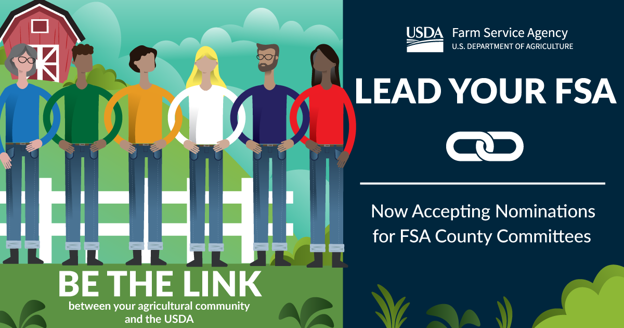
Nominations are now being accepted for farmers and ranchers to serve on local U.S. Department of Agriculture (USDA) Farm Service Agency (FSA) county committees. These committees make important decisions about how federal farm programs are administered locally. All nomination forms for the 2026 election must be postmarked or received in the local FSA office by Aug. 3, 2026.
Learn more about county committee nominations.
Top of page
U.S. Secretary of Agriculture Brooke L. Rollins announced payment rates and the enrollment period for the Assistance for Specialty Crops Farmers (ASCF) program. The U.S. Department of Agriculture (USDA) will issue $1.625 billion in payments to eligible specialty crop producers in response to elevated input costs and market disruptions resulting from foreign competitors engaging in unfair trade practices that impeded specialty crop exports. Producers who have a Login.gov account can access and submit their pre-filled application starting June 1, 2026. Producers who do not have a Login.gov account or prefer to enroll in person at their local Farm Service Agency (FSA) office can request their prefilled application beginning June 8, 2026. The ASCF enrollment period closes on Aug. 7, 2026.
These payments are authorized under the Commodity Credit Corporation Charter Act and are administered by the Farm Service Agency (FSA). Specialty crop payments are intended to provide financial support to allow producers to pay for production and marketing inputs in the face of significant market disruptions during the 2025 growing season.
How to Apply
Pre-filled applications will be available online to producers with a Login.gov account who timely filed their 2025 crop acreage report for eligible specialty crops. Starting on June 1, 2026, producers who have a Login.gov account can access and submit their pre-filled application from fsa.usda.gov/ascf. Beginning June 8, 2026, producers can request their pre-filled ASCF application from their FSA county office.
The deadline to submit completed ASCF applications is Aug. 7, 2026. Producers can complete their applications online or submit them to their FSA county office. Payments will be issued as applications are submitted and approved, beginning as early as the first week of signup.
Login.gov
Login.gov is the public’s one account for government. Producers can use one account and password for secure, private access to participating government agencies, including FSA.
To apply for ASCF online, producers can start by visiting fsa.usda.gov/ascf to create their Login.gov account. Producers who have an existing Login.gov account can work with FSA using their existing account.
With a secure Login.gov account, producers can be amongst the first to apply for ASCF, allowing them to view, complete, certify, and submit their application as well as track their application and payment status. For assistance creating a Login.gov account, visit login.gov/help.
Eligibility
Specialty crop acres of eligible crops reported to FSA as an initial, double crop, repeat crop, or subsequent crop by April 24, 2026, will be used to determine ASCF program payments. Acreage that is reported as a cover crop, prevented planted, or with an intended use of grazing, left standing, green manure, silage, forage, volunteer, or experimental will not be used to determine ASCF program payments.
For a list of eligible specialty crops visit fsa.usda.gov/ascf. Specialty crops grown in a controlled environment are not eligible, except for mushrooms.
Crop insurance linkage is not required; however, USDA strongly urges producers to take advantage of the new risk management tools provided in the Working Families Tax Cuts Act, also known as the One Big Beautiful Bill Act, to best protect against future price risk and volatility.
Payment Calculation
FSA used national average revenue per crop as a metric for developing the ASCF program payment categories and payment rates listed below. For a full list of eligible crops under each category, visit fsa.usda.gov/ascf.
-
Tier 1 - $650 per acre Includes eligible specialty crops with an average annual revenue of more than $10,000 per acre.
-
Tier 2 - $225 per acre Includes eligible specialty crops with an average annual revenue of more than $2,300 per acre and up to $10,000 per acre.
-
Tier 3 - $65 per acre Includes eligible specialty crops with an average annual revenue of up to $2,300 per acre.
-
Beans and Peas - $25 per acre Includes all types of beans and peas that were not eligible for the FBA program.
The ASCF payment limitation is $250,000.
More information on ASCF is available online at fsa.usda.gov/ascf. Producers can also contact their local FSA county office.
Top of page
USDA Farm Service Agency (FSA) reminds you to report prevented planted and failed acres in order to establish or retain FSA program eligibility for some programs.
You should report crop acreage you intended to plant, but due to natural disaster, were prevented from planting. Prevented planting acreage must be reported on form CCC-576, Notice of Loss, no later than 15 calendar days after the final planting date as established by FSA and the Risk Management Agency (RMA).
Additionally, if you have failed acres, you should also use form CCC-576, Notice of Loss, to report failed acres.
For hand-harvested crops and certain perishables, you must notify FSA of damage or loss through the administrative county office within 72 hours of the date of damage or loss first becomes apparent. This notification can be provided by filing a CCC-576, email, fax or phone. If you notify the County Office by any method other than by filing the CCC-576, you are still required to file a CCC-576, Notice of Loss, within the required 15 calendar days.
For losses on crops covered by the Noninsured Crop Disaster Assistance Program (NAP), you must file a Notice of Loss within 15 days of the occurrence of the disaster or when losses become apparent. You must timely file a Notice of Loss for failed acres on all crops including grasses.
To file a Notice of Loss, contact your local County USDA Service Center or visit www.fsa.usda.gov.
Top of page
The Farm Service Agency’s (FSA) Noninsured Crop Disaster Assistance Program (NAP) provides financial assistance to producers of non-insurable crops, including mechanically harvested forage with NAP coverage, to protect against natural disasters that occur during the coverage, resulting in loss of production, loss of value, or prevented planting of an eligible crop.
If you have NAP coverage on mechanically harvested forage, you must:
- Maintain separate production records for each unit, crop, practice, crop type, and intended use.
- Submit production records to FSA by the designated production reporting date for the crop.
- Notify your FSA administrative county office before grazing, abandoning, or destroying forage acreage reported, on FSA form FSA-578, as intended to be mechanically harvested; and request an appraisal.
- Notify your FSA administrative county office of a loss and timely file CCC-576, Notice of Loss and Application for Payment, Part B, the earlier of:
- 15 calendar days after the disaster occurs, or damage first becomes apparent.
- 15 calendar days after the crop’s normal harvest date.
- If you change your intended use or experience a loss during the coverage period, you must:
- Establish and maintain representative sample areas when an appraisal of the acreage is required.
- Inform your FSA administrative county office of the location of representative sample areas within 15 days of placing the panels.
- Request an appraisal of the representative sample areas at the end of harvest period but before first freeze.
For more information on NAP and NAP compliance requirements you must follow to retain NAP coverage, contact your local USDA service center.
Top of page
The U.S. Department of Agriculture’s Farm Service Agency (FSA) is expanding payment limitation and payment eligibility provisions that affect program payments including allowing for the equitable treatment of business entities. Additionally, producers will benefit from an increased payment limitation for certain programs, and a broader definition of farming income that will result in more exceptions to income limitations.
These changes were outlined in the Working Families Tax Cuts Act which provides a large investment in American agriculture by improving eligibility provisions, the farm safety net, disaster assistance, and price support programs. USDA previously announced that this fall, producers will benefit from increased reference prices for major commodities. This announcement gives producers more flexibility in structuring their operations and provides a stronger safety net.
Payment Eligibility
Starting with the 2026 crop year, for payment eligibility purposes, FSA will treat applicable limited liability companies (LLCs) and S-Corporations (S-Corps), and other similar entities, as “pass through entities.” Each member of the qualified pass-through entity who meets actively engaged in farming criteria will help qualify the entity for expanded payments.
Previously, farm operations that were structured as an LLC or an S-Corp were limited to a single payment limitation, which varies by program. Now, partnerships, S-Corps, qualifying LLCs, and joint ventures or general partnerships will be treated the same.
For program year 2026 only, farm operations that are structured as LLCs or S-Corps or one of the new qualified pass-through entities must file updated farm operating plans with FSA for program year 2026 by Sept. 15, 2026. After program year 2026, FSA will continue to use June 1 as the date for determining ownership interest in an entity. Producers who have crop insurance or Noninsured Crop Disaster Assistance Program coverage should contact their crop insurance agent or local FSA office before restructuring their farm operation to ensure appropriate timing for restructuring without impacting current insurance coverage.
Members of qualified pass-through entities must provide contributions and be engaged in farming for the entity to be considered actively engaged in farming.
An additional change allows members of all entity types to receive compensation for labor and management contributions and use the same contribution to qualify as “actively engaged in farming.” This update provides consistent treatment of member contributions across all entity types.
Payment Limitation and Attribution
Payment limitation changes include an increased payment limit for the Agriculture Risk Coverage (ARC) and Price Loss Coverage (PLC) program. Starting with crop year 2025, the ARC and PLC payment limit will increase from $125,000 to $155,000. This payment limit will be adjusted going forward annually based on inflation.
Payment limitations are the maximum amount that a person or legal entity can receive for any crop year, directly or indirectly, through certain USDA programs. The same maximum payment limitation that applied to joint ventures and general partnerships will apply to qualified pass-through entities.
The policy change to payment limitation calculations takes effect beginning with program year 2026 for all qualified pass-through entities.
Average Adjusted Gross Income
The Working Families Tax Cuts Act broadened the definition of farming income to be more reflective of modern agricultural business practices. As a result, diversified producers will not be penalized under USDA’s requirements for average adjusted gross income (AGI).
Producers are exempt from the $900,000 AGI cap for conservation and disaster programs if at least 75% of their average gross income is from farming, ranching, or silviculture, which now includes agri-tourism, direct-to-consumer sales, and certain equipment sales.
Additionally, qualified pass-through entities are not required to certify compliance with the average AGI limitation at the entity level. However, members individually must meet average AGI requirements, which is the same requirement for joint operations.
More Information
Producers should contact their local FSA county office for more information or to update their farm operating plan by the Sept. 15, 2026, deadline for the 2026 program year.
Top of page
Farm Service Agency (FSA) borrowers with farms located in designated primary or contiguous disaster areas who are unable to make their scheduled FSA loan payments should consider the Disaster Set-Aside (DSA) program.
DSA is available to producers who suffered losses as a result of a natural disaster and relieves immediate and temporary financial stress. FSA is authorized to consider setting aside the portion of a payment/s needed for the operation to continue on a viable scale.
Borrowers must have at least two years left on the term of their loan in order to qualify.
Borrowers have eight months from the date of the disaster designation to submit a complete application. The application must include a written request for DSA signed by all parties liable for the debt along with production records and financial history for the operating year in which the disaster occurred. FSA may request additional information from the borrower in order to determine eligibility.
All farm loans must be current or less than 90 days past due at the time the DSA application is complete. Borrowers may not set aside more than one installment on each loan.
The amount set-aside, including interest accrued on the principal portion of the set-aside, is due on or before the final due date of the loan.
For more information, contact your local County USDA Service Center or visit fsa.usda.gov.
Top of page
The USDA Farm Service Agency’s (FSA) Direct Farm Ownership loans can help farmers and ranchers become owner-operators of family farms, improve and expand current operations, increase agricultural productivity, and assist with land tenure to save farmland for future generations.
There are three types of Direct Farm Ownership Loans: regular, down payment and joint financing. FSA also offers a Direct Farm Ownership Microloan option for smaller financial needs up to $50,000.
Joint financing allows FSA to provide more farmers and ranchers with access to capital. FSA lends up to 50 percent of the total amount financed. A commercial lender, a state program or the seller of the property being purchased, provides the balance of loan funds, with or without an FSA guarantee. The maximum loan amount for a joint financing loan is $600,000, and the repayment period for the loan is up to 40 years.
The operation must be an eligible farm enterprise. Farm Ownership loan funds cannot be used to finance nonfarm enterprises and all applicants must be able to meet general eligibility requirements. Loan applicants are also required to have participated in the business operations of a farm or ranch for at least three years out of the 10 years prior to the date the application is submitted. The applicant must show documentation that their participation in the business operation of the farm or ranch was not solely as a laborer.
For more information about farm loans, contact your local County USDA Service Center or visit fsa.usda.gov.
Top of page
Riley and Jimmie Kammerer, producers based in Piedmont, South Dakota, are advancing regenerative agriculture practices through participation in the Regenerative Pilot Program under the United States Department of Agriculture’s Natural Resources Conservation Service (NRCS). Guided by producer objectives and strategic conservation planning, NRCS assists farmers and ranchers in implementing comprehensive, whole-farm solutions to address resource challenges. Over the next five years, Riley and Jimmie aim to tackle concerns related to depletion of organic matter, plant structure and composition, livestock water and shelter availability, facility energy efficiency, aggregate instability, and wind erosion.
Through a systematic approach, they plan to enhance their operation with a suite of conservation practices designed to improve soil health, increase grazing efficiency, and strengthen on-farm resilience. The initial phase involves converting 212 acres from grass to season-long cover crops to provide high-quality forage for grazing, complemented by the adoption of virtual fencing across 5,800 acres for advanced grazing management.
Kammerer’s commitment to regenerative agriculture is rooted in a willingness to lead and to continually evolve with the land. “We are the first producers in the black hills area to sign an early adopter’s contract,” said Riley, a step that reflects both innovation and trust in the long-term benefits of conservation planning. That forward‑looking mindset guides every decision on the operation. “We just keep adapting, doing what we can to ensure the land stays productive for future generations,” Riley added, emphasizing the family’s dedication to stewardship. As the new practices take shape, the excitement is shared across the operation. Jimmie noted, “How fast this place is going to recover, that is going to be cool to watch.”'
To improve livestock health, a new shelterbelt will be established around barns and corrals using strategically placed fabricated windbreaks throughout the rangeland. Furthering livestock vigor efforts, Kammerer will install pipelines and tanks to ensure consistent access to water. These regenerative practices are expected to enhance soil health, optimize water management, and increase long-term productivity, delivering site-specific solutions tailored to the needs of each producer.
Regular soil health testing on cropland and rangeland helps inform management decisions and monitor progress. The NRCS remains committed to helping producers strengthen their operations through regenerative practices that build healthier soils, improve water resources, and support long‑term agricultural resilience. For questions or to explore conservation opportunities, producers are encouraged to contact their local USDA Service Center.
Top of page
The U.S. Department of Agriculture’s (USDA) Risk Management Agency (RMA) announced a series of updates to improve insurance coverage through the Livestock Risk Protection (LRP), Livestock Gross Margin (LGM), and Dairy Revenue Protection (DRP) insurance programs beginning with the 2027 crop year. These updates were approved by the Federal Crop Insurance Corporation Board of Directors.
Uniform changes across LRP, LGM and DRP include:
- Adding subsidy capture language to address off-exchange contracts.
- Updating the definition of beginning farmer or rancher and subsidy percentages to align with the One Big Beautiful Bill Act.
- Permitting concurrent coverage between similar livestock programs.
- Enabling policies that have not earned premium for three consecutive years to be subject to cancellation.
- Revising transfer of coverage language to clarify when coverage can be transferred.
- Updating general policy language for consistency with other RMA insurance policies.
Learn more about these changes.
Top of page
SDSU Extension free regional drought meetings: June 17, 2026, 10 a.m. to 5 p.m. CDT/ 9 a.m. to 4 p.m. MT at the SDSU Extension Winner Regional Center in Winner, Mueller Civic Center in Hot Springs and the Yankton County 4-H building in Yankton. There is no cost to attend, and lunch will be provided. Pre-registration is encouraged. Visit the SDSU Extension Events page to register.
South Dakota FSA State Committee Meeting: June 23-24, 2026, 9:00 a.m.- 4:30 p.m. CT at Federal Building, 200 4th Street SW, Huron, SD 57350.
- Questions? Contact Jean Wharton at jean.wharton@usda.gov.
- If you need to request an accommodation, please contact Jean Wharton at (605) 352-1160 or jean.wharton@usda.gov by June 16, 2026, to request accommodations (e.g., an interpreter, translator, seating arrangements, etc.) or materials in an alternative format (e.g., Braille, large print, audiotape - captioning, etc.).
Top of page
USDA in South Dakota
200 4th Street SW
Huron, SD 57350
FSA Phone: (605) 352-1160
NRCS Phone: (605) 352-1200
RMA Phone: (406) 651-8450
|
|
South Dakota Farm Service Agency
South Dakota Natural Resources Conservation Service
|
|
Farm Service Agency
State Executive Director:
Roger Chase
Deputy State Executive Director:
Ryan Vanden Berge
Administrative Officer:
Theresa Hoadley
Program Managers:
Owen Fagerhaug - Conservation
Logan Kopfmann - Disaster Relief
Donita Garry - Program Delivery
Bridget Weber - Farm Loan Program
South Dakota State Committee:
Mark Gross | Chair
Chance Davis | Member
Douglas Noem | Member
Betsy Pravecek | Member
Brian Top | Member
|
Natural Resources Conservation
Service
Acting State Conservationist:
Jessica Michalski
Assistant State Conservationists:
Jessica Michalski - Ecological Sciences
James Reedy - Engineering
Nathan Jones - Soils
Val Dupraz - Programs
Deke Hobbick - Compliance
Denise Gauer - Management & Strategy
|
| Get Started at Your USDA Service Center |
|






