Kentucky FSA Newsletter - JUNE 2026
In This Issue:

Here at the Farm Service Agency (FSA), we continually focus on supporting our producers. The past few months have been no different. We provided support through the Farmer Bridge Assistance program in record time by utilizing crop reporting data and modernization tools to streamline the application process. We obligated a record number of loans through the efforts of our dedicated staff and business process improvements that expedite the delivery of credit to our producers. We even extended the program deadline for the Supplemental Disaster Relief Program and increased the payment factor to deliver more benefits to impacted producers.
Along with these efforts, we are currently implementing the Livestock Forage Disaster Program in several counties here in Kentucky that are experiencing drought conditions. This program provides assistance to livestock producers who are suffering grazing losses because of the lack of rainfall. We encourage all livestock producers to contact their local service center for more information. Our staff can discuss eligibility and what documentation is required when you apply.
As you start to wrap up planting, please contact your FSA staff to complete your crop report. The deadline to report spring planted crops is July 15, so come by early to avoid the lines. Not only is acreage reporting important for producer eligibility, it’s also important when FSA stands up a new program as it allows us to expedite the application process by providing producers with a pre-filled application for some programs.
Whether its crop reporting, disaster assistance, or loans, FSA is here to serve the American farmer. We work daily to put Farmers First.
David Wayne, State Executive Director
|
The U.S. Department of Agriculture’s (USDA) Farm Service Agency (FSA) announced eligible landowners have from June 1 until Aug. 31, 2026 to review and consider base acre increases on farms enrolled in the Agriculture Risk Coverage (ARC) and Price Loss Coverage (PLC) programs, as authorized by provisions included in the Working Families Tax Cuts Act, also known as the One Big Beautiful Bill Act.
The Act provides landowners with the opportunity to increase base acres in preparation for enrollment in ARC and PLC beginning with the 2026 and future crop years. Nationwide, up to 30 million new base acres can be added by eligible farms.
ARC and PLC are cornerstone commodity safety net programs that provide financial protection to farmers when market prices or revenues decline. These programs help producers manage risk and maintain the economic viability of their operations amid challenging market and weather conditions.
FSA began notifying eligible landowners, by direct mail, that Base Allocation Summaries outlining potential base acre increases will be available for review beginning June 1, 2026. These Base Allocation Summaries can be accessed online at fsa.usda.gov/arc-plc using a Login.gov account. Landowners who do not currently have a Login.gov account are encouraged to contact their local FSA county office to obtain their Base Allocation Summary beginning June 1, 2026. The Base Allocation Summary should be reviewed and any necessary actions completed by Monday, Aug. 31, 2026.
Farm operators often maintain detailed historical planting records. Early communication between landowners and farm operators will ensure the Base Allocation Summary is accurate and all necessary actions are completed by the deadline.
To be eligible for new base acres, a current covered commodity must have been planted or prevented from being planted on the farm during the 2019 through 2023 crop years. The farm’s average planted and prevented planted acres during that period must exceed the total existing base acres for all covered commodities in effect on Sept. 30, 2024, excluding unassigned base acres. FSA farm total base acres cannot exceed the farm’s total cropland acres. If eligible requests exceed the nationwide cap of 30 million acres, USDA will apply an across-the-board, prorated reduction to all approved new base acres.
For additional information, producers should contact their local FSA county office or visit U.S. Department of Agriculture online at fsa.usda.gov/state-offices.
Top of page
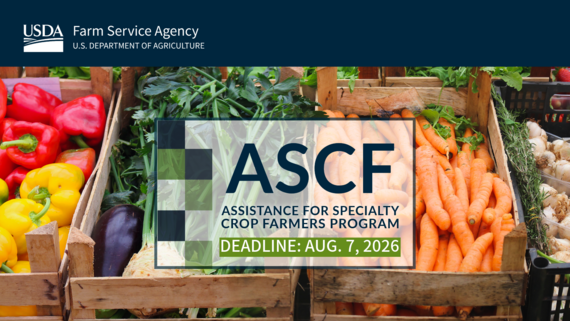 U.S. Secretary of Agriculture Brooke L. Rollins announced payment rates and the enrollment period for the Assistance for Specialty Crops Farmers (ASCF) program. The U.S. Department of Agriculture (USDA) will issue $1.625 billion in payments to eligible specialty crop producers in response to elevated input costs and market disruptions resulting from foreign competitors engaging in unfair trade practices that impeded specialty crop exports. Producers who have a Login.gov account can access and submit their pre-filled application starting June 1, 2026. Producers who do not have a Login.gov account or prefer to enroll in person at their local Farm Service Agency (FSA) office can request their prefilled application beginning June 8, 2026. The ASCF enrollment period closes on Aug. 7, 2026.
These payments are authorized under the Commodity Credit Corporation Charter Act and are administered by the Farm Service Agency (FSA). Specialty crop payments are intended to provide financial support to allow producers to pay for production and marketing inputs in the face of significant market disruptions during the 2025 growing season.
How to Apply
Pre-filled applications will be available online to producers with a Login.gov account who timely filed their 2025 crop acreage report for eligible specialty crops. Starting on June 1, 2026, producers who have a Login.gov account can access and submit their pre-filled application from fsa.usda.gov/ascf. Beginning June 8, 2026, producers can request their pre-filled ASCF application from their FSA county office.
The deadline to submit completed ASCF applications is Aug. 7, 2026. Producers can complete their applications online or submit them to their FSA county office. Payments will be issued as applications are submitted and approved, beginning as early as the first week of signup.
Login.gov
Login.gov is the public’s one account for government. Producers can use one account and password for secure, private access to participating government agencies, including FSA.
To apply for ASCF online, producers can start by visiting fsa.usda.gov/ascf to create their Login.gov account. Producers who have an existing Login.gov account can work with FSA using their existing account.
With a secure Login.gov account, producers can be amongst the first to apply for ASCF, allowing them to view, complete, certify, and submit their application as well as track their application and payment status. For assistance creating a Login.gov account, visit login.gov/help.
Eligibility
Specialty crop acres of eligible crops reported to FSA as an initial, double crop, repeat crop, or subsequent crop by April 24, 2026, will be used to determine ASCF program payments. Acreage that is reported as a cover crop, prevented planted, or with an intended use of grazing, left standing, green manure, silage, forage, volunteer, or experimental will not be used to determine ASCF program payments.
For a list of eligible specialty crops visit fsa.usda.gov/ascf. Specialty crops grown in a controlled environment are not eligible, except for mushrooms.
Crop insurance linkage is not required; however, USDA strongly urges producers to take advantage of the new risk management tools provided in the Working Families Tax Cuts Act, also known as the One Big Beautiful Bill Act, to best protect against future price risk and volatility.
Payment Calculation
FSA used national average revenue per crop as a metric for developing the ASCF program payment categories and payment rates listed below. For a full list of eligible crops under each category, visit fsa.usda.gov/ascf.
-
Tier 1 - $650 per acre Includes eligible specialty crops with an average annual revenue of more than $10,000 per acre.
-
Tier 2 - $225 per acre Includes eligible specialty crops with an average annual revenue of more than $2,300 per acre and up to $10,000 per acre.
-
Tier 3 - $65 per acre Includes eligible specialty crops with an average annual revenue of up to $2,300 per acre.
-
Beans and Peas - $25 per acre Includes all types of beans and peas that were not eligible for the FBA program.
The ASCF payment limitation is $250,000.
More information on ASCF is available online at fsa.usda.gov/ascf. Producers can also contact their local FSA county office.
Top of page
The U.S. Department of Agriculture’s Farm Service Agency (FSA) is expanding payment limitation and payment eligibility provisions that affect program payments including allowing for the equitable treatment of business entities. Additionally, producers will benefit from an increased payment limitation for certain programs, and a broader definition of farming income that will result in more exceptions to income limitations.
These changes were outlined in the Working Families Tax Cuts Act which provides a large investment in American agriculture by improving eligibility provisions, the farm safety net, disaster assistance, and price support programs. USDA previously announced that this fall, producers will benefit from increased reference prices for major commodities. This announcement gives producers more flexibility in structuring their operations and provides a stronger safety net.
Payment Eligibility
Starting with the 2026 crop year, for payment eligibility purposes, FSA will treat applicable limited liability companies (LLCs) and S-Corporations (S-Corps), and other similar entities, as “pass through entities.” Each member of the qualified pass-through entity who meets actively engaged in farming criteria will help qualify the entity for expanded payments.
Previously, farm operations that were structured as an LLC or an S-Corp were limited to a single payment limitation, which varies by program. Now, partnerships, S-Corps, qualifying LLCs, and joint ventures or general partnerships will be treated the same.
For program year 2026 only, farm operations that are structured as LLCs or S-Corps or one of the new qualified pass-through entities must file updated farm operating plans with FSA for program year 2026 by Sept. 15, 2026. After program year 2026, FSA will continue to use June 1 as the date for determining ownership interest in an entity. Producers who have crop insurance or Noninsured Crop Disaster Assistance Program coverage should contact their crop insurance agent or local FSA office before restructuring their farm operation to ensure appropriate timing for restructuring without impacting current insurance coverage.
Members of qualified pass-through entities must provide contributions and be engaged in farming for the entity to be considered actively engaged in farming.
An additional change allows members of all entity types to receive compensation for labor and management contributions and use the same contribution to qualify as “actively engaged in farming.” This update provides consistent treatment of member contributions across all entity types.
Payment Limitation and Attribution
Payment limitation changes include an increased payment limit for the Agriculture Risk Coverage (ARC) and Price Loss Coverage (PLC) program. Starting with crop year 2025, the ARC and PLC payment limit will increase from $125,000 to $155,000. This payment limit will be adjusted going forward annually based on inflation.
Payment limitations are the maximum amount that a person or legal entity can receive for any crop year, directly or indirectly, through certain USDA programs. The same maximum payment limitation that applied to joint ventures and general partnerships will apply to qualified pass-through entities.
The policy change to payment limitation calculations takes effect beginning with program year 2026 for all qualified pass-through entities.
Average Adjusted Gross Income
The Working Families Tax Cuts Act broadened the definition of farming income to be more reflective of modern agricultural business practices. As a result, diversified producers will not be penalized under USDA’s requirements for average adjusted gross income (AGI).
Producers are exempt from the $900,000 AGI cap for conservation and disaster programs if at least 75% of their average gross income is from farming, ranching, or silviculture, which now includes agri-tourism, direct-to-consumer sales, and certain equipment sales.
Additionally, qualified pass-through entities are not required to certify compliance with the average AGI limitation at the entity level. However, members individually must meet average AGI requirements, which is the same requirement for joint operations.
More Information
Producers should contact their local FSA county office for more information or to update their farm operating plan by the Sept. 15, 2026, deadline for the 2026 program year.
Top of page
Across the United States, widespread, severe drought conditions are impacting farms and ranches. While catastrophic for agriculture, the effects are far reaching, impacting wildlife and increasing the risk of wildfires.
Navigating drought can feel overwhelming but be assured that USDA has a team of dedicated people and a suite of programs that can help you recover from losses, reduce future risk or prepare your operation for the future.
Learn about drought assistance programs.
Top of page
A farmers.gov account provides self-service opportunities to Farm Service Agency (FSA) and Natural Resources Conservation Service (NRCS) customers through a secure, authenticated access process.
A new feature now provides access to your current or prior year FSA-578, Report of Commodities (Nationwide Producer Print). Your FSA-578 contains annual crop acreage reporting information submitted to USDA’s Farm Service Agency (FSA). If you are a shareholder (operator, owner or other producer) for a crop on the acreage report, you will be able to view, save and/or print your selected annual FSA-578.
How to Access Your FSA-578’s
From the Land tab in your farmers.gov account, click Land Overview on the navigation drop-down. On the Land Overview page, you will see an information block that states “View and Print Your Acreage Reports” containing a View Your FSA-578 button.
Clicking the button will open a popup modal with a drop-down menu to select the acreage report year. Once you have selected a year, the View FSA-578 button becomes active. Clicking the button will open a new tab with a message indicating the PDF file is being loaded. Once the load is complete, the FSA-578, Report of Commodities (Nationwide Producer Print) PDF document is displayed. You can view, save and/or print the FSA-578 as needed.
If there is no acreage report information on file for the selected acreage report year, the PDF will display the message, “This producer does not have a producer print currently available.”
How to Access FSA-578s Using Your Representative Authority to Act on Behalf of Another Customer
Additionally, if you have been granted the authority to act on behalf of another individual or entity, you can use the yellow banner to “Switch Profile” and view the current or prior year FSA-578, Report of Commodities (Nationwide Producer Print) for the customer you on whose behalf you have been elected to act.
Contact your local FSA office for more information or questions regarding your FSA-578, Report of Commodities (Nationwide Producer Print) or if you have questions regarding establishing representative authority or do not see the expected representative authority options when you log in.
More information can be found in the farmers.gov Fact Sheet and video tutorials. Visit the farmers.gov Account page to log in or learn how to create an account.
Top of page
|
Farm Operating Loans - Direct
|
5.000%
|
|
Farm Ownership Loans - Direct
|
5.875%
|
|
Farm Ownership Loans — Direct Down Payment, Beginning Farmer or Rancher
|
1.875%
|
|
Emergency Loans - Amount of Actual Loss
|
3.750%
|
|
Farm Storage Facility Loans (7 years)
|
4.25%
|
|
Commodity Loans 1996-Present
|
4.750%
|
|
90-Day Treasury Bill
|
3.750%
|
Top of page
Farm Service Agency (FSA) borrowers with farms located in designated primary or contiguous disaster areas who are unable to make their scheduled FSA loan payments should consider the Disaster Set-Aside (DSA) program.
DSA is available to producers who suffered losses as a result of a natural disaster and relieves immediate and temporary financial stress. FSA is authorized to consider setting aside the portion of a payment/s needed for the operation to continue on a viable scale.
Borrowers must have at least two years left on the term of their loan in order to qualify.
Borrowers have eight months from the date of the disaster designation to submit a complete application. The application must include a written request for DSA signed by all parties liable for the debt along with production records and financial history for the operating year in which the disaster occurred. FSA may request additional information from the borrower in order to determine eligibility.
All farm loans must be current or less than 90 days past due at the time the DSA application is complete. Borrowers may not set aside more than one installment on each loan.
The amount set-aside, including interest accrued on the principal portion of the set-aside, is due on or before the final due date of the loan.
Producers should contact their local FSA county office for more information or visit fsa.usda.gov.
Top of page

The Farm Service Agency (FSA) makes loans to youth to establish and operate agricultural income-producing projects in connection with 4-H clubs, FFA and other agricultural groups. Projects must be planned and operated with the help of the organization advisor, produce sufficient income to repay the loan and provide the youth with practical business and educational experience. The maximum loan amount is $10,000.
Youth Loan Eligibility Requirements:
- Be a citizen of the United States (which includes Puerto Rico, the Virgin Islands, Guam, American Samoa, the Commonwealth of the Northern Mariana Islands) or a legal resident alien
- Be 10 years to 20 years of age
- Comply with FSA’s general eligibility requirements
- Conduct a modest income-producing project in a supervised program of work as outlined above
- Demonstrate capability of planning, managing and operating the project under guidance and assistance from a project advisor. The project supervisor must recommend the youth loan applicant, along with providing adequate supervision.
For help preparing the application forms, contact your local FSA county office or visit fsa.usda.gov.
|
Top of page
Kentucky FSA State Office
|
| |
771 Corporate Dr., Ste 205 Lexington, KY 40503 Phone: 859-224-7601 State Webpage
|
|
|
Contact your local USDA Service Center for assistance with FSA loans or programs
|
| |
State Executive Director David Wayne
859-224-7601 David.Wayne@usda.gov
|
|
|
Deputy State Executive Director
Clark Sturgeon
859-224-7622
clark.sturgeon@usda.gov
|
|
Administrative Officer Caleb Thomas
859-224-7441 caleb.thomas@usda.gov
|
Farm Programs Chief Kellie Samuels
859-224-7640 kellie.samuels@usda.gov
|
Farm Loan Chief
Warren Whitaker
859-224-7443 warren.whitaker@usda.gov
|
| |
|
|
|
Kentucky FSA State Committee
Sharon Walker Furches, Chair (Murray)
Tyler Ferguson, Member (Flatgap)
Mark Jenkins, Member (Hopkinsville)
David Andrew Langley, Member (Glendale)
Timothy Wayne White, Member (Lexington)
|
|
|