
Ohio FSA State Newsletter - May 22, 2026
In This Edition of the Ohio FSA State Newsletter:
As I travel across the state, I have seen many farmers make some great planting progress, even though Mother Nature has limited our fieldwork and provided us with some severe storms, frost and freeze damages.
As a reminder, when bad weather prevents planting or damages crops, producers need to report the acreage to the FSA office within 15 days of the final planting date of the crop. This applies to all crops, whether covered by crop insurance, not covered by insurance, or covered by FSA's Non-insured Assistance Program (NAP). Producers who have their crops insured through a private crop insurance company should contact the insurance agent immediately and advise them of the damaged crops.
With planting season, we are also getting into acreage reporting season which is required to establish or maintain FSA program eligibility, so we need you to reach out to your local FSA County office soon after you finish planting to timely report by July 15 deadline.
Your county FSA office will work with you to complete your acreage reporting. Please note we also need to know about any acres you are unable to plant due to weather circumstances. Updated records will also help this process run smoothly. Please contact your office as soon as possible if you have had changes in your farming operation, such as renting new acreage for 2026, dropping farms, ownership changes, breaking out new land, and changes to your operation. Updated farm records are important to maintain the accuracy and integrity of programs administered by FSA. Please remember to follow the acreage reporting process outlined by your county FSA office and get in touch with them as soon as you finish planting.
The Grassland Conservation Reserve Program (CRP) is a voluntary program that contracts with agricultural producers to help landowners and operators protect grassland, including rangeland, pastureland, and certain other lands, while maintaining the areas as grazing lands. Producers and landowners interested in participating in Grassland CRP should contact their local FSA office before the May 29 deadline.
USDA has extended the Supplemental Disaster Relief Program (SDRP) program deadline to give producers and FSA more time to address any program application changes that could impact payments. The original April 30 deadline has been extended to Aug. 12, 2026, to apply for SDRP Stage 1 and Stage 2.
I also want to introduce our Ohio State Committee members; John Motter, Dale Arbaugh, Frederick Hoffman, Ashley Kasler, and Timothy Norris who were appointed by Secretary Rollins on April 16, 2026. Our State Committee members started in May and will bring a great deal of knowledge to this committee.
Lastly, please remember to call ahead to schedule an in-person or phone appointment, so our staff can be most effective with your time. Our staff can also work with producers via phone, email and through Box and OneSpan, our electronic options for sharing and signing FSA forms. To conduct business, please contact your FSA County office.
Respectfully,
Don Jones State Executive Director, Ohio FSA
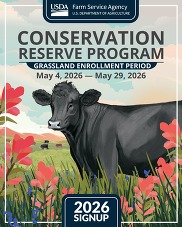
The U.S. Department of Agriculture (USDA) announced that agricultural producers and private landowners can enroll in the Grassland Conservation Reserve Program (Grassland CRP) through May 29, 2026. USDA’s Farm Service Agency (FSA) administers Grassland CRP, a voluntary working lands conservation program that enables participants to conserve grasslands while also continuing most grazing and haying practices.
Grassland CRP emphasizes support for grazing operations, plant and animal biodiversity, and grasslands and land with shrubs and forbs under the greatest threat of conversion.
CRP is USDA’s flagship conservation program, providing financial and technical support to agricultural producers and landowners who place unproductive or marginal cropland under contract for 10-15 years and who agree to voluntarily convert the land to beneficial vegetative cover to improve water quality, prevent soil erosion and support wildlife habitat. The Continuing Appropriations, Agriculture, Legislative Branch, Military Construction and Veterans Affairs, and Extensions Act, 2026, extends FSA’s authority to administer CRP through Sept. 30, 2026.
Currently, more than 26.2 million acres are enrolled in CRP, with nearly 10.3 million acres in Grassland CRP. FSA recently closed the enrollment period for General CRP and Continuous CRP. FSA is reviewing submitted offers and will announce accepted offers at a later date. Due to the 27-million-acre statutory cap, only 1.9 million acres are available for all CRP enrollment this fiscal year.
Producers and landowners interested in participating in CRP should contact their local FSA county office before the May 29 deadline.
|
The U.S. Department of Agriculture (USDA) is maximizing disaster assistance support for producers by issuing a second Supplemental Disaster Relief Program (SDRP) payment to eligible producers who have approved program applications for losses due to natural disasters in calendar years 2023 and 2024.
USDA’s Farm Service Agency (FSA) has already provided $6.7 billion in SDRP payments to eligible producers. Additionally, USDA is extending the program deadline to give producers and FSA more time to address any program application changes that could impact payments. The original April 30 deadline has been extended to Aug. 12, 2026, for SDRP Stage 1 and Stage 2.
Initial SDRP payments were factored at 35%, but after further analysis, USDA is increasing the payment factor to 70%, meaning producers with approved applications will receive an additional 35% of their calculated SDRP payment. Future SDRP payments will also be made using a 70% payment factor.
SDRP Stage 1
The first stage, announced in July 2025, remains available to producers who received an indemnity under crop insurance or the Noninsured Crop Disaster Assistance Program (NAP) for eligible crop losses due to qualifying 2023 and 2024 natural disaster events.
SDRP Stage 2
Stage 2 of SDRP covers eligible crop, tree, bush and vine losses that were not covered under Stage One program provisions, including non-indemnified (shallow loss), uncovered and quality losses.
Eligibility
Eligible losses must be the result of natural disasters occurring in calendar years 2023 and/or 2024. These disasters include wildfires, hurricanes, floods, derechos, excessive heat, tornadoes, winter storms, freeze (including a polar vortex), smoke exposure, excessive moisture, qualifying drought, and related conditions.
To qualify for drought related losses, the loss must have occurred in a county rated by the U.S. Drought Monitor as having a D2 (severe drought) for eight consecutive weeks, D3 (extreme drought), or greater intensity level during the applicable calendar year.
FSA is establishing block grants with Connecticut, Hawaii, Maine, and Massachusetts that cover crop losses; therefore, producers with losses on land physically located in these states are not eligible for SDRP program payments.
For more information on SDRP, please visit fsa.usda.gov/sdrp.
The U.S. Department of Agriculture (USDA) is bolstering support for farmers facing crop setbacks by announcing an increase in replant payments for most producers beginning with the 2026 crop year. This initiative aims to provide financial assistance to farmers who need to replant insured crops damaged by early insurable causes of loss.
Replant payment factors have not been updated since they were established in the 1990s. RMA reviewed replant payment factors to ensure they reflect current replanting costs. The agency determined most small grains and coarse grains crops will receive a significant increase. RMA will consider future updates based on new data, further analysis, and stakeholder feedback from these changes.
Crop insurance is sold and delivered solely through private crop insurance agents. A list of crop insurance agents is available at all USDA Service Centers and online at the RMA Agent Locator. Producers can learn more about crop insurance and the modern farm safety net at rma.usda.gov or by contacting their RMA Regional Office.
Producers planning to use the commodity loan program for their 2025 crops are reminded that June 1, 2026, is the deadline for filing applications for the following 2025 crops: corn, dry peas, grain sorghum, lentils, mustard, safflower, chickpeas, soybeans and sunflowers. These loans carry a nine-month maturity and can be repaid with cash at disbursement to loan maturity. To be eligible, producers must have produced an eligible loan commodity for the applicable crop year, complied with annual program requirements, maintain beneficial interest (have title to the commodity and retain control of the commodity), request MAL on or before the final loan availability date for a specific commodity, and, if required, submit lien waivers for any liens existing on the crop for which a Marketing Assistance Loan (MAL) is being requested.
Producers interested in a commodity loan on the above listed commodities should contact their local County FSA office staff prior to the June 1 deadline.
Maps are now available at our County FSA Offices for acreage reporting purposes. If you want to receive your maps by e-mail, please call your FSA office to request your copies.
The following acreage reporting dates are applicable for Ohio:
-
May 31, 2026 --- Report Nursery Crop Acreage.
-
July 15, 2026 --- Report all your Burley Tobacco, Cabbage (Planted 3/19/26-5/31/26), Corn, Grain Sorghum, Hybrid Corn Seed, Spring Oats, Popcorn, Potatoes, Soybeans, Sugar Beets, Tomatoes and all other crops. Report Perennial Forage Crops. Report Conservation Reserve Program (CRP) acreage.
-
Aug. 15, 2026 --- Report Cabbage (Planted 6/1/26-7/20/26).
-
Sept. 30, 2026 --- Report Aquaculture.
-
Dec. 15, 2026 ---- Report Fall-Seeded 2027 crops, Barley, Fall Wheat, and all other Fall-Seeded Small Grains.
In order to maintain program eligibility and benefits, you must file timely acreage reports. Failure to file an acreage report by the crop acreage reporting deadline may cause ineligibility for future program benefits. FSA will not accept acreage reports provided more than a year after the acreage reporting deadline.
Producers are encouraged to file their acreage reports as soon as planting is completed.
|
Farmers and landowners working with USDA’s Farm Service Agency or Natural Resources Conservation Service can now sign and share documents online in just a few clicks. By using Box or OneSpan, producers can digitally complete business transactions without leaving their homes or agricultural operations. Both services are free, secure, and available for multiple FSA and NRCS programs.
Box is a secure, cloud-based site where FSA or NRCS documents can be managed and shared. Producers who choose to use Box can create a username and password to access their secure Box account, where documents can be downloaded, printed, manually signed, scanned, uploaded, and shared digitally with Service Center staff. This service is available to any FSA or NRCS customer with access to a mobile device or computer with printer connectivity.
OneSpan is a secure eSignature solution for FSA and NRCS customers. Like Box, no software downloads or eAuthentication is required for OneSpan. Instead, producers interested in eSignature through OneSpan can confirm their identity through two-factor authentication using a verification code sent to their mobile device or a personalized question and answer. Once identity is confirmed, documents can be reviewed and e-signed through OneSpan via the producer’s personal email address. Signed documents immediately become available to the appropriate Service Center staff.
Box and OneSpan are both optional services for customers interested in improved efficiency in signing and sharing documents with USDA, and they do not replace existing systems using eAuthentication for digital signature. Instead, these tools provide additional digital options for producers to use when conducting business with FSA or NRCS.
USDA Service Center staff are available to help producers get started with Box and OneSpan through a few simple steps. Please visit farmers.gov/service-locator to find your local office and let Service Center staff know you’re interested in signing and sharing documents through these new features. In most cases, one quick phone call will be all that is needed to initiate the process. Visit farmers.gov/mydocs to learn more about Box and OneSpan, steps for getting started, and additional resources for conducting business with USDA online.
The U.S. Department of Agriculture (USDA) offers a Debt Consolidation Tool, an innovative online tool available through farmers.gov that allows agricultural producers to enter their farm operating debt and evaluate the potential savings that might be provided by obtaining a debt consolidation loan with USDA’s Farm Service Agency (FSA) or a local lender.
A debt consolidation loan is a new loan used to pay off other existing operating loans or lines of credit that might have unreasonable rates and terms. By combining multiple eligible debts into a single, larger loan, borrowers may obtain more favorable payment terms such as a lower interest rate or lower payments. Consolidating debt may also provide farmers and ranchers additional cash flow flexibilities.
The Debt Consolidation Tool is a significant addition to FSA’s suite of improvements designed to modernize its Farm Loan Programs. The tool enhances customer service and increases opportunities for farmers and ranchers to achieve financial viability by helping them identify potential savings that could be reinvested in their farming and ranching operation, retirement accounts, or college savings accounts.
Producers can access the Debt Consolidation Tool by visiting farmers.gov/debt-consolidation-tool. The tool is built to run on modern browsers including Chrome, Edge, Firefox, or the Safari browser. Producers do not need to create a farmers.gov account or access the authenticated customer portal to use the tool.
USDA encourages producers to reach out to their local FSA farm loan staff to ensure they fully understand the wide range of loan and servicing options available to assist with starting, expanding, or maintaining their agricultural operation. To conduct business with FSA, please contact your local USDA Service Center.
Farm Operating Loans, Direct -- 4.750%
Farm Ownership Loans, Direct -- 5.750%
Limited Resource Loans -- 5.000%
Farm Ownership Loans, Down Payment -- 1.750%
Farm Ownership – Joint Financing -- 3.750%
Emergency Loans -- 3.750%
Farm Storage Facility Loan, 3 year -- 3.875%
Farm Storage Facility Loan, 5 year -- 4.000%
Farm Storage Facility Loan, 7 year -- 4.125%
Farm Storage Facility Loan, 10 year -- 4.375%
Farm Storage Facility Loan, 12 year -- 4.500%
Sugar Storage Facility Loans, 15 year -- 4.750%
Commodity Loans -- 4.750%
|
May 25
|
Memorial Day Holiday. USDA Service Centers Closed.
|
|
May 29
|
Deadline to apply for the Grassland Conservation Reserve Program.
|
|
May 31
|
Deadline to apply for 2025 commodity loans and LDP's on feed grains, soybeans, pulse crops.
|
|
June 19
|
Juneteenth National Independence Day. USDA Service Center Closed.
|
|
July 3
|
Independence Day Holiday. USDA Service Center Closed.
|
|
July 15
|
Final certification date to report burley tobacco; cabbage planted through May 31; corn, grain sorghum, hybrid corn seed, spring oats, potatoes, popcorn, sugar beets, tomatoes and other crops. Report perennial forage crops. Report Conservation Reserve Program (CRP) acreage.
|
|
July 15
|
Final Date to Report Production for the preceding Crop Year for Farms Enrolled in ARC-IC.
|
|
July 15
|
End of primary nesting season for CRP program purposes.
|
|
August 1
|
Deadline to Request farm reconstitutions and transfers for 2026.
|
|
August 12
|
Supplemental Disaster Relief Program Stage 1 and Stage 2 Deadline.
|
|
August 14
|
Deadline for producers to request enrollment into Transition Incentives Program (TIP).
|
|
Ongoing
|
Reports of Failed Acreage must be filed with the County Office before disposition of the crop.
|
|
Ongoing
|
Reports of Prevented Planting Acreage must be filed with the County Office no later than 15 calendar days after the final planting date for that county and producers of hand-harvested crops and certain perishable crops must notify FSA within 72 hours of when a loss becomes apparent.
|
|
Ongoing
|
Contact your FSA County office right away for notice of loss deadlines and disaster program requirements.
|
|
Continuous
|
New applications for Farm Service Agency Loan Programs.
|
|
Continuous
|
Submit an Application for a Farm Storage Facility Loan.
|
|
Continuous
|
Sign up for GovDelivery Newsletters, Bulletins and Ohio Press Releases (Subscribe to USDA Emails for Farmers | Farmers.gov)
|
Ohio FSA State Office
200 North High Street, Room 540
Columbus, Ohio 43215
Phone: 614-255-2441
|
|
Visit the Ohio FSA website at: www.fsa.usda.gov/oh
|
State Executive Director:
Don Jones
|
Deputy State Executive Director:
Traci Garza
|
|
Administrative Officer:
Stephanie Moran
|
Conservation Chief:
Brandi Koehler
|
|
Farm Loan Chief:
Andrew Huey
|
Price Support Chief:
Trevor Kerr
|
|
Production Adjustment / Compliance and Risk Management Chief:
Matt Kleski
|
|
|
|








