
Minnesota FSA Updates - May 14, 2026
In This Issue:

Greetings from the State FSA Office!
I wish to extend warm Springtime greetings to you all this busy month of May. We will gain over an hour of sunlight during the month of May in Minnesota, and with it we realize the workdays become long and productive. Producers are making great progress with planting in all parts of our state and with it, a full dose of optimism. May is a very crucial month for crop establishment. Obtaining adequate plant stands and early season vigor is our goal for success. Weather is important all season long, but without a satisfactory beginning, strong yields are difficult to realize. Make sure you take care of yourselves during this important month as well. Like the cropping season, if we’re not able to remain healthy by receiving rest and nutrition, success will also be difficult to realize.
There have been some recent announcements at FSA regarding program deadlines. The Supplemental Disaster Relief Program (SDRP) deadline has been extended until August 12 for both stages one and two. Your local FSA service center can continue to receive your applications until then. The CRP program enrollment for both the general and continuous has expired, but the Grassland CRP program has a signup period running from May 4 – 29. This program allows participants to conserve grasslands while also continuing most grazing and haying practices. Your local FSA county office will assist you with questions and signup procedures. If you happen to have a CRP contract that expires in 2026 or 2027 and you plan to not re-enroll, the Transition Incentives Program (TIP) may be of interest to you. TIP may provide up to two additional payments to you if you sell or lease to a military veteran or beginning farmer. The deadline to submit a TIP offer is Aug. 14. And finally, when you have had the opportunity to complete your planting this season, this is a friendly reminder to stop into your local FSA service center and certify your planted acres, this needs to be completed by July15.
When I return home to Butterfield on the weekends, I get busy helping place and arrange seed where it needs to go and get in the tractor to do some planting. It has always been my favorite farm activity. I’ve been doing this for a career’s worth of time. It still feels fresh every year. If you’re like me, it gives me an opportunity to think and reflect. I realize that I’m an in-between generation. I remember both grandfathers well, both were farmers. I farmed with my father, and now my son. My grandson, although only two years old, has seemingly made his career choice as he rides with me in the buddy seat. I have been blessed to be in between five generations. My hope and wish are that these thoughts and reflections will be ongoing for many generations to come. There isn’t a nobler profession, nor a better place to raise a family than on a farm. My wish for you is that each and every farm family has a profitable, healthy and rewarding year. It is a privilege to serve you.
Kurt Blomgren
FSA State Executive Director, Minnesota
|
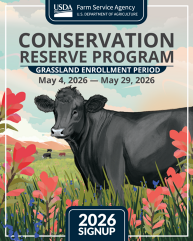
The U.S. Department of Agriculture (USDA) announced that agricultural producers and private landowners can enroll in the Grassland Conservation Reserve Program (Grassland CRP) May 4, 2026, through May 29, 2026. USDA’s Farm Service Agency (FSA) administers Grassland CRP, a voluntary working lands conservation program that enables participants to conserve grasslands while also continuing most grazing and haying practices.
Grassland CRP emphasizes support for grazing operations, plant and animal biodiversity, and grasslands and land with shrubs and forbs under the greatest threat of conversion.
CRP is USDA’s flagship conservation program, providing financial and technical support to agricultural producers and landowners who place unproductive or marginal cropland under contract for 10-15 years and who agree to voluntarily convert the land to beneficial vegetative cover to improve water quality, prevent soil erosion and support wildlife habitat. The Continuing Appropriations, Agriculture, Legislative Branch, Military Construction and Veterans Affairs, and Extensions Act, 2026, extends FSA’s authority to administer CRP through Sept. 30, 2026.
Currently, more than 26.2 million acres are enrolled in CRP, with nearly 10.3 million acres in Grassland CRP. FSA recently closed the enrollment period for General CRP and Continuous CRP. FSA is reviewing submitted offers and will announce accepted offers at a later date. Due to the 27-million-acre statutory cap, only 1.9 million acres are available for all CRP enrollment this fiscal year.
Producers and landowners interested in participating in CRP should contact their local FSA county office before the May 29 deadline.
|
The U.S. Department of Agriculture (USDA)is maximizing disaster assistance support for producers by issuing a second Supplemental Disaster Relief Program (SDRP) payment to eligible producers who have approved program applications for losses due to natural disasters in calendar years 2023 and 2024.
USDA’s Farm Service Agency (FSA) has already provided $6.7 billion in SDRP payments to eligible producers. Additionally, USDA is extending the program deadline to give producers and FSA more time to address any program application changes that could impact payments. The original April 30 deadline has been extended to Aug. 12, 2026, for SDRP Stage 1 and Stage 2.
Initial SDRP payments were factored at 35%, but after further analysis, USDA is increasing the payment factor to 70%, meaning producers with approved applications will receive an additional 35% of their calculated SDRP payment. Future SDRP payments will also be made using a 70% payment factor.
SDRP Stage 1
The first stage, announced in July 2025, remains available to producers who received an indemnity under crop insurance or the Noninsured Crop Disaster Assistance Program (NAP) for eligible crop losses due to qualifying 2023 and 2024 natural disaster events.
SDRP Stage 2
Stage 2 of SDRP covers eligible crop, tree, bush and vine losses that were not covered under Stage One program provisions, including non-indemnified (shallow loss), uncovered and quality losses.
Eligibility
Eligible losses must be the result of natural disasters occurring in calendar years 2023 and/or 2024. These disasters include wildfires, hurricanes, floods, derechos, excessive heat, tornadoes, winter storms, freeze (including a polar vortex), smoke exposure, excessive moisture, qualifying drought, and related conditions.
To qualify for drought related losses, the loss must have occurred in a county rated by the U.S. Drought Monitor as having a D2 (severe drought) for eight consecutive weeks, D3 (extreme drought), or greater intensity level during the applicable calendar year.
FSA is establishing block grants with Connecticut, Hawaii, Maine, and Massachusetts that cover crop losses; therefore, producers with losses on land physically located in these states are not eligible for SDRP program payments.
For more information on SDRP, please visit fsa.usda.gov/sdrp.
Top of Page
Maps are now available to pick up at the local FSA offices for acreage reporting purposes.
The next deadline for annual acreage reporting in Minnesota is July 15, 2026. This includes common spring-planted crops, such as corn, soybeans, wheat, and grain sorghum, but also includes perennial grass (pasture) and Conservation Reserve Program acres.
In order to maintain program eligibility and benefits, you must file timely acreage reports. Failure to file an acreage report by the crop acreage reporting deadline may cause ineligibility for future program benefits. FSA will not accept acreage reports provided more than a year after the acreage reporting deadline.
Producers are encouraged to file their acreage reports as soon as planting is completed. If you wish to receive your maps by e-mail or have questions on the process, please contact your local office.
A farmers.gov account provides self-service opportunities to Farm Service Agency (FSA) and Natural Resources Conservation Service (NRCS) customers through a secure, authenticated access process.
A new feature now provides access to your current or prior year FSA-578, Report of Commodities (Nationwide Producer Print). Your FSA-578 contains annual crop acreage reporting information submitted to USDA’s Farm Service Agency (FSA). If you are a shareholder (operator, owner or other producer) for a crop on the acreage report, you will be able to view, save and/or print your selected annual FSA-578.
How to Access Your FSA-578’s
From the Land tab in your farmers.gov account, click Land Overview on the navigation drop-down. On the Land Overview page, you will see an information block that states “View and Print Your Acreage Reports” containing a View Your FSA-578 button.
Clicking the button will open a popup modal with a drop-down menu to select the acreage report year. Once you have selected a year, the View FSA-578 button becomes active. Clicking the button will open a new tab with a message indicating the PDF file is being loaded. Once the load is complete, the FSA-578, Report of Commodities (Nationwide Producer Print) PDF document is displayed. You can view, save and/or print the FSA-578 as needed.
If there is no acreage report information on file for the selected acreage report year, the PDF will display the message, “This producer does not have a producer print currently available.”
How to Access FSA-578s Using Your Representative Authority to Act on Behalf of Another Customer
Additionally, if you have been granted the authority to act on behalf of another individual or entity, you can use the yellow banner to “Switch Profile” and view the current or prior year FSA-578, Report of Commodities (Nationwide Producer Print) for the customer you on whose behalf you have been elected to act.
Contact your local FSA office for more information or questions regarding your FSA-578, Report of Commodities (Nationwide Producer Print) or if you have questions regarding establishing representative authority or do not see the expected representative authority options when you log in.
More information can be found in the farmers.gov Fact Sheet and video tutorials. Visit the farmers.gov Account page to log in or learn how to create an account.
The Farm Service Agency’s (FSA) Noninsured Crop Disaster Assistance Program (NAP) provides financial assistance to producers of non-insurable crops, including mechanically harvested forage with NAP coverage, to protect against natural disasters that occur during the coverage, resulting in loss of production, loss of value, or prevented planting of an eligible crop.
If you have NAP coverage on mechanically harvested forage, you must:
- Maintain separate production records for each unit, crop, practice, crop type, and intended use.
- Submit production records to FSA by the designated production reporting date for the crop.
- Notify your FSA administrative county office before grazing, abandoning, or destroying forage acreage reported, on FSA form FSA-578, as intended to be mechanically harvested; and request an appraisal.
- Notify your FSA administrative county office of a loss and timely file CCC-576, Notice of Loss and Application for Payment, Part B, the earlier of:
- 15 calendar days after the disaster occurs, or damage first becomes apparent.
- 15 calendar days after the crop’s normal harvest date.
- If you change your intended use or experience a loss during the coverage period, you must:
- Establish and maintain representative sample areas when an appraisal of the acreage is required.
- Inform your FSA administrative county office of the location of representative sample areas within 15 days of placing the panels.
- Request an appraisal of the representative sample areas at the end of harvest period but before first freeze.
For more information on NAP and NAP compliance requirements you must follow to retain NAP coverage, contact your local USDA service center.
Farm Service Agency (FSA) loans require applicants to have a satisfactory credit history. A credit report is requested for all FSA direct farm loan applicants. These reports are reviewed to verify outstanding debts, see if bills are paid timely and to determine the impact on cash flow.
Information on your credit report is strictly confidential and is used only as an aid in conducting FSA business.
Our farm loan staff will discuss options with you if you have an unfavorable credit report and will provide a copy of your report. If you dispute the accuracy of the information on the credit report, it is up to you to contact the issuing credit report company to resolve any errors or inaccuracies.
There are multiple ways to remedy an unfavorable credit score:
- Make sure to pay bills on time
- Setting up automatic payments or automated reminders can be an effective way to remember payment due dates.
- Pay down existing debt
- Keep your credit card balances low
- Avoid suddenly opening or closing existing credit accounts
FSA’s farm loan staff will guide you through the process, which may require you to reapply for a loan after improving or correcting your credit report.
For more information on FSA farm loan programs, contact your local USDA Service Centeror visit fsa.usda.gov.
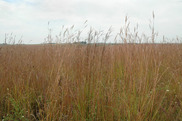
The Conservation Reserve Program (CRP) is a program administered by the Farm Service Agency (FSA) to conserve farmland for future generations while providing habitat for wildlife, reducing soil erosion, and improving water quality. Regular maintenance on CRP acres is needed to ensure the acreage continues to provide conservation benefits and remains in compliance with the CRP contract.
Regular Maintenance
Producers with CRP contracts are required to control all weeds, insects, pests, and other undesirable species to the extent necessary to ensure that the approved conservation cover is adequately protected and to ensure there is no adverse impact on surrounding land. Mowing is one of the allowable practices for weed control, but mowing for aesthetic purposes is never permitted. The Conservation Plan states the required weed control methods for each site.
Once a stand has been certified as fully established, participants are required to maintain plant diversity and stand density according to the Conservation Plan and offer (CRP-2) for the life of the contract. Stands that do not meet practice specific plant diversity or density requirements may be considered non-compliant. Refer to your conservation plan or contact FSA if you have any questions or concerns about the vegetative cover requirements.
Maintenance activities cannot occur during the primary nesting season for birds without written prior approval from the local county office. Contact your local office to verify the primary nesting season dates for your county.
Mid-Contract Management
Regular maintenance for weed and pest control is separate from the Mid-Contract Management (MCM) requirement. MCM ensures plant diversity and wildlife benefits while ensuring protection of the soil and water resources. Such activities are site-specific and are for the purpose of enhancing the approved cover.
MCM must be completed between years four and six of a 10-year contract and between years seven and nine of a 15-year contract. The Conservation Plan will state what year MCM must take place.
Noncompliance with Maintenance Requirements
Failure to adequately maintain the stand may result in noncompliance with the terms and conditions of the CRP contract. Noncompliance can result in adverse actions up to and including termination of the CRP contract. Contracts that are out of compliance are ineligible to re-enroll, unless the stand is brought back into compliance prior to the enrollment deadline.
For general information about CRP, visit the Conservation Reserve Program webpage. For information about specific contracts, reach out to the local FSA office.
|
Top of Page
The National Environmental Policy Act (NEPA) requires Federal agencies to consider all potential environmental impacts for federally funded projects before the project is approved.
For all Farm Service Agency (FSA) programs, an environmental review must be completed before actions are approved, such as site preparation or ground disturbance. These programs include, but are not limited to, the Emergency Conservation Program (ECP), Farm Storage Facility Loan (FSFL) program and farm loans. If project implementation begins before FSA has completed an environmental review, the request will be denied. Although there are exceptions regarding the Stafford Act and emergencies, it’s important to wait until you receive written approval of your project proposal before starting any actions.
Applications cannot be approved until FSA has copies of all permits and plans. Contact your local FSA office early in your planning process to determine what level of environmental review is required for your program application so that it can be completed timely.
The USDA Farm Service Agency’s (FSA) Direct Farm Ownership loans can help farmers and ranchers become owner-operators of family farms, improve and expand current operations, increase agricultural productivity, and assist with land tenure to save farmland for future generations.
There are three types of Direct Farm Ownership Loans: regular, down payment and joint financing. FSA also offers a Direct Farm Ownership Microloan option for smaller financial needs up to $50,000.
Joint financing allows FSA to provide more farmers and ranchers with access to capital. FSA lends up to 50 percent of the total amount financed. A commercial lender, a state program or the seller of the property being purchased, provides the balance of loan funds, with or without an FSA guarantee. The maximum loan amount for a joint financing loan is $600,000, and the repayment period for the loan is up to 40 years.
The operation must be an eligible farm enterprise. Farm Ownership loan funds cannot be used to finance nonfarm enterprises and all applicants must be able to meet general eligibility requirements. Loan applicants are also required to have participated in the business operations of a farm or ranch for at least three years out of the 10 years prior to the date the application is submitted. The applicant must show documentation that their participation in the business operation of the farm or ranch was not solely as a laborer.
For more information about farm loans, contact your local USDA Service Center or visit fsa.usda.gov.
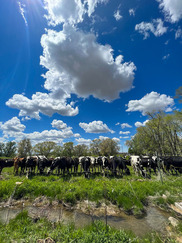
The Minnesota Farm Service Agency (FSA) reminds producers that annual acreage reporting is an important eligibility requirement to receive financial benefits through the Livestock Forage Disaster Assistance Program (LFP), as well as several other FSA-administered programs.
The next deadline for annual acreage reporting in Minnesota is July 15, 2026. This includes common spring-planted crops, such as corn, soybeans, wheat, and grain sorghum, but also includes perennial grass (pasture) and Conservation Reserve Program acres.
Noninsured Crop Disaster Assistance Program (NAP) policy holders should note that the acreage reporting date for NAP-covered crops is July 15, 2026, or 15 calendar days before grazing or harvesting of the crop begins.
Even though the acreage reporting deadline is months away, we are encouraging producers with pasture acres and acres planted for grazing purposes to complete certification of those acres as soon as possible to assist us with preparations for potential program implementation.
LFP provides financial assistance to livestock producers and contract growers who also are producers of grazed forage crop acres (native and improved pasture and crops planted specifically for grazing purposes) and who have suffered a loss due to a qualifying drought during the grazing season.
Other points regarding LFP and acreage certification:
- Producers must have a risk in the pasture or hay crop acres in order to complete the acreage certification process.
- If a producer applies for LFP they must be able to support their application with either a written lease or an Annual Lease Certification (CCC-855).
- In addition to the acreage reporting requirement, LFP applicants who lease acres must be able to support their application with either a written lease or an Annual Lease Certification (CCC-855).
- Producers who previously have certified grazing land through a continuous certification may want to contact the county FSA office to ensure that certification remains in place and reflects 2026 producers and shares.
Producers can contact their local USDA Service Center for additional information.
|
Top of page
Minnesota USDA Farm Service Agency
375 Jackson Street
Suite 400
Saint Paul, MN 55101
Phone: 651-602-7700
Fax: 855-719-9917
www.fsa.usda.gov/state-offices/minnesota
|
|
Minnesota FSA State Executive Director:
Kurt Blomgren
|
Deputy State Executive Director:
Daniel Mahoney
Division Leaders:
Cassie Buck
Lee Crawford
Calvin Gellatly
|
Minnesota State Committee:
Charlie Radman, Chairperson
Jim Kukowski, Member
Jason May, Member
Pamela Uhlenkamp, Member
Scott Winslow, Member
|
To find contact information for your local USDA Farm Service Agency office, go to: www.farmers.gov/working-with-us/service-center-locator
|
|








