Connecticut State Newsletter - May 20, 2026
In This Issue:

Hello again from the office of the Connecticut State Executive Director of the USDA Farm service Agency where we’re continuing the important work of supporting our agricultural producers day in and day out. Our newsletters are a valuable resource to help our producers, stakeholders and academic institutions understand how the Farm Service Agency (FSA) serves the community and how to work with us to protect agriculture across our state.
Since my last message, I have been working tirelessly to connect with our farmers across all agriculture sectors. I’ve toured greenhouses at our state’s robust nurseries, met with our region’s aquaculture producers, attended ag council meetings with our stakeholders, and had conversations with our dairy farmers about the unique problems they face and how we at FSA can assist.
This spring has had its challenges including an unseasonably late frost and now we’re keeping our eyes on the threat of drought that is setting into our area. At USDA, we have a suite of programs to support farmers and ranchers recover from these types of disasters, and we highly suggest impacted producers contact your local county office for available assistance. Our county office staff are as hard working as they are passionate about serving our state’s farmers and will do everything they can to help you properly sign up for our disaster programs. I have personally seen their dedication on a daily basis and encourage you to call or come in when you need us and see for yourself the level of professionalism and integrity they provide.
Your feedback is very important and helps us understand how our work helps producers, as well as ways we can better improve programs and service. The beauty of small states like ours is access to one another and fast communication. From my first day on the job, I have maintained the policy of always being accessible to you and encourage you to reach out to us with any questions, suggestions or concerns, my door is always open.
Robert Sullivan
State Executive Director, Connecticut and Rhode Island
|
Application Deadline July 17
Tolland, Conn., May 18, 2026 – The U.S. Department of Agriculture (USDA) Farm Service Agency (FSA) in Connecticut today announced the agency is reopening the Emergency Conservation Program (ECP) to address damages from 2023 drought and 2024 floods. ECP provides cost-share and technical assistance to producers to restore farmland to pre-disaster conditions following a qualifying natural disaster. ECP signup begins on May 18, 2026, and ends on July 17, 2026.
“Connecticut producers have faced incredibly difficult conditions from the 2023 drought and the devastating floods in 2024, and USDA is committed to helping them recover,” said Robert Sullivan, FSA State Executive Director for Connecticut. “By reopening the Emergency Conservation Program signup, we are providing another important opportunity for agricultural producers to access the recovery assistance they may need to restore their land, protect their operations and continue producing.”
ECP 2023 (Drought)
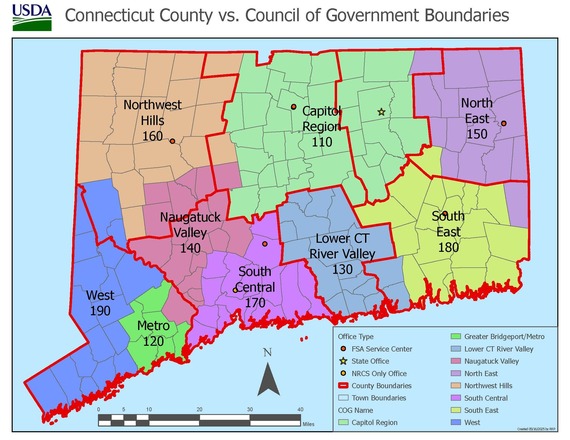
FSA is reopening ECP to address severe drought damage in 2023 in the Southeast Council of Government (COG). Agricultural producers who experienced water issues, specifically with insufficient supply to provide water to confined livestock including deepening wells or irrigation for orchards and vineyards, may be eligible for assistance under ECP administered by the Southeast COG FSA. Expenses for piping, pumps and storage tanks for new wells may also be eligible.
Water hauling costs are not an ECP reimbursable expense. ECP funding also cannot be used to install new wells for vegetable or other short-term crops and cannot be used to reimburse for wells that do not produce sufficient water or to frack existing wells.
ECP 2024 (Flood)
FSA is also reopening for the ECP signup to address 2024 severe storm and flood damage experienced in 2024 in the South Central, Northwest Hills, Naugatuck Valley, Greater Bridgeport, and West COG.
For land to be eligible, the natural disaster must create new conservation problems that, if untreated, would:
-
be so costly to rehabilitate that federal assistance is or will be needed to return the land to productive agricultural use,
-
is unusual and is not the type that would recur frequently in the same area,
-
affect the productive capacity of the farmland, or
-
impair or endanger the land.
ECP Cost-Share Assistance
ECP cost-share assistance can provide advance payments for up to 25% of the total allowable cost for all ECP practices before the restoration is carried out. The advance payment must be spent within 60 days. To ensure eligibility for ECP cost-share payment, check with FSA before beginning work.
If you qualify for ECP assistance for 2023 or 2024 disasters, you may receive cost-share levels not to exceed 75% of the eligible cost of restoration measures. Per statute, eligible socially disadvantaged and beginning farmers and ranchers can receive up to 90% of the eligible cost of restoration. No one is eligible for more than $500,000 in cost share assistance per natural disaster event.
Eligibility and Environmental Requirements
Producers with damage from qualifying natural disaster events must apply for ECP assistance before beginning reconstructive work. FSA’s environmental compliance review process is required to be completed before any actions are taken. A waiver can be requested for necessary activities that are taken as emergency action to prevent further loss. Producers who apply after reconstructive work has been completed are at risk of not qualifying for ECP.
To be eligible for assistance, ECP approved practices must not be started until all the following are met:
-
an application for cost-share assistance has been filed,
-
the local FSA county committee (COC) or its representative has conducted an onsite inspection of the damaged area, and
-
the agency responsible for technical assistance, such as the Natural Resources Conservation Service (NRCS), has made a needs determination, which may include cubic yards of earthmoving, etc., required for rehabilitation.
Producers who lease federally owned or managed lands, including tribal trust land, as well as state land, are eligible to participate in ECP. Conservation concerns present on the land prior to the qualifying natural disaster event are not eligible for ECP assistance.
FSA county committees will evaluate applications based on an on-site inspection of the damaged land, taking into consideration the type and extent of the damage. An on-site inspection does not guarantee that cost-share funding will be provided.
More Information
To learn more about ECP, producers can contact your local FSA office fsa.usda.gov/state-offices. For more detailed information about COG boundaries, please visit the Connecticut Geodata Portal.
FSA helps America’s farmers, ranchers and forest landowners invest in, improve, protect and expand their agricultural operations through the delivery of agricultural programs for all Americans. FSA implements agricultural policy, administers credit and loan programs, and manages conservation, commodity, disaster recovery and marketing programs through a national network of state and county offices and locally elected county committees. For more information, visit fsa.usda.gov.
 ^ back to top
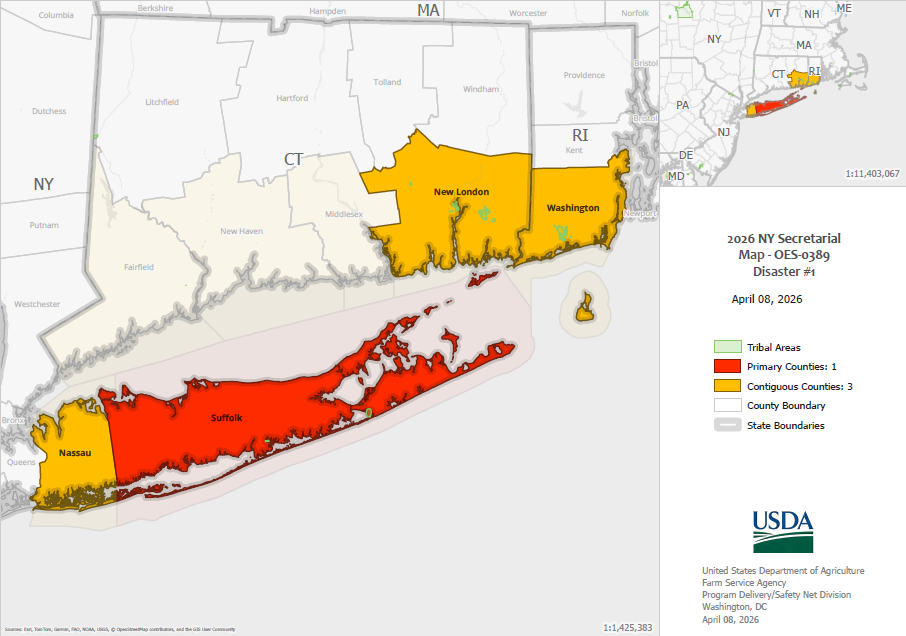
This Secretarial natural disaster designation allows the United States Department of Agriculture (USDA) Farm Service Agency (FSA) to extend much-needed emergency credit to producers recovering from natural disasters through emergency loans. Emergency loans can be used to meet various recovery needs including the replacement of essential items such as equipment or livestock, reorganization of a farming operation, or to refinance certain debts. FSA will review the loans based on the extent of losses, security available, and repayment ability.
Impacted Area: New York
Triggering Disaster: Freeze, Ice Floes, and Tidal Surge - 1/26/26 - 2/23/26
Application Deadline: 12/21/2026
Primary Counties Eligible:
Contiguous Counties Also Eligible:
-
New York: Nassau
-
Connecticut: New London (South East Council of Government)
-
Rhode Island: Washington
More Resources
On farmers.gov, the Disaster Assistance Discovery Tool, Disaster Assistance-at-a-Glance fact sheet, and Loan Assistance Tool can help you determine program or loan options. To file a Notice of Loss or to ask questions about available programs, contact your local USDA Service Center.
^ back to top

Agricultural operations in Connecticut have been significantly impacted by recent freeze. The U.S. Department of Agriculture (USDA) has technical and financial assistance available to help farmers and livestock producers recover from these adverse weather events.
“USDA has a suite of programs to support farmers and ranchers as they recover from disasters,” said Farm Production and Conservation Under Secretary Richard Fordyce. “I encourage impacted producers to contact their local USDA Service Center to report losses and learn more about program options available to assist in their recovery from crop, land, infrastructure, and livestock losses and damages.”
USDA Disaster Assistance
Producers who experience livestock deaths in excess of normal mortality or sell injured livestock at a reduced price may be eligible for the Livestock Indemnity Program (LIP). To participate in LIP, producers will have to provide acceptable documentation of death losses or evidence of reduced sales due to an injury or condition resulting from an eligible cause of loss, including an adverse weather event, and must submit a notice of loss to the USDA Farm Service Agency (FSA) no later than March 1, 2027, for 2026 calendar year losses.
Meanwhile, the Emergency Assistance for Livestock, Honeybees, and Farm-Raised Fish Program (ELAP) provides assistance to honeybee and farm-raised fish producers for eligible death losses. For eligible livestock, assistance for feed loss may be available through ELAP. For ELAP, producers are required to complete a notice of loss and application for payment to their local FSA office no later than March 1, 2027, for 2026 calendar year losses.
Additionally, eligible orchardists and nursery tree growers may be eligible for cost-share assistance through the Tree Assistance Program (TAP) to replant or rehabilitate eligible trees, bushes or vines. TAP complements the Noninsured Crop Disaster Assistance Program (NAP) or crop insurance coverage, which covers the crop but not the plants or trees in all cases. For TAP, a program application must be filed within 90 days of the disaster event or the date when the loss of the trees, bushes or vines is apparent.
“Once you are able to evaluate the impact on your operation, be sure to contact your local FSA county office to timely report all crop, livestock and farm infrastructure damages and losses,” said Robert Sullivan, State Executive Director for FSA in Connecticut. “To expedite FSA disaster assistance, you may need to provide documents, such as farm records, herd inventory, receipts and pictures of damages or losses.”
FSA also offers a variety of direct and guaranteed farm loans, including operating and emergency farm loans, to producers unable to secure commercial financing. Producers in counties with a primary or contiguous disaster designation may be eligible for low interest emergency loans to help them recover from production and physical losses. Loans can help producers replace essential property, purchase inputs like livestock, equipment, feed and seed, cover family living expenses or refinance farm-related debts and other needs.
Additionally, FSA offers several loan servicing options available for borrowers who are unable to make scheduled payments on their farm loan programs debt to the agency because of reasons beyond their control.
Risk Management
Producers with NAP coverage should report crop damage to their local FSA office and must file a Notice of Loss (CCC-576) within 15 days of the loss becoming apparent, except for hand-harvested crops, which should be reported within 72 hours.
Producers with risk protection through Federal Crop Insurance should report crop damage to their crop insurance agent within 72 hours of discovering damage and be sure to follow up in writing within 15 days.
“Crop insurance and other USDA risk management options are offered to help producers manage risk because we never know what nature has in store for the future,” said Kevin Wooten, Director of USDA’s Risk Management Agency (RMA) Regional Office that covers Connecticut. “Disasters can be trying for producers, and they should stay in close contact with their crop insurance agent. Producers can be assured that the Approved Insurance Providers, loss adjusters and agents are experienced and well-trained in handling these types of events.”
Conservation
FSA’s Emergency Conservation Program (ECP) and Emergency Forest Restoration Program (EFRP) can assist landowners and nonindustrial private forest stewards with financial assistance to restore damaged farmland and conservation structures or forests.
More Information
Additional USDA disaster assistance information can be found on farmers.gov, including USDA resources specifically for producers impacted by winter weather. Those resources include the Disaster Assistance Discovery Tool, Disaster-at-a-Glance fact sheet, Loan Assistance Tool, and Natural Disasters and Crop Insurance fact sheet. Additionally, FarmRaise offers an FSA educational hub with LIP and ELAP decision tools as well as farm loan resource videos. For FSA programs, producers should contact their local USDA Service Center. For assistance with a crop insurance claim, producers and landowners should contact their crop insurance agent.
^ back to top
|
USDA Farm Service Agency (FSA) reminds you to report prevented planted and failed acres in order to establish or retain FSA program eligibility for some programs.
You should report crop acreage you intended to plant, but due to natural disaster, were prevented from planting. Prevented planting acreage must be reported on form CCC-576, Notice of Loss, no later than 15 calendar days after the final planting date as established by FSA and the Risk Management Agency (RMA).
The final planting date for most annual and perennial crops is July 15.
Additionally, if you have failed acres, you should also use form CCC-576, Notice of Loss, to report failed acres.
For hand-harvested crops and certain perishables, you must notify FSA of damage or loss through the administrative county office within 72 hours of the date of damage or loss first becomes apparent. This notification can be provided by filing a CCC-576, email, fax or phone. If you notify the County Office by any method other than by filing the CCC-576, you are still required to file a CCC-576, Notice of Loss, within the required 15 calendar days.
For losses on crops covered by the Noninsured Crop Disaster Assistance Program (NAP), you must file a Notice of Loss within 15 days of the occurrence of the disaster or when losses become apparent. You must timely file a Notice of Loss for failed acres on all crops including grasses.
To file a Notice of Loss, contact your local USDA Service Center or visit www.fsa.usda.gov.
^ back to top
This is likely no surprise to you, but drought persists across the U.S. and is intensifying in some areas. No geographic area is immune to the potential of drought at any given time. The U.S. Drought Monitor provides a weekly drought assessment, and it plays an important role in USDA programs that help farmers and ranchers recover from drought.
Fact #1 - Numerous agencies use the Drought Monitor to inform drought-related decisions.
The map identifies areas of drought and labels them by intensity on a weekly basis. It categorizes the entire country as being in one of six levels of drought. The first two, None and Abnormally Dry (D0), are not considered to be drought. The next four describe increasing levels of drought: Moderate (D1), Severe (D2), Extreme (D3) and Exceptional (D4).
While many entities consult the Drought Monitor for drought information, drought declarations are made by federal, state and local agencies that may or may not use the Drought Monitor to inform their decisions. Some of the ways USDA uses it to determine a producer’s eligibility for certain drought assistance programs, like the Livestock Forage Disaster Program and Emergency Haying or Grazing on Conservation Reserve Program acres and to “fast-track” Secretarial drought disaster designations.
Fact #2 - U.S. Drought Monitor is made with more than precipitation data.
When you think about drought, you probably think about water, or the lack of it. Precipitation plays a major role in the creation of the Drought Monitor, but the map’s author considers numerous indicators, including drought impacts and local insight from over 450 expert observers around the country. Authors use several dozen indicators to assess drought, including precipitation, streamflow, reservoir levels, temperature and evaporative demand, soil moisture and vegetation health. Because the drought monitor depicts both short and long‐term drought conditions, the authors must look at data for multiple timeframes. The final map produced each week represents a summary of the story being told by all the pieces of data. To help tell that story, authors don’t just look at data. They converse over the course of the map-making week with experts across the country and draw information about drought impacts from media reports and private citizens.
Fact #3 - A real person, using real data, updates the map.
Each week’s map author, not a computer, processes and analyzes data to update the drought monitor. The map authors are trained climatologists or meteorologists from the National Drought Mitigation Center at the University of Nebraska-Lincoln (the academic partner and website host of the Drought Monitor), the National Oceanic and Atmospheric Administration, the National Aeronautics and Space Administration and USDA. The author’s job is to do what a computer can’t – use their expertise to reconcile the sometimes-conflicting stories told by each stream of data into a single assessment.
Fact #4 - The Drought Monitor provides a current snapshot, not a forecast.
The Drought Monitor is a “snapshot” of conditions observed during the most recent week and builds off the previous week’s map. The map is released on Thursdays and depicts conditions based on data for the week that ended the preceding Tuesday. Rain that falls on the Wednesday just before the USDM’s release won’t be reflected until the next map is published. This provides a consistent, week‐to‐week product and gives the author a window to assess the data and come up with a final map.
Fact #5 – Your input can be part of the drought-monitoring process.
State climatologists and other trained observers in the drought monitoring network relay on-the-ground information from numerous sources to the US Drought monitor author each week. That can include information that you contribute.
The Drought Monitor serves as a trigger for multiple forms of federal disaster relief for agricultural producers, and sometimes producers contact the author to suggest that drought conditions in their area are worse than what the latest drought monitor shows. When the author gets a call like that, it prompts them to look closely at all available data for that area, to see whether measurements of precipitation, temperature, soil moisture and other indicators corroborate producer-submitted reports. This is the process that authors follow whether they receive one report or one hundred reports, although reports from more points may help state officials and others know where to look for impacts.
There are multiple ways to contribute your observations:
-
Talk to your state climatologist - Find the current list at the American Association of State Climatologists website.
-
Email - Emails sent to droughtmonitor@unl.edu inform the USDM authors.
-
Become a CoCoRaHS observer - Submit drought reports along with daily precipitation observations to the Community Collaborative Rain, Hail & Snow Network.
-
Submit Condition Monitoring Observer Reports (CMOR) - go.unl.edu/CMOR.
^ back to top
Maps are now available at FSA Offices for acreage reporting purposes. If you wish to receive your maps by e-mail, please call your local FSA Office.
Please see the following acreage reporting deadlines:
- July 15, 2026: Most annual and perennial crops.
In order to maintain program eligibility and benefits, you must file timely acreage reports. Failure to file an acreage report by the crop acreage reporting deadline may cause ineligibility for future program benefits. FSA will not accept acreage reports provided more than a year after the acreage reporting deadline.
Producers are encouraged to file their acreage reports as soon as planting is completed.
^ back to top
 USDA is here to help you prepare for and recover from hurricanes and related tropical weather activity. The 2026 hurricane season begins on June 1, and USDA is asking producers to prepare their operations for potential impacts and explore recovery resources. Learn more...
^ back to top
 The U.S. Department of Agriculture (USDA) is establishing a second national deadline for agricultural producers and landowners to apply for fiscal year 2026 assistance in the Agricultural Conservation Easement Program (ACEP) through the Natural Resources Conservation Service (NRCS). The new deadline for entities to apply is May 29, 2026. NRCS is providing up to $200 million in funding for the application period for agricultural land easements.
ACEP helps landowners, land trusts, and other entities protect, restore, and enhance wetlands; protect the agricultural viability and related conservation values of eligible land by limiting nonagricultural uses of that land that negatively affect the agriculture and conservation values; and protect grazing and related conservation values by restoring or conserving eligible land. While NRCS accepts applications on a continuous basis, NRCS uses application cutoff periods to assess and rank applications based on their potential conservation impact. NRCS is offering a second national application period for ACEP Agricultural Land Easements with a May 29, 2026, application deadline. A complete Agricultural Land Easement application only requires the following:
- Completed form NRCS-CPA-41A, “Parcel Sheet for Entity Application for an Agricultural Land Easement (ALE) Agreement”;
- Proof of ownership;
- Written pending offer;
- Map or geospatial boundary of proposed easement (NRCS provides an online tool to help you create this map with a geospatial boundary); and
- Documented access to the easement.
Entities and landowners interested in fiscal year 2026 funding should apply through NRCS at their local USDA Service Center.
^ back to top
 Join NRCS Chief Aubrey J.D. Bettencourt as she “Dishes the Dirt” on the agency’s history, celebrating 91 years of conservation.
The Natural Resources Conservation Service continues to fulfill the conservation legacy established in 1935 by Hugh Hammond Bennett even as it adapts to changing natural resource concerns and takes on new responsibilities to address present and future challenges. For 91 years, we have helped people make investments in their operations and local communities to keep working lands working, boost rural economies, increase the competitiveness of American agriculture, and improve the quality of our air, water, soil, and habitat.
Watch the video now.
^ back to top
 USDA is announcing $52 million to help state and tribal governments encourage private landowners to allow public access to their land for hunting, fishing and other wildlife-dependent recreation through the Voluntary Public Access and Habitat Incentive Program (VPA-HIP).
Find out more here!
^ back to top
Major weather events leave damage and destruction in their wake, and often financial and tax records are lost. In the second part of an Ask the Expert series on taxes and dealing with disasters, Dr. Tamara Cushing provides tips for reconstructing records after a disaster. Dr. Cushing is an Extension Forest Business Specialist from the University of Florida, working in the area of taxation.
Learn more about record keeping after disasters.
^ back to top
USDA’s Risk Management Agency (RMA) is upgrading the source for rainfall data used in several Federal crop insurance programs, moving from the National Oceanic and Atmospheric Administration’s Climate Prediction Center (CPC) to the National Centers for Environmental Information (NCEI). RMA will begin this transition with the Tropical Storm Option on the Hurricane Insurance Protection - Wind Index program on April 30, 2026.
This change will also affect Pasture, Rangeland, Forage (PRF); Annual Forage (AF); Apiculture; and Shellfish insurance programs that use precipitation data to calculate coverage and indemnities. PRF, Apiculture, and Shellfish will transition on August 31, 2026, with AF following on April 30, 2027. RMA will release corresponding producer tools and resources at each contract change date to help explain the new dataset. Producers should work with their crop insurance agent to review impacts on their coverage.
The geographic grids used to measure rainfall and overall structure of the programs will remain the same. Keeping the grids in place helps minimize impacts to producers. With this upgrade, RMA anticipates that final grid index values and indemnity payments will be delivered faster. Historical data shows that overall loss ratios remain nearly identical under the new data source.
Producers and agents have raised concerns about the current data source. The transition to using NCEI data addresses those concerns in three key ways:
- It’s easy to access. NCEI data is available in formats like Microsoft Excel that anyone can open and read. The current CPC data is in a technical format that requires special software to view.
- Potential for data enhancements. RMA is working with NCEI and state climatologists to review options on expanding the number of weather stations used in the data over time which was previously not an option with CPC.
- It comes with better support. RMA has a formal agreement with NCEI that includes dedicated staff to respond to RMA questions, a consistent data release schedule, and a pathway to add more weather stations over time. This supports faster, more predictable indemnity payments.
Contact a crop insurance agent to see how Federal crop insurance can meet the specific needs of your operation. Crop insurance is sold and delivered solely through private crop insurance agents. A list of crop insurance agents is available online at the RMA Agent Locator. Producers can learn more about crop insurance and the modern farm safety net at rma.usda.gov or by contacting their RMA Regional Office. RMA’s Basics for Beginners provides information for those new to crop insurance.
^ back to top
Connecticut State NRCS Office
344 Merrow Road, Suite A
Tolland, CT 06084-3917
Phone: 860-871-4011
Connecticut NRCS State Website
Connecticut State FSA Office
344 Merrow Road, Suite B
Tolland, CT 06084-3917
Phone: 860-871-4090
Fax: 855-934-2463
State Executive Director:
Robert Sullivan
|
|
Connecticut FSA State Website
|
|
State Office Staff:
Rebecca Palmer, Acting Deputy State Executive Director/ Program Chief
Jule Dybdahl, Administrative Officer
A.J. Bellagamba, Program Specialist
Claire Vaterlaus-Staby, Outreach Coordinator
Keith Durao, Administrative Specialist
|
State Committee Chair:
Jeffery Lipton
State Committee Members:
Kelly Bloom
Shane Collett
Joseph Geremia
Kies Orr LaVack
|
Top of page
|