
Rhode Island Service Center Newsletter - May 20, 2026
In This Issue:
- May 22, 2026 - 32nd Rhode Island Envirothon, Goddard Park, East Greenwich.
- May 27-28, 2026 - Rhode to Regenerative Conference, URI Center for Environment and Life Sciences, Kingston.
-
May 29, 2026 - ACEP Ag Land Easements, Wetland Reserve Easements sign-up cutoff date.
-
June 8, 2026 - Deadline for State & Tribal governments to apply for Voluntary Public Access and Habitat Incentive Program (VPA-HIP) funding through Grants.gov.
-
July 15, 2026 - Deadline to report acreage for most annual and perennial crops.

Hello again from the office of the Connecticut State Executive Director of the USDA Farm service Agency where we’re continuing the important work of supporting our agricultural producers day in and day out. Our newsletters are a valuable resource to help our producers, stakeholders and academic institutions understand how the Farm Service Agency (FSA) serves the community and how to work with us to protect agriculture across our state.
Since my last message, I have been working tirelessly to connect with our farmers across all agriculture sectors. I’ve toured greenhouses at our state’s robust nurseries, met with our region’s aquaculture producers, attended ag council meetings with our stakeholders, and had conversations with our dairy farmers about the unique problems they face and how we at FSA can assist.
This spring has had its challenges including an unseasonably late frost and now we’re keeping our eyes on the threat of drought that is setting into our area. At USDA, we have a suite of programs to support farmers and ranchers recover from these types of disasters, and we highly suggest impacted producers contact your local county office for available assistance. Our county office staff are as hard working as they are passionate about serving our state’s farmers and will do everything they can to help you properly sign up for our disaster programs. I have personally seen their dedication on a daily basis and encourage you to call or come in when you need us and see for yourself the level of professionalism and integrity they provide.
Your feedback is very important and helps us understand how our work helps producers, as well as ways we can better improve programs and service. The beauty of small states like ours is access to one another and fast communication. From my first day on the job, I have maintained the policy of always being accessible to you and encourage you to reach out to us with any questions, suggestions or concerns, my door is always open.
Robert Sullivan
State Executive Director, Connecticut and Rhode Island
|
The U.S. Department of Agriculture (USDA)is maximizing disaster assistance support for producers by issuing a second Supplemental Disaster Relief Program (SDRP) payment to eligible producers who have approved program applications for losses due to natural disasters in calendar years 2023 and 2024.
USDA’s Farm Service Agency (FSA) has already provided $6.7 billion in SDRP payments to eligible producers. Additionally, USDA is extending the program deadline to give producers and FSA more time to address any program application changes that could impact payments. The original April 30 deadline has been extended to Aug. 12, 2026, for SDRP Stage 1 and Stage 2.
Initial SDRP payments were factored at 35%, but after further analysis, USDA is increasing the payment factor to 70%, meaning producers with approved applications will receive an additional 35% of their calculated SDRP payment. Future SDRP payments will also be made using a 70% payment factor.
SDRP Stage 1
The first stage, announced in July 2025, remains available to producers who received an indemnity under crop insurance or the Noninsured Crop Disaster Assistance Program (NAP) for eligible crop losses due to qualifying 2023 and 2024 natural disaster events.
SDRP Stage 2
Stage 2 of SDRP covers eligible crop, tree, bush and vine losses that were not covered under Stage One program provisions, including non-indemnified (shallow loss), uncovered and quality losses.
Eligibility
Eligible losses must be the result of natural disasters occurring in calendar years 2023 and/or 2024. These disasters include wildfires, hurricanes, floods, derechos, excessive heat, tornadoes, winter storms, freeze (including a polar vortex), smoke exposure, excessive moisture, qualifying drought, and related conditions.
To qualify for drought related losses, the loss must have occurred in a county rated by the U.S. Drought Monitor as having a D2 (severe drought) for eight consecutive weeks, D3 (extreme drought), or greater intensity level during the applicable calendar year.
FSA is establishing block grants with Connecticut, Hawaii, Maine, and Massachusetts that cover crop losses; therefore, producers with losses on land physically located in these states are not eligible for SDRP program payments.
For more information on SDRP, please visit fsa.usda.gov/sdrp.
^ back to top
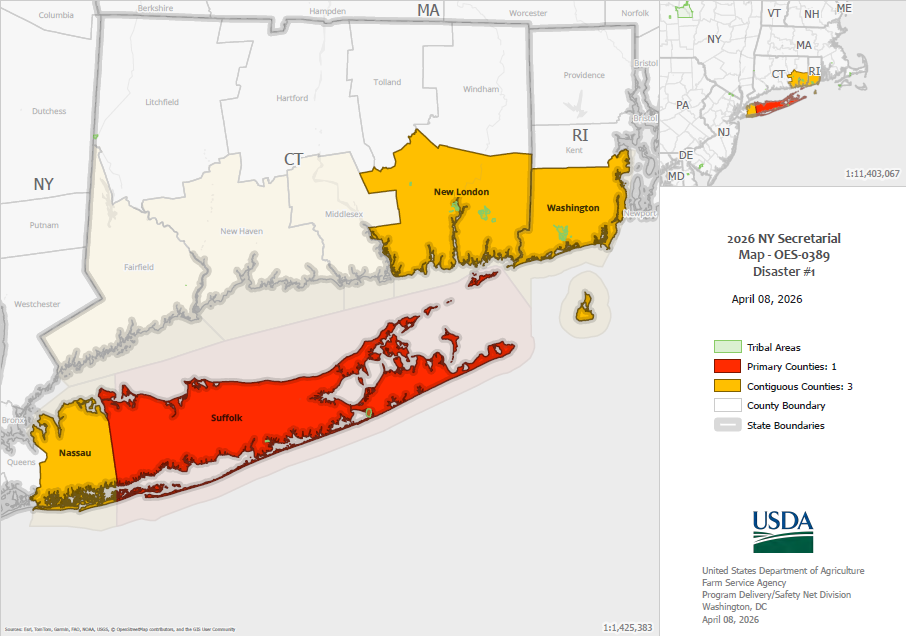
This Secretarial natural disaster designation allows the United States Department of Agriculture (USDA) Farm Service Agency (FSA) to extend much-needed emergency credit to producers recovering from natural disasters through emergency loans. Emergency loans can be used to meet various recovery needs including the replacement of essential items such as equipment or livestock, reorganization of a farming operation, or to refinance certain debts. FSA will review the loans based on the extent of losses, security available, and repayment ability.
Impacted Area: New York
Triggering Disaster: Freeze, Ice Floes, and Tidal Surge - 1/26/26 - 2/23/26
Application Deadline: 12/21/2026
Primary Counties Eligible:
Contiguous Counties Also Eligible:
-
New York: Nassau
-
Connecticut: New London
-
Rhode Island: Washington
More Resources
On farmers.gov, the Disaster Assistance Discovery Tool, Disaster Assistance-at-a-Glance fact sheet, and Loan Assistance Tool can help you determine program or loan options. To file a Notice of Loss or to ask questions about available programs, contact your local USDA Service Center.
^ back to top

Agricultural operations in Rhode Island have been significantly impacted by recent freeze. The U.S. Department of Agriculture (USDA) has technical and financial assistance available to help farmers and livestock producers recover from these adverse weather events.
“USDA has a suite of programs to support farmers and ranchers as they recover from disasters,” said Farm Production and Conservation Under Secretary Richard Fordyce. “I encourage impacted producers to contact their local USDA Service Center to report losses and learn more about program options available to assist in their recovery from crop, land, infrastructure, and livestock losses and damages.”
USDA Disaster Assistance
Producers who experience livestock deaths in excess of normal mortality or sell injured livestock at a reduced price may be eligible for the Livestock Indemnity Program (LIP). To participate in LIP, producers will have to provide acceptable documentation of death losses or evidence of reduced sales due to an injury or condition resulting from an eligible cause of loss, including an adverse weather event, and must submit a notice of loss to the USDA Farm Service Agency (FSA) no later than March 1, 2027, for 2026 calendar year losses.
Meanwhile, the Emergency Assistance for Livestock, Honeybees, and Farm-Raised Fish Program (ELAP) provides assistance to honeybee and farm-raised fish producers for eligible death losses. For eligible livestock, assistance for feed loss may be available through ELAP. For ELAP, producers are required to complete a notice of loss and application for payment to their local FSA office no later than March 1, 2027, for 2026 calendar year losses.
Additionally, eligible orchardists and nursery tree growers may be eligible for cost-share assistance through the Tree Assistance Program (TAP) to replant or rehabilitate eligible trees, bushes or vines. TAP complements the Noninsured Crop Disaster Assistance Program (NAP) or crop insurance coverage, which covers the crop but not the plants or trees in all cases. For TAP, a program application must be filed within 90 days of the disaster event or the date when the loss of the trees, bushes or vines is apparent.
“Once you are able to evaluate the impact on your operation, be sure to contact your local FSA county office to timely report all crop, livestock and farm infrastructure damages and losses,” said Robert Sullivan, State Executive Director for FSA in Rhode Island. “To expedite FSA disaster assistance, you may need to provide documents, such as farm records, herd inventory, receipts and pictures of damages or losses.”
FSA also offers a variety of direct and guaranteed farm loans, including operating and emergency farm loans, to producers unable to secure commercial financing. Producers in counties with a primary or contiguous disaster designation may be eligible for low interest emergency loans to help them recover from production and physical losses. Loans can help producers replace essential property, purchase inputs like livestock, equipment, feed and seed, cover family living expenses or refinance farm-related debts and other needs.
Additionally, FSA offers several loan servicing options available for borrowers who are unable to make scheduled payments on their farm loan programs debt to the agency because of reasons beyond their control.
Risk Management
Producers with NAP coverage should report crop damage to their local FSA office and must file a Notice of Loss (CCC-576) within 15 days of the loss becoming apparent, except for hand-harvested crops, which should be reported within 72 hours.
Producers with risk protection through Federal Crop Insurance should report crop damage to their crop insurance agent within 72 hours of discovering damage and be sure to follow up in writing within 15 days.
“Crop insurance and other USDA risk management options are offered to help producers manage risk because we never know what nature has in store for the future,” said Kevin Wooten, Director of USDA’s Risk Management Agency (RMA) Regional Office that covers Rhode Island. “Disasters can be trying for producers, and they should stay in close contact with their crop insurance agent. Producers can be assured that the Approved Insurance Providers, loss adjusters and agents are experienced and well-trained in handling these types of events.”
Conservation
FSA’s Emergency Conservation Program (ECP) and Emergency Forest Restoration Program (EFRP) can assist landowners and nonindustrial private forest stewards with financial assistance to restore damaged farmland and conservation structures or forests.
More Information
Additional USDA disaster assistance information can be found on farmers.gov, including USDA resources specifically for producers impacted by winter weather. Those resources include the Disaster Assistance Discovery Tool, Disaster-at-a-Glance fact sheet, Loan Assistance Tool, and Natural Disasters and Crop Insurance fact sheet. Additionally, FarmRaise offers an FSA educational hub with LIP and ELAP decision tools as well as farm loan resource videos. For FSA programs, producers should contact their local USDA Service Center. For assistance with a crop insurance claim, producers and landowners should contact their crop insurance agent.
^ back to top
|
Maps are now available at the Rhode Island County FSA Office for acreage reporting purposes. If you wish to receive your maps by e-mail, please call our office or email Lillian Toth at Lillian.Toth@usda.gov.
Please see the following acreage reporting deadlines for Rhode Island:
-
July 15, 2026: Most annual and perennial crops.
In order to maintain program eligibility and benefits, you must file timely acreage reports. Failure to file an acreage report by the crop acreage reporting deadline may cause ineligibility for future program benefits. FSA will not accept acreage reports provided more than a year after the acreage reporting deadline.
Producers are encouraged to file their acreage reports as soon as planting is completed.
Producers can contact the Rhode Island County FSA at (401) 828-3120, ext 1 for additional information.
^ back to top
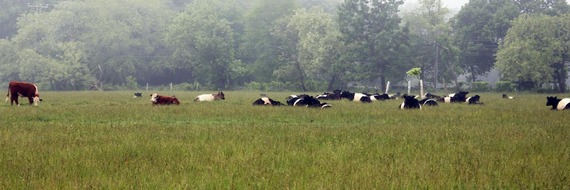 Rhode Island Farm Service Agency (FSA) reminds producers that annual acreage reporting is an important eligibility requirement to receive financial benefits through the Livestock Forage Disaster Assistance Program (LFP), as well as several other FSA-administered programs.
The next deadline for annual acreage reporting in Rhode Island is July 15, 2026. This includes common spring-planted crops, such as corn, soybeans, wheat, and grain sorghum, but also includes perennial grass (pasture) and Conservation Reserve Program acres.
Noninsured Crop Disaster Assistance Program (NAP) policy holders should note that the acreage reporting date for NAP-covered crops is July 15, 2026, or 15 calendar days before grazing or harvesting of the crop begins.
Even though the acreage reporting deadline is months away, we are encouraging producers with pasture acres and acres planted for grazing purposes to complete certification of those acres as soon as possible to assist us with preparations for potential program implementation.
LFP provides financial assistance to livestock producers and contract growers who also are producers of grazed forage crop acres (native and improved pasture and crops planted specifically for grazing purposes) and who have suffered a loss due to a qualifying drought during the grazing season.
Other points regarding LFP and acreage certification:
- Producers must have a risk in the pasture or hay crop acres in order to complete the acreage certification process.
- If a producer applies for LFP they must be able to support their application with either a written lease or an Annual Lease Certification (CCC-855).
- In addition to the acreage reporting requirement, LFP applicants who lease acres must be able to support their application with either a written lease or an Annual Lease Certification (CCC-855).
- Producers who previously have certified grazing land through a continuous certification may want to contact the county FSA office to ensure that certification remains in place and reflects 2026 producers and shares.
Producers can contact the Rhode Island FSA at (401) 828-3120, ext 1 for additional information.
^ back to top
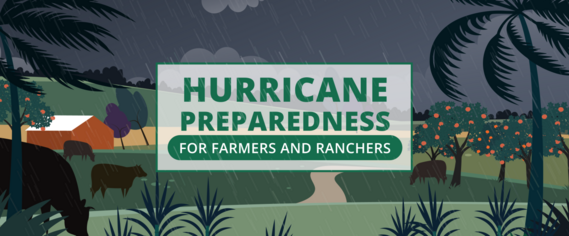 USDA is here to help you prepare for and recover from hurricanes and related tropical weather activity. The 2026 hurricane season begins on June 1, and USDA is asking producers to prepare their operations for potential impacts and explore recovery resources. Learn more...
^ back to top

The U.S. Department of Agriculture (USDA) is establishing a second national deadline for agricultural producers and landowners to apply for fiscal year 2026 assistance in the Agricultural Conservation Easement Program (ACEP) through the Natural Resources Conservation Service (NRCS). The new deadline for entities to apply is May 29, 2026. NRCS is providing up to $200 million in funding for the application period for agricultural land easements.
ACEP helps landowners, land trusts, and other entities protect, restore, and enhance wetlands; protect the agricultural viability and related conservation values of eligible land by limiting nonagricultural uses of that land that negatively affect the agriculture and conservation values; and protect grazing and related conservation values by restoring or conserving eligible land. While NRCS accepts applications on a continuous basis, NRCS uses application cutoff periods to assess and rank applications based on their potential conservation impact. NRCS is offering a second national application period for ACEP Agricultural Land Easements with a May 29, 2026, application deadline. A complete Agricultural Land Easement application only requires the following:
- Completed form NRCS-CPA-41A, “Parcel Sheet for Entity Application for an Agricultural Land Easement (ALE) Agreement”;
- Proof of ownership;
- Written pending offer;
- Map or geospatial boundary of proposed easement (NRCS provides an online tool to help you create this map with a geospatial boundary); and
- Documented access to the easement.
^ back to top
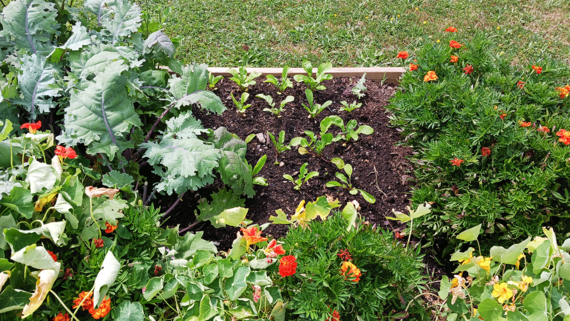
The simple act of planting a garden can have big impacts – from building a more resilient local food system to empowering communities.
NRCS in Rhode Island funded a highly successful six-year project with the Eastern, Northern, and Southern RI Conservation Districts through the Rhode Island State Conservation Committee (RISCC) to create People’s Gardens throughout the Ocean State.
Through this project, over $401,000 was awarded to schools, community groups, NGOs, and local government agencies to fund 77 gardens. Projects included community gardens, pollinator gardens, school gardens, and food forests. These projects leveraged over $623,000 in partner match through in-kind services and supplies and volunteer hours.
People’s Gardens foster community collaboration, create jobs and green spaces, provide access to nutritious food, and provide an educational space for consumers. People’s Gardens can include school gardens, community gardens, pollinator and wildlife habitat gardens, beautification gardens, and small-scale agriculture projects in rural and urban areas.
Learn more or view our RI People's Garden Story Map.

Join NRCS Chief Aubrey J.D. Bettencourt as she “Dishes the Dirt” on the agency’s history, celebrating 91 years of conservation.
The Natural Resources Conservation Service continues to fulfill the conservation legacy established in 1935 by Hugh Hammond Bennett even as it adapts to changing natural resource concerns and takes on new responsibilities to address present and future challenges. For 91 years, we have helped people make investments in their operations and local communities to keep working lands working, boost rural economies, increase the competitiveness of American agriculture, and improve the quality of our air, water, soil, and habitat.
^ back to top
 USDA is announcing $52 million to help state and tribal governments encourage private landowners to allow public access to their land for hunting, fishing and other wildlife-dependent recreation through the Voluntary Public Access and Habitat Incentive Program (VPA-HIP).
Find out more here!
^ back to top
USDA’s Risk Management Agency (RMA) is upgrading the source for rainfall data used in several Federal crop insurance programs, moving from the National Oceanic and Atmospheric Administration’s Climate Prediction Center (CPC) to the National Centers for Environmental Information (NCEI). RMA will begin this transition with the Tropical Storm Option on the Hurricane Insurance Protection - Wind Index program on April 30, 2026.
This change will also affect Pasture, Rangeland, Forage (PRF); Annual Forage (AF); Apiculture; and Shellfish insurance programs that use precipitation data to calculate coverage and indemnities. PRF, Apiculture, and Shellfish will transition on August 31, 2026, with AF following on April 30, 2027. RMA will release corresponding producer tools and resources at each contract change date to help explain the new dataset. Producers should work with their crop insurance agent to review impacts on their coverage.
The geographic grids used to measure rainfall and overall structure of the programs will remain the same. Keeping the grids in place helps minimize impacts to producers. With this upgrade, RMA anticipates that final grid index values and indemnity payments will be delivered faster. Historical data shows that overall loss ratios remain nearly identical under the new data source.
Producers and agents have raised concerns about the current data source. The transition to using NCEI data addresses those concerns in three key ways:
- It’s easy to access. NCEI data is available in formats like Microsoft Excel that anyone can open and read. The current CPC data is in a technical format that requires special software to view.
- Potential for data enhancements. RMA is working with NCEI and state climatologists to review options on expanding the number of weather stations used in the data over time which was previously not an option with CPC.
- It comes with better support. RMA has a formal agreement with NCEI that includes dedicated staff to respond to RMA questions, a consistent data release schedule, and a pathway to add more weather stations over time. This supports faster, more predictable indemnity payments.
Contact a crop insurance agent to see how Federal crop insurance can meet the specific needs of your operation. Crop insurance is sold and delivered solely through private crop insurance agents. A list of crop insurance agents is available online at the RMA Agent Locator. Producers can learn more about crop insurance and the modern farm safety net at rma.usda.gov or by contacting their RMA Regional Office. RMA’s Basics for Beginners provides information for those new to crop insurance.
^ back to top
USDA – Rhode Island
60 Quaker Lane
Warwick, RI 02886
|
Natural Resources Conservation Service (NRCS)
401-828-1300 | www.RI.nrcs.usda.gov
|
|
Eastern RI – Serving Newport and Bristol counties
|
|
NRCS Field Office
Kat Zuromski, Acting District Conservationist
401-786-1389/ Kathryn.Zuromski@usda.gov
|
Conservation District Office
401-934-0842 info@easternriconservation.org
|
|
Northern RI – Serving Providence County
|
|
NRCS Field Office
Ghyllian Alger, District Conservationist
401-822-8835/ Ghyllian.Alger@usda.gov
|
Conservation District Office
401-934-0840/ mallard.nricd@gmail.com
|
|
Southern RI – Serving Kent and Washington counties
|
|
NRCS Field Office
Jameson Long, District Conservationist
401-822-8837/Jameson.Long@usda.gov
|
Conservation District Office
401-326-9001/ information@sricd.org
|
|
|
|
RI FSA County Office, Suite 49
RI FSA Farm Loan Team, Suite 62
RI FSA State Office, Suite 62
|
401-828-3120 Option 1
401-828-3120 Option 2
401-828-3120 Option 3
|
| |
| |
|
|
|
|







