Nevada May USDA Newsletter
In This Issue:
USDA’s Farm Service Agency (FSA) offers disaster assistance and low-interest loan programs to assist you in your recovery efforts following drought. Available programs and loans include:
-
Non-Insured Crop Disaster Assistance Program (NAP) - provides financial assistance to producers of non-insurable crops when low yields, loss of inventory, or prevented planting occur due to natural disasters including qualifying drought (includes native grass for grazing).
-
Livestock Forage Disaster Program (LFP) – provides compensation to eligible livestock producers who suffered grazing losses for covered livestock due to drought on privately owned or cash leased land.
-
Livestock Indemnity Program (LIP) - offers payments to eligible producers for livestock death losses in excess of normal mortality due to adverse weather. Drought is not an eligible adverse weather event, except when associated with anthrax, a condition that occurs because of drought and directly results in the death of eligible livestock.
-
Tree Assistance Program (TAP) – provides assistance to eligible orchardists and nursery tree growers for qualifying tree, shrub and vine losses due to natural disasters including excessive wind and qualifying drought.
-
Emergency Assistance for Livestock, Honeybees, and Farm-Raised Fish Program (ELAP) - provides emergency relief for losses due to feed or water shortages, disease, adverse weather, or other conditions, which are not adequately addressed by other disaster programs.
-
Emergency Loan Program – available to producers with agriculture operations located in a county under a primary or contiguous Secretarial Disaster designation. These low interest loans help producers recover from production and physical losses.
-
Emergency Conservation Program (ECP) - provides emergency funding for farmers and ranchers to rehabilitate land severely damaged by natural disasters and to implement emergency water conservation measures in periods of severe drought.
To establish or retain FSA program eligibility, you must report prevented planting and failed acres (crops and grasses). Prevented planting acreage must be reported on form FSA-576, Notice of Loss, no later than 15 calendar days after the final planting date as established by FSA and Risk Management Agency (RMA).
For more information on these programs, contact your County USDA Service Center or visit fsa.usda.gov/disaster.
The U.S. Department of Agriculture (USDA) is establishing a second national deadline for agricultural producers and landowners to apply for fiscal year 2026 assistance in the Agricultural Conservation Easement Program (ACEP) through the Natural Resources Conservation Service (NRCS). The new deadline for entities to apply is May 29, 2026. NRCS is providing up to $200 million in funding for the application period for agricultural land easements.
ACEP helps landowners, land trusts, and other entities protect, restore, and enhance wetlands; protect the agricultural viability and related conservation values of eligible land by limiting nonagricultural uses of that land that negatively affect the agriculture and conservation values; and protect grazing and related conservation values by restoring or conserving eligible land. While NRCS accepts applications on a continuous basis, NRCS uses application cutoff periods to assess and rank applications based on their potential conservation impact. NRCS is offering a second national application period for ACEP Agricultural Land Easements with a May 29, 2026, application deadline. A complete Agricultural Land Easement application only requires the following:
- Completed form NRCS-CPA-41A, “Parcel Sheet for Entity Application for an Agricultural Land Easement (ALE) Agreement”,
- Proof of ownership,
- Written pending offer,
- Map or geospatial boundary of proposed easement (NRCS provides an online tool to help you create this map with a geospatial boundary) , and
- Documented access to the easement.
Entities and landowners interested in fiscal year 2026 funding should apply through NRCS at their local USDA Service Center.
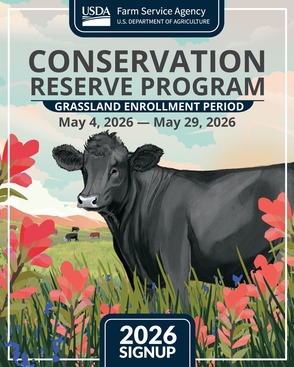
The U.S. Department of Agriculture (USDA) announced that agricultural producers and private landowners can enroll in the Grassland Conservation Reserve Program (Grassland CRP) May 4, 2026, through May 29, 2026. USDA’s Farm Service Agency (FSA) administers Grassland CRP, a voluntary working lands conservation program that enables participants to conserve grasslands while also continuing most grazing and haying practices.
Grassland CRP emphasizes support for grazing operations, plant and animal biodiversity, and grasslands and land with shrubs and forbs under the greatest threat of conversion.
CRP is USDA’s flagship conservation program, providing financial and technical support to agricultural producers and landowners who place unproductive or marginal cropland under contract for 10-15 years and who agree to voluntarily convert the land to beneficial vegetative cover to improve water quality, prevent soil erosion and support wildlife habitat. The Continuing Appropriations, Agriculture, Legislative Branch, Military Construction and Veterans Affairs, and Extensions Act, 2026, extends FSA’s authority to administer CRP through Sept. 30, 2026.
Currently, more than 26.2 million acres are enrolled in CRP, with nearly 10.3 million acres in Grassland CRP. FSA recently closed the enrollment period for General CRP and Continuous CRP. FSA is reviewing submitted offers and will announce accepted offers at a later date. Due to the 27-million-acre statutory cap, only 1.9 million acres are available for all CRP enrollment this fiscal year.
Producers and landowners interested in participating in CRP should contact their local FSA county office before the May 29 deadline.
 Join NRCS Chief Aubrey J.D. Bettencourt as she “Dishes the Dirt” on the agency’s history, celebrating 91 years of conservation.
The Natural Resources Conservation Service continues to fulfill the conservation legacy established in 1935 by Hugh Hammond Bennett even as it adapts to changing natural resource concerns and takes on new responsibilities to address present and future challenges. For 91 years, we have helped people make investments in their operations and local communities to keep working lands working, boost rural economies, increase the competitiveness of American agriculture, and improve the quality of our air, water, soil, and habitat.
Watch the video now.
The Farm Service Agency encourages you to examine available USDA crop risk protection options, including federal crop insurance and Noninsured Crop Disaster Assistance Program (NAP) coverage, before the applicable crop sales deadline.
Federal crop insurance covers crop losses from natural adversities such as drought, hail and excessive moisture. NAP covers losses from natural disasters on crops for which no permanent federal crop insurance program is available. You can determine if crops are eligible for federal crop insurance or NAP by visiting the RMA website.
NAP offers higher levels of coverage, from 50 to 65 percent of expected production in 5 percent increments, at 100 percent of the average market price. Producers of organics and crops marketed directly to consumers also may exercise the “buy-up” option to obtain NAP coverage of 100 percent of the average market price at the coverage levels of between 50 and 65 percent of expected production. Buy-up levels of NAP coverage are available if the producer can show at least one year of previously successfully growing the crop for which coverage is being requested. NAP basic coverage is available at 55 percent of the average market price for crop losses that exceed 50 percent of expected production.
For all coverage levels, the NAP service fee is the lesser of $325 per crop or $825 per producer per county, not to exceed a total of $1,950 for a producer with farming interests in multiple counties.
Beginning, underserved, veterans and limited resource farmers are now eligible for free catastrophic level coverage.
Deadlines for coverage vary by state and crop. contact your County USDA Service Center or visit fsa.usda.gov.
Federal crop insurance coverage is sold and delivered solely through private insurance agents. Agent lists are available at all USDA Service Centers or at USDA’s online Agent Locator. You can use the USDA Cost Estimator to predict insurance premium costs.
The USDA Farm Service Agency’s (FSA) Direct Farm Ownership loans can help farmers and ranchers become owner-operators of family farms, improve and expand current operations, increase agricultural productivity, and assist with land tenure to save farmland for future generations.
There are three types of Direct Farm Ownership Loans: regular, down payment and joint financing. FSA also offers a Direct Farm Ownership Microloan option for smaller financial needs up to $50,000.
Joint financing allows FSA to provide more farmers and ranchers with access to capital. FSA lends up to 50 percent of the total amount financed. A commercial lender, a state program or the seller of the property being purchased, provides the balance of loan funds, with or without an FSA guarantee. The maximum loan amount for a joint financing loan is $600,000, and the repayment period for the loan is up to 40 years.
The operation must be an eligible farm enterprise. Farm Ownership loan funds cannot be used to finance nonfarm enterprises and all applicants must be able to meet general eligibility requirements. Loan applicants are also required to have participated in the business operations of a farm or ranch for at least three years out of the 10 years prior to the date the application is submitted. The applicant must show documentation that their participation in the business operation of the farm or ranch was not solely as a laborer.
For more information about farm loans, contact your County USDA Service Center or visit fsa.usda.gov.
Options Help More Beginning, Small and Urban Producers Gain Access to Credit
Producers can apply for a streamlined version of USDA guaranteed loans, which are tailored for smaller scale farms and urban producers EZ Guarantee Loans use a simplified application process to help beginning, small, underserved, and family farmers and ranchers apply for loans of up to $100,000 from USDA-approved lenders to purchase farmland or finance agricultural operations.
A new category of lenders will join traditional lenders, such as banks and credit unions, in offering USDA EZ Guarantee Loans. Microlenders, which include Community Development Financial Institutions and Rural Rehabilitation Corporations, will be able to offer their customers up to $50,000 of EZ Guaranteed Loans, helping to reach urban areas and underserved producers. Banks, credit unions and other traditional USDA-approved lenders, can offer customers up to $100,000 to help with agricultural operation costs.
EZ Guarantee Loans offer low interest rates and terms up to seven years for financing operating expenses and 40 years for financing the purchase of farm real estate. USDA-approved lenders can issue these loans with the Farm Service Agency (FSA) guaranteeing the loan up to 95 percent.
For more information about the available types of FSA farm loans, contact your County USDA Service Center or visit fsa.usda.gov/farmloans.
FSA/NRCS Contacts
Nevada State Office
300 Booth Street, Suite 2081 Reno, NV 89509
775-857-8500
|
State Executive Director
Philip Cowee
775.834.0895
|
NRCS State Conservationist
Heidi Ramsey
775.857.8500
|
|
Acting District Director District 1 FSA
Katie Nuffer
775.834.0882
|
District Director District 2 FSA
Claire Kehoe
775.738.6445 x 106
|
|
Elko
Tamara Thompson, Acting CED - FSA
775.738.6445 x 106
Allen Moody, Acting DC - NRCS
775.433.3921
|
Ely
Chris Ward, CED - FSA
775.738.6445 x 106
Joe Noyes, DC - NRCS
775.289.4065 x 105
|
|
Fallon
Krysta Roose, CED - FSA
775.423.5124 x 109
Albert Mulder, DC - NRCS
775.423.5124 x 114
|
Las Vegas
Dariya Zaporozhchenko,Urban Ag CED - FSA
702.407.1400
Jasmine Wilson, Urban Ag DC - NRCS
702.407.1400 x 6003
Jamie Gottlieb, DC-NRCS
775.623.5025 x 101
|
|
Lovelock
Ali Phillips, CED - FSA
775.273.2922 x 100
Cory Lytle, - Acting DC - NRCS
775.857.8500
|
Minden
Carson Hicks, DC - NRCS
775.782.3661
Caliente
Amanda Wheatley, Range Management
Specialist - NRCS
775.726.3101
|
|
Winnemucca
Leah Mori, CED - FSA
775.623.5025 x 107
Angela Williams, DC - NRCS
775.623.5025
|
Yerington
Julie Thompson, CED - FSA
775.463.2265
Carson Hicks, Acting District Conservationist- NRCS
775.463.2265
|
###
USDA is an equal opportunity provider, employer and lender
|