
TN State Newsletter- April 30, 2026
Producers are off to a record early start, getting the 2026 row crops in the ground. The specialty crop producers are benefitting from this dry spring by getting their tillage completed early to get crops and plasticulture in place.
Unfortunately, the drought monitor continues to look worse week after week. Most counties in Tennessee are now in D2 drought or greater. The spring hay crops and early grazing are being stressed; over 58 counties have met the eligibility for Livestock Forage Program payments.
Make sure to maintain your eligibility for current and future programs by assuring your farm records are in order, eligibility documents in place, and report of 2026 crop acres are on file in your local Farm Service Agency office.
We continually strive to keep Farmers First!
In This Issue:
The Livestock Forage Program (LFP), administered by USDA’s Farm Service Agency (FSA), provides financial support to eligible livestock producers to compensate for lost grazing opportunities and to help cover additional feed costs incurred due to qualifying drought.
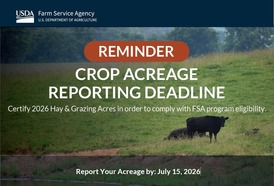
County committees can only accept LFP applications after notification is received by the National Office of qualifying drought. To prepare for LFP, grazing acres must be certified with your local FSA office by July 15, 2026.
Your input can be part of the drought-monitoring process. State climatologists and other trained observers in the drought monitoring network relay on-the-ground information from numerous sources to the U.S. Drought Monitor author each week. You can report dry conditions here.
For additional information about LFP, including eligible livestock, contact your local USDA Service Center or visit fsa.usda.gov.
|
 |
The USDA Farm Service Agency’s (FSA) Direct Farm Ownership loans can help farmers and ranchers become owner-operators of family farms, improve and expand current operations, increase agricultural productivity, and assist with land tenure to save farmland for future generations.
There are three types of Direct Farm Ownership Loans: regular, down payment and joint financing. FSA also offers a Direct Farm Ownership Microloan option for smaller financial needs up to $50,000.
Joint financing allows FSA to provide more farmers and ranchers with access to capital. FSA lends up to 50 percent of the total amount financed. A commercial lender, a state program or the seller of the property being purchased, provides the balance of loan funds, with or without an FSA guarantee. The maximum loan amount for a joint financing loan is $600,000, and the repayment period for the loan is up to 40 years.
The operation must be an eligible farm enterprise. Farm Ownership loan funds cannot be used to finance nonfarm enterprises and all applicants must be able to meet general eligibility requirements. Loan applicants are also required to have participated in the business operations of a farm or ranch for at least three years out of the 10 years prior to the date the application is submitted. The applicant must show documentation that their participation in the business operation of the farm or ranch was not solely as a laborer.
For more information about farm loans, contact your local USDA Service Center or visit fsa.usda.gov.
Carrie-Ann Houdeshell is a Grazing Land Co-Lead for the Conservation Effects Assessment Project (CEAP), an effort led by USDA’s Natural Resources Conservation Service (NRCS) to evaluate and inform voluntary conservation across the nation’s working lands. In this Ask the Expert, Carrie-Ann answers questions about recent findings on three key grazing land conservation practices, new resources to assist data-driven conservation decision making across the nation’s non-federal grazing land and federal rangeland, and NRCS programs and services to support ranchers and other land managers in pursuing voluntary conservation.
Let’s start with the basics: When we talk about “grazing land,” what is included?
Grazing land is a collective term that includes rangeland, pastureland, grazed forests, native and naturalized pasture, hayland, and grazed cropland. All 50 states have grazing land, and the national grazing land footprint is incredible – approximately 40 percent of all land across the United States. That includes more than 580 million acres of private land and more than 390 million acres of land managed by federal agencies.
Ranchers and other land managers use grazing land to feed and raise livestock, providing food and fiber for the United States and beyond. Through their stewardship, grazing land also delivers a suite of ecosystem services – like water conservation, wildlife habitat, and carbon sequestration – that benefit us all.
Read more about grazing lands.
The U.S. Department of Agriculture (USDA) reminds agricultural producers that the final date to apply for or make changes to their existing crop insurance coverage is quickly approaching. Sales closing dates vary by crop and location, but the next major sales closing dates are May 1, May 15, July 15 and July 31.
Producers are encouraged to visit their crop insurance agent soon to learn specific details for the 2027 crop year. Crop insurance coverage decisions must be made on or before the applicable sales closing date.
The USDA’s Risk Management Agency lists sales closing dates in the Actuarial Information Browser, under the “Dates” tab.
Producers can also access the RMA Map Viewer tool to visualize the insurance program date choices for acreage reporting, cancellation, contract change, earliest planting, end of insurance, end of late planting period, final planting, premium billing, production reporting, sales closing, and termination dates, when applicable, per commodity, insurance plan, type and practice. Additionally, producers can access the RMA Information Reporting System tool to specifically identify applicable dates for their operation, using the “Insurance Offer Reports” application.
Federal crop insurance is critical to the farm safety net. It helps producers and owners manage revenue risks and strengthens the rural economy. Producers may select from several coverage options, including yield coverage, revenue protection and area risk plans of insurance.
RMA secures the future of agriculture by providing world class risk management tools to rural America through Federal crop insurance and risk management education programs. RMA provides policies for more than 130 crops and is constantly working to adjust and create new policies based on producer needs and feedback. Crop insurance is sold and delivered solely through private crop insurance agents. A list of crop insurance agents is available online at the RMA Agent Locator. Producers can learn more about crop insurance and the modern farm safety net at rma.usda.gov or by contacting their RMA Regional Office.
Livestock inventory records are necessary in the event of a natural disaster, so remember to keep them updated.
When disasters strike, the USDA Farm Service Agency (FSA) can help you if you’ve suffered excessive livestock death losses and grazing or feed losses due to eligible natural disasters.
For 2026 losses through the Livestock Indemnity Program (LIP) and Emergency Assistance for Livestock, Honeybees, and Farm-raised Fish Program (ELAP), you must file a notice of loss, provide the following supporting documentation, and application for payment to your local FSA office by March 1, 2027.
You should record all pertinent information regarding livestock inventory records including:
- Documentation of the number, kind, type, and weight range of livestock
- Beginning inventory supported by birth recordings or purchase receipts.

Livestock producers in Ohio may be eligible for Livestock Indemnity Program (LIP) assistance payments to offset losses caused by Theileria Orientalis (TO), transmitted by the Asian Longhorned tick. TO has been identified in livestock herds in several states including Tennessee.
LIP, administered by USDA’s Farm Service Agency (FSA) provides assistance for livestock deaths in excess of normal mortality caused by adverse weather, disease and attacks by animals reintroduced into the wild by the federal government or protected by federal law.
Eligibility and Testing
LIP-eligible livestock deaths must be directly due to TO. Herds having high tick infestation or livestock having blood loss from the tick are not eligible for a LIP payment. Producers will be required to submit positive TO test results.
Payments and Mortality Rates
Calendar year 2026 LIP losses are calculated based on 75% of the fair market value of the livestock on the day before the death occurred. Specific rates are set for different categories of livestock.
USDA has established normal mortality rates for each type and weight range of eligible livestock. These established percentages reflect losses that are considered expected or typical under “normal” conditions.
Reporting and Documenting Loss
Producers are encouraged to report losses throughout the year. To participate in LIP, producers will have to provide acceptable documentation of death losses and must submit a notice of loss and application to their local FSA County Office no later than March 1, 2027, for 2026 calendar year losses.
Acceptable TO Loss Documentation:
- Proof of death documentation
- Livestock beginning inventory documentation and inventory changes throughout the year
- Positive test results for Theileria Orientalis
Application for LIP benefits is made through your local County FSA office and producers should address specific questions to that office about eligibility and documentation requirements.
|
Top of page
FSA in Tennessee
579 U.S. Courthouse
801 Broadway
Nashville, TN 37203
Phone: 615-277-2600
Service Center Locator
Farm Service Agency
State Executive Director - Mike Mayfield
Deputy State Executive Director - Tyeisha Samples
State Committee Members
George McDonald, Chairperson
Perry Dykes
Wesley "Worth" Eubanks
Charlotte Kelley
Jared "Bo" Jackson
|
|








