
NRCS-Michigan Conservation Notes Newsletter - March/April 2026
 In This Issue:

Saying its been a wet spring in Michigan is an understatement. In addition to snow melt, areas of the state are far above their average precipitation. For example, Grand Rapids saw nearly double its rainfall during March compared to 2025.
The wet spring is keeping farmers out of the fields and severely testing infrastructure such as dams and spillways all over the state. Conditions like these highlight the importance of conservation. Fields planted with cover crops and not tilled will experience less soil erosion and will allow farmers to get in their fields sooner.
~
A project to compost food waste in Traverse City is taking off, according to this recent report. The program has increased the amount of food waste it collects from 21,000 to 125,000 pounds over the past year. The pilot project received a national grant from NRCS and began operation in 2024. The goal of the project is to demonstrate how to reduce the amount of food waste entering landfills.
~
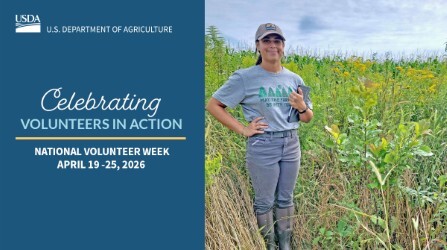
National Volunteer Week was April 19-25, NRCS marks the week by celebrating our Earth Team volunteers. Becoming an Earth Team volunteer is a great way to support natural resources conservation in your community. Anyone over age 14 can become an Earth Team volunteer. To learn more about Earth Team visit our website or call 517-324-5244.
|
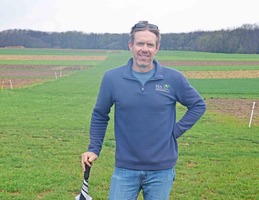
To meet the world’s growing demand for food, fiber, and biofuels, farmers will need to increase their production while conserving natural resources. Brook Wilke, research specialist at MSU’s Kellogg Biological Station (KBS) near Hickory Corners, calls this goal sustainable intensification.
KBS is one of 19 locations taking part in the USDA’s Long-Term Agroecosystem Research network (LTAR) that are studying different strategies to make sustainable intensification a reality. In addition to serving as coordinator of the 1,500-acre farm, Wilke is the LTAR Associate Director for Agronomy and Science for the LTAR research site at KBS that is in its fifth growing season.
KBS studies agricultural practices that seek to maintain or increase production with fewer inputs, like fertilizers, while improving soil health and water quality. The tactics the farm is using include crop diversification, reduced tillage, precision inputs, and improved nutrient efficiency through cover crops and livestock manures. LTAR combines or stacks these practices in what they refer to as the “Aspirational System,” which they compare to a more prevailing system referred to as “Business-As-Usual.”
For the past four years, and continuing in 2026, the Aspirational System at KBS includes a five-crop rotation, continuous no-till, prairie strips on field borders and unproductive crop land, and cover crops. In addition to recording yields and input costs, researchers at KBS also monitor leachate and gases coming from test plots to measure nutrient loss.
|
“We’re pretty aggressive as far as our Aspirational System here,” said Wilke. “Few farmers in Michigan are ready to try this many conservation practices together all in one system.” The scientists at KBS hope that their research can help farmers learn the real risks and benefits of such management, and in the long-term, facilitate greater adoption of such practices.
The Aspirational Cropping System at KBS includes winter wheat, winter canola, perennial forage, corn, and soybeans. Incorporating livestock is an important component for a more sustainable agricultural system and KBS simulates this by planting and harvesting forage in its rotation and applying composted manure. Cover crops include frost seeding clover into winter wheat, a perennial cover crop mix after canola harvest, and drone applied rye on corn ground before harvest.
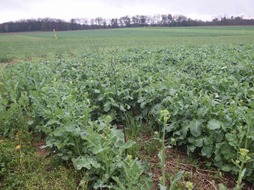
After four years, the results are encouraging but not without challenges. Canola in particular, with its delicate seed, requires careful handling. The canola was also impacted by a crop pest, the cabbage pod weevil, which reduced yields. Canola was an attractive crop to include in the Aspirational System because it introduces a new plant family into the rotation, could be fall planted, and marketed to a facility in Windsor, Ontario which purchases canola grown in Michigan. “The canola adventure has been a lot of fun and the crop shows a lot of promise for Michigan farmers,” said Wilke.
|
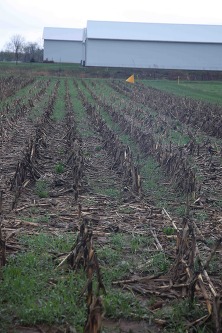
“Corn planted in the Aspirational System is phenomenal”, said Wilke. Growing corn in the Aspirational System has been more profitable than in the farm’s Business-As-Usual fields. Yields have been comparable, even though the Aspirational corn received about a third of the nitrogen compared to the Business-as-Usual fields.
The Michigan LTAR project has received a lot of interest from a variety of audiences including farmers, researchers, and agricultural professionals. “It’s important to share not only what went well but also the challenges we encounter,” Wilke said.
The prairie strips are one example of these challenges, which scientists are researching. While the prairie strips attracted beneficial insects, they also attracted pests and complicated weed management leading to competition with cash crops. Perennials in the rotation were a major benefit to soil quality. “Biological activity really increased in the Aspirational fields”, said Wilke. “Active carbon and crop performance are indicators of improved soil health, so farmers shouldn’t be discouraged if total soil organic matter doesn’t increase rapidly”, he said.
The KBS LTAR project has a 19-member stakeholder advisory board that advises on LTAR research priorities and outputs. One of the board members is Jason Stegink, a private crop advisor who works with farmers in southwest Michigan. He visits KBS frequently to monitor crop conditions and advises on practices for the experiment.
“It’s an interesting project to be involved in,” said Steglink. “It offers the freedom to try off-the-wall things.”
“We don’t expect any farmers to copy what we’re doing exactly,” said Wilke. Farmers can review the results of LTAR trials across the country and determine what works best for them. “KBS is currently working with stakeholder partners to make adjustments to the next version of the Aspirational System, which will start after it completes its 5-year rotation in fall of 2026”, said Wilke.
|
Top of page
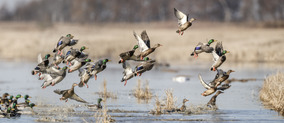
USDA is announcing $52 million to help state and tribal governments encourage private landowners to allow public access to their land for hunting, fishing and other wildlife-dependent recreation through the Voluntary Public Access and Habitat Incentive Program (VPA-HIP). Applications are being accepted now through June 8, 2026 on Grants.gov.
Find out more here.
|
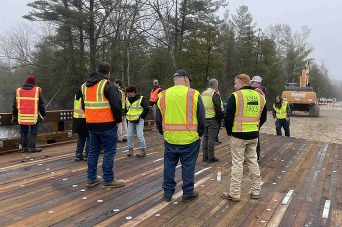
NRCS Michigan engineering and field staff participated in a workshop held in Traverse City the week of April 13. Attendees visited projects in the area and discussed challenges and best practices.
One of the projects they visited was an aquatic organism passage on the Crystal River in Leelanau County.
|

LANSING, MI — The Michigan Association of Conservation Districts (MACD) has been awarded a
$1.5 million, three-year capacity-building grant
from the Fred A. and Barbara M. Erb Family Foundation (https://www.erbff.org/) to strengthen statewide conservation leadership, coordination, and delivery across Michigan.
Beginning in 2026, the investment will allow MACD to significantly expand its ability to support Conservation Districts throughout the state by building the systems, training, and infrastructure districts need to focus more time and resources on conservation outcomes that protect Michigan’s land, water, and Great Lakes.
“This investment allows us to build what Conservation Districts have been asking for: stronger systems, clearer support, and statewide coordination that matches the scale of Michigan’s conservation needs,” said Rivka Hodgkinson, Executive Director of MACD. “By strengthening MACD’s capacity, we are strengthening every Conservation District. This means districts can spend less time reinventing administrative processes and more time delivering conservation practices that improve water quality and protect the Great Lakes.”
Conservation Districts are locally led, special-purpose units of state government that serve landowners, farmers, and communities in every Michigan county. The grant will support MACD in developing standardized HR, accounting, and governance tools; expanding leadership training for district boards and staff; and providing hands-on implementation support to help districts meet grant deliverables and scale conservation impact.
The investment also strengthens MACD’s role as a statewide coordinating body. This grant will build internal capacity, improving their ability to connect local districts with state, federal, nonprofit, and private-sector partners amid rapid change in conservation funding and policy environments.
“This grant is about building long-term resilience,” said Jerry Miller, President of MACD. “Local leadership is the backbone of conservation in Michigan. By investing in the systems that support that leadership statewide, we are ensuring Conservation Districts remain strong, effective, and responsive to their communities for generations to come.”
The grant will support a three-year phased approach, beginning with statewide strategic planning and staff expansion, followed by broad implementation of new systems and training. The effort will also include continued support for farmer-led conservation initiatives and expanded opportunities for district directors to learn from national best practices.
By investing in organizational capacity rather than short-term programming, the Erb Family Foundation’s support positions MACD and Michigan’s Conservation Districts to deliver more consistent, measurable conservation outcomes for soil health and statewide watersheds, strengthening water quality, protecting the Great Lakes, and reinforcing locally driven environmental stewardship.
|
Top of page

May
1 - A Walk in the Wild Woods: Regenerative Agriculture, 10 a.m. to 2 p.m., The Wild Woods Farm - Lapeer, for more information go to members.macd.org/event-calendar
6 - Beginning Farmer Field Day - Soil Health, Pollinators, Beneficials, 10 a.m. to 2 p.m., Schomaker Farms - Saginaw, for more information go to canr.msu.edu/events
12 - Cover Crop Grazing & Variety Trial Field Day, 9 a.m. to 12:30 p.m., Kellogg Biological Station - Hickory Corners, for more information go to canr.msu.edu/events
12-14 - Michigan Envirothon State Competition, Northern Michigan University - Marquette, for more information go to members.macd.org/event-calendar
13-14 - 2026 Agritourism Summit, Grand Traverse Resort - Acme, for more information go to canr.msu.edu/events
29 - MSU Pollinator Performance Center Open House, 2 p.m. to 4 p.m., MSU Pollinator Performance Center - Lansing, for more information go to canr.msu.edu/events
|
June
17 - Third Annual Food-Grade Grains Field Day, 9 a.m. to 1:30 p.m., Kellogg Biological Station - Hickory Corners, for more information go to canr.msu.edu/events
18 - Regen Ag Field Day, 8 a.m. to 4 p.m., Flatwater Farms - Buchanan, for more information call 269/471-9111 ext. 3, or email berriencd@macd.org
18 - Healthy Habitats and Productive Pollinators, 9 a.m. to 4 p.m., Crossroads Village - Flint, for more information go to canr.msu.edu/events
Top of page
|








