USDA News - Lone Star State Edition - April 29, 2026
In This Issue:
As we get closer to celebrating the 250th anniversary of the signing of the Declaration of Independence, it reminds us that our Founding Fathers believed that agriculture production was one of our greatest strengths. The commitment of President Trump and Secretary Rollins echoes that same belief after 250 years.
It is an honor to work with farmers and ranchers every day. Putting Farmers First is not just a slogan, but it is our mission. When President Trump and Secretary Rollins announced in December the Farmer Bridge Assistance (FBA) program, and that beginning in February we would begin implementing this brand-new program and have payments to producers in as little as 72 hours, there were many doubters.
However, with the use of the digital platform login.gov producers were able to apply in minutes, and payments started arriving a few days after signing up. The program began on February 23, and ran through April 17, with $10 billion in assistance being distributed nationwide to date. In Texas, we processed almost 29,000 applications and have distributed over $800 million in two months. Thanks to the hard work of your FSA staff this program is an example of how we can modernize program delivery. We are currently processing the second phase of assistance for specialty crop producers.
Speaking of FSA staff and their hard work. They continue to work on delivering the Supplemental Disaster Relief Program (SDRP) which provides financial assistance to producers who suffered crop, tree, bush or vine losses due to a qualifying natural disaster in 2023 and 2024. Secretary Rollins has announced that there will be a second payment and the application deadline has been extended to Aug. 12.
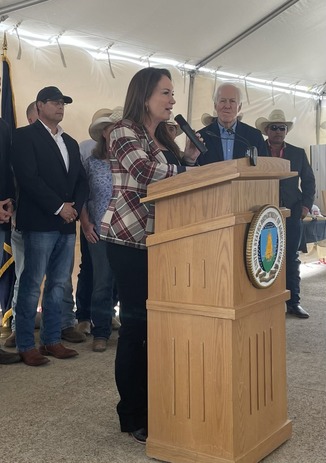
With the support of President Trump and the vision of Secretary Rollins we will continue to make sure that national security is enhanced because of our food security. This was emphasized again recently at an event in the Rio Grande Valley that I attended with Secretary Rollins to highlight work being done to protect our ranchers against screwworms that have been detected in Mexico. Keeping our farms and ranches safe from invasive diseases and pests is critical to our production capability.
Secretary Rollins, joined by Sen. Cornyn, delivering remarks at groundbreaking for the new sterile fly production facility at Moore Air Base in Edinburg, Texas.
Just like the great agriculture innovators and Founding Fathers George Washington and Thomas Jefferson, President Trump and Secretary Rollins understand that a country that cannot independently feed itself, is no longer an independent country. It was true 250 years ago and is still true today.
Thank you to all of you that play the vital role of feeding the nation and the world.
Sincerely,
Dan J. Hunter, FSA State Executive Director -Texas
Top of Page
This spring has been very busy for NRCS Texas. We co-hosted a successful Beginner Farmer and Rancher Workshop in El Paso and have two more coming up in Waxahachie and Hockley with the Farm Service Agency (FSA). We are so appreciative of the partnership we have with Farm Service Agency to provide workshops for Texas’ new and beginning farmers and ranchers to help them get started on their journey with USDA.
NRCS Texas recently announced a second batching period for the Conservation Stewardship Program (CSP) including the new Regenerative Pilot Program, which provides targeted Farmer First assistance through CSP.
To participate in the Regenerative Pilot Program, producers must work with NRCS staff, partners or technical service providers to conduct a whole-farm assessment; use at least one primary regenerative management practice; and agree to perform soil health testing in the first and last year of the contract.
Primary practices include conservation crop rotation, cover crops, forage harvest management, irrigation water management, nutrient management, grazing management and many more.
Agricultural producers at every stage, from beginners just starting out with cover crops to advanced operations with years of conservation experience will find a pathway through this pilot program.
I encourage anyone who may be interested to contact the local office for more information and to schedule a time for a conservation professional to visit your farm or ranch to help you get started.
Although NRCS accepts applications for conservation programs continuously, to take advantage of fiscal year 2026 funding for this opportunity, applications must be submitted by May 22, 2026.
We also recently highlighted several conservation success stories across the state including Whitehurst Farm in Brenham, Tregallas Family Farms in Perryton, Texas and Danner Land Farms just outside of Amarillo.
NRCS has programs and services available for all agricultural operations and staff across the state that will help guide you through the process of getting assistance. I encourage you all to contact your local office to learn more.
Sincerely,
Kristy Oates, NRCS State Conservationist - Texas
Top of Page
The U.S. Department of Agriculture (USDA) is maximizing disaster assistance support for producers by issuing a second Supplemental Disaster Relief Program (SDRP) payment to eligible producers who have approved program applications for losses due to natural disasters in calendar years 2023 and 2024. USDA’s Farm Service Agency (FSA) has already provided $6.7 billion in SDRP payments to eligible producers. Additionally, USDA is extending the program deadline to give producers and FSA more time to address any program application changes that could impact payments. The original April 30 deadline has been extended to Aug. 12, 2026, for SDRP Stage 1 and Stage 2.
Initial SDRP payments were factored at 35%, but after further analysis, USDA is increasing the payment factor to 70%, meaning producers with approved applications will receive an additional 35% of their calculated SDRP payment. Future SDRP payments will also be made using a 70% payment factor.
Over the past year, the Trump administration and USDA, under the leadership of Secretary Rollins, have supported U.S. farmers and ranchers with over $17.9 billion in supplemental disaster assistance mandated by Congress in the American Relief Act, 2025. To date, USDA has provided over $6.7 billion in SDRP payments, $9.3 billion through the Emergency Commodity Assistance Program and nearly $1.9 billion through the Emergency Livestock Relief Program.
Additionally, through recent efforts to provide economic relief as the Trump administration works to open new markets, FSA has made over $10 billion in payments, to date, through the Farmers Bridge Assistance program with more assistance on the way for specialty crop producers. Since 2025, through permanent programs, FSA has provided over $2.0 billion in disaster assistance, $5.3 billion in commodity price support, $3.1 billion in safety net assistance, and $685 million through conservation programs.
All in all, this administration has put Farmers First with over $39.1 billion in economic support needed to recover from market and weather-related financial hardships beyond their control, protect our natural resources and keep their operations moving forward.
SDRP Stage 1
The first stage, announced in July 2025, remains available to producers who received an indemnity under crop insurance or the Noninsured Crop Disaster Assistance Program (NAP) for eligible crop losses due to qualifying 2023 and 2024 natural disaster events.
SDRP Stage 2
Stage 2 of SDRP covers eligible crop, tree, bush and vine losses that were not covered under Stage One program provisions, including non-indemnified (shallow loss), uncovered and quality losses.
Eligibility
Eligible losses must be the result of natural disasters occurring in calendar years 2023 and/or 2024. These disasters include wildfires, hurricanes, floods, derechos, excessive heat, tornadoes, winter storms, freeze (including a polar vortex), smoke exposure, excessive moisture, qualifying drought, and related conditions.
To qualify for drought related losses, the loss must have occurred in a county rated by the U.S. Drought Monitor as having a D2 (severe drought) for eight consecutive weeks, D3 (extreme drought), or greater intensity level during the applicable calendar year.
FSA is establishing block grants with Connecticut, Hawaii, Maine, and Massachusetts that cover crop losses; therefore, producers with losses on land physically located in these states are not eligible for SDRP program payments.
More Information
For more information on SDRP, please visit fsa.usda.gov/sdrp.
Top of Page
Producers are encouraged to call their local FSA and NRCS office to schedule an appointment to ensure maximum use of their time and to make sure staff are available to tend to their important business needs. Please call your local office ahead to set an appointment and to discuss any records or documentation that might be needed during your appointment. To find your local USDA Service Center, visit farmers.gov/working-with-us/service-center-locator.
Top of Page
The first Continuous CRP batching period closed on March 20, 2026. Since acreage remains available, FSA is opening a second batching period and will consider Continuous CRP offers submitted by interested agricultural producers and landowners between March 23, 2026, and May 1, 2026. Offers to re-enroll expiring CRP continuous acreage will be accepted on a first-come, first-served basis. New acreage offered in continuous CRP practices will be considered for acceptance on a first-come, first-serve basis if they support USDA conservation priorities including but not limited to practices that address water quality, such as filter strips and grass waterways, and practices that restore native ecosystems or target specific resource concerns.
Continuous CRP participants voluntarily offer environmentally sensitive lands, typically smaller parcels than offered through General CRP including wetlands, riparian buffers, and varying wildlife habitats. In return, they receive annual rental payments and cost-share assistance to establish long-term, resource-conserving vegetative cover.
CRP is USDA’s flagship conservation program, providing financial and technical support to agricultural producers and landowners who place unproductive or marginal cropland under contract for 10-15 years and who agree to voluntarily convert the land to beneficial vegetative cover to improve water quality, prevent soil erosion and support wildlife habitat. The Continuing Appropriations, Agriculture, Legislative Branch, Military Construction and Veterans Affairs, and Extensions Act, 2026, extends FSA’s authority to administer CRP through Sept. 30, 2026.
Top of Page
The U.S. Department of Agriculture (USDA) reminds agricultural producers that the final date to apply for or make changes to their existing crop insurance coverage is quickly approaching. Sales closing dates vary by crop and location, but the next major sales closing dates are May 1, May 15, July 15 and July 31.
Producers are encouraged to visit their crop insurance agent soon to learn specific details for the 2027 crop year. Crop insurance coverage decisions must be made on or before the applicable sales closing date.
The USDA’s Risk Management Agency lists sales closing dates in the Actuarial Information Browser, under the “Dates” tab.
Producers can also access the RMA Map Viewer tool to visualize the insurance program date choices for acreage reporting, cancellation, contract change, earliest planting, end of insurance, end of late planting period, final planting, premium billing, production reporting, sales closing, and termination dates, when applicable, per commodity, insurance plan, type and practice. Additionally, producers can access the RMA Information Reporting System tool to specifically identify applicable dates for their operation, using the “Insurance Offer Reports” application.
Federal crop insurance is critical to the farm safety net. It helps producers and owners manage revenue risks and strengthens the rural economy. Producers may select from several coverage options, including yield coverage, revenue protection and area risk plans of insurance.
RMA secures the future of agriculture by providing world class risk management tools to rural America through Federal crop insurance and risk management education programs. RMA provides policies for more than 130 crops and is constantly working to adjust and create new policies based on producer needs and feedback. Crop insurance is sold and delivered solely through private crop insurance agents. A list of crop insurance agents is available online at the RMA Agent Locator. Producers can learn more about crop insurance and the modern farm safety net at rma.usda.gov or by contacting their RMA Regional Office.
Top of Page
FSA offers direct farm ownership and direct farm operating loans to producers who want to establish, maintain, or strengthen their farm or ranch. Direct loans are processed, approved and serviced by FSA loan officers.
Direct farm operating loans can be used to purchase livestock and feed, farm equipment, fuel, farm chemicals, insurance, and other costs including family living expenses. Operating loans can also be used to finance minor improvements or repairs to buildings and to refinance some farm-related debts, excluding real estate.
Direct farm ownership loans can be used to purchase farmland, enlarge an existing farm, construct and repair buildings, and to make farm improvements.
The maximum loan amount for direct farm ownership loans is $600,000 and the maximum loan amount for direct operating loans is $400,000 and a down payment is not required. Repayment terms vary depending on the type of loan, collateral and the producer's ability to repay the loan. Operating loans are normally repaid within seven years and farm ownership loans are not to exceed 40 years.
Please contact your local FSA office for more information or to apply for a direct farm ownership or operating loan.
Top of Page
Farmers can use USDA farm ownership microloans to buy and improve property. These microloans are especially helpful to beginning or underserved farmers, U.S. veterans looking for a career in farming, and those who have small and mid-sized farming operations. Microloans have helped farmers and ranchers with operating costs, such as feed, fertilizer, tools, fencing, equipment, and living expenses since 2013.
Microloans can also help with farmland and building purchases and soil and water conservation improvements. FSA designed the expanded program to simplify the application process, expand eligibility requirements and expedite smaller real estate loans to help farmers strengthen their operations. Microloans provide up to $50,000 to qualified producers and can be issued to the applicant directly from the USDA Farm Service Agency (FSA).
To learn more about the FSA microloan program, contact your local USDA Service Center or visit fsa.usda.gov/microloans.
Top of Page
The Farm Service Agency (FSA) has noticed a rise in fraudulent scams that target FSA farm loan customers by obtaining publicly available information about your FSA Farm Program participation or Farm Loan information. These unauthorized contacts are made through email, text messages, phone calls, or social media to gain your personal information so the scammer can access your bank account or gain additional personal information.
Signs of a Scam:
- Emails or messages urging immediate action or requesting personal details.
- Unexpected attachments or links in emails from unknown sources.
- Calls or texts claiming to be from FSA requesting passwords, PINs, Social Security numbers, or credit card information.
- Offers that seem too good to be true, particularly investment or debt relief schems.
- Messages from unfamiliar social media accounts or door-to-door solicitations related to banking.
How to Protect Yourself:
- Always verify communications are coming from official sources. If you have concerns about a contact being genuine, please reach out to your local FSA Service Center directly.
- Do not click on links or download attachments from suspicious emails or texts.
- Use strong, unique passwords and enable two-factor authentication when available.
- Report suspicious activity to FSA immediately and, if applicable, submit a report to the U.S. General Services Administration here.
If you have questions about your FSA accounts, including your farm loans, contact your local USDA Service Center or visit fsa.usda.gov.
Top of Page
Are you interested in working with USDA to start or grow your farm, ranch, or private forest operation, but don’t know where to start?
Whether you’re looking to access capital or disaster assistance through USDA’s Farm Service Agency (FSA) or address natural resource concerns on your land with assistance from USDA’s Natural Resources Conservation Service (NRCS), a great place to start is farmers.gov.
Farmers.gov is a one-stop shop for information about the assistance available from FSA and NRCS. The site also offers many easy-to-use tools for farmers, ranchers, and private forestland owners, whether you are reaching out for the first time or are a long-term customer with a years-long relationship with USDA.
With a farmers.gov account you can:
- Complete an AD-2047, Customer Data Worksheet, prior to your first meeting with FSA and NRCS.
- View farm loan payments history from FSA.
- View cost share assistance received and anticipated from NRCS conservation programs.
- Request conservation assistance from NRCS as well as view and track your conservation plans, practices, and contracts.
- View, print, and export detailed farm records and farm/tract maps for the current year, which are particularly useful when fulfilling acreage reporting requirements.
- Print FSA-156 EZ, Abbreviated Farm Record and your Producer Farm Data Report for the current year.
- Pay FSA debt using the “Make an FSA Payment” feature
- Apply for a farm loan online, view information on your existing loans, and make USDA direct farm loan payments using the Pay My Loan feature.
Learn how to create a farmers.gov account today!
Top of Page
|