|
   The Natural Resources Conservation Service (NRCS) produces this weekly report using data and products from the National Water and Climate Center and other agencies. The report focuses on seasonal snowpack, precipitation, temperature, and drought conditions in the U.S.
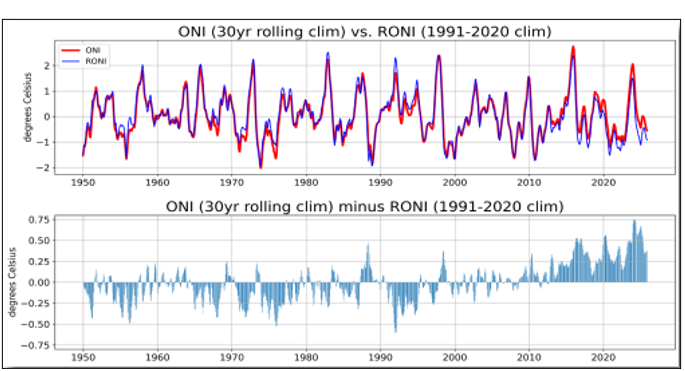
The Climate Prediction Center (CPC) is adopting the new Relative Oceanic Niño Index (RONI) to better characterize El Niño Southern Oscillation (ENSO). According to the CPC, “The traditional Oceanic Niño Index (ONI) relies on a departure from 30-year average that struggles to keep pace with anomalous changes in tropical sea surface temperature (SST), which is particularly problematic in real-time when using a time lagged climatology.”
Key points from the CPC include:
- ENSO impacts depend on how warm or cool the east-central Pacific is compared to the rest of the tropics.
- RONI measures the relative ocean temperature departures directly, while ONI only looks at one region compared to a 30-year average.
- Thresholds and definitions stay the same, only the measurement improves.
- RONI provides a more stable and physically meaningful measure of El Niño and La Niña conditions, especially in real time.
|
|
|
|