
North Dakota FSA eNews - March, 2026
In This Issue:
March 13, 2026: Deadline to Report 2025 Specialty Crops for ASCF
March 16, 2026: Deadline to apply for 2026 NAP Coverage- Spring planted crops
March 16, 2026: Deadline to apply for 2026 Nap Coverage- Perennial and other forage
March 20, 2026: Deadline for first batch period for Continuous CRP
April 17, 2026: Deadline to submit offer for General CRP
April 17, 2026: Deadline to apply Farmers Bridge Assistance (FBA) Program
April 22, 2026: Application Deadline for the Value-Added Producer Grant (VAPG) for Rural Development
April 30, 2026: Deadline to apply for SDRP Stage 1 and Stage 2
It’s been a busy couple of weeks after the Farm Bridge Assistance program sign-up opened on February 23rd. We’re about two weeks in and we have roughly two-thirds of the program money in the hands of North Dakota producers. As of today, we’ve distributed $544 million across the state in FBA payments. We estimate that over 20% of applications in the state have been completed via Login.gov, which is a good step forward in working with FSA online. This program is a big win for producers, bankers, and vendors after lower commodity prices.
You’ll see more puddles than snow drifts after the warm temperatures we’ve experienced as of late. That gives me hope for an early spring, but I know that March can certainly give us all types of weather! Here’s to hoping our “final” spring comes in April sometime. A good chunk of cattle producers are either in the thick of calving or just a few short weeks away. If Mother Nature treats us well, I’m optimistic pens will stay dry, and calves will remain healthy for producers.
While right now might not be the easiest time to pencil in a profit, I urge you to set up a meeting and keep in contact with your banker or business lender to develop a successful financial plan. As a reminder, FSA offers a suite of different loan options, and the FSA team can help borrowers establish their goals to ensure financial success.
Finally, I’d like to show a little optimism from seeing Farm Bill progress after a marathon of work. The Farm Bill provides safety net and price support programs that are crucial for American farmers that the Farm Service Agency executes.
Take care until next month,
Brad Thykeson,
State Executive Director, North Dakota FSA
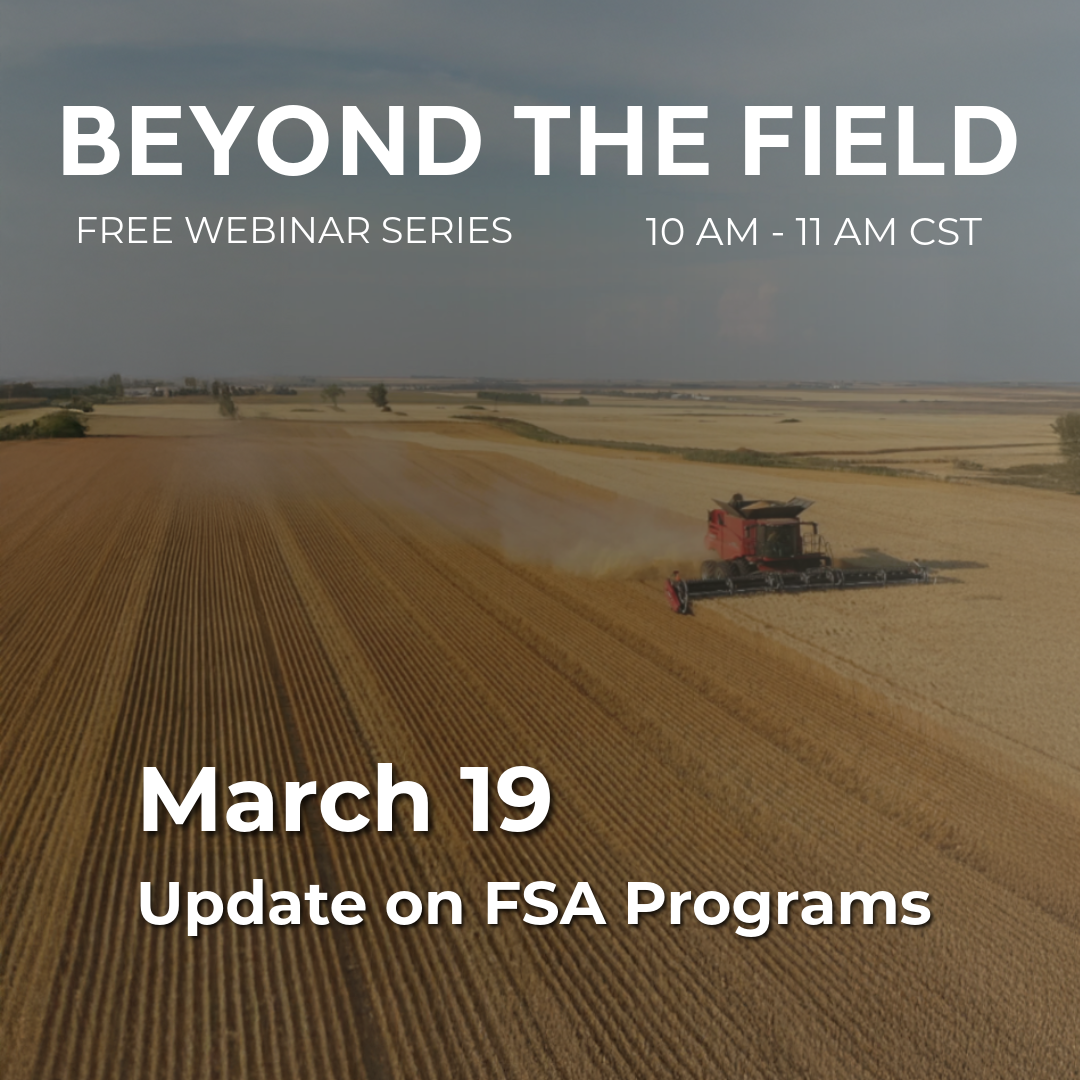
North Dakota Farm Service Agency is teaming up with North Dakota Farmer's Union to produce an update on FSA programs. Learn the latest on the Farmers Bridge Assistance Program, disaster relief, One Big Beautiful Bill Act implementation, and the 2025 ARC/PLC signup. The webinar is set to take place March 19, 2026 at 10:00 a.m.
USDA announced the enrollment periods for agricultural producers and landowners to submit offers for the Continuous and General Conservation Reserve Program (CRP). USDA’s Farm Service Agency (FSA) is accepting offers for Continuous CRP from Feb. 12, 2026, through March 20, 2026. Enrollment for General CRP will run from March 9, 2026, through April 17, 2026. FSA will announce dates for Grassland CRP signup in the near future.
CRP is USDA’s flagship conservation program, providing financial and technical support to agricultural producers and landowners who place unproductive or marginal cropland under contract for 10-15 years and who agree to voluntarily convert the land to beneficial vegetative cover to improve water quality, prevent soil erosion and support wildlife habitat. The Continuing Appropriations, Agriculture, Legislative Branch, Military Construction and Veterans Affairs, and Extensions Act, 2026, extends FSA’s authority to administer CRP through Sept. 30, 2026.
Continuous CRP (Signup 65)
FSA will batch Continuous CRP offers submitted by interested agricultural producers and landowners. Offers to re-enroll expiring CRP continuous acreage will be accepted on a first-come, first-serve basis. New acreage offered in continuous CRP practices will be considered for acceptance on a first-come, first-serve basis if they support USDA conservation priorities including but not limited to practices that address water quality, such as filter strips and grass waterways, and practices that restore native ecosystems or target specific resource concerns.
The first Continuous CRP batching period ends on March 20, 2026. Offers submitted after this date will be considered for acceptance in subsequent batching periods if acreage remains available.
Continuous CRP participants voluntarily offer environmentally sensitive lands, typically smaller parcels than offered through General CRP including wetlands, riparian buffers, and varying wildlife habitats. In return, they receive annual rental payments and cost-share assistance to establish long-term, resource-conserving vegetative cover.
Continuous CRP enrollment options include:
-
Clean Lakes, Estuaries and Rivers (CLEAR) Initiative: Prioritizes water quality practices on the land that, if enrolled, will help reduce sediment loadings, nutrient loadings, and harmful algal blooms. The vegetative covers also contribute to increased wildlife populations.
-
CLEAR30 (a component of the CLEAR Initiative): Offers additional incentives for water quality practice adoption and can be accessed in 30-year contracts.
-
Highly Erodible Land Initiative (HELI): Producers and landowners can enroll in CRP to establish long-term cover on highly erodible cropland that has a weighted erodibility index greater than or equal to 20.
-
Conservation Reserve Enhancement Program (CREP): Addresses high priority conservation objectives of states and Tribal governments on agricultural lands in specific geographic areas.
-
State Acres for Wildlife Enhancement Initiative (SAFE): Restores vital habitat in order to meet high-priority state wildlife conservation goals.
General CRP (Signup 66)
General CRP offers are submitted through a competitive bid process. After the enrollment period closes, General CRP offers are ranked and scored by FSA, using nationally established environmental benefits criteria. USDA will announce accepted offers once ranking and scoring for all offers is completed. In addition to annual rental payments, approved General CRP participants may also be eligible for cost-share assistance to establish long-term, resource-conserving vegetative cover.
If you’re interested in participating in CRP, contact your local FSA county office.
The Conservation Reserve Program (CRP) is a program administered by the Farm Service Agency (FSA) to conserve farmland for future generations while providing habitat for wildlife, reducing soil erosion, and improving water quality. Regular maintenance on CRP acres is needed to ensure the acreage continues to provide conservation benefits and remains in compliance with the CRP contract.
Regular Maintenance
Producers with CRP contracts are required to control all weeds, insects, pests, and other undesirable species to the extent necessary to ensure that the approved conservation cover is adequately protected and to ensure there is no adverse impact on surrounding land. Mowing is one of the allowable practices for weed control, but mowing for aesthetic purposes is never permitted. The Conservation Plan states the required weed control methods for each site.
Once a stand has been certified as fully established, participants are required to maintain plant diversity and stand density according to the Conservation Plan and offer (CRP-2) for the life of the contract. Stands that do not meet practice specific plant diversity or density requirements may be considered non-compliant. Refer to your conservation plan or contact FSA if you have any questions or concerns about the vegetative cover requirements.
Maintenance activities cannot occur during the primary nesting season for birds without written prior approval from the local county office. The primary nesting season in North Dakota is April 15 through August 1.
Mid-Contract Management
Regular maintenance for weed and pest control is separate from the Mid-Contract Management (MCM) requirement. MCM ensures plant diversity and wildlife benefits while ensuring protection of the soil and water resources. Such activities are site-specific and are for the purpose of enhancing the approved cover.
MCM must be completed between years four and six of a 10-year contract and between years seven and nine of a 15-year contract. The Conservation Plan will state what year MCM must take place.
Noncompliance with Maintenance Requirements
Failure to adequately maintain the stand may result in noncompliance with the terms and conditions of the CRP contract. Noncompliance can result in adverse actions up to and including termination of the CRP contract. Contracts that are out of compliance are ineligible to re-enroll, unless the stand is brought back into compliance prior to the enrollment deadline.
For general information about CRP, visit the Conservation Reserve Program webpage. For information about specific contracts, reach out to the local FSA office.
The U.S. Department of Agriculture (USDA) has opened the enrollment period for the Farmer Bridge Assistance (FBA) program, providing $11 billion in one-time bridge payments to row crop producers in response to temporary trade market disruptions and increased production costs. The FBA enrollment period opened Feb. 23 and closes April 17, 2026.
These bridge payments are authorized under the Commodity Credit Corporation Charter Act and are administered by the Farm Service Agency (FSA). Bridge payments are intended in part to aid farmers until historic investments from the One Big Beautiful Bill Act (OBBBA), including reference prices which are set to increase between 10-21% for major covered commodities and will reach eligible farmers after Oct. 1, 2026.
How to Apply
Pre-filled applications will be available online to producers with a Login.gov account who timely filed their 2025 crop acreage report for eligible commodities. Producers who have a Login.gov account can access and submit their pre-filled application from fsa.usda.gov/fba. Additionally, producers can also request their pre-filled FBA application from their FSA county office.
April 17, 2026, is the deadline to submit completed FBA applications. Producers can complete FBA applications online or submit to their FSA county office.
Login.gov
Login.gov is the public’s one account for government. Producers can use one account and password for secure, private access to participating government agencies, including FSA.
To apply for FBA online, producers can start by visiting fsa.usda.gov/fba. to create their Login.gov account. Producers who have an existing Login.gov account, can work with FSA using their existing account.
With a secure Login.gov account, producers can be amongst the first to apply for FBA allowing them to view, certify, and submit their application as well as track their application and payment status.
For assistance creating a Login.gov account, visit https://login.gov/help/.
Eligibility
The following commodities are eligible for FBA: Barley, Chickpeas, Corn, Cotton, Lentils, Oats, Peanuts, Peas, Rice, Sorghum, Soybeans, Wheat, Canola, Crambe, Flax, Mustard, Rapeseed, Safflower, Sesame, and Sunflower.
All intended uses for FBA eligible commodities are eligible excluding grazing, experimental, green manure, left standing, or cover crops. Initial acres, double crop acres, and subsequently planted acres, are eligible. Prevent plant acres are not eligible.
Crop insurance linkage is not required; however, USDA strongly urges producers to take advantage of the new risk management tools provided for in OBBBA to best protect against future price risk and volatility.
Payment Calculation
In December, USDA released the payment rates by commodity. FBA payment rates are based on 2025 planted acres, Economic Research Service cost of production, and the World Agriculture Supply and Demand Estimate Report.
More information on FBA is available online at fsa.usda.gov/fba. Producers can also contact their local FSA county office
U.S. Department of Agriculture (USDA) is providing $1 billion in Assistance for Specialty Crop Farmers (ASCF) Program assistance for specialty crops and sugar, commodities not covered through the previously announced Farmer Bridge Assistance (FBA) program. These one-time bridge payments will help address market disruptions, elevated input costs, persistent inflation, and market losses from foreign competitors engaging in unfair trade practices that impede exports. Specialty crop producers have until March 13, 2026, to report 2025 acres to USDA’s Farm Service Agency (FSA).
The Assistance for Specialty Crop Farmers Program is authorized under the Commodity Credit Corporation Charter Act and will be administered by FSA.
Eligible Specialty Crops
ASCF-eligible specialty crops include: (A) Almond, Apple, Apricot, Aronia berry, Artichoke, Asparagus, Avocado (B) Banana, Bean (Snap or green; Lima; Dry edible), Beet (Table), Blackberry, Blueberry, Breadfruit, Broccoli (including Broccoli Raab), Brussels Sprouts (C) Cabbage (including Chinese), Cacao, Carrot, Cashew, Cauliflower, Celeriac, Celery, Cherimoya, Cherry, Chestnut (for Nuts), Chive, Citrus, Coconut, Coffee, Collards (including Kale), Cranberry, Cucumber, Currant (D) Date, Dry Edible Beans and Peas* (E) Eggplant, Endive (F) Feijou, Fig, Filbert (Hazelnut) (G) Garlic, Gooseberry, Grape (including Raisin), Guava (H) Horseradish (K) Kiwi, Kohlrabi (L) Leek, Lettuce, Litchi (M) Macadamia, Mango, Melon (All Types), Mushroom (Cultivated), Mustard and Other Greens (N) Nectarine (O) Okra, Olive, Onion, Opuntia (P) Papaya, Parsley, Parsnip, Passion Fruit, Pea (Garden; English or Edible Pod; Dry edible), Peach, Pear, Pecan, Pepper, Persimmon, Pineapple, Pistachio, Plum (including Prune), Pomegranate, Potato, Pumpkin (Q) Quince (R) Radish (All Types), Raspberry, Rhubarb, Rutabaga (S) Salsify, Spinach, Squash (Summer and Winter), Strawberry, Suriname Cherry, Sweet Corn, Sweet Potato, Swiss Chard (T) Taro, Tomato (including Tomatillo), Turnip (W) Walnut, Watermelon
*Dry edible beans and peas covered by FBA will not be eligible for ASCF.
Commodities covered by FBA will not be eligible for ASCF.
ASCF payments are based on reported 2025 planted acres.
Eligible farmers should ensure their 2025 acreage reporting is factual and accurate by 5 p.m. ET on March 13, 2026. Commodity-specific payment rates will be released by the end of March. Crop insurance linkage will not be required for the ASCF Program. However, USDA strongly urges producers to take advantage of the new One Big Beautiful Bill Act (OBBBA) risk management tools to best protect against price risk and volatility in the future.
More information on ASCF is available online at www.fsa.usda.gov/fba or producers can contact their local FSA county office.
The Farm Service Agency encourages you to examine available USDA crop risk protection options, including federal crop insurance and Noninsured Crop Disaster Assistance Program (NAP) coverage, before the applicable crop sales deadline.
Federal crop insurance covers crop losses from natural adversities such as drought, hail and excessive moisture. NAP covers losses from natural disasters on crops for which no permanent federal crop insurance program is available. You can determine if crops are eligible for federal crop insurance or NAP by visiting the RMA website.
NAP offers higher levels of coverage, from 50 to 65 percent of expected production in 5 percent increments, at 100 percent of the average market price. Producers of organics and crops marketed directly to consumers also may exercise the “buy-up” option to obtain NAP coverage of 100 percent of the average market price at the coverage levels of between 50 and 65 percent of expected production. Buy-up levels of NAP coverage are available if the producer can show at least one year of previously successfully growing the crop for which coverage is being requested. NAP basic coverage is available at 55 percent of the average market price for crop losses that exceed 50 percent of expected production.
For all coverage levels, the NAP service fee is the lesser of $325 per crop or $825 per producer per county, not to exceed a total of $1,950 for a producer with farming interests in multiple counties.
Beginning, underserved, veterans and limited resource farmers are now eligible for free catastrophic level coverage.
Deadlines for coverage vary by state and crop. For more detailed information on NAP, download the NAP Fact Sheet. To get started with NAP, we recommend you contact your local USDA service center.
Federal crop insurance coverage is sold and delivered solely through private insurance agents. Agent lists are available at all USDA Service Centers or at USDA’s online Agent Locator. You can use the USDA Cost Estimator to predict insurance premium costs.
FSA and NRCS program applicants for benefits are required to submit a completed CCC-902 Farming Operation Plan and CCC-941 Average Gross Income (AGI) Certification and Consent to Disclosure of Tax Information for FSA to determine the applicant’s payment eligibility and establish the maximum payment limitation applicable to the program applicant.
Participants are not required to annually submit new CCC-902s for payment eligibility and payment limitation purposes unless a change in the farming operation occurs that may affect the previous determination of record. A valid CCC-902 filed by the participant is considered to be a continuous certification used for all payment eligibility and payment limitation determinations applicable for the program benefits requested.
Participants are responsible for ensuring that all CCC-902 and CCC-941 and related forms on file in the county office are updated, current, and correct. Participants are required to timely notify the county office of any changes in the farming operation that may affect the previous determination of record by filing a new or updated CCC-902 as applicable.
Changes that may require a new determination include, but are not limited to, a change of:
- Shares of a contract, which may reflect:
- A land lease from cash rent to share rent
- A land lease from share rent to cash rent (subject to the cash rent tenant rule
- A modification of a variable/fixed bushel-rent arrangement
- The size of the producer’s farming operation by the addition or reduction of cropland that may affect the application of a cropland factor
- The structure of the farming operation, including any change to a member's share
- The contribution of farm inputs of capital, land, equipment, active personal labor, and/or active personal management
- Farming interests not previously disclosed on CCC-902 including the farming interests of a spouse or minor child
- Certifications of average AGI are required to be filed annually for participation in an annual USDA program. For multi-year conservation contracts and NRCS easements, a certification of AGI must be filed prior to approval of the contract or easement and is applicable for the duration of the contract period.
Participants are encouraged to file or review these forms within the deadlines established for each applicable program for which program benefits are being requested.
Program payments may be limited by direct attribution to individuals or entities. A legal entity is defined as an entity created under Federal or State law that owns land or an agricultural commodity, product or livestock.
Through direct attribution, payment limitation is based on the total payments received by a person or legal entity, both directly and indirectly.
Payments and benefits under certain FSA programs are subject to some or all of the following:
- payment limitation by direct attribution (including common attribution)
- payment limitation amounts for the applicable programs
- substantive change requirements when a farming operation adds persons, resulting in an increase in persons to which payment limitation applies
- actively engaged in farming requirements
- cash-rent tenant rule
- foreign person rule
- average AGI limitations
- programs subject to AGI limitation
No program benefits subject to payment eligibility and limitation will be provided until all required forms for the specific situation are provided and necessary payment eligibility and payment limitation determinations are made. Payment eligibility and payment limitation determinations may be initiated by the County Committee or requested by the producer.
Statutory and Regulatory rules require persons and legal entities, provide the names and Tax Identification Numbers (TINs) for all persons and legal entities with an ownership interest in the farming operation to be eligible for payment.
Payment eligibility and payment limitation forms submitted by persons and legal entities are subject to spot check through FSA’s end-of-year review process. Persons or legal entities selected for end-of-year review must provide the County Committee with operating loan documents, income and expense ledgers, canceled checks for all expenditures, lease and purchase agreements, sales contracts, property tax statements, equipment listings, lease agreements, purchase contracts, documentation of who provided actual labor and management, employee time sheets or books, crop sales documents, warehouse ledgers, gin ledgers, corporate or entity papers, etc.
A finding that a person or legal entity is not actively engaged in farming results in the person or legal entity being ineligible for any payment or benefit subject to the actively engaged in farming rules.
Noncompliance with AGI provisions, either by exceeding the applicable limitation or failure to submit a certification and consent for disclosure statement, will result in payment ineligibility for all program benefits subject to AGI provisions. Program payments are reduced in an amount that is commensurate with the direct and indirect interest held by an ineligible person or legal entity in any legal entity, general partnership, or joint operation that receives benefits subject to the average AGI limitations.
If any changes occur that could affect an actively engaged in farming, cash-rent tenant, foreign person, or average Adjusted Gross Income (AGI) determination, producers must timely notify the County FSA Office by filing revised farm operating plans and/or supporting documentation, as applicable. Failure to timely notify the County Office may adversely affect payment eligibility.
Producers who received an Emergency Relief Program (ERP) payment need to meet ERP insurance linkage requirements by purchasing crop insurance, or Noninsured Crop Disaster Assistance Program (NAP) coverage where crop insurance is not available.
Purchase coverage must be at the 60/100 coverage level or higher for insured crops or at the catastrophic coverage level or higher for NAP crops for the next two available crop years, which will be determined from the date you received an ERP payment and may vary depending on the timing and availability of coverage. The insurance coverage requirement applies to the physical location of the county where the crop was located and for which an ERP payment was issued.
Contact your crop insurance agent or local FSA county office as soon as possible to ask about coverage options. Producers who do not obtain the applicable coverage by the sales/application closing date will be required to refund the ERP benefits received on the applicable crop, plus interest. To determine which crops are eligible for federal crop insurance or NAP, visit the RMA website.
USDA’s Farm Service Agency (FSA) is delivering more than $16 billion in total Congressionally approved disaster relief. FSA is now accepting applications for assistance through the second stage of the Supplemental Disaster Relief Program (SDRP) from agricultural producers who suffered eligible non-indemnified, uncovered or quality crop losses due to qualifying natural disasters in 2023 and 2024.
Stage Two covers eligible crop, tree, bush and vine losses that were not covered under Stage One program provisions, including non-indemnified (shallow loss), uncovered and quality losses. Although the majority of payments from the first stage are already in the hands of producers helping them prepare for and invest in the next crop year, Stage One assistance, announced in July, remains available to producers who received an indemnity under crop insurance or the Noninsured Crop Disaster Assistance Program (NAP) for eligible crop losses due to qualifying 2023 and 2024 natural disaster events.
The deadline to apply for both Stage One and Stage Two assistance is April 30, 2026.
SDRP Stage Two Program Details
SDRP Stage Two provides assistance for eligible crop, tree, bush and vine losses not covered under Stage One, including:
-
Non-Indemnified Losses (Including Shallow Losses)
- Insured losses through federal crop insurance that did not trigger a crop insurance indemnity.
- Losses with NAP coverage that did not trigger a NAP payment.
-
Uncovered Losses (Uninsured Losses)
- Includes losses that were not insured through federal crop insurance or NAP.
-
Quality Losses
- Includes quality losses to commodities indicated by:
- A decrease in value based on discounts due to the physical condition of the crop supported by applicable grading factors
- A decline in the nutritional value of forage crops supported by documented forage tests.
- Producers will certify to an SDRP quality loss percentage.
FSA is establishing block grants with Connecticut, Hawaii, Maine, and Massachusetts that cover crop losses; therefore, producers with losses on land physically located in these states are not eligible for SDRP program payments.
For information on program eligibility and to download an application checklist, visit fsa.usda.gov/sdrp.
More information will be provided in early 2026 regarding a separate enrollment period for quality losses covered by SDRP Stage One as well as for insured producers in Puerto Rico who were not included in Stage One because data was not available when pre-filled applications were mailed.
To make an appointment to apply, call the local County FSA Office.
The application window for the USDA, Rural Development, Value-Added Producer Grant (VAPG) is OPEN. VAPG helps ag producers enter into value-added activities related to processing and/or marketing of value-added products. The goals of the VAPG program are generating new products, creating and expanding marketing opportunities, and increasing producer income. Grant and matching funds can be used for planning activities or for working capital expenses related to producing and marketing a Value-Added Agricultural Product. The maximum grant request for a planning grant is $50,000 and the maximum grant for working capital expenses is $200,000. Applications are due by Wednesday, April 22, 2026, 1:00 p.m. Eastern Time via VAPG Application Portal. For additional details, visit the VAPG website or contact Kacy Elkins at 701-495-7699 or kacy.elkins@usda.gov.
Producers planning to use the commodity loan program for their 2025 crops are reminded that March 31, 2026, is the deadline for filing applications for the following crops: wheat, barley, oats, canola, crambe, flaxseed, rapeseed, sesame seed and honey
These loans can be repaid with cash at disbursement up until loan maturity. To be eligible, producers must have produced an eligible loan commodity during the applicable crop year, complied with annual program requirements, maintain beneficial interest (have title to the commodity and retain control of the commodity), request a marketing assistance loan (MAL) on or before the final loan availability date for a specific commodity, and, if required, submit lien waivers for any liens existing on the crop for which MAL is being requested.
Producers interested in a commodity loan on the above listed commodities should contact their local county FSA office staff prior to the March 31 deadline. The 2025 crop commodity loan rates are available at any county FSA office, or online at:
https://www.fsa.usda.gov/resources/price-support/commodity-loan-rates
The Farm Service Agency (FSA) makes loans to youth to establish and operate agricultural income-producing projects in connection with 4-H clubs, FFA and other agricultural groups. Projects must be planned and operated with the help of the organization advisor, produce sufficient income to repay the loan and provide the youth with practical business and educational experience. The maximum loan amount is $10,000.
Youth Loan Eligibility Requirements:
- Be a citizen of the United States (which includes Puerto Rico, the Virgin Islands, Guam, American Samoa, the Commonwealth of the Northern Mariana Islands) or a legal resident alien
- Be 10 years to 20 years of age
- Comply with FSA’s general eligibility requirements
- Conduct a modest income-producing project in a supervised program of work as outlined above
- Demonstrate capability of planning, managing and operating the project under guidance and assistance from a project advisor. The project supervisor must recommend the youth loan applicant, along with providing adequate supervision.
For help preparing the application forms, contact your local county USDA Service Center or visit fsa.usda.gov.
There are options for Farm Service Agency (FSA) loan customers during financial stress. If you are a borrower who is unable to make payments on a loan, contact your local FSA Farm Loan Manager to learn about your options.
Farm Service Agency (FSA) is committed to providing our farm loan borrowers the tools necessary to be successful. FSA staff will provide guidance and counsel from the loan application process through the borrower’s graduation to commercial credit. While it is FSA’s commitment to advise borrowers as they identify goals and evaluate progress, it is crucial for borrowers to communicate with their farm loan staff when changes occur. It is the borrower’s responsibility to alert FSA to any of the following:
- Any proposed or significant changes in the farming operation
- Any significant changes to family income or expenses
- The development of problem situations
- Any losses or proposed significant changes in security
If a farm loan borrower can’t make payments to suppliers, other creditors, or FSA on time, contact your farm loan staff immediately to discuss loan servicing options.
For more information on FSA farm loan programs, contact your local county USDA Service Center or visit fsa.usda.gov.
Many Farm Service Agency (FSA) programs require all program participants, either individuals or legal entities, to be “actively engaged in farming.” This means participants provide a significant contribution to the farming operation, whether it is capital, land, equipment, active personal labor and/or management. For entities, each partner, stockholder or member with an ownership interest, must contribute active personal labor and/or management to the operation on a regular basis that is identifiable and documentable as well as separate and distinct from contributions of any other member. Members of joint operations must have a share of the profits or losses from the farming operation commensurate with the member’s contributions to the operation and must make contributions to the farming operation that are at risk for a loss, with the level of risk being commensurate with the member’s claimed share on the farming operation.
Joint operations comprised of non-family members or partners, stockholders or persons with an ownership in the farming operation must meet additional payment eligibility provisions. Joint operations comprised of family members are exempt from these additional requirements. For 2016 and subsequent crop years, non-family joint operations can have one member that may use a significant contribution of active personal management exclusively to meet the requirements to be determined “actively engaged in farming.” The person or member will be defined as the farm manager for the purposes of administering these management provisions.
Non-family joint operations may request to add up to two additional managers for their farming operation based on the size and/or complexity of the operation. If additional farm managers are requested and approved, all members who contribute management are required to complete form CCC-902MR, Management Activity Record. The farm manager should use the form to record management activities including capital, labor and agronomics, which includes crop selection, planting decisions, acquisition of inputs, crop management and marketing decisions. One form should be used for each month and the farm manager should enter the number of hours of time spent for each activity under the date of the month the actions were completed. The farm manager must also document if each management activity was completed on the farm or remotely.
The records and supporting business documentation must be maintained and timely made available for review by the appropriate FSA reviewing authority, if requested.
If the farm manager fails to meet these requirements, their contribution of active personal management to the farming operation for payment eligibility purposes will be disregarded and their payment eligibility status will be re-determined for the applicable program year.
In some instances, additional persons or members of a non-family member joint operation who meet the definition of farm manager may also be allowed to use such a contribution of active personal management to meet the eligibility requirements. However, under no circumstances may the number of farm managers in a non-family joint operation exceed a total of three in any given crop and program year.
Are you interested in working with USDA to start or grow your farm, ranch, or private forest operation, but don’t know where to start?
Whether you’re looking to access capital or disaster assistance through USDA’s Farm Service Agency (FSA) or address natural resource concerns on your land with assistance from USDA’s Natural Resources Conservation Service (NRCS), a great place to start is farmers.gov.
Farmers.gov is a one-stop shop for information about the assistance available from FSA and NRCS. The site also offers many easy-to-use tools for farmers, ranchers, and private forestland owners, whether you are reaching out for the first time or are a long-term customer with a years-long relationship with USDA.
With a farmers.gov account you can:
- Complete an AD-2047, Customer Data Worksheet, prior to your first meeting with FSA and NRCS.
- View farm loan payments history from FSA.
- View cost share assistance received and anticipated from NRCS conservation programs.
- Request conservation assistance from NRCS as well as view and track your conservation plans, practices, and contracts.
- View, print, and export detailed farm records and farm/tract maps for the current year, which are particularly useful when fulfilling acreage reporting requirements.
- Print FSA-156 EZ, Abbreviated Farm Record and your Producer Farm Data Report for the current year.
- Pay FSA debt using the “Make an FSA Payment” feature
- Apply for a farm loan online, view information on your existing loans, and make USDA direct farm loan payments using the Pay My Loan feature.
Learn how to create a farmers.gov account today!
Farm Storage Facility Loan, 3-Year Term: 3.625%
Farm Storage Facility Loan, 5-Year Term: 3.750%
Farm Storage Facility Loan, 7-Year Term: 4.000%
Farm Storage Facility Loan, 10-Year Term: 4.250%
Farm Storage Facility Loan, 12-Year Term: 4.375%
Commodity Loans: 4.500%
Top of page
North Dakota FSA eNews
North Dakota State Office
1025 28th St. South
Fargo, ND 58103
Phone: 701-239-5224
Fax: 855-813-6644
|
|
State Office Staff:
State Executive Director: Brad Thykeson
Deputy State Executive Director: Kristen Knudtson
Administrative Officer: Amber Briss
Compliance/Payment Limitations: Kristen Knudtson, Acting
Conservation/Livestock: Beau Peterson
ARC/PLC/NAP/Disaster: Brandi Laframboise
Farm Loan Programs: Ryan Lindbom
Price Support: Brian Haugen
Outreach/Communication Coordinator: Cierra Hauck
|
| |
|








