
Phillips County USDA Service Center Updates - March 16, 2026
In This Issue:
Continuous CRP Sign-Up: February 12, 2026 - March 20, 2026
2026 Noninsured Crop Disaster Assistance Program (NAP): deadline is March 16, 2026, for Millet, Cane Sorghum Forage, Dual Purpose Sorghum Forage
General CRP Sign-Up: March 9, 2026 - April 17, 2026
Farmer Bridge Program (FBA): April 17, 2026
Supplemental Disaster Relief Program (SDRP) 1 and 2: April 30, 2026
The U.S. Department of Agriculture (USDA) has opened the enrollment period for the Farmer Bridge Assistance (FBA) program, providing $11 billion in one-time bridge payments to row crop producers in response to temporary trade market disruptions and increased production costs. The FBA enrollment period opened Feb. 23 and closes April 17, 2026.
These bridge payments are authorized under the Commodity Credit Corporation Charter Act and are administered by the Farm Service Agency (FSA). Bridge payments are intended in part to aid farmers until historic investments from the One Big Beautiful Bill Act (OBBBA), including reference prices which are set to increase between 10-21% for major covered commodities and will reach eligible farmers after Oct. 1, 2026.
How to Apply
Pre-filled applications will be available online to producers with a Login.gov account who timely filed their 2025 crop acreage report for eligible commodities. Producers who have a Login.gov account can access and submit their pre-filled application from fsa.usda.gov/fba. Additionally, producers can also request their pre-filled FBA application from their FSA county office.
April 17, 2026, is the deadline to submit completed FBA applications. Producers can complete FBA applications online or submit to their FSA county office.
Login.gov
Login.gov is the public’s one account for government. Producers can use one account and password for secure, private access to participating government agencies, including FSA.
To apply for FBA online, producers can start by visiting fsa.usda.gov/fba. to create their Login.gov account. Producers who have an existing Login.gov account, can work with FSA using their existing account.
With a secure Login.gov account, producers can be amongst the first to apply for FBA allowing them to view, certify, and submit their application as well as track their application and payment status.
For assistance creating a Login.gov account, visit https://login.gov/help/.
Eligibility
The following commodities are eligible for FBA: Barley, Chickpeas, Corn, Cotton, Lentils, Oats, Peanuts, Peas, Rice, Sorghum, Soybeans, Wheat, Canola, Crambe, Flax, Mustard, Rapeseed, Safflower, Sesame, and Sunflower.
All intended uses for FBA eligible commodities are eligible excluding grazing, experimental, green manure, left standing, or cover crops. Initial acres, double crop acres, and subsequently planted acres, are eligible. Prevent plant acres are not eligible.
Crop insurance linkage is not required; however, USDA strongly urges producers to take advantage of the new risk management tools provided for in OBBBA to best protect against future price risk and volatility.
Payment Calculation
In December, USDA released the payment rates by commodity. FBA payment rates are based on 2025 planted acres, Economic Research Service cost of production, and the World Agriculture Supply and Demand Estimate Report.
More information on FBA is available online at fsa.usda.gov/fba. Producers can also contact their local FSA county office
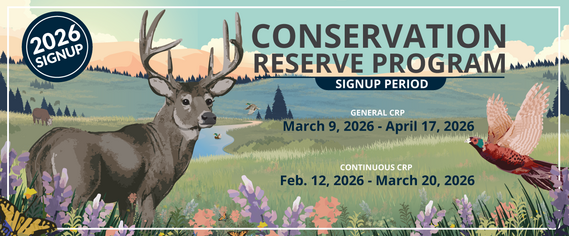
The U.S. Department of Agriculture (USDA) today announced the enrollment periods for agricultural producers and landowners to submit offers for the Continuous and General Conservation Reserve Program (CRP). USDA’s Farm Service Agency (FSA) is accepting offers for Continuous CRP starting Feb. 12, 2026, through March 20, 2026. Enrollment for General CRP will run from March 9, 2026, through April 17, 2026. FSA will announce dates for Grassland CRP signup in the near future.
|
Top of page
The U.S. Department of Agriculture (USDA) Farm Service Agency (FSA) in Phillips County announced that Russell Dettmer of Agra was elected to represent his Local Administrative Areas (LAA) during the recent county committee election. All recently elected county committee members took office on March 2, 2026.
Every FSA office is served by a county committee made up of local farmers, ranchers and foresters who are elected by local producers. Other members currently serving on the FSA county committee include Greg Keeten, Elwynn Jansonius, and De Suchsland.
Nationwide, more than 7,700 dedicated members of the agricultural community serve on FSA county committees. The committees are comprised of three to 11 members who serve three-year terms. Committee members play a key role in how FSA delivers disaster recovery, safety-net, conservation, commodity and price support programs, as well as making decisions on county office employment and other agricultural issues.
For more information, visit the FSA website at fsa.usda.gov/elections or contact the Phillips County FSA office at 785-543-2732.

Landowners and operators are reminded that in order to receive payments from USDA, compliance with Highly Erodible Land (HEL) and Wetland Conservation (WC) provisions are required. Farmers with HEL determined soils are reminded of tillage, crop residue, and rotation requirements as specified per their conservation plan. Producers are to notify the USDA Farm Service Agency prior to breaking sod, clearing land (tree removal), and of any drainage projects (tiling, ditching, etc.) to ensure compliance. Failure to update certification of compliance, with form AD-1026, triggering applicable HEL and/or wetland determinations, for any of these situations, can result in the loss of FSA farm program payments, FSA farm loans, NRCS program payments, and premium subsidy to Federal Crop Insurance administered by RMA.
|
Top of page
Farm Service Agency (FSA) loans require applicants to have a satisfactory credit history. A credit report is requested for all FSA direct farm loan applicants. These reports are reviewed to verify outstanding debts, see if bills are paid timely and to determine the impact on cash flow.
Information on your credit report is strictly confidential and is used only as an aid in conducting FSA business.
Our farm loan staff will discuss options with you if you have an unfavorable credit report and will provide a copy of your report. If you dispute the accuracy of the information on the credit report, it is up to you to contact the issuing credit report company to resolve any errors or inaccuracies.
There are multiple ways to remedy an unfavorable credit score:
- Make sure to pay bills on time
- Setting up automatic payments or automated reminders can be an effective way to remember payment due dates.
- Pay down existing debt
- Keep your credit card balances low
- Avoid suddenly opening or closing existing credit accounts
FSA’s farm loan staff will guide you through the process, which may require you to reapply for a loan after improving or correcting your credit report.
For more information on FSA farm loan programs, contact your Smith County USDA Service Center at 785-282-3832 or visit fsa.usda.gov.
Top of page
|






