ALABAMA Updates - February 2026
In This Issue:
February Message from the SED
Alabama Producers
February is a month of preparation. I want to personally thank you for the hard work, resilience, and commitment you continue to show across our great state. Whether you are preparing equipment for spring planting, managing winter livestock needs or reviewing last year’s records, please know your Alabama FSA team is here to support you every step of the way.
Our mission at FSA is simple: Serve Alabama farmers with integrity, accountability, and professionalism. Our team is working diligently to ensure that we are prepared to answer your questions, process applications efficiently and support your operation as you plan for the 2026 production year.
Deadlines matter. Timely reporting protects your eligibility, and communication with your local FSA office helps us serve you better. If you ever need assistance, please reach out to your local county office or visit farmers.gov for additional resources.
Thank you for what you do to feed, fuel and clothe our nation.
Alabama SED
Monica Carroll
Reduced forage quality is considered a production loss for weather disaster assistance coverage under the buy-up provisions of the Farm Service Agency (FSA) Noninsured Crop Disaster Assistance Program (NAP). This safety net is important for cattlemen who produce non-insurable forages for feeding livestock.
To receive coverage for this crop year, you must enroll your eligible forage acreage in NAP by February 28, 2026. Beginning, limited resource and targeted underserved farmers or ranchers are eligible for a waiver of the NAP service fee and a 50 percent premium reduction in buy-up provisions.
For more information on NAP, contact your County USDA Service Center or visit
fsa.usda.gov/nap.
The U.S. Department of Agriculture (USDA) today announced the
enrollment periods for agricultural producers and landowners to submit offers for the
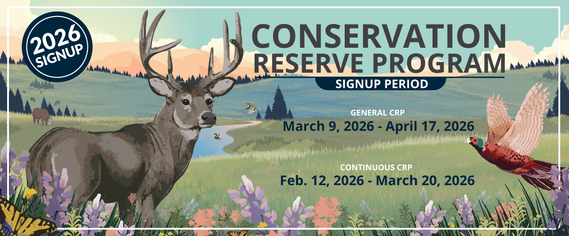
Continuous and General Conservation Reserve Program (CRP). USDA’s Farm Service Agency (FSA) is accepting offers for Continuous CRP starting Feb. 12, 2026, through March 20, 2026. Enrollment for General CRP will run from March 9, 2026, through April 17, 2026. FSA will announce dates for Grassland CRP signup in the near future.
CRP is USDA’s flagship conservation program, providing financial and technical support to agricultural producers and landowners who place unproductive or marginal cropland under contract for 10-15 years and who agree to voluntarily convert the land to beneficial vegetative cover to improve water quality, prevent soil erosion and support wildlife habitat. The Continuing Appropriations, Agriculture, Legislative Branch, Military Construction and Veterans Affairs, and Extensions Act, 2026, extends FSA’s authority to administer CRP through Sept. 30, 2026.
Continuous CRP (Signup 65)
FSA will batch Continuous CRP offers submitted by interested agricultural producers
and landowners. Offers to re-enroll expiring CRP continuous acreage will be accepted
on a first-come, first-serve basis. New acreage offered in continuous CRP practices will be considered for acceptance on a first-come, first-serve basis if they support USDA conservation priorities including but not limited to practices that address water quality, such as filter strips and grass waterways, and practices that restore native ecosystems or target specific resource concerns.
The first Continuous CRP batching period ends on March 20, 2026. Offers submitted
after this date will be considered for acceptance in subsequent batching periods if
acreage remains available.
Continuous CRP participants voluntarily offer environmentally sensitive lands, typically smaller parcels than offered through General CRP including wetlands, riparian buffers, and varying wildlife habitats. In return, they receive annual rental payments and cost- share assistance to establish long-term, resource-conserving vegetative cover.
Continuous CRP enrollment options include:
• Clean Lakes, Estuaries and Rivers (CLEAR) Initiative: Prioritizes water quality practices on the land that, if enrolled, will help reduce sediment loadings, nutrient
loadings, and harmful algal blooms. The vegetative covers also contribute to
increased wildlife populations.
•CLEAR30 (a component of the CLEAR Initiative): Offers additional incentives
for water quality practice adoption and can be accessed in 30-year contracts.
• Highly Erodible Land Initiative (HELI): Producers and landowners can enroll in
CRP to establish long-term cover on highly erodible cropland that has a weighted
erodibility index greater than or equal to 20.
• Conservation Reserve Enhancement Program (CREP): Addresses high
priority conservation objectives of states and Tribal governments on agricultural
lands in specific geographic areas.
• State Acres for Wildlife Enhancement Initiative (SAFE): Restores vital habitat
in order to meet high-priority state wildlife conservation goals.
General CRP (Signup 66)
General CRP offers are submitted through a competitive bid process. After the
enrollment period closes, General CRP offers are ranked and scored by FSA, using
nationally established environmental benefits criteria. USDA will announce accepted
offers once ranking and scoring for all offers is completed. In addition to annual rental
payments, approved General CRP participants may also be eligible for cost-share
assistance to establish long-term, resource-conserving vegetative cover.
Producers and landowners interested in participating in CRP should contact their local FSA county office.
Farm loan borrowers who have pledged real estate as security for their Farm Service Agency (FSA) direct or guaranteed loans are responsible for maintaining loan collateral. Borrowers must obtain prior consent or approval from FSA or the guaranteed lender for any transaction that affects real estate security. These transactions include, but are not limited to:
- Leases of any kind
- Easements of any kind
- Subordinations
- Partial releases
- Sales
Failure to meet or follow the requirements in the loan agreement, promissory note, and other security instruments could lead to nonmonetary default which could jeopardize your current and future loans.
It is critical that borrowers keep an open line of communication with their FSA loan staff or guaranteed lender when it comes to changes in their operation. For more information on borrower responsibilities, read Your FSA Farm Loan Compass.
USDA announced the next phase in the Farmer Bridge Assistance Program (FBA), the eligible commodity per-acre payment rates. In 2026, $12 billion will be paid to American farmers. Of that amount, $11 billion consists of one-time FBA program payments.
Eligible Row Crop Commodities and Payment Rates:
Below are the payment rates for the FBA eligible commodities that triggered a payment.
Commodity, Per Acre Payment Rates
•Barley: $20.51
• Canola: $23.57
• Chickpeas (Large): $26.46
• Chickpeas (Small): $33.36
• Corn: $44.36
• Cotton: $117.35
• Flax: $8.05
• Lentils: $23.98
• Mustard: $23.21
• Oats: $81.75
• Peanuts: $55.65
• Peas: $19.60
• Rice: $132.89
• Safflower: $24.86
• Sesame: $13.68
• Sorghum: $48.11
• Soybeans: $30.88
• Sunflower: $17.32
• Wheat: $39.35
Eligibility, Program Applications, and Crop Insurance Linkage
FBA payments are based on 2025 planted acres, Economic Research Service cost of production, and the World Agriculture Supply and Demand Estimate Report. Double crop acres, including all initial and subsequently planted crops, are eligible. Prevent plant acres are not eligible.
All intended row crop uses are eligible for FBA except grazing, volunteer stands, experimental, green manure, crops left standing and abandoned or cover crops.
Crop insurance linkage is not required; however, USDA strongly urges producers to take advantage of the new risk management tools provided for in the One Big Beautiful Bill Act (OBBBA) to best protect against future price risk and volatility. The OBBBA federal crop insurance improvements include expanding benefits for beginning farmers and ranchers, increasing coverage options, and making crop insurance more affordable.
Specialty Crop Assistance
Of the $12 billion being provided by the Commodity Credit Corporation Charter Act, up to $11 billion is being directed to eligible row crop producers and the remaining $1 billion of the $12 billion in assistance is reserved for specialty crops and sugar. Timelines for payments to producers of these crops are still under development and require additional understanding of market impacts and economic needs.
Producers, including specialty crop producers and stakeholder groups, can submit questions to farmerbridge@usda.gov.
More information on FBA is available online at https://www.fsa.usda.gov/fba or you can contact your local USDA FSA county office.
If you’re enrolled in the Agriculture Risk Coverage (ARC) or Price Loss Coverage (PLC) programs, you must protect all cropland and noncropland acres on the farm from wind and water erosion and noxious weeds. By signing ARC county or individual contracts and PLC contracts, you agree to effectively control noxious weeds on the farm according to sound agricultural practices. If you fail to take necessary actions to correct a maintenance problem on your farm that is enrolled in ARC or PLC, the County Committee may elect to terminate your contract for the program year.
The Conservation Stewardship Program (CSP) is sometimes misunderstood. It is perceived by some as complicated or not for small operations, and neither of those perceptions is true. CSP is designed to help you take your existing conservation efforts on your operation to the next higher level while maintaining your current ones. It’s supposed to help you add to what you’re already doing, either by enhancing your current practices or adding new ones.
The Natural Resources Conservation Service (NRCS) works one-on-one with you to develop a conservation plan under CSP to implement these additions or enhancements and help strengthen your operation.
Under CSP, you receive annual payments to help you maintain your existing conservation efforts and enhance them using new conservation practices or activities. CSP contracts last five years, with the opportunity to compete for a contract renewal if you successfully fulfill the initial contract and agree to achieve additional conservation objectives.
CSP is often misunderstood, so here are a few “myths” about the program that we want to dispel.
Myth #1: The deadline to apply for CSP in my state has already passed, so I don’t need to think about applying until next year.
Don’t wait to apply! We accept applications year-round, but funding decisions are made locally at specific times and that “ranking date” may be coming up soon in your area. If we already have your application, it will be considered at the next ranking date. Plus, if you start planning now, you will be ready for application ranking dates as they approach. See program application ranking dates for all states at https://www.nrcs.usda.gov/ranking-dates.
Myth #2: Enrolling land in CSP is complicated and time-consuming.
If you have a farm and tract number (available from USDA’s Farm Service Agency) and have kept good farm records, you’re already well on your way. You just need to complete a three-page NRCS-CPA-1200 form, see Applications and Forms. You can even complete this form online if you create a farmers.gov account at https://www.farmers.gov/account.
Read more myths.
ALABAMA USDA
|
| |
|
Farm Service Agency (FSA)
4121 Carmichael Road, Ste 600
Montgomery, AL 36106
Phone: 334-279-3500
Fax: 855-747-0599
Monica Carroll
FSA State Director
Shnequie Bowman-Greene,
FSA Deputy State Director
FSA State Committee
|
Natural Resource Conservation Service (NRCS)
3381 Skyway Dr. Auburn, AL 36830 Phone: (334) 887-4500
Fax: (855)292-1671
Ben Malone, NRCS State Conservationist
Risk Management
106 S. Patterson Street, Suite 250
Valdosta, GA 31601-5673
Phone: 229-242-7235
Fax: (229) 242-3566
Davina Lee, RMA Regional Director
|
|
USDA is an equal opportunity provider, employer and lender. To file a complaint of discrimination, write: USDA, Office of the Assistant Secretary for Civil Rights, Office of Adjudication, 1400 Independence Ave., SW, Washington, DC 20250-9410 or call (866) 632-9992 (Toll-free Customer Service), (800) 877-8339 (Local or Federal relay), (866) 377-8642 (Relay voice users).
|
|