
Rhode Island Service Center Newsletter - February 19, 2026
In This Issue:
- February 25, 2026 - Eastern RI Local Working Group Meeting, 6:00-7:00 p.m., Greenvale Vineyards, Portsmouth. Register at https://www.eventbrite.com/e/eastern-ri-conservation-district-local-working-group-meeting-tickets-1980023294976
-
February 26, 2026 - Deadline to submit application for coverage for the 2026 Dairy Margin Coverage Program (DMC).
- February 27, 2026 - Sign up deadline for Conservation Easements and RI Statewide Natural Systems Demo RCPP Project
- February 28, 2026 - Southern RI Local Working Group Meeting, 10:00 a.m.-12:00 p.m., South Kingstown Land Trust Barn. Register at sricd.org or email gmanchester@sricd.org.
- March 1, 2026 - Deadline to file a notice of loss and application for payment for 2025 .
- March 1, 2026 - Deadline to file a notice of loss and application for payment for 2025 the Livestock Indemnity Program (LIP).
-
March 11, 2026 - NRICD Local Working Group Meeting - Chepachet, 6:00-7:00 p.m., Glocester Manton Library, 1137 Putnam Pike, Chepachet, RI 02814
-
March 13, 2026 - Deadline to complete/correct acreage report in order to apply for Assistance for Specialty Crop Farmers (ASCF) program.
-
March 16, 2026 - Deadline to file a 2026 Noninsured Disaster Assistance Program (NAP) application for coverage for spring-seeded crops.
-
March 18, 2026, NRICD Local Working Group Meeting - Cranston, 6:00-7:00 p.m., William Hall Library, 1825 Broad St., Cranston, RI 02905
-
March 20, 2026 - Second signup cutoff date for AMA, CSP, and EQIP
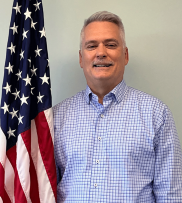
Greetings Conservation Clients & Partners!
These short winter days are the perfect time to plan for spring planting and summer crops. As you look ahead, consider joining NRCS's new Regenerative Pilot Program (RPP), a farmer-first approach that helps you apply practices to improve natural resources and build resilience on your land.
The Regenerative Pilot Program (RPP) streamlines conservation by combining practices into one simple application. It focuses on whole-farm planning to improve soil health, water quality, and long-term productivity, while giving you flexibility to choose what works best for your operation. Whether you’re just starting with cover crops or managing a well-established farm or woodland, there's a pathway for you in this program.
Examples of primary practices include crop rotation, cover crops, contour farming, forest stand improvement, irrigation water management, mulching, forage and grazing management, nutrient and pest management, and residue management, and more regenerative options tailored to your goals.
Sign up today! Our second signup period is now open, with a deadline of March 20, 2026. Contact your local NRCS Field Office or Conservation District Office to apply and start building a healthier, more productive farm for the future.
Tom Morgart
State Conservationist, Connecticut and Rhode Island
|
 NRCS Chief Aubrey J.D. Bettencourt outlines how the agency is helping producers cut through red tape to plan and implement whole-farm regenerative practices through the new Regenerative Pilot Program. The new pilot program focuses on meeting producers where they are and integrating into farm operations to create a more sustainable, efficient, and profitable system that ultimately gives producers the credit they deserve for integrating voluntary conservation efforts.
^ back to top
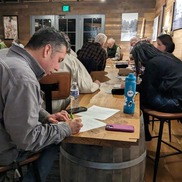
BE THE VOICE OF YOUR AGRICULTURAL COMMUNITY – Help shape conservation priorities and NRCS program delivery in Rhode Island.
Rhode Island’s Conservation Districts in partnership with USDA’s Natural Resources Conservation Service (NRCS) will be holding Local Working Group meetings throughout the Ocean State between January 22 and March 25. These meetings are open to the public.
Local Working Group meetings are a valuable part of the NRCS planning process, enabling farmers, woodland owners, and local land managers to be part of a collaborative effort to improve natural resources in their community. Learn more...
2026 LWG Meeting Schedule
- Eastern RI Local Working Group Meeting:
- February 25, 2026, 6:00-7:00 p.m., Greenvale Vineyards, 582 Wapping Road, Portsmouth, RI
- Northern RI Local Working Group Meetings:
- March 11, 2026, 6:00-7:00 p.m., Glocester Manton Library, 1137 Putnam Pike, Chepachet, RI 02814
- March 18, 2026, 6:00-7:00 p.m., William Hall Library, 1825 Broad St., Cranston, RI 02905
- March 25, 2026, 6:00-7:00 p.m., Cumberland Library, 1464 Diamond Hill Rd #1, Cumberland, RI 02864
- Southern RI Local Working Group Meeting:
- February 28, 2026, 10:00 a.m. – 12:00 p.m., South Kingstown Land Trust Barn, 17 Matunuck Beach Rd, South Kingstown, RI 02879
^ back to top
|
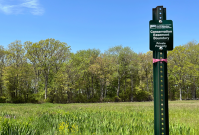
The USDA Natural Resources Conservation Service (NRCS) in Rhode Island is extending the fiscal year (FY) 2026 signup for property owners for conservation easements to protect working ag lands and wetlands through the Agricultural Conservation Easement Program (ACEP)to February 27, 2026.
ACEP helps landowners, land trusts, and other entities protect, restore, and enhance wetlands or protect farmland and ranchland through conservation easements. We offer two easement types, Agricultural Land Easements (ALE) to protect working crop and pasture lands, and Wetland Reserve Easements (WRE) to protect, restore and enhance wetlands previously degraded by ag activities.
Contact Rhode Island NRCS Easements Program Manager, Marina Capraro, at 401-527-5147 or Marina.Capraro@usda.gov. Learn more...
^ back to top
|
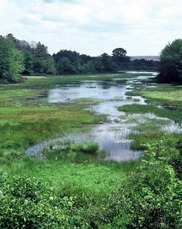
NRCS encourages farmers and forestland owners to sign up for conservation assistance as part of the Rhode Island Statewide Natural Systems Demonstration Project through the Regional Conservation Partnership Program (RCPP).
RCPP is a voluntary program that provides financial and technical assistance to farmers and forestland owners to address natural resource concerns through an array of conservation practices. This demonstration project has two focus areas:
-
Northern Rhode Island (Providence County) – Funding will be used to implement a suite of natural systems-based approaches including green infrastructure improvements, riparian buffers, and stream corridor restoration to protect water quality in the Scituate Reservoir Watershed.
-
Southern Rhode Island (Kent and Washington counties) – Funding be used to implement a suite of natural system-based approaches including green infrastructure to protect water quality in Winnapaug Pond Watershed, Westerly (a coastal saltwater pond).
Learn more...
^ back to top
|
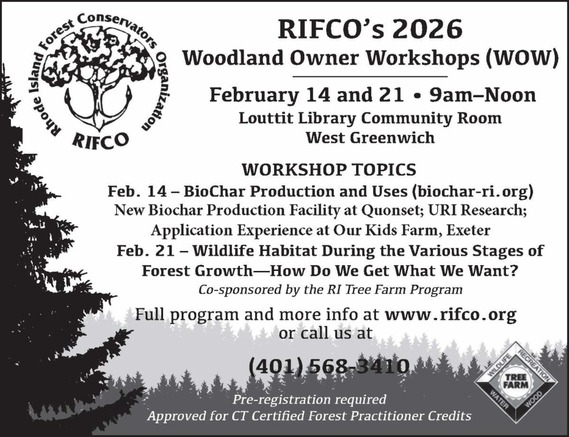 The RI Forest Conservator’s Organization (RIFCO) continues its popular Saturday-morning series of workshops on woodland management topics this winter on Saturdays February 14th and February 21st, 2026, from 9 am until noon at the West Greenwich Community Center on Victory Highway (Route 102) behind the Louttit Library in West Greenwich.
Topics covered include Forest Conservation Strategies, Old Growth Forest Ecology, the emerging field of Bio-Char production and it’s uses, and Wildlife Habitat throughout the life span of a forest environment.
“The workshops will help you appreciate and get more enjoyment from your woodlands," said Bill Fortune, RIFCO President and a Foster woodlot owner. We hope this learning experience will encourage future conservation of Rhode Island’s forest resources.”
Pre-registration for the workshops is required. For more information and a registration form, please visit www.rifco.org or call 401-568-3410.
^ back to top
The U.S. Department of Agriculture (USDA) Farm Service Agency (FSA) in Rhode Island is pleased to announce the results of the recent county committee election.
Results for Kent County (LAA 2): Gilbert W. Rathbun Jr.
Results for Newport County (LAA 4): Michelle Garman
Results for Bristol County (LAA 5): Spencer Morris
"County Committee members are a critical component of the day-to-day operations of FSA,” said Lillian Toth, County Executive Director. "They help deliver programs at the county level and work to serve the needs of local producers. All recently elected county committee members will take office on March 2, 2026.”
Every FSA office is served by a county committee made up of local farmers, ranchers and foresters who are elected by local producers. Other members currently serving on the FSA county committee include:
Representing Providence County (LAA 1): Howard Tucker III
Representing Washington County (LAA 3): William Coulter
Nationwide, more than 7,700 dedicated members of the agricultural community serve on FSA county committees. The committees are comprised of three to 11 members who serve three-year terms. Committee members play a key role in how FSA delivers disaster recovery, safety-net, conservation, commodity and price support programs, as well as making decisions on county office employment and other agricultural issues.
For more information, visit the FSA website at fsa.usda.gov/elections or contact Lillian Toth at the Rhode Island County FSA office at 401-828-3120 ext 1.
^ back to top
Are you interested in working with USDA to start or grow your farm, ranch, or private forest operation, but don’t know where to start?
Whether you’re looking to access capital or disaster assistance through USDA’s Farm Service Agency (FSA) or address natural resource concerns on your land with assistance from USDA’s Natural Resources Conservation Service (NRCS), a great place to start is farmers.gov.
Farmers.gov is a one-stop shop for information about the assistance available from FSA and NRCS. The site also offers many easy-to-use tools for farmers, ranchers, and private forestland owners, whether you are reaching out for the first time or are a long-term customer with a years-long relationship with USDA.
With a farmers.gov account you can:
- Complete an AD-2047, Customer Data Worksheet, prior to your first meeting with FSA and NRCS.
- View farm loan payments history from FSA.
- View cost share assistance received and anticipated from NRCS conservation programs.
- Request conservation assistance from NRCS as well as view and track your conservation plans, practices, and contracts.
- View, print, and export detailed farm records and farm/tract maps for the current year, which are particularly useful when fulfilling acreage reporting requirements.
- Print FSA-156 EZ, Abbreviated Farm Record and your Producer Farm Data Report for the current year.
- Pay FSA debt using the “Make an FSA Payment” feature
- Apply for a farm loan online, view information on your existing loans, and make USDA direct farm loan payments using the Pay My Loan feature.
Learn how to create a farmers.gov account today!
^ back to top
FSA and NRCS program applicants for benefits are required to submit a completed CCC-902 Farming Operation Plan and CCC-941 Average Gross Income (AGI) Certification and Consent to Disclosure of Tax Information for FSA to determine the applicant’s payment eligibility and establish the maximum payment limitation applicable to the program applicant.
Participants are not required to annually submit new CCC-902s for payment eligibility and payment limitation purposes unless a change in the farming operation occurs that may affect the previous determination of record. A valid CCC-902 filed by the participant is considered to be a continuous certification used for all payment eligibility and payment limitation determinations applicable for the program benefits requested.
Participants are responsible for ensuring that all CCC-902 and CCC-941 and related forms on file in the county office are updated, current, and correct. Participants are required to timely notify the county office of any changes in the farming operation that may affect the previous determination of record by filing a new or updated CCC-902 as applicable.
Changes that may require a new determination include, but are not limited to, a change of:
- Shares of a contract, which may reflect:
- A land lease from cash rent to share rent
- A land lease from share rent to cash rent (subject to the cash rent tenant rule
- A modification of a variable/fixed bushel-rent arrangement
- The size of the producer’s farming operation by the addition or reduction of cropland that may affect the application of a cropland factor
- The structure of the farming operation, including any change to a member's share
- The contribution of farm inputs of capital, land, equipment, active personal labor, and/or active personal management
- Farming interests not previously disclosed on CCC-902 including the farming interests of a spouse or minor child
- Certifications of average AGI are required to be filed annually for participation in an annual USDA program. For multi-year conservation contracts and NRCS easements, a certification of AGI must be filed prior to approval of the contract or easement and is applicable for the duration of the contract period.
Participants are encouraged to file or review these forms within the deadlines established for each applicable program for which program benefits are being requested.
^ back to top
The Farm Loan team in Rhode Island is already working on operating loans for spring 2026 and asks potential borrowers to submit their requests early so they can be timely processed. The farm loan team can help determine which loan programs are best for applicants.
FSA offers a wide range of low-interest loans that can meet the financial needs of any farm operation for just about any purpose. The traditional farm operating and farm ownership loans can help large and small farm operations take advantage of early purchasing discounts for spring inputs as well expenses throughout the year.
Microloans are a simplified loan program that will provide up to $50,000 for both Farm Ownership and Operating Microloans to eligible applicants. These loans, targeted for smaller and non-traditional operations, can be used for operating expenses, starting a new operation, purchasing equipment, and other needs associated with a farming operation. Loans to beginning farmers and members of underserved groups are a priority.
Other types of loans available include:
Marketing Assistance Loans allow producers to use eligible commodities as loan collateral and obtain a 9-month loan while the crop is in storage. These loans provide cash flow to the producer and allow them to market the crop when prices may be more advantageous.
Farm Storage Facility Loans can be used to build permanent structures used to store eligible commodities, for storage and handling trucks, or portable or permanent handling equipment. A variety of structures are eligible under this loan, including bunker silos, grain bins, hay storage structures, and refrigerated structures for vegetables and fruit. A producer may borrow up to $500,000 per loan.
^ back to top
The USDA is launching a new online portal to streamline reporting of transactions involving U.S. agricultural land by foreign persons, which can include businesses and governments, under the Agricultural Foreign Investment Disclosure Act of 1978 (AFIDA). The new online portal is part of a broader effort to strengthen enforcement and protect American farmland as USDA continues its implementation of the National Farm Security Action Plan.
The new online portal is available at afida.landmark.usda.gov. Users can access the portal with Login.gov, a sign in service that provides secure online access to participate in certain government programs and reporting requirements.
The new digital portal will gather the same information found on the current form FSA-153 and those subject to filing may still file using the current FSA-153 hard copy form if desired. However, filers should not duplicate filings by using both submission options.
About the National Farm Security Action Plan
One of the key tenets of USDA’s National Farm Security Action Plan (PDF, 1.2 MB) is strengthening processes around disclosure of foreign persons who have an interest in U.S. farmland. This historic plan, announced in July 2025, calls for aggressive implementation of reforms to the AFIDA process including improved verification and monitoring of collected AFIDA data. In addition to the new portal, USDA published an Advanced Notice of Proposed Rulemaking for AFIDA in December 2025.
About AFIDA
The new portal is part of USDA’s efforts to streamline its process for electronic submission and retention of AFIDA disclosures, as initially required by the Consolidated Appropriations Act, 2023. Today USDA also shared its annual AFIDA report for 2024 with Congress, which is available online. The report lists foreign holdings of U.S. agricultural land as 46 million acres, as of December 31, 2024 and includes a section on land held and acquired by China, Russia, Iran, and North Korea in recent years. The data obtained from AFIDA disclosures are used in the preparation of an annual report to Congress, which is published online.
The AFIDA regulations define the term “foreign person” and specifies the information that must be included in the report. AFIDA focuses on foreign persons who hold direct or indirect interest in the agricultural land, provided those foreign persons with an indirect interest have “significant interest or substantial control” in the direct interest holder.
^ back to top
Application Window: Opened January 15, 2026
Program Application Period: Electronic applications will be accepted via the VAPG application portal until 1:00 p.m. Eastern Time on April 15, 2026.
Value-Added Producer Grants (VAPGs) help agricultural producers generate new products, create or expand marketing opportunities, and increase producer income.
Program Overview
The objective of this grant program is to assist viable Agricultural Producers, Agricultural Producer Groups, Farmer and Rancher Cooperatives, and Majority-Controlled Producer-Based Businesses in starting or expanding value-added activities related to the processing and/or marketing of Value-Added Agricultural Products. Grants will be awarded competitively for either planning or working capital projects directly related to the processing and/or marketing of value-added products. Generating new products, creating and expanding marketing opportunities, and increasing producer income are the end goals of the program. All proposals must demonstrate economic viability and sustainability to compete for funding.
How to get started
Contact your Southern New England USDA Rural Development office for details and help.
^ back to top
USDA – Rhode Island
60 Quaker Lane
Warwick, RI 02886
|
Natural Resources Conservation Service (NRCS)
401-828-1300 | www.RI.nrcs.usda.gov
|
|
Eastern RI – Serving Newport and Bristol counties
|
|
NRCS Field Office
Kat Zuromski, Acting District Conservationist
401-786-1389 Kathryn.Zuromski@usda.gov
|
Conservation District Office
401-934-0842 info@easternriconservation.org
|
|
Northern RI – Serving Providence County
|
|
NRCS Field Office
Ghyllian Alger, Acting District Conservationist
401-822-8835/ Ghyllian.Alger@usda.gov
|
Conservation District Office
401-934-0840/ mallard.nricd@gmail.com
|
|
Southern RI – Serving Kent and Washington counties
|
|
NRCS Field Office
Jameson Long, District Conservationist
401-822-8837/ Jameson.Long@usda.gov
|
Conservation District Office
401-661-5761/ gfuller@sricd.org
|
|
|
|
RI FSA County Office, Suite 49
RI FSA Farm Loan Team, Suite 62
RI FSA State Office, Suite 62
|
401-828-3120 Option 1
401-828-3120 Option 2
401-828-3120 Option 3
|
| |
| |
|
|
|
|







