
New York FSA Updates - February 10, 2026
In This Issue:
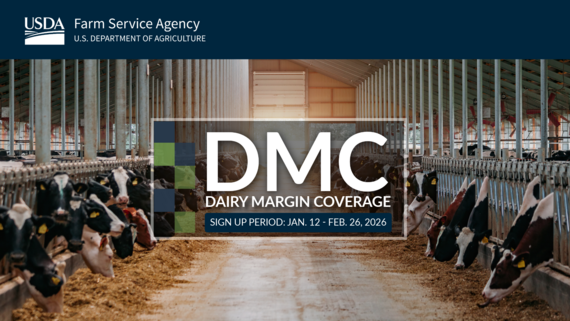 The U.S. Department of Agriculture (USDA) announced the enrollment period for the Dairy Margin Coverage (DMC) program for the 2026 coverage year, an important safety net program that provides producers with price support to help offset milk and feed price differences. Dairy producers can enroll in DMC from January 12, 2026, to February 26, 2026.
The One Big Beautiful Bill Act (OBBBA) reauthorized DMC for calendar years 2026 through 2031 and provided substantial program improvements, including establishing new production history and increasing Tier 1 coverage.
The OBBBA increased DMC’s Tier 1 coverage level increased from five million pounds to six million pounds. All dairy operations that elect to enroll in DMC for 2026 will establish a new production history.
- Existing dairy operations that started marketing milk on or before January 1, 2023, will use the higher of milk marketings for the years of 2021, 2022, or 2023.
- New dairy operations starting after January 1, 2023, will use their first year of monthly milk marketings, even for a partial year.
- Milk marketing statements or production evidence are required to establish a production history.
Dairy operations also have the option to lock-in coverage levels for six years (2026-2031) with premium fees discounted by 25%.
DMC offers different levels of coverage, including an option that is free to producers, minus a $100 administrative fee. To determine the appropriate level of DMC coverage for a specific dairy operation, producers can use the online dairy decision tool.
For more information visit the DMC webpage or contact your local USDA Service Center.
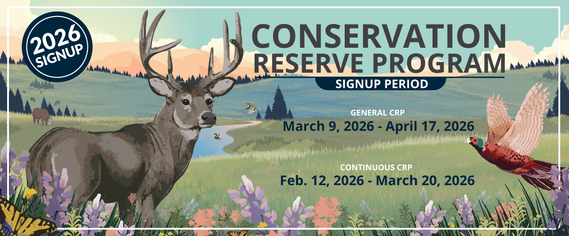 The U.S. Department of Agriculture (USDA) today announced the enrollment periods for agricultural producers and landowners to submit offers for the Continuous and General Conservation Reserve Program (CRP). USDA’s Farm Service Agency (FSA) is accepting offers for Continuous CRP starting Feb. 12, 2026, through March 20, 2026. Enrollment for General CRP will run from March 9, 2026, through April 17, 2026. FSA will announce dates for Grassland CRP signup in the near future.
CRP is USDA’s flagship conservation program, providing financial and technical support to agricultural producers and landowners who place unproductive or marginal cropland under contract for 10-15 years and who agree to voluntarily convert the land to beneficial vegetative cover to improve water quality, prevent soil erosion and support wildlife habitat. The Continuing Appropriations, Agriculture, Legislative Branch, Military Construction and Veterans Affairs, and Extensions Act, 2026, extends FSA’s authority to administer CRP through Sept. 30, 2026.
Continuous CRP (Signup 65)
FSA will batch Continuous CRP offers submitted by interested agricultural producers and landowners. Offers to re-enroll expiring CRP continuous acreage will be accepted on a first-come, first-serve basis. New acreage offered in continuous CRP practices will be considered for acceptance on a first-come, first-serve basis if they support USDA conservation priorities including but not limited to practices that address water quality, such as filter strips and grass waterways, and practices that restore native ecosystems or target specific resource concerns.
The first Continuous CRP batching period ends on March 20, 2026. Offers submitted after this date will be considered for acceptance in subsequent batching periods if acreage remains available.
Continuous CRP participants voluntarily offer environmentally sensitive lands, typically smaller parcels than offered through General CRP including wetlands, riparian buffers, and varying wildlife habitats. In return, they receive annual rental payments and cost-share assistance to establish long-term, resource-conserving vegetative cover.
Continuous CRP enrollment options include:
-
Clean Lakes, Estuaries and Rivers (CLEAR) Initiative: Prioritizes water quality practices on the land that, if enrolled, will help reduce sediment loadings, nutrient loadings, and harmful algal blooms. The vegetative covers also contribute to increased wildlife populations.
-
CLEAR30 (a component of the CLEAR Initiative): Offers additional incentives for water quality practice adoption and can be accessed in 30-year contracts.
-
Highly Erodible Land Initiative (HELI): Producers and landowners can enroll in CRP to establish long-term cover on highly erodible cropland that has a weighted erodibility index greater than or equal to 20.
-
Conservation Reserve Enhancement Program (CREP): Addresses high priority conservation objectives of states and Tribal governments on agricultural lands in specific geographic areas.
-
State Acres for Wildlife Enhancement Initiative (SAFE): Restores vital habitat in order to meet high-priority state wildlife conservation goals.
General CRP (Signup 66)
General CRP offers are submitted through a competitive bid process. After the enrollment period closes, General CRP offers are ranked and scored by FSA, using nationally established environmental benefits criteria. USDA will announce accepted offers once ranking and scoring for all offers is completed. In addition to annual rental payments, approved General CRP participants may also be eligible for cost-share assistance to establish long-term, resource-conserving vegetative cover.
Producers and landowners interested in participating in CRP should contact their local FSA county office.
The USDA is launching a new online portal to streamline reporting of transactions involving U.S. agricultural land by foreign persons, which can include businesses and governments, under the Agricultural Foreign Investment Disclosure Act of 1978 (AFIDA). The new online portal is part of a broader effort to strengthen enforcement and protect American farmland as USDA continues its implementation of the National Farm Security Action Plan.
The new online portal is available at afida.landmark.usda.gov. Users can access the portal with Login.gov, a sign in service that provides secure online access to participate in certain government programs and reporting requirements.
The new digital portal will gather the same information found on the current form FSA-153 and those subject to filing may still file using the current FSA-153 hard copy form if desired. However, filers should not duplicate filings by using both submission options.
About the National Farm Security Action Plan
One of the key tenets of USDA’s National Farm Security Action Plan (PDF, 1.2 MB) is strengthening processes around disclosure of foreign persons who have an interest in U.S. farmland. This historic plan, announced in July 2025, calls for aggressive implementation of reforms to the AFIDA process including improved verification and monitoring of collected AFIDA data. In addition to the new portal, USDA published an Advanced Notice of Proposed Rulemaking for AFIDA in December 2025.
About AFIDA
The new portal is part of USDA’s efforts to streamline its process for electronic submission and retention of AFIDA disclosures, as initially required by the Consolidated Appropriations Act, 2023. Today USDA also shared its annual AFIDA report for 2024 with Congress, which is available online. The report lists foreign holdings of U.S. agricultural land as 46 million acres, as of December 31, 2024 and includes a section on land held and acquired by China, Russia, Iran, and North Korea in recent years. The data obtained from AFIDA disclosures are used in the preparation of an annual report to Congress, which is published online.
The AFIDA regulations define the term “foreign person” and specifies the information that must be included in the report. AFIDA focuses on foreign persons who hold direct or indirect interest in the agricultural land, provided those foreign persons with an indirect interest have “significant interest or substantial control” in the direct interest holder.
USDA’s Farm Service Agency (FSA) is delivering more than $16 billion in total Congressionally approved disaster relief. FSA is now accepting applications for assistance through the second stage of the Supplemental Disaster Relief Program (SDRP) from agricultural producers who suffered eligible non-indemnified, uncovered or quality crop losses due to qualifying natural disasters in 2023 and 2024.
Stage Two covers eligible crop, tree, bush and vine losses that were not covered under Stage One program provisions, including non-indemnified (shallow loss), uncovered and quality losses. Although the majority of payments from the first stage are already in the hands of producers helping them prepare for and invest in the next crop year, Stage One assistance, announced in July, remains available to producers who received an indemnity under crop insurance or the Noninsured Crop Disaster Assistance Program (NAP) for eligible crop losses due to qualifying 2023 and 2024 natural disaster events.
The deadline to apply for both Stage One and Stage Two assistance is April 30, 2026.
SDRP Stage Two Program Details
SDRP Stage Two provides assistance for eligible crop, tree, bush and vine losses not covered under Stage One, including:
-
Non-Indemnified Losses (Including Shallow Losses)
- Insured losses through federal crop insurance that did not trigger a crop insurance indemnity.
- Losses with NAP coverage that did not trigger a NAP payment.
-
Uncovered Losses (Uninsured Losses)
- Includes losses that were not insured through federal crop insurance or NAP.
-
Quality Losses
- Includes quality losses to commodities indicated by:
- A decrease in value based on discounts due to the physical condition of the crop supported by applicable grading factors
- A decline in the nutritional value of forage crops supported by documented forage tests.
- Producers will certify to an SDRP quality loss percentage.
FSA is establishing block grants with Connecticut, Hawaii, Maine, and Massachusetts that cover crop losses; therefore, producers with losses on land physically located in these states are not eligible for SDRP program payments.
For information on program eligibility and to download an application checklist, visit fsa.usda.gov/sdrp.
More information will be provided in early 2026 regarding a separate enrollment period for quality losses covered by SDRP Stage One as well as for insured producers in Puerto Rico who were not included in Stage One because data was not available when pre-filled applications were mailed.
To make an appointment to apply, call your local service center.
Farm Loan teams across New York are already working on operating loans for spring 2026 and asks potential borrowers to submit their requests early so they can be timely processed. The farm loan team can help determine which loan programs are best for applicants.
FSA offers a wide range of low-interest loans that can meet the financial needs of any farm operation for just about any purpose. The traditional farm operating and farm ownership loans can help large and small farm operations take advantage of early purchasing discounts for spring inputs as well expenses throughout the year.
Microloans are a simplified loan program that will provide up to $50,000 for both Farm Ownership and Operating Microloans to eligible applicants. These loans, targeted for smaller and non-traditional operations, can be used for operating expenses, starting a new operation, purchasing equipment, and other needs associated with a farming operation. Loans to beginning farmers and members of underserved groups are a priority.
Other types of loans available include:
Marketing Assistance Loans allow producers to use eligible commodities as loan collateral and obtain a 9-month loan while the crop is in storage. These loans provide cash flow to the producer and allow them to market the crop when prices may be more advantageous.
Farm Storage Facility Loans can be used to build permanent structures used to store eligible commodities, for storage and handling trucks, or portable or permanent handling equipment. A variety of structures are eligible under this loan, including bunker silos, grain bins, hay storage structures, and refrigerated structures for vegetables and fruit. A producer may borrow up to $500,000 per loan.
|

USDA Farm Service Agency (FSA) reminds producers of approaching application deadlines for purchasing risk coverage for some crops through the Noninsured Crop Disaster Assistance Program (NAP). NAP provides financial assistance to producers of non-insurable crops impacted by natural disasters that result in lower yields, crop losses, or prevented crop planting.
NAP covers losses from natural disasters on crops for which no permanent federal crop insurance program is available, including forage and grazing crops, fruits, vegetables, floriculture, ornamental nursery, aquaculture, turf grass and more.
Upcoming application deadlines for NAP coverage in New York for the 2026 production season include:
- March 16 - most spring planted fruits and vegetables
NAP basic coverage is available at 55% of the average market price for crop losses that exceed 50% of expected production. Buy-up coverage is available in some cases. NAP offers higher levels of coverage, ranging from 50% to 65% of expected production in 5% increments, at 100% of the average market price. Producers of organic crops and crops marketed directly to consumers also may exercise the “buy-up” option to obtain NAP coverage of 100% of the average market price at coverage levels ranging between 50% and 65% of expected production. Buy-up coverage is not available for crops intended for grazing.
For all coverage levels, the NAP service fee is the lesser of $325 per crop or $825 per producer per county, not to exceed a total of $1,950 for a producer with farming interests in multiple counties. Premiums apply for buy-up coverage.
If a producer has a Socially Disadvantaged, Limited Resource, Beginning and Veteran Farmer or Rancher Certification (form CCC-860) on file with FSA, it may serve as an application for basic coverage for all eligible crops beginning with crop year 2022. These producers will have all NAP-related service fees for basic coverage waived. These producers may also receive a 50% premium reduction if higher levels of coverage are elected on form CCC-471, prior to the application closing date for each crop.
To learn more about NAP visit fsa.usda.gov/nap or contact your local USDA Service Center.
|
Farm Service Agency (FSA) is committed to providing our farm loan borrowers the tools necessary to be successful. FSA staff will provide guidance and counsel from the loan application process through the borrower’s graduation to commercial credit. While it is FSA’s commitment to advise borrowers as they identify goals and evaluate progress, it is crucial for borrowers to communicate with their farm loan staff when changes occur. It is the borrower’s responsibility to alert FSA to any of the following:
- Any proposed or significant changes in the farming operation
- Any significant changes to family income or expenses
- The development of problem situations
- Any losses or proposed significant changes in security
If a farm loan borrower can’t make payments to suppliers, other creditors, or FSA on time, contact your farm loan staff immediately to discuss loan servicing options.
For more information on FSA farm loan programs, contact your local USDA Service Center or visit fsa.usda.gov.
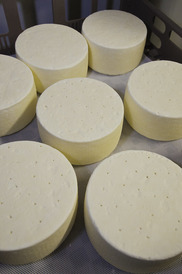
The Value-Added Producer Grant (VAPG) program is administered by USDA Rural Development, and helps U.S. agricultural producers enter into value-added activities that:
- Generate new products from raw agricultural commodities
- Create and expand marketing opportunities
- Increase producer income through enhanced product value and market reach
These grants support either:
- Planning activities (e.g., feasibility studies, business and marketing plans)
- Working capital needs (e.g., processing, packaging, advertising, inventory, and salaries)
Eligible applicants include:
- Agricultural producers (including harvesters and steering committees)
- Agricultural producer groups
- Farmer- or rancher-cooperatives
- Majority-controlled producer-based business ventures
Applicants must demonstrate that they:
- Own and produce more than 50% of the raw commodity
- Will retain greater revenue from the value-added product than from the raw commodity alone
How to Apply
Visit the official for detailed instructions, eligibility requirements, and access to the Grant Application Portal. A is available to help applicants determine eligibility before starting an application.
|
USDA recently announced a $700 million Regenerative Pilot Program to help American farmers adopt practices that improve soil health, enhance water quality, and boost long-term productivity, all while strengthening America’s food and fiber supply.
Administered by the USDA Natural Resources Conservation Service (NRCS), this new Regenerative Pilot Program delivers a streamlined, outcome-based conservation model—empowering producers to plan and implement whole-farm regenerative practices through a single application.
In FY 2026, the Regenerative Pilot Program will focus on whole-farm planning that addresses every major resource concern—soil, water, and natural vitality—under a single conservation framework. USDA is dedicating $400 million through the Environmental Quality Incentives Program (EQIP) and $300 million through the Conservation Stewardship Program (CSP) to fund this first year of regenerative agriculture projects.
Learn more about the Regenerative Pilot Program.
Top of page
Farm Service Agency
New York State Office
441 S. Salina St.
Syracuse, NY 13202
Ph: 315-477-6300
http://www.fsa.usda.gov/ny
Click to find your local USDA office.
|
|
State Executive Director
Clark Putman
clark.putman@usda.gov
|
|
New York FSA State Committee
Lawrence K. Eckhardt, Chair
Ryan Timothy Fessenden
Barbara J. Hanselman
Brenden L. Martin
Joseph P. Shultz
|
|
Farm Program Chief:
Jenifer Dean
jenifer.dean@usda.gov
|
Acting Farm Loan Chief:
Christen Koch
Christen.Koch@usda.gov
|
|
________________________________________________________
|
|
Current Interest Rates
|
|
Farm Storage Facility Loans:
3 yr - 3.625%
5 yr - 3.750%
7 yr - 4.000%
10 yr - 4.125%
12 yr - 4.375%
Commodity Loans: 4.500%
|
Farm Loan Programs:
Farm Operating: 4.625%
Farm Ownership: 5.750%
Conservation Loans: 5.750%
Direct Down Payment: 1.750%
Joint Financing: 3.750%
Emergency Loan: 3.750%
|
|








