
Ohio FSA State Newsletter - January 28, 2026
In This Edition of the Ohio FSA State Newsletter:
As we begin the New Year, I want to take a moment to remind you of some upcoming program deadlines. I want to make sure you’re on the right track when it comes to applying for program assistance.
The Farm Service Agency (FSA) recently announced the new Farmer Bridge Assistance (FBA) program in December that provides a one-time bridge payment to American farmers in response to temporary trade market disruptions and increased production costs. This program is based on FSA reported planted acres. Commodity-specific payment rates were released and we’re expecting pre-filled applications to go out to eligible producers during the week of Feb. 23 to meet the target of FBA payments processing by Feb. 28, 2026. We continue to work on FBA policies and provisions for specialty crop producer assistance. We understand you have questions. Producers, including specialty crop producers and stakeholder groups, can submit questions to farmerbridge@usda.gov. I will provide FBA updates as details unfold.
Sign-up is underway for Stage 2 of the Supplemental Disaster Relief Program (SDRP), which covers eligible crop, tree, bush and vine losses that were not covered under Stage 1 program provisions, including non-indemnified (shallow losses), uncovered, and quality losses. Producers have until April 30, 2026, to apply for both Stage 1 and Stage 2 assistance. I strongly encourage you to use the SDRP Stage 2 Pre-Application Checklist to ensure you have the required forms on file with your FSA county office and to help you start gathering supporting documentation that may be required. When you’re ready, please make an appointment with your local FSA office.
For the first time, USDA disaster assistance will cover shallow losses – losses that didn’t trigger a crop insurance or NAP indemnity but still hit the bottom line. We heard loud and clear from producers that this was a gap in previous programs. Stage 2 also covers uninsured losses and quality losses, everything from smoke-damaged fruit to forage that lost nutritional value due to weather extremes. If the crop’s value dropped because of a disaster, we’re going to recognize that loss.
Ohio experienced a second consecutive year of drought impacting many Northwest and Eastern Ohio counties. For those counties, I would like to remind our livestock producers who suffered grazing losses that occurred throughout 2025 due to the drought to report their losses timely and to enroll in the Livestock Forage Disaster Program (LFP) by March 1, 2026. Additionally, FSA also has assistance available through the Emergency Assistance for Livestock, Honeybees and Farm-Raised Fish Program (ELAP) for costs incurred for transporting water to livestock due to drought. Additional information about both programs is available in our newsletter below.
Since March 2025, FSA has supported farmers, producers and growers in Ohio through supplemental disaster assistance including $301 million through the Emergency Commodity Assistance Program, $11.4 million through the Emergency Livestock Relief Program and more than $120 million in Supplemental Disaster Relief Program (SDRP) Stage 1 payments to date.
In Oct. 2025, Ohio FSA provided $84.5 million in Agriculture Risk Coverage and Price Loss Coverage (ARC/PLC) payments as well as $51.7 million in Conservation Reserve Program (CRP) annual rental payments to producers and landowners in Ohio. These payments came at a critical time as I know many of you are booking inputs and planning for the 2026 crop year.
For the 2025 crop year, FSA also provided $119 million to producers through the Marketing Assistance Loan (MAL) program, which provides a short-term loan on eligible commodities that gives producers marketing flexibility to sell their crops when prices are more favorable.
In addition to farm program payments, FSA farm loan staff continue to see strong interest in our direct and guaranteed ownership and operating loans, which offer loans with flexible terms and favorable loan rates. Over the last fiscal year FSA obligated over a total of $66 million in direct loans and over $188 million in guaranteed loans across Ohio. These loans help borrowers start or expand their agricultural operations, pay family living expenses and fund day-to-day operating expenses.
I’m proud of the support that the FSA staff in Ohio have provided to our producers. We recognize the challenges that producers continue to face and I look forward to working on behalf of the Trump Administration and U.S. Secretary of Agriculture Brooke Rollins to ensure the success of the agriculture industry across the state.
It’s an honor to serve our farmers, producer and growers in the great state of Ohio.
Additional program details and more in-depth information is provided in our newsletter. Please don’t hesitate to contact your FSA County office with questions about our programs, loans and information that is included in this newsletter edition.
Respectfully,
Don Jones
State Executive Director, Ohio FSA
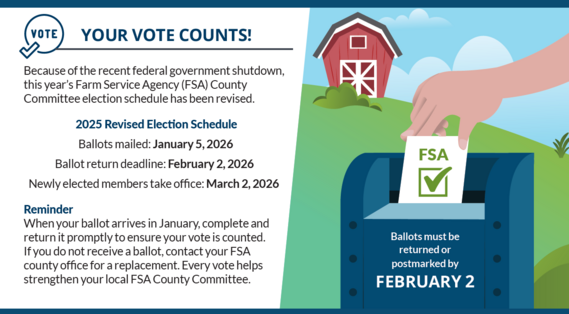 Voting is now open for the USDA’s Farm Service Agency’s (FSA) County Committee throughout Ohio.
It is important that every eligible producer participates in these elections because FSA county committees are a link between the agricultural community and the USDA.
County committee election ballots were mailed to eligible voters on Jan. 5, 2026. The last day to return completed ballots to FSA is Feb. 2, 2026. For more information on FSA county committee elections talk with your FSA office staff or visit fsa.usda.gov/elections.
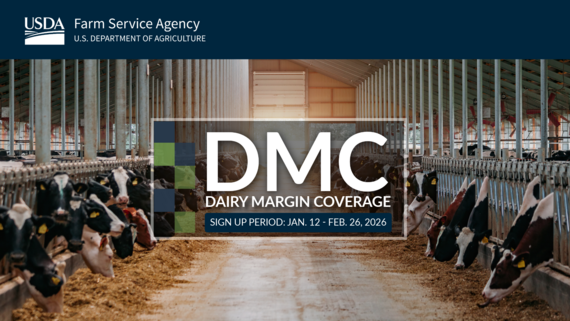 The U.S. Department of Agriculture (USDA) announced the enrollment period for the Dairy Margin Coverage (DMC) program for the 2026 coverage year, an important safety net program that provides producers with price support to help offset milk and feed price differences. Dairy producers can enroll in DMC from January 12, 2026, to February 26, 2026.
The One Big Beautiful Bill Act (OBBBA), signed by President Donald J. Trump on July 4, 2025, reauthorized DMC for calendar years 2026 through 2031 and provided substantial program improvements, including establishing new production history and increasing Tier 1 coverage.
The OBBBA increased DMC’s Tier 1 coverage level increased from five million pounds to six million pounds. All dairy operations that elect to enroll in DMC for 2026 will establish a new production history.
- Existing dairy operations that started marketing milk on or before January 1, 2023, will use the higher of milk marketings for the years of 2021, 2022, or 2023.
- New dairy operations starting after January 1, 2023, will use their first year of monthly milk marketings, even for a partial year.
- Milk marketing statements or production evidence are required to establish a production history.
Dairy operations also have the option to lock-in coverage levels for six years (2026-2031) with premium fees discounted by 25%.
DMC offers different levels of coverage, including an option that is free to producers, minus a $100 administrative fee. To determine the appropriate level of DMC coverage for a specific dairy operation, producers can use the online dairy decision tool.
For more information visit the DMC webpage or contact your local USDA Service Center.
The U.S. Department of Agriculture (USDA) Ohio Farm Service Agency reminds livestock producers who suffered grazing losses that occurred throughout 2025 due to the drought to report their losses timely and to enroll in the Livestock Forage Disaster Program (LFP) by March 1, 2026.
LFP provides compensation to eligible livestock producers who suffered grazing losses for covered livestock due to drought on privately-owned or cash-leased land. Producers in Allen, Auglaize, Belmont, Carroll, Columbiana, Defiance, Erie, Fulton, Hancock, Henry, Huron, Jefferson, Lucas, Mercer, Monroe, Ottawa, Paulding, Putnam, Sandusky, Seneca, Van Wert, Wood, and Wyandot Counties are eligible to apply for 2025 LFP benefits on small grain, native pasture, improved pasture, annual ryegrass or forage sorghum. Livestock producers are encouraged to contact their FSA County Office with any questions regarding specific forage crops that are eligible.
Livestock eligible for LFP include alpacas, beef cattle, bison, buffalo, beefalo, dairy cattle, deer, elk, emus, equine, goats, llamas, ostriches, reindeer, or sheep that have been or would have been grazing the eligible grazing land or pastureland. Recently, FSA updated LFP policy to expand program eligibility to include additional income producing grazing animals, like horses and ostrich, that contribute to the commercial viability of an agricultural operation. Livestock used for hunting and consumption by the owner and horses and other animals that are used or intended to be used for racing and wagering remain ineligible.
As a reminder, producers who want to participate in many USDA programs including disaster assistance programs like LFP, must file timely acreage reports by filling out the FSA-578 form to remain eligible for program benefits. Livestock producers interested in applying for LFP should contact their FSA County office with any questions about the eligibility of specific livestock and forage crops.
Contact your FSA County Office to schedule an appointment for LFP or to find a local FSA office, visit http://offices.usda.gov.
FSA is delivering more than $16 billion in total Congressionally approved disaster relief. FSA is now accepting applications for assistance through the second stage of the Supplemental Disaster Relief Program (SDRP) from agricultural producers who suffered eligible non-indemnified, uncovered or quality crop losses due to qualifying natural disasters in 2023 and 2024.
Stage Two covers eligible crop, tree, bush and vine losses that were not covered under Stage One program provisions, including non-indemnified (shallow loss), uncovered and quality losses. Although the majority of payments from the first stage are already in the hands of producers helping them prepare for and invest in the next crop year, Stage One assistance, announced in July, remains available to producers who received an indemnity under crop insurance or the Noninsured Crop Disaster Assistance Program (NAP) for eligible crop losses due to qualifying 2023 and 2024 natural disaster events.
The deadline to apply for both Stage One and Stage Two assistance is April 30, 2026.
Additionally, FSA is taking applications for assistance from producers who had to dump or remove milk from the commercial market and who incurred losses of eligible farm stored commodities due to qualifying disaster events in 2023 and 2024.
SDRP Stage Two Program Details
SDRP Stage Two provides assistance for eligible crop, tree, bush and vine losses not covered under Stage One, including:
-
Non-Indemnified Losses (Including Shallow Losses)
- Insured losses through federal crop insurance that did not trigger a crop insurance indemnity.
- Losses with NAP coverage that did not trigger a NAP payment.
-
Uncovered Losses (Uninsured Losses)
- Includes losses that were not insured through federal crop insurance or NAP.
-
Quality Losses
- Includes quality losses to commodities indicated by:
- A decrease in value based on discounts due to the physical condition of the crop supported by applicable grading factors
- A decline in the nutritional value of forage crops supported by documented forage tests.
- Producers will certify to an SDRP quality loss percentage.
For information on program eligibility and to download an application checklist, visit fsa.usda.gov/sdrp.
More information will be provided in early 2026 regarding a separate enrollment period for quality losses covered by SDRP Stage One as well as for insured producers in Puerto Rico who were not included in Stage One because data was not available when pre-filled applications were mailed.
Milk and On-Farm Stored Crop Loss Assistance
The Milk Loss Program provides up to $1.65 million in payments to eligible dairy operations for milk that was dumped or removed without compensation from the commercial milk market because of a qualifying natural disaster event in 2023 and/or 2024.
Producers who suffered losses of eligible harvested commodities while stored in on-farm structures in 2023 and/or 2024 due to a qualifying natural disaster event may be eligible for assistance through the On-Farm Stored Commodity Loss Program, which provides for up to $5 million to impacted producers.
The deadline to apply for milk and on-farm stored commodity losses is Jan. 23, 2026. Information and fact sheets for both programs are available online at fsa.usda.gov/mlp for milk loss and fsa.usda.gov/ofsclp for on-farm stored commodity losses.
Producers are encouraged to make an appointment to apply, by contacting their FSA County office.
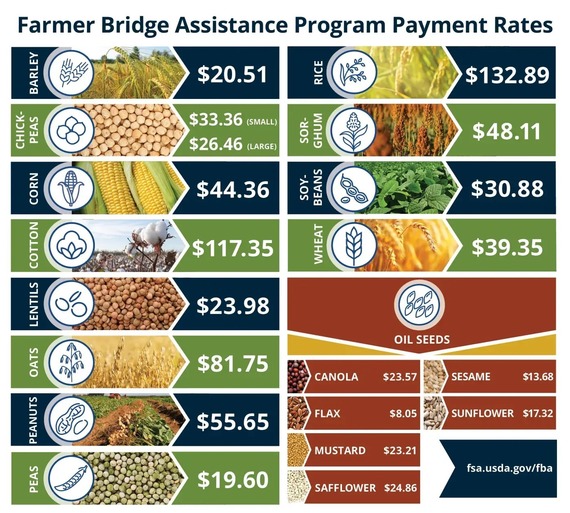
USDA announced the next phase in the Farmer Bridge Assistance Program (FBA), the eligible commodity per-acre payment rates. In 2026, $12 billion will be paid to American farmers. Of that amount, $11 billion consists of one-time FBA program payments.
Eligible Row Crop Commodities and Payment Rates:
Below are the payment rates for the FBA eligible commodities that triggered a payment.
 Eligibility, Program Applications, and Crop Insurance Linkage
FBA payments are based on 2025 planted acres, Economic Research Service cost of production, and the World Agriculture Supply and Demand Estimate Report. Double crop acres, including all initial and subsequently planted crops, are eligible. Prevent plant acres are not eligible.
All intended row crop uses are eligible for FBA except grazing, volunteer stands, experimental, green manure, crops left standing and abandoned or cover crops.
Crop insurance linkage is not required; however, USDA strongly urges producers to take advantage of the new risk management tools provided for in the One Big Beautiful Bill Act (OBBBA) to best protect against future price risk and volatility. The OBBBA federal crop insurance improvements include expanding benefits for beginning farmers and ranchers, increasing coverage options, and making crop insurance more affordable.
Specialty Crop Assistance
Of the $12 billion being provided by the Commodity Credit Corporation Charter Act, up to $11 billion is being directed to eligible row crop producers and the remaining $1 billion of the $12 billion in assistance is reserved for specialty crops and sugar. Timelines for payments to producers of these crops are still under development and require additional understanding of market impacts and economic needs.
Producers, including specialty crop producers and stakeholder groups, can submit questions to farmerbridge@usda.gov.
More information on FBA is available online at https://www.fsa.usda.gov/fba or you can contact your local USDA FSA county office.
Landowners and operators are reminded that in order to receive payments from USDA, compliance with Highly Erodible Land (HEL) and Wetland Conservation (WC) provisions are required. Farmers with HEL determined soils are reminded of tillage, crop residue, and rotation requirements as specified per their conservation plan. Producers are to notify the USDA Farm Service Agency prior to breaking sod, clearing land (tree removal), and of any drainage projects (tiling, ditching, etc.) to ensure compliance. Failure to update certification of compliance, with form AD-1026, triggering applicable HEL and/or wetland determinations, for any of these situations, can result in the loss of FSA farm program payments, FSA farm loans, NRCS program payments, and premium subsidy to Federal Crop Insurance administered by RMA.
USDA’s Farm Service Agency (FSA) reminds drought-impacted producers for calendar year 2025 in Ohio that they may be eligible for assistance through the Emergency Assistance for Livestock, Honey Bees, and Farm-Raised Fish Program (ELAP). Producers in Allen, Auglaize, Belmont, Carroll, Columbiana, Darke, Defiance, Erie, Fulton, Hancock, Henry, Huron, Jefferson, Lucas, Mercer, Monroe, Ottawa, Paulding, Putnam, Sandusky, Seneca, Van Wert, Williams, Wood, and Wyandot counties that assistance is available through the Emergency Assistance for Livestock, Honeybees and Farm-Raised Fish Program (ELAP) for costs incurred for transporting water to livestock due to drought.
For eligible livestock in qualifying counties, ELAP provides financial assistance for:
- the transportation of water to livestock;
- the above normal cost of mileage for transporting feed to livestock; and
- the above normal cost of transporting livestock to forage/grazing acres.* *Hauling livestock both ways starting in 2023, one haul per animal reimbursement and no payment for “empty miles.”
- Eligible honeybee producers must provide acceptable documentation, as determined by the COC, of purchased feed intended as feed for hon that was lost or additional feed purchased above normal quantities.
Eligible livestock include cattle, bison, goats and sheep, among others, that are maintained for commercial use and located in a county where qualifying drought conditions occur. A county must have had D2 severe drought intensity on the U.S. Drought Monitor for eight consecutive weeks during the normal grazing period, or D3 or D4 drought intensity at any time during the normal grazing period. Producers must have risk in both eligible livestock and eligible grazing land in an eligible county to qualify for ELAP assistance.
Transporting Water
Producers must be transporting water to eligible livestock on eligible grazing land where adequate livestock watering systems or facilities were in place before the drought occurred and where water transportation is not normally required. Cost of the water itself is not covered. ELAP covers $0.10 per gallon to transport water.
Transporting Feed
ELAP provides financial assistance to livestock producers who incur above normal expenses for transporting feed to livestock during drought. The payment formula excludes the first 25 miles and any mileage over 1,000 miles. The reimbursement rate is 60% of the cost above what would normally would have been incurred during the same time period in a normal (non-drought) year.
Livestock feed that is transported to livestock located on land enrolled in the Conservation Reserve Program (CRP) is eligible if the producer has an approved conservation plan with acceptable grazing practices developed in coordination with the Natural Resources Conservation Service
The payment rate to transport feed is $3.50/ loaded mile for expenses above what would have normally been incurred.
Transporting Livestock
ELAP provides financial assistance to livestock producers who are hauling livestock to a new location for feed resources due to insufficient feed or grazing in drought-impacted areas. As with transporting feed, the payment formula for transporting livestock excludes the first 25 miles and any mileage over 1,000 miles. The reimbursement rate is 60% of the costs above what would normally have been incurred during the same time period in a normal (non-drought) year.
The payment rate to transport livestock is $3.50/loaded mile for expenses above what would have normally been incurred and covers hauling livestock one-way, one haul per animal reimbursement and no payment for “empty miles.”
An online tool is now available to help ranchers document and estimate payments to cover feed and livestock transportation costs caused by drought.
Reporting Losses
Producers should contact FSA as soon as the loss of water or feed resources are known.
For ELAP eligibility, documentation of expenses is critical. Producers should maintain records and receipts associated with the costs of transporting water to eligible livestock, the costs of transporting feed to eligible livestock, the costs of additional feed purchases, and the costs of transporting eligible livestock to forage or other grazing acres.
Producers have until March 2, 2026, to file 2025 calendar year losses which is the deadline to file a notice of loss and application for payment for the Emergency Assistance for Livestock, Honeybees, and Farm-Raised Fish Program (ELAP) is 60 days after the calendar year in which the eligible loss condition occurred with their FSA County office.
More Information
Producers interested in ELAP assistance can contact their local USDA Service Center to learn more or to apply for programs.
The National Environmental Policy Act (NEPA) requires Federal agencies to consider all potential environmental impacts for federally funded projects before the project is approved.
For all Farm Service Agency (FSA) programs, an environmental review must be completed before actions are approved, such as site preparation or ground disturbance. These programs include, but are not limited to, the Emergency Conservation Program (ECP), Farm Storage Facility Loan (FSFL) program and farm loans. If project implementation begins before FSA has completed an environmental review, the request will be denied. Although there are exceptions regarding the Stafford Act and emergencies, it’s important to wait until you receive written approval of your project proposal before starting any actions.
Applications cannot be approved until FSA has copies of all permits and plans. Contact your local FSA office early in your planning process to determine what level of environmental review is required for your program application so that it can be completed timely.
The Farm Service Agency (FSA) offers two types of set-aside programs to assist FSA direct loan borrowers. The set-aside programs are intended to help distressed borrowers as well as borrowers impacted by natural disasters.
Disaster Set-Aside Program
The Disaster Set-Aside Program (DSA) assists existing FSA direct loan borrowers who have been impacted by natural disasters. The DSA program provides short-term financial relief by allowing eligible borrowers to delay FSA direct loan payments that are due this year or next year (but not both). You may delay up to one full annual payment per loan and the delayed payment will be moved to the end of the loan term. You will not be required to pay this set-aside installment until the loan’s final due date.
The principal portion of the amount set-aside will continue to accrue interest at your loan’s existing interest rate.
To be eligible, borrowers must have operated a farm in a county declared a disaster area or a contiguous county at the time of the disaster. In addition, the borrower’s inability to make their upcoming payment must be due to the disaster.
To apply for DSA, borrowers must provide their local USDA Service Center with a letter requesting DSA, which must be signed by all parties liable for the debt. The letter must be provided to your local Service Center within eight months of the disaster declaration date. The application process also includes providing your actual production, income, and expense records for the last three years. FSA may also request additional information as needed to make an eligibility decision.
Below is a list of the current disaster designations in your area and their respective application deadlines:
Below is a list of the current disaster designations in your area and their respective application deadlines:
Current Disaster Designation for Allen County
|
Date Declared
|
Ohio Notice
|
Disaster Description
|
Final Date to Apply for DSA
|
|
09/30/2026
|
FLP-286
|
Drought beginning Sept. 23, 2025
|
06/01/2026
|
Current Disaster Designation for Belmont County
|
Date Declared
|
Ohio Notice
|
Disaster Description
|
Final Date to Apply for DSA
|
|
09/22/2026
|
FLP-283
|
Drought beginning Sept. 16, 2025
|
05/22/2026
|
|
09/30/2025
|
FLP-286
|
Drought beginning Sept. 23, 2025
|
06/01/2026
|
|
09/30/2025
|
FLP-287
|
Drought beginning Sept. 23, 2025
|
06/01/2026
|
Current Disaster Designation for Brown County
|
Date Declared
|
Ohio Notice
|
Disaster Description
|
Final Date to Apply for DSA
|
|
07/23/2025
|
FLP-282
|
Severe storms, straight-line winds, tornadoes, and flooding that occurred March 30 through April 9, 2025
|
03/23/2026
|
Current Disaster Designation for Butler County
|
Date Declared
|
Ohio Notice
|
Disaster Description
|
Final Date to Apply for DSA
|
|
07/22/2025
|
FLP-279
|
Severe storms, straight-line winds, tornadoes, and flooding that occurred March 30 through April 9, 2025
|
03/23/2026
|
Current Disaster Designation for Carroll County
|
Date Declared
|
Ohio Notice
|
Disaster Description
|
Final Date to Apply for DSA
|
|
09/22/2025
|
FLP-283
|
Drought beginning Sept. 16, 2025
|
05/22/2026
|
Current Disaster Designations for Clermont County
|
Date Declared
|
Ohio Notice
|
Disaster Description
|
Final Date to Apply for DSA
|
|
06/20/2025
|
FLP-275
|
Severe storms, straight-line winds, tornadoes, flooding, landslides, and mudslides that occurred between April 2, 2025 and May 16, 2025
|
02/20/2026
|
|
09/16/2025
|
FLP-276
|
Flooding, excessive rain, and flash flooding that occurred April 2nd through April 15, 2025
|
05/16/2026
|
|
09/16/2025
|
FLP-277
|
Flooding, excessive rain, a tornado, and high winds that occurred April 2 through April 6, 2025
|
05/16/2026
|
|
12/22/2025
|
FLP-278
|
Flooding, flash flooding, and excessive rain beginning April 2 through April 15, 2025
|
08/24/2026
|
|
07/22/2025
|
FLP-181
|
Severe Storms, Straight-line Winds, Tornadoes, Flooding, Landslides, and Mudslides April 2 through May 16, 2025
|
03/23/2026
|
|
07/23/2025
|
FLP-282
|
Severe Storms, Straight-line Winds, Tornadoes, Flooding, Landslides, and Mudslides April 2 through May 16, 2025
|
03/23/2026
|
Current Disaster Designation for Columbiana County
|
Date Declared
|
Ohio Notice
|
Disaster Description
|
Final Date to Apply for DSA
|
|
09/22/2025
|
FLP-283
|
Drought beginning Sept. 16, 2025
|
05/22/2026
|
|
09/23/2025
|
FLP-284
|
Drought beginning Sept. 16, 2025
|
05/26/2026
|
|
09/23/2025
|
FLP-285
|
Drought beginning Sept. 16, 2025
|
05/26/2026
|
Current Disaster Designation for Defiance County
|
Date Declared
|
Ohio Notice
|
Disaster Description
|
Final Date to Apply for DSA
|
|
09/30/2025
|
FLP-286
|
Drought beginning Sept. 23, 2025
|
06/01/2026
|
Current Disaster Designation for Fulton County
|
Date Declared
|
Ohio Notice
|
Disaster Description
|
Final Date to Apply for DSA
|
|
09/30/2025
|
FLP-286
|
Drought beginning Sept. 23, 2025
|
06/01/2026
|
Current Disaster Designation for Guernsey County
|
Date Declared
|
Ohio Notice
|
Disaster Description
|
Final Date to Apply for DSA
|
|
09/30/2025
|
FLP-286
|
Drought beginning Sept. 23, 2025
|
06/01/2026
|
Current Disaster Designations for Hamilton County
|
Date Declared
|
Ohio Notice
|
Disaster Description
|
Final Date to Apply for DSA
|
|
09/16/2025
|
FLP-276
|
Flooding, excessive rain, and flash flooding that occurred April 2nd through April 15, 2025
|
05/16/2026
|
|
12/22/2025
|
FLP-278
|
Flooding, flash flooding, and excessive rain beginning April 2 through April 15, 2025
|
08/24/2026
|
|
07/22/2025
|
FLP-279
|
Severe storms, straight-line winds, tornadoes, and flooding that occurred March 30 through April 9, 2025
|
03/23/2026
|
Current Disaster Designation for Hancock County
|
Date Declared
|
Ohio Notice
|
Disaster Description
|
Final Date to Apply for DSA
|
|
09/30/2025
|
FLP-286
|
Drought beginning Sept. 23, 2025
|
06/01/2026
|
Current Disaster Designation for Hardin County
|
Date Declared
|
Ohio Notice
|
Disaster Description
|
Final Date to Apply for DSA
|
|
09/30/2025
|
FLP-286
|
Drought beginning Sept. 23, 2025
|
06/01/2026
|
Current Disaster Designation for Harrison County
|
Date Declared
|
Ohio Notice
|
Disaster Description
|
Final Date to Apply for DSA
|
|
09/30/2025
|
FLP-286
|
Drought beginning Sept. 23, 2025
|
06/01/2026
|
Current Disaster Designation for Henry County
|
Date Declared
|
Ohio Notice
|
Disaster Description
|
Final Date to Apply for DSA
|
|
09/30/2025
|
FLP-286
|
Drought beginning Sept. 23, 2025
|
06/01/2026
|
Current Disaster Designation for Jefferson County
|
Date Declared
|
Ohio Notice
|
Disaster Description
|
Final Date to Apply for DSA
|
|
09/22/2025
|
FLP-283
|
Drought beginning Sept. 16, 2025
|
05/22/2026
|
|
09/30/2025
|
FLP-286
|
Drought beginning Sept. 23, 2025
|
06/01/2026
|
|
09/30/2025
|
FLP-287
|
Drought beginning Sept. 23, 2025
|
06/01/2026
|
Current Disaster Designation for Lawrence County
|
Date Declared
|
Ohio Notice
|
Disaster Description
|
Final Date to Apply for DSA
|
|
07/22/2025
|
FLP-281
|
Severe Storms, Straight-line Winds, Tornadoes, Flooding, Landslides, and Mudslides April 2 through May 16, 2025
|
03/23/2026
|
Current Disaster Designation for Lucas County
|
Date Declared
|
Ohio Notice
|
Disaster Description
|
Final Date to Apply for DSA
|
|
09/30/2025
|
FLP-286
|
Drought beginning Sept. 23, 2025
|
06/01/2026
|
Current Disaster Designation for Monroe County
|
Date Declared
|
Ohio Notice
|
Disaster Description
|
Final Date to Apply for DSA
|
|
09/30/2025
|
FLP-286
|
Drought beginning Sept. 23, 2025
|
06/01/2026
|
|
09/30/2025
|
FLP-287
|
Drought beginning Sept. 23, 2025
|
06/01/2026
|
Current Disaster Designation for Noble County
|
Date Declared
|
Ohio Notice
|
Disaster Description
|
Final Date to Apply for DSA
|
|
09/30/2025
|
FLP-286
|
Drought beginning Sept. 23, 2025
|
06/01/2026
|
Current Disaster Designation for Ottawa County
|
Date Declared
|
Ohio Notice
|
Disaster Description
|
Final Date to Apply for DSA
|
|
09/30/2025
|
FLP-286
|
Drought beginning Sept. 23, 2025
|
06/01/2026
|
Current Disaster Designation for Putnam County
|
Date Declared
|
Ohio Notice
|
Disaster Description
|
Final Date to Apply for DSA
|
|
09/30/2025
|
FLP-286
|
Drought beginning Sept. 23, 2025
|
06/01/2026
|
Current Disaster Designation for Sandusky County
|
Date Declared
|
Ohio Notice
|
Disaster Description
|
Final Date to Apply for DSA
|
|
09/30/2025
|
FLP-286
|
Drought beginning Sept. 23, 2025
|
06/01/2026
|
Current Disaster Designation for Scioto County
|
Date Declared
|
Ohio Notice
|
Disaster Description
|
Final Date to Apply for DSA
|
|
07/22/2025
|
FLP-281
|
Severe Storms, Straight-line Winds, Tornadoes, Flooding, Landslides, and Mudslides April 2 through May 16, 2025
|
03/23/2026
|
Current Disaster Designation for Seneca County
|
Date Declared
|
Ohio Notice
|
Disaster Description
|
Final Date to Apply for DSA
|
|
09/30/2025
|
FLP-286
|
Drought beginning Sept. 23, 2025
|
06/01/2026
|
Current Disaster Designation for Van Wert County
|
Date Declared
|
Ohio Notice
|
Disaster Description
|
Final Date to Apply for DSA
|
|
09/30/2025
|
FLP-286
|
Drought beginning Sept. 23, 2025
|
06/01/2026
|
Current Disaster Designation for Washington County
|
Date Declared
|
Ohio Notice
|
Disaster Description
|
Final Date to Apply for DSA
|
|
09/30/2025
|
FLP-286
|
Drought beginning Sept. 23, 2025
|
06/01/2026
|
|
09/30/2025
|
FLP-287
|
Drought beginning Sept. 23, 2025
|
06/01/2026
|
Current Disaster Designation for Williams County
|
Date Declared
|
Ohio Notice
|
Disaster Description
|
Final Date to Apply for DSA
|
|
09/30/2025
|
FLP-286
|
Drought beginning Sept. 23, 2025
|
06/01/2026
|
Current Disaster Designation for Wood County
|
Date Declared
|
Ohio Notice
|
Disaster Description
|
Final Date to Apply for DSA
|
|
09/30/2025
|
FLP-286
|
Drought beginning Sept. 23, 2025
|
06/01/2026
|
Current Disaster Designation for Wyandot County
|
Date Declared
|
Ohio Notice
|
Disaster Description
|
Final Date to Apply for DSA
|
|
09/30/2025
|
FLP-286
|
Drought beginning Sept. 23, 2025
|
06/01/2026
|
Distressed Borrower Set-Aside Program
FSA Direct Farm Loan Program borrowers whose loans were closed before Sept. 25, 2024, may be eligible for assistance under the Distressed Borrower Set-Aside Program (DBSA). Similar to DSA, DBSA also provides short-term financial relief by allowing eligible borrowers to delay FSA direct loan payments that are due this year or next year (but not both). You may delay up to one full annual payment per loan and the delayed payment will be moved to the end of the loan term. You will not be required to pay this set-aside installment until the loan’s final due date.
An increased benefit with DBSA is that the principal portion of the set-aside will accrue interest at a reduced rate of 0.125% rather than your loan’s existing interest rate.
To be eligible for DBSA, the borrower must demonstrate financial distress, but their inability to make the upcoming payment does not need to be due to a disaster.
The DBSA application process is similar to DSA as borrowers must provide their local USDA Service Center with a letter requesting DBSA, which must be signed by all parties liable for the debt. The application process also includes providing your actual production, income, and expense records for the last three years. FSA may also request additional information as needed to make an eligibility decision.
Important Factors for Both DSA and DBSA:
FSA direct loan borrowers are not able to obtain more than one set-aside per loan. Borrowers also cannot obtain both a DSA and DBSA simultaneously on the same loan. In addition, FSA direct loans with less than two years remaining are not eligible for a DSA or DBSA. Other eligibility requirements apply; we encourage you to contact your local Service Center for more information.
Both DSA and DBSA are intended to provide short-term relief for situations where borrowers anticipate the ability to resume paying their full annual installment(s) in the following year. If you require a more long-term form of financial relief, FSA has other potential options available through primary loan servicing (PLS).
For more information on DSA, DBSA, or PLS, please contact your FSA County office.
Additional information, eligibility criteria and program limitations may be found within the Disaster Set-Aside and Distressed Borrower Set-Aside Program fact sheets.
 Technical and Financial Assistance is Available
Winter storms create significant challenges and can result in catastrophic loss for agricultural producers, especially for those raising livestock, row crops and vulnerable crops like citrus. Despite attempts to mitigate risk, your operation may suffer losses. As you prepare for the potential impacts of upcoming winter weather, know that USDA offers several programs to help with recovery.
Risk Management
Producers with NAP coverage should report crop damage to their local FSA office and must file a Notice of Loss (CCC-576) within 15 days of the loss becoming apparent, except for hand-harvested crops, which should be reported within 72 hours.
Producers with risk protection through Federal Crop Insurance should report crop damage to their crop insurance agent within 72 hours of discovering damage and be sure to follow up in writing within 15 days.
Disaster Assistance
USDA also offers disaster assistance programs, which are especially important to livestock, fruit and vegetable, specialty and perennial crop producers.
Producers who experience livestock deaths in excess of normal mortality or sell injured livestock at a reduced price may be eligible for the Livestock Indemnity Program (LIP). To participate in LIP, producers will have to provide acceptable documentation of death losses or evidence of reduced sales due to injuries resulting from an eligible adverse weather event and must submit a notice of loss to the USDA Farm Service Agency (FSA) no later than March 1, 2027, for 2026 calendar year losses.
Meanwhile, the Emergency Assistance for Livestock, Honeybees, and Farm-Raised Fish Program (ELAP) provides eligible producers with compensation for feed and grazing losses. ELAP also includes costs associated with equipment rental fees for hay lifts and snow removal. For ELAP, producers are required to complete a notice of loss and application for payment to their local FSA office no later than March 1, 2027, for 2026 calendar year losses.
Additionally, eligible orchardists and nursery tree growers may be eligible for cost-share assistance through the Tree Assistance Program (TAP) to replant or rehabilitate eligible trees, bushes or vines. TAP complements the Noninsured Crop Disaster Assistance Program (NAP) or crop insurance coverage, which covers the crop but not the plants or trees in all cases. For TAP, a program application must be filed within 90 days of the disaster event or the date when the loss of the trees, bushes or vines is apparent.
Other Programs
FSA’s Emergency Conservation Program (ECP) and Emergency Forest Restoration Program (EFRP) can assist landowners and forest stewards with financial and technical assistance to restore fencing, damaged farmland or forests.
FSA also offers a variety of direct and guaranteed farm loans, including operating and emergency farm loans, to producers unable to secure commercial financing. Producers in counties with a primary or contiguous disaster designation may be eligible for low interest emergency loans to help them recover from production and physical losses. Loans can help producers replace essential property, purchase inputs like livestock, equipment, feed and seed, cover family living expenses or refinance farm-related debts and other needs. Additionally, FSA offers several loan servicing options available for borrowers who are unable to make scheduled payments on their farm loan programs debt to the agency because of reasons beyond their control.
Meanwhile, USDA’s Natural Resources Conservation Service (NRCS) is always available to provide technical assistance during the recovery process by assisting producers to plan and implement conservation practices on farms, rangelands, and working forests impacted by natural disasters. The Environmental Quality Incentives Program (EQIP) can help producers plan and implement conservation practices on land impacted by natural disasters.
Additional Resources
Additional USDA disaster assistance information can be found on farmers.gov, including USDA resources specifically for producers impacted by winter weather. Those resources include the Disaster Assistance Discovery Tool, Disaster-at-a-Glance fact sheet, Loan Assistance Tool, and Natural Disasters and Crop Insurance fact sheet. Additionally, FarmRaise offers an FSA educational hub with LIP and ELAP decision tools as well as farm loan resource videos.
To inquire about available programs, contact your local USDA Service Center.
The U.S. Department of Agriculture (USDA) is now accepting applications for the USDA 1890 National Scholars Program, which aims to encourage students at the Congressionally created 1890 land-grant universities to pursue careers in food, agriculture, and natural resource sciences. The application deadline is March 8, 2026.
Students around the country are invited to complete and submit their applications online through an application portal. The USDA 1890 National Scholars Program is available to eligible high school seniors entering their freshman year of college that will attend one of the 1890 land-grant universities and pursue degrees in agriculture, food, natural resource sciences, or related academic disciplines. The program is also open to rising college sophomores and juniors that meet the same criteria.
The Conservation Reserve Program (CRP) is a program administered by the Farm Service Agency (FSA) to conserve farmland for future generations while providing habitat for wildlife, reducing soil erosion, and improving water quality. Regular maintenance on CRP acres is needed to ensure the acreage continues to provide conservation benefits and remains in compliance with the CRP contract.
Regular Maintenance
Producers with CRP contracts are required to control all weeds, insects, pests, and other undesirable species to the extent necessary to ensure that the approved conservation cover is adequately protected and to ensure there is no adverse impact on surrounding land. Mowing is one of the allowable practices for weed control, but mowing for aesthetic purposes is never permitted. The Conservation Plan states the required weed control methods for each site.
Once a stand has been certified as fully established, participants are required to maintain plant diversity and stand density according to the Conservation Plan and offer (CRP-2) for the life of the contract. Stands that do not meet practice specific plant diversity or density requirements may be considered non-compliant. Refer to your conservation plan or contact FSA if you have any questions or concerns about the vegetative cover requirements.
Maintenance activities cannot occur during the primary nesting season for birds without written prior approval from the local county office. The primary nesting season in Ohio is March 1 through July 15, 2026.
Mid-Contract Management
Regular maintenance for weed and pest control is separate from the Mid-Contract Management (MCM) requirement. MCM ensures plant diversity and wildlife benefits while ensuring protection of the soil and water resources. Such activities are site-specific and are for the purpose of enhancing the approved cover.
MCM must be completed between years four and six of a 10-year contract and between years seven and nine of a 15-year contract. The Conservation Plan will state what year MCM must take place.
Noncompliance with Maintenance Requirements
Failure to adequately maintain the stand may result in noncompliance with the terms and conditions of the CRP contract. Noncompliance can result in adverse actions up to and including termination of the CRP contract. Contracts that are out of compliance are ineligible to re-enroll, unless the stand is brought back into compliance prior to the enrollment deadline.
For general information about CRP, visit the Conservation Reserve Program webpage. For information about specific contracts, reach out to the local FSA office.
Farm Operating Loans, Direct -- 4.625%
Farm Ownership Loans, Direct -- 5.625%
Limited Resource Loans -- 5.000%
Farm Ownership Loans, Down Payment -- 1.625%
Farm Ownership – Joint Financing -- 3.625%
Emergency Loans -- 3.750%
Farm Storage Facility Loan, 3 year -- 3.500%
Farm Storage Facility Loan, 5 year -- 3.625%
Farm Storage Facility Loan, 7 year -- 3.875%
Farm Storage Facility Loan, 10 year -- 4.125%
Farm Storage Facility Loan, 12 year -- 4.250%
Sugar Storage Facility Loans, 15 year -- 4.500%
Commodity Loans -- 4.625%
|
January 31
|
The final availability date to claim benefits for 2025 LDP for wool, mohair and unshorn lamb pelts.
|
|
January 31
|
The Food Safety Certification for Specialty Crops (FSCSC) application deadline for 2025.
|
|
February 2
|
Producers and landowners must return ballots to their local FSA county office or have their ballots postmarked by Feb. 2, 2026, for those ballots to be counted.
|
|
February 16
|
George Washington’s Birthday. USDA Service Center is Closed.
|
|
March 1
|
Primary Nesting Season begins.
|
|
March 2
|
The deadline to file a notice of loss and application for payment for the Livestock Indemnity Program (LIP) which is 60 calendar days after the calendar year in which the eligible loss condition occurred.
|
|
March 2
|
The deadline to file a notice of loss and application for payment for the Emergency Assistance for Livestock, Honeybees, and Farm-Raised Fish Program (ELAP) which is 60 calendar days after the calendar year in which the eligible loss condition occurred. Producers in Allen, Auglaize, Belmont, Carroll, Columbiana, Darke, Defiance, Erie, Fulton, Hancock, Henry, Huron, Jefferson, Lucas, Mercer, Monroe, Ottawa, Paulding, Putnam, Sandusky, Seneca, Van Wert, Williams, Wood, and Wyandot counties that assistance is available through the Emergency Assistance for Livestock, Honeybees and Farm-Raised Fish Program (ELAP) for costs incurred for transporting water to livestock due to drought.
|
|
April 30
|
Supplemental Disaster Relief Program Stage 1 and Stage 2 Deadline.
|
|
Ongoing
|
Contact your FSA County office right away for notice of loss deadlines and disaster program requirements.
|
|
Continuous
|
New applications for Farm Service Agency Loan Programs.
|
|
Continuous
|
Submit an Application for a Farm Storage Facility Loan.
|
|
Continuous
|
Sign up for GovDelivery Newsletters, Bulletins and Ohio Press Releases (Subscribe to USDA Emails for Farmers | Farmers.gov)
|
Top of page
Ohio FSA State Office
200 North High Street, Room 540
Columbus, Ohio 43215
Phone: 614-255-2441
|
|
Visit the Ohio FSA website at: www.fsa.usda.gov/oh
|
State Executive Director:
Don Jones
|
Deputy State Executive Director:
Traci Garza
|
|
Administrative Officer:
Stephanie Moran
|
Conservation Chief:
Brandi Koehler
|
|
Farm Loan Chief:
Andrew Huey
|
Price Support Chief:
Trevor Kerr
|
|
Production Adjustment / Compliance and Risk Management Chief:
Matt Kleski
|
|
|
| |
| |
|








