
USDA - Missouri State Office Newsletter - February 17, 2026
In This Issue:
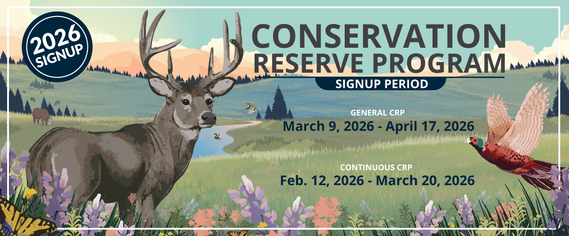 The U.S. Department of Agriculture (USDA) announced the enrollment periods for agricultural producers and landowners to submit offers for the Continuous and General Conservation Reserve Program (CRP). USDA’s Farm Service Agency (FSA) is accepting offers for Continuous CRP starting Feb. 12, 2026, through March 20, 2026. Enrollment for General CRP will run from March 9, 2026, through April 17, 2026. FSA will announce dates for Grassland CRP signup in the near future.
CRP is USDA’s flagship conservation program, providing financial and technical support to agricultural producers and landowners who place unproductive or marginal cropland under contract for 10-15 years and who agree to voluntarily convert the land to beneficial vegetative cover to improve water quality, prevent soil erosion and support wildlife habitat. The Continuing Appropriations, Agriculture, Legislative Branch, Military Construction and Veterans Affairs, and Extensions Act, 2026, extends FSA’s authority to administer CRP through Sept. 30, 2026.
Continuous CRP (Signup 65)
FSA will batch Continuous CRP offers submitted by interested agricultural producers and landowners. Offers to re-enroll expiring CRP continuous acreage will be accepted on a first-come, first-serve basis. New acreage offered in continuous CRP practices will be considered for acceptance on a first-come, first-serve basis if they support USDA conservation priorities including but not limited to practices that address water quality, such as filter strips and grass waterways, and practices that restore native ecosystems or target specific resource concerns.
The first Continuous CRP batching period ends on March 20, 2026. Offers submitted after this date will be considered for acceptance in subsequent batching periods if acreage remains available.
Continuous CRP participants voluntarily offer environmentally sensitive lands, typically smaller parcels than offered through General CRP including wetlands, riparian buffers, and varying wildlife habitats. In return, they receive annual rental payments and cost-share assistance to establish long-term, resource-conserving vegetative cover.
Continuous CRP enrollment options include:
-
Clean Lakes, Estuaries and Rivers (CLEAR) Initiative: Prioritizes water quality practices on the land that, if enrolled, will help reduce sediment loadings, nutrient loadings, and harmful algal blooms. The vegetative covers also contribute to increased wildlife populations.
-
CLEAR30 (a component of the CLEAR Initiative): Offers additional incentives for water quality practice adoption and can be accessed in 30-year contracts.
-
Highly Erodible Land Initiative (HELI): Producers and landowners can enroll in CRP to establish long-term cover on highly erodible cropland that has a weighted erodibility index greater than or equal to 20.
-
Conservation Reserve Enhancement Program (CREP): Addresses high priority conservation objectives of states and Tribal governments on agricultural lands in specific geographic areas.
-
State Acres for Wildlife Enhancement Initiative (SAFE): Restores vital habitat in order to meet high-priority state wildlife conservation goals.
General CRP (Signup 66)
General CRP offers are submitted through a competitive bid process. After the enrollment period closes, General CRP offers are ranked and scored by FSA, using nationally established environmental benefits criteria. USDA will announce accepted offers once ranking and scoring for all offers is completed. In addition to annual rental payments, approved General CRP participants may also be eligible for cost-share assistance to establish long-term, resource-conserving vegetative cover.
Producers and landowners interested in participating in CRP should contact their local FSA county office.
The Custom Rates for Farm Services in Missouri Survey is now seeking responses to update the rates published. The survey is conducted once every three years, so your knowledge of custom rates is especially valuable during this collection period. The survey covers 175 common farm activities across all areas of midwestern agriculture, from row crop operations to livestock facility rental and even commercial horticulture services. Taking the survey is easier this year than ever. Download a physical copy or view the online survey at muext.us/customrates. The MU Extension office in your county or a neighboring county also has paper copies available for walk-in responses. Survey collection runs until March 1st, and 2026 Custom Rates data will be published in early April.
The Value-Added Producer Grant (VAPG) program helps U.S. agricultural producers enter into value-added activities that:
- Generate new products from raw agricultural commodities
- Create and expand marketing opportunities
- Increase producer income through enhanced product value and market reach
These grants support either:
- Planning activities (e.g., feasibility studies, business and marketing plans)
- Working capital needs (e.g., processing, packaging, advertising, inventory, and salaries)
Eligible applicants include:
- Agricultural producers (including harvesters and steering committees)
- Agricultural producer groups
- Farmer- or rancher-cooperatives
- Majority-controlled producer-based business ventures
Applicants must demonstrate that they:
- Own and produce more than 50% of the raw commodity
- Will retain greater revenue from the value-added product than from the raw commodity alone
How to Apply
Visit the official for detailed instructions, eligibility requirements, and access to the Grant Application Portal. A is available to help applicants determine eligibility before starting an application.
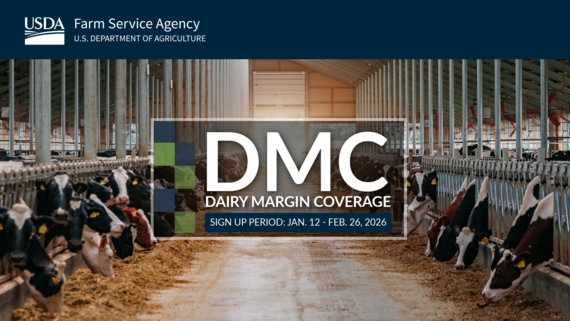
The U.S. Department of Agriculture (USDA) announced the enrollment period for the Dairy Margin Coverage (DMC) program for the 2026 coverage year, an important safety net program that provides producers with price support to help offset milk and feed price differences. Dairy producers can enroll in DMC from January 12, 2026, to February 26, 2026.
The One Big Beautiful Bill Act (OBBBA), signed by President Donald J. Trump on July 4, 2025, reauthorized DMC for calendar years 2026 through 2031 and provided substantial program improvements, including establishing new production history and increasing Tier 1 coverage.
The OBBBA increased DMC’s Tier 1 coverage level increased from five million pounds to six million pounds. All dairy operations that elect to enroll in DMC for 2026 will establish a new production history.
-
Existing dairy operations that started marketing milk on or before January 1, 2023, will use the higher of milk marketings for the years of 2021, 2022, or 2023.
-
New dairy operations starting after January 1, 2023, will use their first year of monthly milk marketings, even for a partial year.
-
Milk marketing statements or production evidence are required to establish a production history.
Dairy operations also have the option to lock-in coverage levels for six years (2026-2031) with premium fees discounted by 25%.
DMC offers different levels of coverage, including an option that is free to producers, minus a $100 administrative fee. To determine the appropriate level of DMC coverage for a specific dairy operation, producers can use the online dairy decision tool.
The Conservation Stewardship Program (CSP) is sometimes misunderstood. It is perceived by some as complicated or not for small operations, and neither of those perceptions is true. CSP is designed to help you take your existing conservation efforts on your operation to the next higher level while maintaining your current ones. It’s supposed to help you add to what you’re already doing, either by enhancing your current practices or adding new ones.
The Natural Resources Conservation Service (NRCS) works one-on-one with you to develop a conservation plan under CSP to implement these additions or enhancements and help strengthen your operation.
Under CSP, you receive annual payments to help you maintain your existing conservation efforts and enhance them using new conservation practices or activities. CSP contracts last five years, with the opportunity to compete for a contract renewal if you successfully fulfill the initial contract and agree to achieve additional conservation objectives.
CSP is often misunderstood, so here are a few “myths” about the program that we want to dispel.
Myth #1: The deadline to apply for CSP in my state has already passed, so I don’t need to think about applying until next year.
Don’t wait to apply! We accept applications year-round, but funding decisions are made locally at specific times and that “ranking date” may be coming up soon in your area. If we already have your application, it will be considered at the next ranking date. Plus, if you start planning now, you will be ready for application ranking dates as they approach. See program application ranking dates for all states at https://www.nrcs.usda.gov/ranking-dates.
Myth #2: Enrolling land in CSP is complicated and time-consuming.
If you have a farm and tract number (available from USDA’s Farm Service Agency) and have kept good farm records, you’re already well on your way. You just need to complete a three-page NRCS-CPA-1200 form, see Applications and Forms. You can even complete this form online if you create a farmers.gov account at https://www.farmers.gov/account.
Read more myths.
The Livestock Indemnity Program (LIP) provides assistance for livestock deaths in excess of normal mortality caused by eligible adverse weather, disease and attacks by animals reintroduced into the wild by the federal government or protected by federal law. FSA has determined that Theileria Orientalis is an eligible disease for LIP as it is a disease transmitted by vectors, specifically Asian longhorned ticks.
For 2025 livestock losses, you must file a notice of loss, provide the following supporting documentation, and file an application for payment to your local FSA office by March 2, 2026.
- Proof of eligible loss documentation
- Proof of death documentation
- Copy of contract grower’s agreement, as applicable
- Proof of livestock death loss due to normal mortality documentation, as applicable
- Livestock beginning inventory documentation
For eligible disease losses, FSA county committees can accept veterinarian certifications that livestock deaths were directly related to Theileria Orientalis and unpreventable through good animal husbandry and management.
USDA has established normal mortality rates for each type and weight range of eligible livestock, i.e. Adult Beef Cow = 1.5% and Non-Adult Beef Cattle = 5%. These established percentages reflect losses that are considered expected or typical under “normal” conditions.
For more information, contact your local USDA Service Center or visit fsa.usda.gov.
USDA recently announced a $700 million Regenerative Pilot Program to help American farmers adopt practices that improve soil health, enhance water quality, and boost long-term productivity, all while strengthening America’s food and fiber supply.
Administered by the USDA Natural Resources Conservation Service (NRCS), this new Regenerative Pilot Program delivers a streamlined, outcome-based conservation model—empowering producers to plan and implement whole-farm regenerative practices through a single application.
In FY2026, the Regenerative Pilot Program will focus on whole-farm planning that addresses every major resource concern—soil, water, and natural vitality—under a single conservation framework. USDA is dedicating $400 million through the Environmental Quality Incentives Program (EQIP) and $300 million through the Conservation Stewardship Program (CSP) to fund this first year of regenerative agriculture projects.
Learn more about the Regenerative Pilot Program.
Top of page
Farm Loan teams in Missouri are already working on operating loans for spring 2026 and ask potential borrowers to submit their requests early so they can be timely processed. FSA farm loan teams across the state can help determine which loan programs are best for applicants.
FSA offers a wide range of low-interest loans that can meet the financial needs of any farm operation for just about any purpose. The traditional farm operating and farm ownership loans can help large and small farm operations take advantage of early purchasing discounts for spring inputs as well expenses throughout the year.
Microloans are a simplified loan program that will provide up to $50,000 for both Farm Ownership and Operating Microloans to eligible applicants. These loans, targeted for smaller and non-traditional operations, can be used for operating expenses, starting a new operation, purchasing equipment, and other needs associated with a farming operation. Loans to beginning farmers and members of underserved groups are a priority.
Other types of loans available include:
Marketing Assistance Loans allow producers to use eligible commodities as loan collateral and obtain a 9-month loan while the crop is in storage. These loans provide cash flow to the producer and allow them to market the crop when prices may be more advantageous.
Farm Storage Facility Loans can be used to build permanent structures used to store eligible commodities, for storage and handling trucks, or portable or permanent handling equipment. A variety of structures are eligible under this loan, including bunker silos, grain bins, hay storage structures, and refrigerated structures for vegetables and fruit. A producer may borrow up to $500,000 per loan.
The U.S. Department of Agriculture’s Risk Management Agency (RMA) made significant enhancements to federal crop insurance programs by expanding benefits for beginning farmers and ranchers, increasing coverage options, and making crop insurance more affordable and accessible across multiple insurance programs.
Putting American Farmers First with Enhanced Support for Beginning Farmers and Ranchers
Beginning farmers and ranchers will receive substantially increased premium support during their first decade of farming operations, making crop insurance more affordable for the next generation of American agricultural producers. The enhanced benefits mean beginning farmers and ranchers will now receive:
- 15 percentage points additional subsidy for the first two crop years
- 13 percentage points for the third crop year
- 11 percentage points for the fourth crop year
- 10 percentage points for years five through ten
These benefits build upon existing support that waives administrative fees and provides base premium subsidies. A beginning farmer or rancher is now defined as an individual who has not actively operated and managed a farm or ranch for more than 10 crop years.
Making Crop Insurance More Accessible with Expanded Coverage Options
Improvements to area-based crop insurance programs include:
- Whole Farm Revenue Protection (WFRP) maximum coverage level increase from 85% to 90%, providing producers with enhanced protection for diversified operations.
- Supplemental Coverage Option (SCO) premium support increase from 65% to 80%, making this valuable gap coverage more affordable. Additionally, producers can now purchase SCO regardless of their Area Risk Coverage (ARC) elections with the Farm Service Agency, dramatically increasing accessibility.
- Enhanced Coverage Option (ECO) and similar programs including Margin Coverage Option (MCO), Hurricane Insurance Protection Wind Index (HIP-WI), and Fire Insurance Protection Smoke Index (FIP-SI) will also receive the increased 80% in premium support, making comprehensive coverage more affordable than ever.
- SCO coverage will also expand to a coverage level of 90% (from 86%). Producers will have access to this option in 2026 via the ECO product, which has identical coverage at the same cost and premium support levels. USDA will then change the SCO policy for the 2027 crop year.
These changes will be effective for all crops with sales closing dates on or after July 1, 2025.
RMA will provide additional guidance on other provisions within the One Big Beautiful Bill Act as implementation details are finalized. Producers should contact their local crop insurance agent or visit the RMA website for more information about how these changes may affect their coverage options.
USDA announced the next phase in the Farmer Bridge Assistance Program (FBA), the eligible commodity per-acre payment rates. In 2026, $12 billion will be paid to American farmers. Of that amount, $11 billion consists of one-time FBA program payments.
Eligible Row Crop Commodities and Payment Rates:
Below are the payment rates for the FBA eligible commodities that triggered a payment.
Commodity, Per Acre Payment Rates
- Barley: $20.51 • Canola: $23.57 • Chickpeas (Large): $26.46 • Chickpeas (Small): $33.36 • Corn: $44.36 • Cotton: $117.35 • Flax: $8.05 • Lentils: $23.98 • Mustard: $23.21 • Oats: $81.75 • Peanuts: $55.65 • Peas: $19.60 • Rice: $132.89 • Safflower: $24.86 • Sesame: $13.68 • Sorghum: $48.11 • Soybeans: $30.88 • Sunflower: $17.32 • Wheat: $39.35
Producers, including specialty crop producers and stakeholder groups, can submit questions to farmerbridge@usda.gov.
More information on FBA is available online at https://www.fsa.usda.gov/fba or you can contact your local USDA FSA county office.
There are options for Farm Service Agency (FSA) loan customers during financial stress. If you are a borrower who is unable to make payments on a loan, contact your local FSA Farm Loan Manager to learn about your options.
Washington, D.C., February 13, 2026 – U.S. Secretary of Agriculture Brooke L. Rollins today announced U.S. Department of Agriculture’s (USDA) Farm Service Agency (FSA) has issued final Emergency Livestock Relief Program (ELRP) payments totaling more than $1.89 billion. Eligible applicants who applied for ELRP 2023 and 2024 Flood and Wildfire (ELRP 2023 and 2024 FW) assistance will receive 100% of their eligible calculated payment in a single lump sum. USDA is also making a second payment to producers who previously received their initial factored payment for ELRP 2023 and 2024 assistance for losses due to eligible drought and wildfires.
Full news release here: https://www.fsa.usda.gov/news-events/news/02-13-2026/usda-issues-final-emergency-livestock-relief-program-payments-2023-2024
Top of page
MISSOURI - USDA
|
|
Service Center Locator
|
|
FARM SERVICE AGENCY (FSA)
601 Business Loop 70 West, Suite 225 Columbia, MO 65203
Phone: 573-876-0925
Fax: 855-830-0680
fsa.usda.gov
State Executive Director
Ronnie Russell
Deputy State Executive Director
Vancant
|
NATURAL RESOURCE CONSERVATION SERVICE (NRCS)
601 Business Loop 70 West, Suite 250 Columbia, MO 65203
Phone: 573-876-0901
Fax: 855-865-2188
nrcs.usda.gov
State Conservationist
Scott Edwards
|
|
USDA is an equal opportunity provider, employer, and lender.
|
|






