
Indiana FSA State Newsletter - January 28, 2026
In This Edition of the Indiana FSA State Newsletter:
As we start the New Year, I want to take a moment to remind you of some upcoming program deadlines. We’re all very busy at this time of year. I want to make sure you’re on the right track when it comes to applying for program assistance.
The Farm Service Agency (FSA) recently announced the new Farmer Bridge Assistance (FBA) program that provides a one-time bridge payment to American farmers in response to temporary trade market disruptions and increased production costs. This program is based on FSA reported planted acres. Commodity-specific payment rates was released by the end of December and we’re expecting pre-filled applications to go out to eligible producers during the week of Feb. 23 to meet the target of FBA payments processing by Feb. 28, 2026. We continue to work on FBA policies and provisions for specialty crop producer assistance. We understand you have questions. Producers, including specialty crop producers and stakeholder groups, can submit questions to farmerbridge@usda.gov. I will provide FBA updates as details unfold.
Sign-up is underway for Stage 2 of the Supplemental Disaster Relief Program (SDRP), which covers eligible crop, tree, bush and vine losses that were not covered under Stage 1 program provisions, including non-indemnified (shallow losses), uncovered, and quality losses. Producers have until April 30, 2026, to apply for both Stage 1 and Stage 2 assistance. I strongly encourage you to use the SDRP Stage 2 Pre-Application Checklist to ensure you have the required forms on file with your FSA county office and to help you start gathering supporting documentation that may be required. When you’re ready, please make an appointment with your local FSA office.
For the first time, USDA disaster assistance will cover shallow losses – losses that didn’t trigger a crop insurance or NAP indemnity but still hit the bottom line. We heard loud and clear from producers that this was a gap in previous programs. Stage 2 also covers uninsured losses and quality losses, everything from smoke-damaged fruit to forage that lost nutritional value due to weather extremes. If the crop’s value dropped because of a disaster, we’re going to recognize that loss.
FSA is also delivering additional disaster assistance through the Milk Loss Program (MLP) for dumped milk and the On-Farm Stored Commodity Loss Program (OFSCLP), which both have a Jan. 23, 2026, signup deadline.
The U.S. Department of Agriculture (USDA) announced the enrollment period for the Dairy Margin Coverage (DMC) program for the 2026 coverage year, an important safety net program that provides producers with price support to help offset milk and feed price differences. Dairy producers can enroll in DMC from January 12, 2026, to February 26, 2026.
2025 Overview – Indiana FSA is Delivering on Our Promise to Put Farmers First
Over the past year, the Trump Administration and FSA have demonstrated our commitment to putting Indian Farmers First.
Since March 2025, FSA has supported our farmers and producers in Indiana through supplemental disaster assistance including over $395M through the Emergency Commodity Assistance Program, $392,650 through the Emergency Livestock Relief Program and more than $84M in SDRP Stage 1 payments to date.
In October 2025, FSA provided over $35M in Agriculture Risk Coverage and Price Loss Coverage (ARC/PLC) payments as well as $205M in Conservation Reserve Program (CRP) annual rental payments to producers and landowners in Indiana. These payments came at a critical time as I know many of you are booking inputs and planning for the 2026 crop year.
For the 2025 crop year, FSA also provided over $29M to producers through the Marketing Assistance Loan (MAL) program, which provides a short-term loan on eligible commodities that gives producers marketing flexibility to sell their crops when prices are more favorable.
In addition to farm program payments, FSA farm loan staff continue to see strong interest in our direct and guaranteed ownership and operating loans, which offer loans with flexible terms and favorable loan rates. Over the last fiscal year FSA obligated a total of $61M in direct loans and $88M in guaranteed loans across Indiana. These loans help borrowers start or expand their agricultural operations, pay family living expenses and fund day-to-day operating expenses.
I’m proud of the support that the FSA staff in Indiana have provided to our producers. We recognize the challenges that producers continue to face and I look forward to working on behalf of the Trump Administration and U.S. Secretary of Agriculture Brooke Rollins to ensure the success of the agriculture industry across the state.
Read more about how The Trump Administration has been working around the clock since January 20th to put American Farmers First.
It’s an honor to serve the farmers and producers in the great state of Indiana.
Wishing you a safe and Happy New Year.
Steve Brown
FSA State Executive Director, Indiana
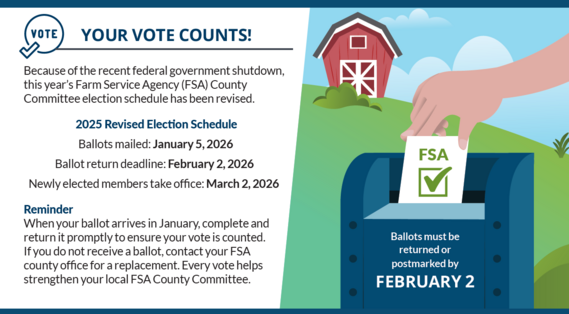 Voting is now open for the USDA’s Farm Service Agency’s (FSA) County Committee throughout Indiana.
It is important that every eligible producer participates in these elections because FSA county committees are a link between the agricultural community and the USDA.
County committee election ballots were mailed to eligible voters on Jan. 5, 2026. The last day to return completed ballots to FSA is Feb. 2, 2026. For more information on FSA county committee elections talk with your FSA office staff or visit fsa.usda.gov/elections.
Producers in Adams, Allen, Blackford, Carroll, Cass, Delaware, Howard, Jay, Miami, Randolph, Tipton, Wabash and Wells County are eligible to apply for 2025 Livestock Forage Disaster Program (LFP) benefits on full season improved pasture, native pasture, forage sorghum.
LFP provides compensation if you suffer grazing losses for covered livestock due to drought on privately owned or cash leased land or fire on federally managed land.
County committees can only accept LFP applications after notification is received by the National Office of qualifying drought or if a federal agency prohibits producers from grazing normal permitted livestock on federally managed lands due to qualifying fire. Producers must complete a CCC-853 and the required supporting documentation no later than March 2, 2026, for 2025 losses.
For additional information about LFP, including eligible livestock and fire criteria, contact your local County USDA Service Center.
The Farm Service Agency (FSA), Natural Resources Conservation Service (NRCS) and Risk Management Agency (RMA) worked together to develop consistent, simple and a flexible policy for cover crop practices.
Cover crops, such as grasses, legumes and forbs, can be planted: with no subsequent crop planted, before a subsequent crop, after prevented planting acreage, after a planted crop, or into a standing crop.
Termination:
The cover crop termination guidelines provide the timeline for terminating cover crops, are based on zones and apply to non-irrigated cropland. To view the zones and additional guidelines visit nrcs.usda.gov/wps/portal/nrcs/main/national/landuse/crops/ and click “Cover Crop Termination Guidelines.”
The cover crop may be terminated by natural causes, such as frost, or intentionally terminated through chemical application, crimping, rolling, tillage or cutting. A cover crop managed and terminated according to NRCS Cover Crop Termination Guidelines is not considered a crop for crop insurance purposes.
Reporting:
The intended use of cover only will be used to report cover crops. This includes crops
that were terminated by tillage and reported with an intended use code of green manure. An FSA policy change will allow cover crops to be hayed and grazed. Program eligibility for the cover crop that is being hayed or grazed will be determined by each specific program.
If the crop reported as cover only is harvested for any use other than forage or grazing and is not terminated properly, then that crop will no longer be considered a cover crop.
Crops reported with an intended use of cover only will not count toward the total cropland on the farm. In these situations, a subsequent crop will be reported to account for all cropland on the farm.
Marketing Assistance Loans (MALs) and Loan Deficiency Payments (LDPs) provide financing and marketing assistance for wheat, feed grains, soybeans, and other oilseeds, pulse crops, rice, peanuts, cotton, wool and honey. MALs provide you with interim financing after harvest to help you meet cash flow needs without having to sell your commodities when market prices are typically at harvest-time lows. A producer who is eligible to obtain a loan, but agrees to forgo the loan, may obtain an LDP if such a payment is available. Marketing loan provisions and LDPs are not available for sugar and extra-long staple cotton.
FSA is now accepting requests for 2025 MALs and LDPs for all eligible commodities after harvest. Requests for loans and LDPs shall be made on or before the final availability date for the respective commodities.
Commodity certificates are available to loan holders who have outstanding nonrecourse loans for wheat, upland cotton, rice, feed grains, pulse crops (dry peas, lentils, large and small chickpeas), peanuts, wool, soybeans and designated minor oilseeds. These certificates can be purchased at the posted county price (or adjusted world price or national posted price) for the quantity of commodity under loan, and must be immediately exchanged for the collateral, satisfying the loan. MALs redeemed with commodity certificates are not subject to Adjusted Gross Income provisions.
To be considered eligible for an LDP, you must have form CCC-633EZ, Page 1 on file at your local FSA Office before losing beneficial interest in the crop. Pages 2, 3 or 4 of the form must be submitted when payment is requested.
Marketing loan gains (MLGs) and loan deficiency payments (LDPs) are no longer subject to payment limitations, actively engaged in farming and cash-rent tenant rules.
Adjusted Gross Income (AGI) provisions state that if your total applicable three-year average AGI exceeds $900,000, then you’re not eligible to receive an MLG or LDP. You must have a valid CCC-941 on file to earn a market gain of LDP. The AGI does not apply to MALs redeemed with commodity certificate exchange.
For more information and additional eligibility requirements, producers should contact their County USDA Service Center.
The Conservation Reserve Program (CRP) is a program administered by the Farm Service Agency (FSA) to conserve farmland for future generations while providing habitat for wildlife, reducing soil erosion, and improving water quality. Regular maintenance on CRP acres is needed to ensure the acreage continues to provide conservation benefits and remains in compliance with the CRP contract.
Regular Maintenance
Producers with CRP contracts are required to control all weeds, insects, pests, and other undesirable species to the extent necessary to ensure that the approved conservation cover is adequately protected and to ensure there is no adverse impact on surrounding land. Mowing is one of the allowable practices for weed control, but mowing for aesthetic purposes is never permitted. The Conservation Plan states the required weed control methods for each site.
Once a stand has been certified as fully established, participants are required to maintain plant diversity and stand density according to the Conservation Plan and offer (CRP-2) for the life of the contract. Stands that do not meet practice specific plant diversity or density requirements may be considered non-compliant. Refer to your conservation plan or contact FSA if you have any questions or concerns about the vegetative cover requirements.
Maintenance activities cannot occur during the primary nesting season for birds without written prior approval from the local county office. The primary nesting season in Indiana is April 1 through August 1.
Mid-Contract Management
Regular maintenance for weed and pest control is separate from the Mid-Contract Management (MCM) requirement. MCM ensures plant diversity and wildlife benefits while ensuring protection of the soil and water resources. Such activities are site-specific and are for the purpose of enhancing the approved cover.
MCM must be completed between years four and six of a 10-year contract and between years seven and nine of a 15-year contract. The Conservation Plan will state what year MCM must take place.
Noncompliance with Maintenance Requirements
Failure to adequately maintain the stand may result in noncompliance with the terms and conditions of the CRP contract. Noncompliance can result in adverse actions up to and including termination of the CRP contract. Contracts that are out of compliance are ineligible to re-enroll, unless the stand is brought back into compliance prior to the enrollment deadline.
For general information about CRP, visit the Conservation Reserve Program webpage. For information about specific contracts, reach out to the local FSA office.
Your Indiana Farm Loan team is already working on operating loans for spring 2026 and asks potential borrowers to submit their requests early so they can be timely processed. The farm loan team can help determine which loan programs are best for applicants.
FSA offers a wide range of low-interest loans that can meet the financial needs of any farm operation for just about any purpose. The traditional farm operating and farm ownership loans can help large and small farm operations take advantage of early purchasing discounts for spring inputs as well expenses throughout the year.
Microloans are a simplified loan program that will provide up to $50,000 for both Farm Ownership and Operating Microloans to eligible applicants. These loans, targeted for smaller and non-traditional operations, can be used for operating expenses, starting a new operation, purchasing equipment, and other needs associated with a farming operation. Loans to beginning farmers and members of underserved groups are a priority.
Other types of loans available include:
Marketing Assistance Loans allow producers to use eligible commodities as loan collateral and obtain a 9-month loan while the crop is in storage. These loans provide cash flow to the producer and allow them to market the crop when prices may be more advantageous.
Farm Storage Facility Loans can be used to build permanent structures used to store eligible commodities, for storage and handling trucks, or portable or permanent handling equipment. A variety of structures are eligible under this loan, including bunker silos, grain bins, hay storage structures, and refrigerated structures for vegetables and fruit. A producer may borrow up to $500,000 per loan.
The Farm Service Agency (FSA) offers two types of set-aside programs to assist FSA direct loan borrowers. The set-aside programs are intended to help distressed borrowers as well as borrowers impacted by natural disasters.
Disaster Set-Aside Program
The Disaster Set-Aside Program (DSA) assists existing FSA direct loan borrowers who have been impacted by natural disasters. The DSA program provides short-term financial relief by allowing eligible borrowers to delay FSA direct loan payments that are due this year or next year (but not both). You may delay up to one full annual payment per loan and the delayed payment will be moved to the end of the loan term. You will not be required to pay this set-aside installment until the loan’s final due date.
The principal portion of the amount set-aside will continue to accrue interest at your loan’s existing interest rate.
To be eligible, borrowers must have operated a farm in a county declared a disaster area or a contiguous county at the time of the disaster. In addition, the borrower’s inability to make their upcoming payment must be due to the disaster.
To apply for DSA, borrowers must provide their local USDA Service Center with a letter requesting DSA, which must be signed by all parties liable for the debt. The letter must be provided to your local Service Center within eight months of the disaster declaration date. The application process also includes providing your actual production, income, and expense records for the last three years. FSA may also request additional information as needed to make an eligibility decision.
Below is a list of the current disaster designations in your area and their respective application deadlines:
Current Disaster Designations
|
Date Declared
|
Code
|
Disaster Description
|
Final Date to Apply for DSA
|
Primary & Contiguous Counties
|
|
05/23/2025
|
M4875
|
Severe storms, straight-line winds, & tornadoes
|
01/23/2026
|
Posey
|
|
07/22/2025
|
M4882
|
Severe storms, straight-line winds, tornadoes, & flooding
|
03/23/2026
|
Bartholomew, Boone, Brown, Clark, Clay, Clinton, Crawford, Daviess, Dearborn, Decatur, Delaware, Dubois, Elkhart, Fayette, Floyd, Fountain, Franklin, Fulton, Gibson, Grant, Greene, Hamilton, Hancock, Harrison, Hendricks, Henry, Jackson, Jefferson, Jennings, Johnson, Knox, Kosciusko, Lawrence, Madison, Marion, Marshall, Martin, Monroe, Montgomery, Morgan, Ohio, Orange, Owen, Parke, Perry, Pike, Posey, Pulaski, Putnam, Ripley, Rush, St. Joseph, Scott, Shelby, Spencer, Starke, Sullivan, Switzerland, Tippecanoe, Tipton, Union, Vanderburgh, Warrick, & Washington
|
|
07/22/2025
|
M4864, Amend. 3
|
Severe storms, straight-line winds, tornadoes, flooding, landslides, & mudslides
|
03/23/2026
|
Posey & Switzerland
|
|
08/04/2025
|
S6038
|
Excessive rain
|
04/06/2026
|
Ripley, Dearborn, Decatur, Franklin, Jefferson, Jennings, Ohio, & Switzerland
|
|
08/11/2025
|
M4882,
Amend. 1
|
Severe storms, straight-line winds, tornadoes, & flooding
|
04/13/2026
|
Benton, Fountain, Tippecanoe, Vermillion, & Warren
|
|
08/21/2025
|
M4882,
Amend. 2
|
Severe storms, straight-line winds, tornadoes, & flooding
|
04/21/2026
|
Clay, Greene, Owen, Parke, Putnam, Sullivan, & Vigo
|
|
08/18/2025
|
N1875
|
Tornadoes, winds, & flooding
|
04/20/2026
|
Benton, Gibson, Newton, Sullivan, & Vigo
|
|
09/16/2025
|
N1881
|
Flooding, excessive rain, & flash flooding
|
05/18/2026
|
Crawford, Harrison, Perry, Spencer, & Warrick
|
|
09/16/2025
|
N1883
|
Flooding
|
05/18/2026
|
Posey, Vanderburgh, & Warrick
|
|
09/30/2025
|
S6091
|
Excessive rain & flooding
|
06/01/2026
|
Gibson, Knox, Posey, Sullivan, & Vigo
|
|
12/22/2025
|
S6123
|
Flooding, flash flooding, & excessive rain
|
08/24/2026
|
Spencer & Perry
|
|
12/29/2025
|
S6098
|
Drought
(fast track)
|
08/31/2026
|
Adams, Allen, Blackford, Carroll, Cass, Clinton, DeKalb, Delaware, Fulton, Grant, Hamilton, Henry, Howard, Huntington, Jay, Kosciusko, Madison, Miami, Noble, Pulaski, Randolph, Tippecanoe, Tipton, Wabash, Wayne, Wells, White, & Whitley
|
|
12/26/2025
|
S6106
|
Drought
(fast track)
|
08/31/2026
|
Adams, Allen, DeKalb, Jay, & Steuben
|
Distressed Borrower Set-Aside Program
FSA Direct Farm Loan Program borrowers whose loans were closed before Sept. 25, 2024, may be eligible for assistance under the Distressed Borrower Set-Aside Program (DBSA). Similar to DSA, DBSA also provides short-term financial relief by allowing eligible borrowers to delay FSA direct loan payments that are due this year or next year (but not both). You may delay up to one full annual payment per loan and the delayed payment will be moved to the end of the loan term. You will not be required to pay this set-aside installment until the loan’s final due date.
An increased benefit with DBSA is that the principal portion of the set-aside will accrue interest at a reduced rate of 0.125% rather than your loan’s existing interest rate.
To be eligible for DBSA, the borrower must demonstrate financial distress, but their inability to make the upcoming payment does not need to be due to a disaster.
The DBSA application process is similar to DSA as borrowers must provide their local USDA Service Center with a letter requesting DBSA, which must be signed by all parties liable for the debt. The application process also includes providing your actual production, income, and expense records for the last three years. FSA may also request additional information as needed to make an eligibility decision.
Important Factors for Both DSA and DBSA:
FSA direct loan borrowers are not able to obtain more than one set-aside per loan. Borrowers also cannot obtain both a DSA and DBSA simultaneously on the same loan. In addition, FSA direct loans with less than two years remaining are not eligible for a DSA or DBSA. Other eligibility requirements apply; we encourage you to contact your local Service Center for more information.
Both DSA and DBSA are intended to provide short-term relief for situations where borrowers anticipate the ability to resume paying their full annual installment(s) in the following year. If you require a more long-term form of financial relief, FSA has other potential options available through primary loan servicing (PLS).
For more information on DSA, DBSA, or PLS, please contact your local FSA Farm Loan Service Center. You may also visit fsa.usda.gov.
Additional information, eligibility criteria and program limitations may be found within the Disaster Set-Aside and Distressed Borrower Set-Aside Program fact sheets.
Landowners and operators are reminded that in order to receive payments from USDA, compliance with Highly Erodible Land (HEL) and Wetland Conservation (WC) provisions are required. Farmers with HEL determined soils are reminded of tillage, crop residue, and rotation requirements as specified per their conservation plan. Producers are to notify the USDA Farm Service Agency prior to breaking sod, clearing land (tree removal), and of any drainage projects (tiling, ditching, etc.) to ensure compliance. Failure to update certification of compliance, with form AD-1026, triggering applicable HEL and/or wetland determinations, for any of these situations, can result in the loss of FSA farm program payments, FSA farm loans, NRCS program payments, and premium subsidy to Federal Crop Insurance administered by RMA.
Are you interested in working with USDA to start or grow your farm, ranch, or private forest operation, but don’t know where to start?
Whether you’re looking to access capital or disaster assistance through USDA’s Farm Service Agency (FSA) or address natural resource concerns on your land with assistance from USDA’s Natural Resources Conservation Service (NRCS), a great place to start is farmers.gov.
Farmers.gov is a one-stop shop for information about the assistance available from FSA and NRCS. The site also offers many easy-to-use tools for farmers, ranchers, and private forestland owners, whether you are reaching out for the first time or are a long-term customer with a years-long relationship with USDA.
With a farmers.gov account you can:
- Complete an AD-2047, Customer Data Worksheet, prior to your first meeting with FSA and NRCS.
- View farm loan payments history from FSA.
- View cost share assistance received and anticipated from NRCS conservation programs.
- Request conservation assistance from NRCS as well as view and track your conservation plans, practices, and contracts.
- View, print, and export detailed farm records and farm/tract maps for the current year, which are particularly useful when fulfilling acreage reporting requirements.
- Print FSA-156 EZ, Abbreviated Farm Record and your Producer Farm Data Report for the current year.
- Pay FSA debt using the “Make an FSA Payment” feature
- Apply for a farm loan online, view information on your existing loans, and make USDA direct farm loan payments using the Pay My Loan feature.
Learn how to create a farmers.gov account today!
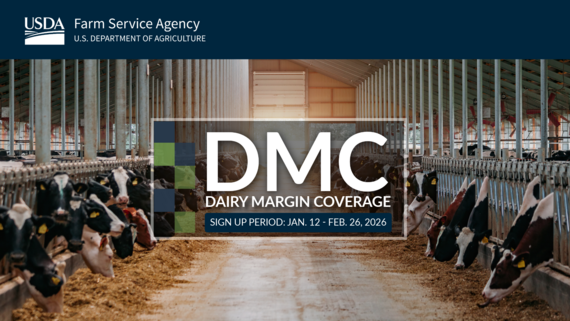 The U.S. Department of Agriculture (USDA) announced the enrollment period for the Dairy Margin Coverage (DMC) program for the 2026 coverage year, an important safety net program that provides producers with price support to help offset milk and feed price differences. Dairy producers can enroll in DMC from January 12, 2026, to February 26, 2026.
The One Big Beautiful Bill Act (OBBBA), signed by President Donald J. Trump on July 4, 2025, reauthorized DMC for calendar years 2026 through 2031 and provided substantial program improvements, including establishing new production history and increasing Tier 1 coverage.
The OBBBA increased DMC’s Tier 1 coverage level increased from five million pounds to six million pounds. All dairy operations that elect to enroll in DMC for 2026 will establish a new production history.
- Existing dairy operations that started marketing milk on or before January 1, 2023, will use the higher of milk marketings for the years of 2021, 2022, or 2023.
- New dairy operations starting after January 1, 2023, will use their first year of monthly milk marketings, even for a partial year.
- Milk marketing statements or production evidence are required to establish a production history.
Dairy operations also have the option to lock-in coverage levels for six years (2026-2031) with premium fees discounted by 25%.
DMC offers different levels of coverage, including an option that is free to producers, minus a $100 administrative fee. To determine the appropriate level of DMC coverage for a specific dairy operation, producers can use the online dairy decision tool.
For more information visit the DMC webpage or contact your local USDA Service Center.
Farm Service Agency (FSA) loans require applicants to have a satisfactory credit history. A credit report is requested for all FSA direct farm loan applicants. These reports are reviewed to verify outstanding debts, see if bills are paid timely and to determine the impact on cash flow.
Information on your credit report is strictly confidential and is used only as an aid in conducting FSA business.
Our farm loan staff will discuss options with you if you have an unfavorable credit report and will provide a copy of your report. If you dispute the accuracy of the information on the credit report, it is up to you to contact the issuing credit report company to resolve any errors or inaccuracies.
There are multiple ways to remedy an unfavorable credit score:
- Make sure to pay bills on time
- Setting up automatic payments or automated reminders can be an effective way to remember payment due dates.
- Pay down existing debt
- Keep your credit card balances low
- Avoid suddenly opening or closing existing credit accounts
FSA’s farm loan staff will guide you through the process, which may require you to reapply for a loan after improving or correcting your credit report.
For more information on FSA farm loan programs, producer should contact their FSA County office.
In order to claim a Farm Service Agency (FSA) payment on behalf of a deceased producer, all program conditions for the payment must have been met before the applicable producer’s date of death.
If a producer earned an FSA payment prior to his or her death, the following is the order of precedence for the representatives of the producer:
- administrator or executor of the estate
- the surviving spouse
- surviving sons and daughters, including adopted children
- surviving father and mother
- surviving brothers and sisters
- heirs of the deceased person who would be entitled to payment according to the State law
For FSA to release the payment, the legal representative of the deceased producer must file a form FSA-325 to claim the payment for themselves or an estate. The county office will verify that the application, contract, loan agreement, or other similar form requesting payment issuance, was signed by the applicable deadline by the deceased or a person legally authorized to act on their behalf at that time of application.
If the application, contract or loan agreement form was signed by someone other than the deceased participant, FSA will determine whether the person submitting the form has the legal authority to submit the form.
Payments will be issued to the respective representative’s name using the deceased program participant’s tax identification number. Payments made to representatives are subject to offset regulations for debts owed by the deceased.
FSA is not responsible for advising persons in obtaining legal advice on how to obtain program benefits that may be due to a participant who has died, disappeared or who has been declared incompetent.
In this Ask the Expert, Tyler Kendall, management and program analyst for the Natural Resources Conservation Service (NRCS) answers a few questions about USDA’s farmers.gov customer portal. Tyler helps lead the effort to provide personalized customer information via farmers.gov. A farmers.gov account provides self-service opportunities to Farm Service Agency (FSA) and NRCS customers through a secure, authenticated access process.
What features will conservation customers be most interested in?
There are several self-help options that allow you to access your conservation data from home or on your phone or tablet. For example, you can access, view, download, and print all of your conservation documents including your conservation plans, contracts, and plan maps. Contract documents can be conveniently eSigned in farmers.gov and the feature is mobile enabled so you can sign your documents from the field while on the go!
To read the full blog visit farmers.gov/blog/ask-the-expert-farmersgov-conservation-section-with-tyler-kendall.
Farm Operating Loans, Direct -- 4.625%
Farm Ownership Loans, Direct -- 5.625%
Limited Resource Loans -- 5.000%
Farm Ownership Loans, Down Payment -- 1.625%
Farm Ownership – Joint Financing -- 3.625%
Emergency Loans -- 3.750%
Farm Storage Facility Loan, 3 year -- 3.500%
Farm Storage Facility Loan, 5 year -- 3.625%
Farm Storage Facility Loan, 7 year -- 3.875%
Farm Storage Facility Loan, 10 year -- 4.125%
Farm Storage Facility Loan, 12 year -- 4.250%
Sugar Storage Facility Loans, 15 year -- 4.500%
Commodity Loans -- 4.625%
|
January 23
|
Milk Loss Program (MLP) provides payments to eligible dairy operations for milk that was dumped or removed without compensation from the commercial milk market because of a qualifying weather event in 2023 and/or 2024. The deadline to apply is Jan. 23, 2026.
|
|
January 23
|
On-Farm Stored Commodity Loss Program (OFSCLP) provides assistance to producers who suffered losses of eligible harvested commodities while stored in on-farm structures in 2023 and/or 2024 due to a qualifying natural disaster event. The deadline to apply is Jan. 23, 2026.
|
|
January 31
|
The 2025 LDPs Deadline for wool and unshorn lamb pelts.
|
|
January 31
|
The Food Safety Certification for Specialty Crops (FSCSC) application deadline for 2025.
|
|
February 2
|
Producers and landowners must return ballots to their local FSA county office or have their ballots postmarked by Feb. 2, 2026, for those ballots to be counted.
|
|
February 16
|
George Washington’s Birthday. USDA Service Centers are Closed.
|
|
March 2
|
Deadline to file a notice of loss and application for payment for the Livestock Indemnity Program (LIP) which is 60 calendar days after the calendar year in which the eligible loss condition occurred.
|
|
March 2
|
Deadline to file a notice of loss and application for payment for the Emergency Assistance for Livestock, Honeybees, and Farm-Raised Fish Program (ELAP) which is 60 calendar days after the calendar year in which the eligible loss condition occurred.
|
|
March 2
|
Deadline to apply for 2025 LFP assistance is March 2, 2026. Producers in Adams, Allen, Blackford, Carroll, Cass, Delaware, Howard, Jay, Miami, Randolph, Tipton, Wabash and Wells Counties are eligible to apply for 2025 LFP benefits for grazing losses on small grains, native pasture, improved pasture mixed forage, annual ryegrass, crabgrass, or forage sorghum. Visit the FSA LFP webpage for a full list of eligible counties and pasture types.
|
|
April 1
|
Primary Nesting Season Begins.
|
|
April 30
|
Supplemental Disaster Relief Program Stage 1 and Stage 2 Deadline.
|
|
Ongoing
|
Submit an Application for a Farm Storage Facility Loan.
|
|
Continuous
|
Submit an Application for FSA Farm Loans.
|
|
Continuous
|
Sign up for GovDelivery Newsletters, Bulletins and Indiana Press Releases (Subscribe to USDA Emails for Farmers | Farmers.gov)
|
Top of Page
|








