
South Dakota USDA Newsletter - January 2026
In This Issue:
Greetings from the South Dakota FSA State Office,
January is the month of new beginnings and starting over. Many of us set new year’s resolutions of something we want to do better or bad habits we want to drop. While we may have economic challenges in agriculture, each year we have the opportunity to reset and look forward to what we can do to improve ourselves and our farming operations.
In 2026 additional benefits will be available to producers that passed in legislation last year including the new Farmer Bridge Assistance (FBA) program that provides a one-time bridge payment to American farmers in response to temporary trade market disruptions and increased production costs. Commodity-specific payment rates were released at the end of December, and we’re expecting pre-filled applications to be made available for eligible producers during the week of Feb. 23 to meet the target of FBA payments starting to process by Feb. 28, 2026.
FSA opened the Dairy Margin Coverage program for the 2026 coverage year on Jan. 12. The One Big Beautiful Bill Act (OBBBA) reauthorized DMC for calendar years 2026 through 2031 and provided substantial program improvements, including establishing new production history and increasing Tier 1 coverage. The enrollment period ends Feb. 26, 2026.
As a reminder, the Jan. 23, 2026, deadline is quickly approaching for the Milk Loss Program (MLP) for dumped milk and the On-Farm Stored Commodity Loss Program (OFSCLP).
Sign-up is still underway for Stage 2 of the Supplemental Disaster Relief Program (SDRP), which covers eligible crop, tree, bush and vine losses that were not covered under Stage 1 program provisions, including non-indemnified (shallow losses), uncovered, and quality losses. Producers have until April 30, 2026, to apply for both Stage 1 and Stage 2 assistance. I strongly encourage you to use the SDRP Stage 2 Pre-Application Checklist to ensure you have the required forms on file with your FSA county office and to help you start gathering supporting documentation that may be required. When you’re ready, please make an appointment with your local FSA office.
As you can see, the Farm Service Agency continues to work hard for and with you to implement these program benefits. Please contact your local FSA office to schedule an appointment ahead of these important deadlines.
Sincerely,
Roger Chase
State Executive Director, South Dakota FSA
Top of page
Greetings,
As we welcome the new year, I want to take this opportunity to welcome new customers and beginning farmers and ranchers who are considering utilizing NRCS technical and financial assistance to implement or expand conservation practices on their operations. In 2025, the most widely utilized conservation practices across South Dakota included watering facilities, heavy use area protection, fencing, livestock pipeline, windbreak and shelterbelt establishment and renovation, grazing management, herbaceous weed treatment, nutrient management, and pest management conservation systems.
Addressing natural resource concerns through sound conservation planning remains at the core of NRCS’s mission. Our staff works one-on-one with producers and landowners to develop practical, site-specific solutions that support long-term productivity, profitability, and sustainability of working lands.
Several upcoming events provide excellent opportunities to learn more about conservation options and connect with NRCS staff and partners. These include the 2026 Soil Health Event in Mitchell on February 5, 2026, and the Forest Management Workshop in Rapid City on March 24, 2026. I encourage anyone interested in conservation planning or program opportunities to attend.
As a reminder, application deadlines for several NRCS programs are due in January. Producers interested in the Conservation Stewardship Program (CSP), the Environmental Quality Incentives Program (EQIP), and the Agricultural Conservation Easement Program (ACEP) were to apply by January 15, 2026. A new program this year is the Regenerative Pilot Program (RPP), and applications are made under either EQIP or CSP. Click here to find more information on the RPP. The deadline to apply for the Regional Conservation Partnership Program (RCPP) is January 23, 2026. All NRCS conservation programs remain continuous sign-up and producer applications are accepted year-round. Interested applicants are encouraged to contact their local NRCS office as soon as possible to begin the application process.
Thank you to South Dakota’s farmers, ranchers, land managers, landowners, and NRCS partners for your continued commitment to conservation and stewardship of our natural resources. Your efforts are truly moving the needle of conservation across our state.
Sincerely,
Jessica Michalski
Acting State Conservationist, South Dakota NRCS
Top of page
January 23, 2026 - Deadline to apply for On-Farm Stored Commodity Loss Program
January 23, 2026 - Deadline to apply for the Milk Loss Program
January 23, 2026 - Deadline to apply for NRCS Regional Conservation Partnership Program (RCPP)
January 31, 2026 - Deadline to submit application for Food Safety Certification for Specialty Crops Program for calendar year 2025
January 31, 2026 - Deadline for wool and mohair producers to apply for loans and LDP’s and submit all required eligibility documents on wool shorn in calendar year 2025
February 2, 2026 - Deadline to return county committee election ballots to your local FSA county office or have your ballots postmarked by this date
February 4, 2026 - "Financial Assistance Opportunities for Women in Agriculture" event at Black Hills Stock Show, 3 p.m. - 5 p.m. MT, Monument Room 206. Contact emily.rohrer@usda.gov for more details.
February 16, 2026 - Washington's Birthday Holiday - USDA Service Centers Closed
February 26, 2026 - Deadline to enroll in Dairy Margin Coverage (DMC) for the 2026 coverage year
March 2, 2026 - Deadline to submit Livestock Indemnity Program (LIP) notice of loss and payment application for 2025 program year
March 2, 2026 - Deadline to submit ELAP notice of loss and payment application for 2025 eligible losses
March 2, 2026 - Deadline to submit application for Livestock Forage Program (LFP)
March 16, 2026 - Deadline to apply for 2026 Non-insured Disaster Assistance (NAP) Coverage
April 30, 2026 - Deadline to apply for Supplemental Disaster Relief Program Stage 1 and Stage 2
January 2026
|
Farm Operating Loans — Direct
|
4.625% |
|
Farm Ownership Loans — Direct
|
5.625% |
|
Farm Ownership Loans — Direct Down Payment, Beginning Farmer or Rancher
|
1.625% |
|
Emergency Loans
|
3.750% |
|
Farm Storage Facility Loans (7 years)
|
3.875% |
Top of page
The U.S. Department of Agriculture (USDA) announced the enrollment period for the Dairy Margin Coverage (DMC) program for the 2026 coverage year, an important safety net program that provides producers with price support to help offset milk and feed price differences. Dairy producers can enroll in DMC from January 12, 2026, to February 26, 2026.
The One Big Beautiful Bill Act (OBBBA), signed by President Donald J. Trump on July 4, 2025, reauthorized DMC for calendar years 2026 through 2031 and provided substantial program improvements, including establishing new production history and increasing Tier 1 coverage.
The OBBBA increased DMC’s Tier 1 coverage level increased from five million pounds to six million pounds. All dairy operations that elect to enroll in DMC for 2026 will establish a new production history.
- Existing dairy operations that started marketing milk on or before January 1, 2023, will use the higher of milk marketings for the years of 2021, 2022, or 2023.
- New dairy operations starting after January 1, 2023, will use their first year of monthly milk marketings, even for a partial year.
- Milk marketing statements or production evidence are required to establish a production history.
Dairy operations also have the option to lock-in coverage levels for six years (2026-2031) with premium fees discounted by 25%.
DMC offers different levels of coverage, including an option that is free to producers, minus a $100 administrative fee. To determine the appropriate level of DMC coverage for a specific dairy operation, producers can use the online dairy decision tool.
For more information visit the DMC webpage or contact your local USDA Service Center.
Top of page
USDA announced the next phase in the Farmer Bridge Assistance Program (FBA), the eligible commodity per-acre payment rates. In 2026, $12 billion will be paid to American farmers. Of that amount, $11 billion consists of one-time FBA program payments.
Eligible Row Crop Commodities and Payment Rates:
Below are the payment rates for the FBA eligible commodities that triggered a payment.
Commodity, Per Acre Payment Rates
Barley: $20.51 • Canola: $23.57 • Chickpeas (Large): $26.46 • Chickpeas (Small): $33.36 • Corn: $44.36 • Cotton: $117.35 • Flax: $8.05 • Lentils: $23.98 • Mustard: $23.21 • Oats: $81.75 • Peanuts: $55.65 • Peas: $19.60 • Rice: $132.89 • Safflower: $24.86 • Sesame: $13.68 • Sorghum: $48.11 • Soybeans: $30.88 • Sunflower: $17.32 • Wheat: $39.35
Eligibility, Program Applications, and Crop Insurance Linkage
FBA payments are based on 2025 planted acres, Economic Research Service cost of production, and the World Agriculture Supply and Demand Estimate Report. Double crop acres, including all initial and subsequently planted crops, are eligible. Prevent plant acres are not eligible.
All intended row crop uses are eligible for FBA except grazing, volunteer stands, experimental, green manure, crops left standing and abandoned or cover crops.
Crop insurance linkage is not required; however, USDA strongly urges producers to take advantage of the new risk management tools provided for in the One Big Beautiful Bill Act (OBBBA) to best protect against future price risk and volatility. The OBBBA federal crop insurance improvements include expanding benefits for beginning farmers and ranchers, increasing coverage options, and making crop insurance more affordable.
Specialty Crop Assistance
Of the $12 billion being provided by the Commodity Credit Corporation Charter Act, up to $11 billion is being directed to eligible row crop producers and the remaining $1 billion of the $12 billion in assistance is reserved for specialty crops and sugar. Timelines for payments to producers of these crops are still under development and require additional understanding of market impacts and economic needs.
Producers, including specialty crop producers and stakeholder groups, can submit questions to farmerbridge@usda.gov.
More information on FBA is available online at https://www.fsa.usda.gov/fba or you can contact your local USDA FSA county office.
Top of page
Marketing Assistance Loans (MALs) and Loan Deficiency Payments (LDPs) provide financing and marketing assistance for producers of many commodities, including graded and non-graded wool, mohair, and unshorn pelts. MALs and LDPs are available during shearing and provide interim financing to help you meet cash flow needs without having to sell commodities when market prices are low, enabling you to delay selling until more favorable marketing conditions emerge. LDPs are payments made to producers who, although eligible to obtain an MAL, agree to forgo the loan in return for a payment on the eligible commodity.
FSA is now accepting requests for 2025 MALs and LDPs for all eligible wool, mohair and unshorn pelts. These requests should be made on or before the final availability date of Jan. 31, 2026. USDA recently announced 2025 wool and mohair marketing assistance loan rates.
Eligibility
To be eligible for a wool or mohair MAL or LDP, producers must produce and shear eligible mohair and wool in the U.S. during the applicable crop year and must:
- comply with conservation and wetland protection requirements;
- report all cropland acreage on applicable farms where the eligible commodity is produced;
- have and retain beneficial interest in the commodity until the MAL is repaid or the Commodity Credit Corporation (CCC) takes title to the commodity, and;
- meet Adjusted Gross Income (AGI) limitations.
Unshorn pelts are eligible for LDPs only. In addition to the criteria above, producers of unshorn pelts must have sold the unshorn lamb for immediate slaughter or slaughter the lambs for personal use. LDPs and marketing loan gains are not subject to payment limitation, including actively engaged in farming and cash rent tenant provisions.
In addition to producer eligibility, the loan commodity must have been produced and shorn from live animals by an eligible producer, be in storable condition, and meet specific CCC minimum grade and quality standards. Producers are responsible for any loss in quantity or quality of the wool or mohair pledged as loan collateral.
To retain beneficial interest, the producer must have control and title of the wool, mohair, or unshorn pelt. If beneficial interest in the commodity is lost, the commodity loses eligibility for an MAL or LDP and remains ineligible even if the producer later regains beneficial interest. The producer must be able to make all decisions affecting the commodity including movement, sale, and the request for an MAL or LDP.
Producers may repay an MAL any time during the loan period at the lesser of the loan rate plus accrued interest and other charges or an alternative loan repayment rate, the national posted price, which is announced weekly. Visit the Farm Service Agency (FSA) website for posted loan and LDP rates.
How to Apply
Producers can apply for an MAL by contacting their local FSA county office. To be considered for a LDP, producers must first have the form CCC-633 EZ, Page 1, on file with FSA prior to losing beneficial interest in the wool, mohair or unshorn pelt. It is best to visit the county office and submit the CCC-633 Page 1 right before you shear. This is completed one time per crop year and indicates your intention to receive LDP benefits.
To apply and learn more information, contact your local USDA Service Center or visit fsa.usda.gov.
Top of page
The Farm Service Agency (FSA) offers two types of set-aside programs to assist FSA direct loan borrowers. The set-aside programs are intended to help distressed borrowers as well as borrowers impacted by natural disasters.
Disaster Set-Aside Program
The Disaster Set-Aside Program (DSA) assists existing FSA direct loan borrowers who have been impacted by natural disasters. The DSA program provides short-term financial relief by allowing eligible borrowers to delay FSA direct loan payments that are due this year or next year (but not both). You may delay up to one full annual payment per loan and the delayed payment will be moved to the end of the loan term. You will not be required to pay this set-aside installment until the loan’s final due date.
The principal portion of the amount set-aside will continue to accrue interest at your loan’s existing interest rate.
To be eligible, borrowers must have operated a farm in a county declared a disaster area or a contiguous county at the time of the disaster. In addition, the borrower’s inability to make their upcoming payment must be due to the disaster.
To apply for DSA, borrowers must provide their local USDA Service Center with a letter requesting DSA, which must be signed by all parties liable for the debt. The letter must be provided to your local Service Center within eight months of the disaster declaration date. The application process also includes providing your actual production, income, and expense records for the last three years. FSA may also request additional information as needed to make an eligibility decision.
Distressed Borrower Set-Aside Program
FSA Direct Farm Loan Program borrowers whose loans were closed before Sept. 25, 2024, may be eligible for assistance under the Distressed Borrower Set-Aside Program (DBSA). Similar to DSA, DBSA also provides short-term financial relief by allowing eligible borrowers to delay FSA direct loan payments that are due this year or next year (but not both). You may delay up to one full annual payment per loan and the delayed payment will be moved to the end of the loan term. You will not be required to pay this set-aside installment until the loan’s final due date.
An increased benefit with DBSA is that the principal portion of the set-aside will accrue interest at a reduced rate of 0.125% rather than your loan’s existing interest rate.
To be eligible for DBSA, the borrower must demonstrate financial distress, but their inability to make the upcoming payment does not need to be due to a disaster.
The DBSA application process is similar to DSA as borrowers must provide their local USDA Service Center with a letter requesting DBSA, which must be signed by all parties liable for the debt. The application process also includes providing your actual production, income, and expense records for the last three years. FSA may also request additional information as needed to make an eligibility decision.
Important Factors for Both DSA and DBSA:
FSA direct loan borrowers are not able to obtain more than one set-aside per loan. Borrowers also cannot obtain both a DSA and DBSA simultaneously on the same loan. In addition, FSA direct loans with less than two years remaining are not eligible for a DSA or DBSA. Other eligibility requirements apply; we encourage you to contact your local Service Center for more information.
Both DSA and DBSA are intended to provide short-term relief for situations where borrowers anticipate the ability to resume paying their full annual installment(s) in the following year. If you require a more long-term form of financial relief, FSA has other potential options available through primary loan servicing (PLS).
For more information on DSA, DBSA, or PLS, please contact your local County Service Center. You may also visit fsa.usda.gov.
Additional information, eligibility criteria and program limitations may be found within the Disaster Set-Aside and Distressed Borrower Set-Aside Program fact sheets.
Top of page
Farm Service Agency (FSA) is committed to providing our farm loan borrowers the tools necessary to be successful. FSA staff will provide guidance and counsel from the loan application process through the borrower’s graduation to commercial credit. While it is FSA’s commitment to advise borrowers as they identify goals and evaluate progress, it is crucial for borrowers to communicate with their farm loan staff when changes occur. It is the borrower’s responsibility to alert FSA to any of the following:
- Any proposed or significant changes in the farming operation
- Any significant changes to family income or expenses
- The development of problem situations
- Any losses or proposed significant changes in security
If a farm loan borrower can’t make payments to suppliers, other creditors, or FSA on time, contact your farm loan staff immediately to discuss loan servicing options.
For more information on FSA farm loan programs, contact your local County USDA Service Center or visit fsa.usda.gov.
Top of page
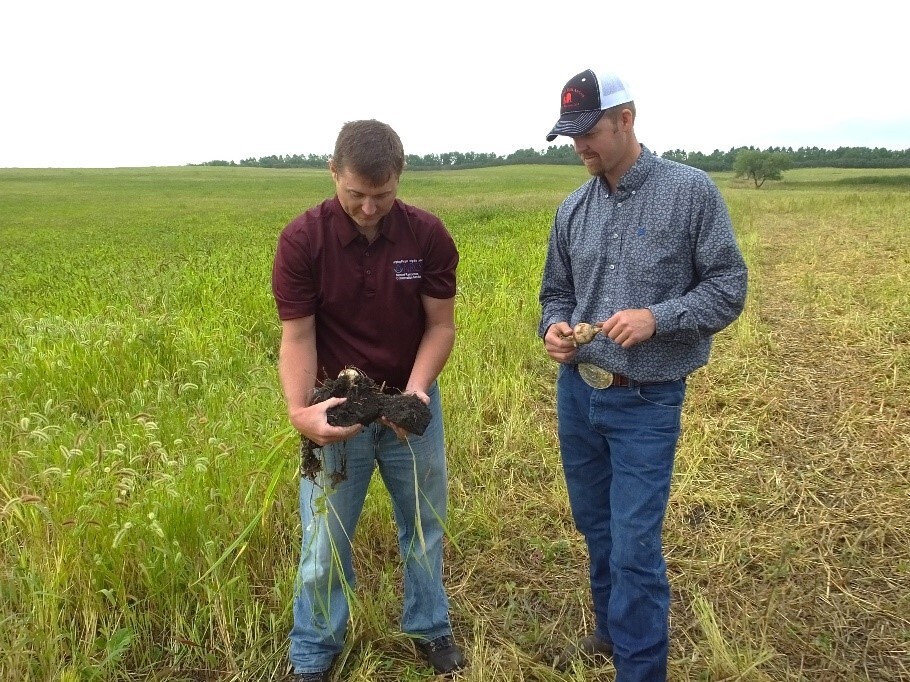 Pictured: Coteau Resource Unit Conservationist, Jim Dylla (left), and Hamlin County producer, Jared Namken
The United States Department of Agriculture’s (USDA) Natural Resources Conservation Service (NRCS) serving South Dakota (SD) had a successful fiscal year 2025 (FY25) while serving others through helping people help the land. What does it mean to “help the land?” During the Dust Bowl, 90 years ago, soil erosion was a major concern. This resource concern prompted the creation of NRCS, which at that time was called the Soil Conservation Service. The increasing demand for conservation planning assistance is the reason NRCS is in every SD county, gathering field data and providing step-by-step information to SD’s private landowners and operators to help improve productivity, soil health, and water quality. In FY25, NRCS staff in SD developed over 3,500 conservation plans that covered more than 2.5 million acres. Jessica Michalski, NRCS Acting State Conservationist in SD, says conservation plans can transform an operation by helping farmers achieve both their conservation and production goals.
Almost half of NRCS staff in SD are level 3-certified conservation planners. To obtain level 3 certification, an employee must pass several rigorous planning courses, complete a resource management system plan with a mentor, and demonstrate competency in the planning process. Level 3 planners can write and certify conservation plans and add specialty areas, such as grazing or nutrient management. Jim Dylla is a level 3 NRCS planner who has been planning conservation practices on farms and ranches in 10 counties in Northeastern SD for 26 years as a Soil Conservation Technician, Soil Conservationist, District Conservationist, and Resource Unit Conservationist.
“Conservation planning is done best in the field, talking to the producer and asking questions,” Dylla says. “Sometimes the producers don’t realize what goals or problems they have— by spending time with them on their land, you will get a better understanding of what goals they hope to obtain, and the conservation challenges they need to overcome to achieve their goals. From my experience, the more involved the producer is during the conservation planning process, the more ownership they will take in the conservation being installed, resulting in a successful outcome.”
Beyond free one-on-one conservation planning consultations, NRCS also offers financial assistance to implement conservation practices on private lands. In FY25, SD producers met with NRCS staff for technical support and voluntarily enrolled over 1.2 million acres into conservation plans and contracts with the NRCS programs: Environmental Quality Incentives Program (EQIP), Conservation Stewardship Program (CSP), Regional Conservation Partnership Program (RCPP), and Agricultural Conservation Easement Program (ACEP), both Agricultural Land Easements (ALE), and Wetland Reserve Easements (WRE), obligating over $128.7 million for conservation activities in SD while benefiting local economies. Showcasing the importance of these programs, the demand for financial assistance regularly outweighs the available funds. For example, in FY25, the EQIP had 1904 applications resulting in 298 contracts (16%), and the CSP had 605 applications, resulting in 291 contracts (48%). Applications are accepted year-round, however, consideration for FY26 funding applications was due by January 15, 2026.
Whether you are part of a multi-generational farm or ranch, just acquired a land lease, or are growing specialty crops and are interested in implementing conservation practices into your operation, you will find your “fit” with NRCS. If you are interested in a free one-on-one consultation or potential financial assistance, please visit your local NRCS office to discuss your goals and learn how an NRCS specialist or program can support your efforts.
Top of page
USDA announced major updates to federal crop insurance, reducing red tape for farmers, modernizing long-standing policies, and expanding access to critical risk protection beginning with the 2026 crop year. The Expanding Access to Risk Protection (EARP) Final Rule streamlines requirements across multiple crops, responds to producer feedback, and strengthens USDA’s commitment to putting America’s farmers first.
Learn more about the EARP Final Rule.
Top of page
USDA in South Dakota
200 4th Street SW
Huron, SD 57350
FSA Phone: (605) 352-1160
NRCS Phone: (605) 352-1200
RMA Phone: (406) 651-8450
|
|
Get Started at Your USDA Service Center
|
|
Farm Service Agency
State Executive Director:
Roger Chase
Deputy State Executive Director:
Ryan Vanden Berge
Administrative Officer:
Theresa Hoadley
Program Managers:
Owen Fagerhaug - Conservation
Logan Kopfmann - Disaster Relief
Donita Garry - Program Delivery
Bridget Weber - Farm Loan Program,
Acting
|
Natural Resources Conservation
Service
Acting State Conservationist:
Jessica Michalski
Assistant State Conservationists:
Jessica Michalski - Ecological Sciences
James Reedy - Engineering
Nathan Jones - Soils
Val Dupraz - Programs
Colette Kessler - Partnerships
Deke Hobbick - Compliance
Denise Gauer - Management & Strategy
|
|
Next South Dakota FSA State Committee Meeting: February 10, 2026, 9:00 a.m. - 4:00 p.m. CT at Federal Building, 200 4th Street SW, Huron, SD 57350.
- Questions? Contact Jean Wharton at jean.wharton@usda.gov.
- If you need to request an accommodation, please contact Jean Wharton at (605) 352-1160 or jean.wharton@usda.gov by February 3, 2026, to request accommodations (e.g., an interpreter, translator, seating arrangements, etc.) or materials in an alternative format (e.g., Braille, large print, audiotape – captioning, etc.).
South Dakota Farm Service Agency
South Dakota Natural Resources Conservation Service
|
|






